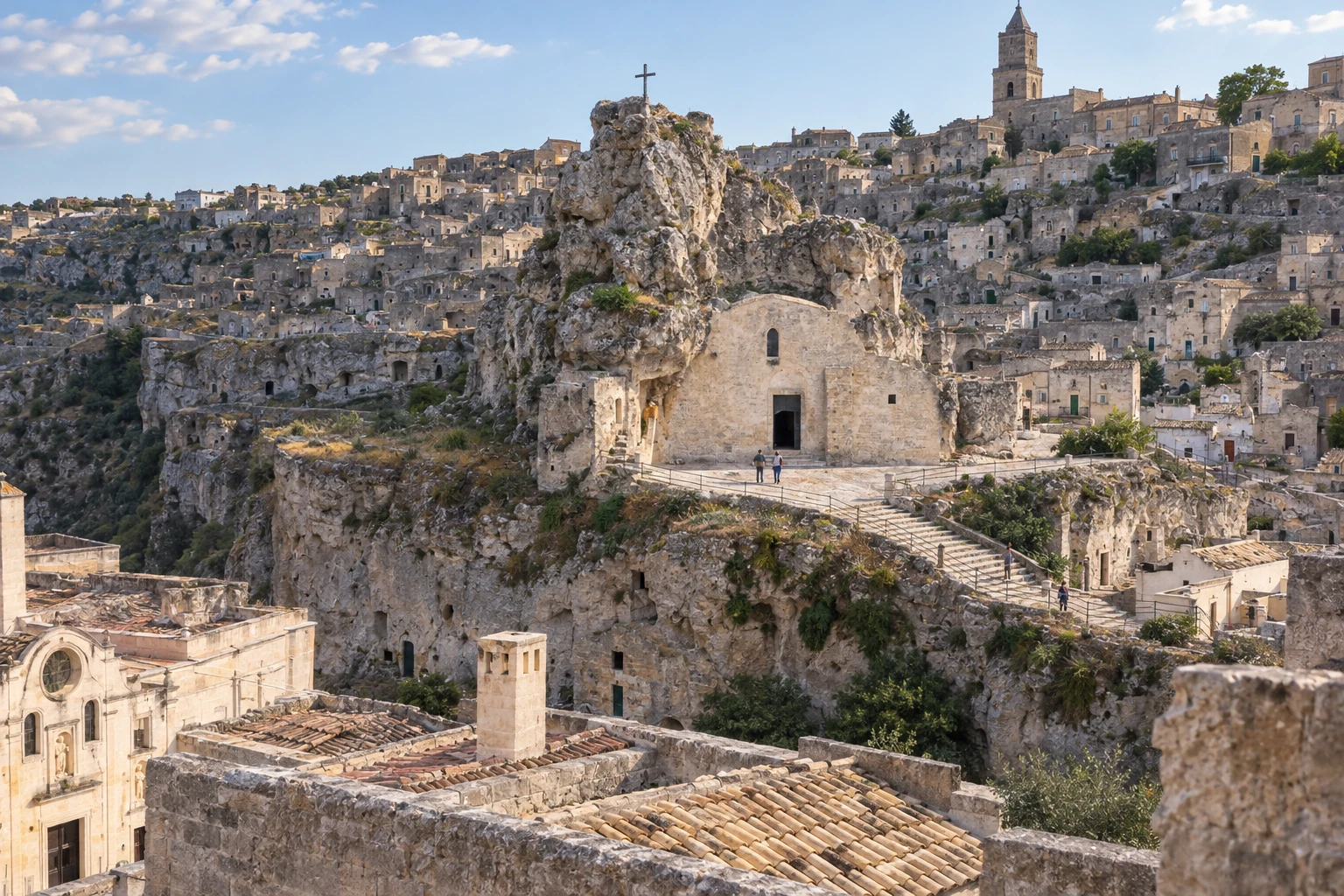
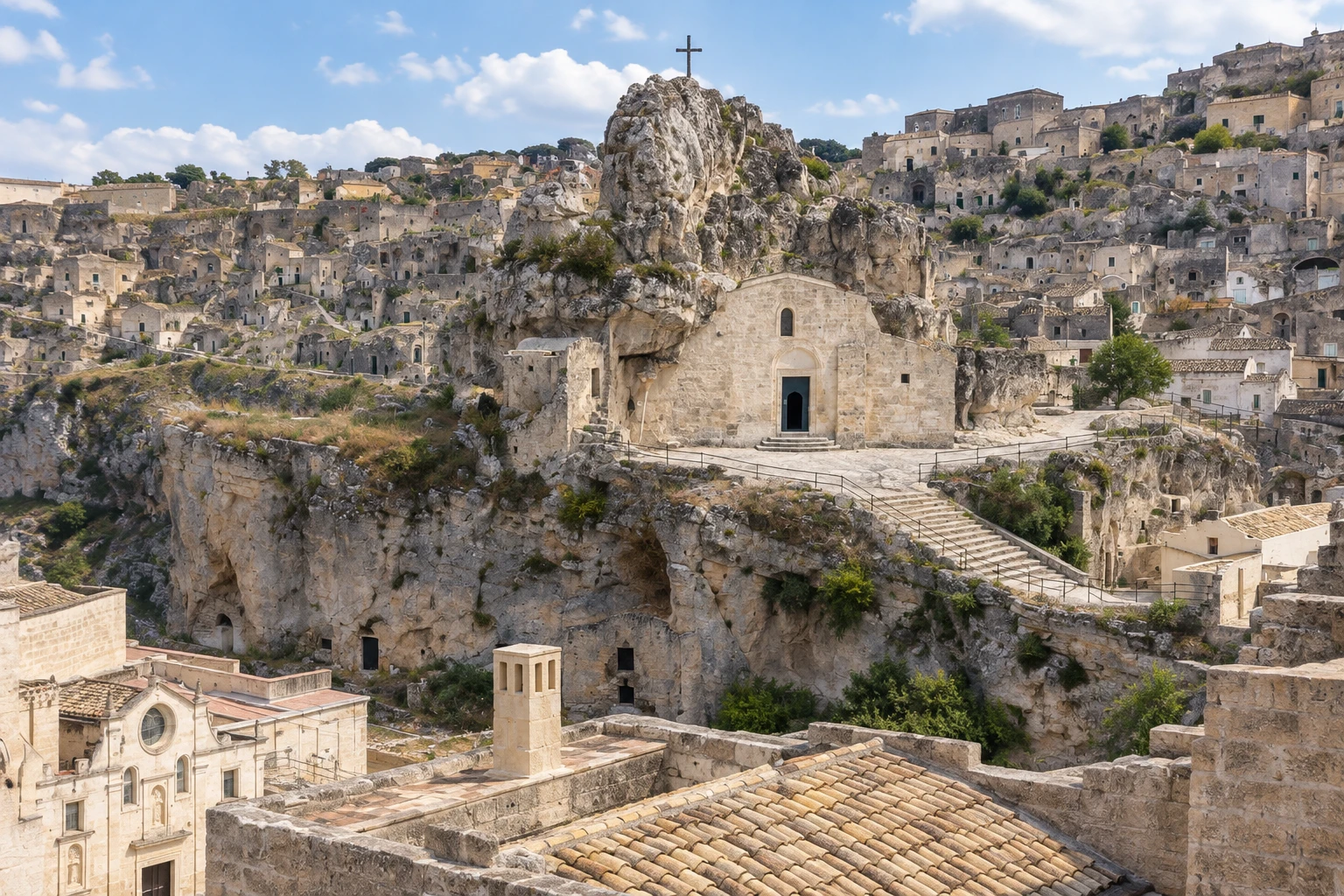
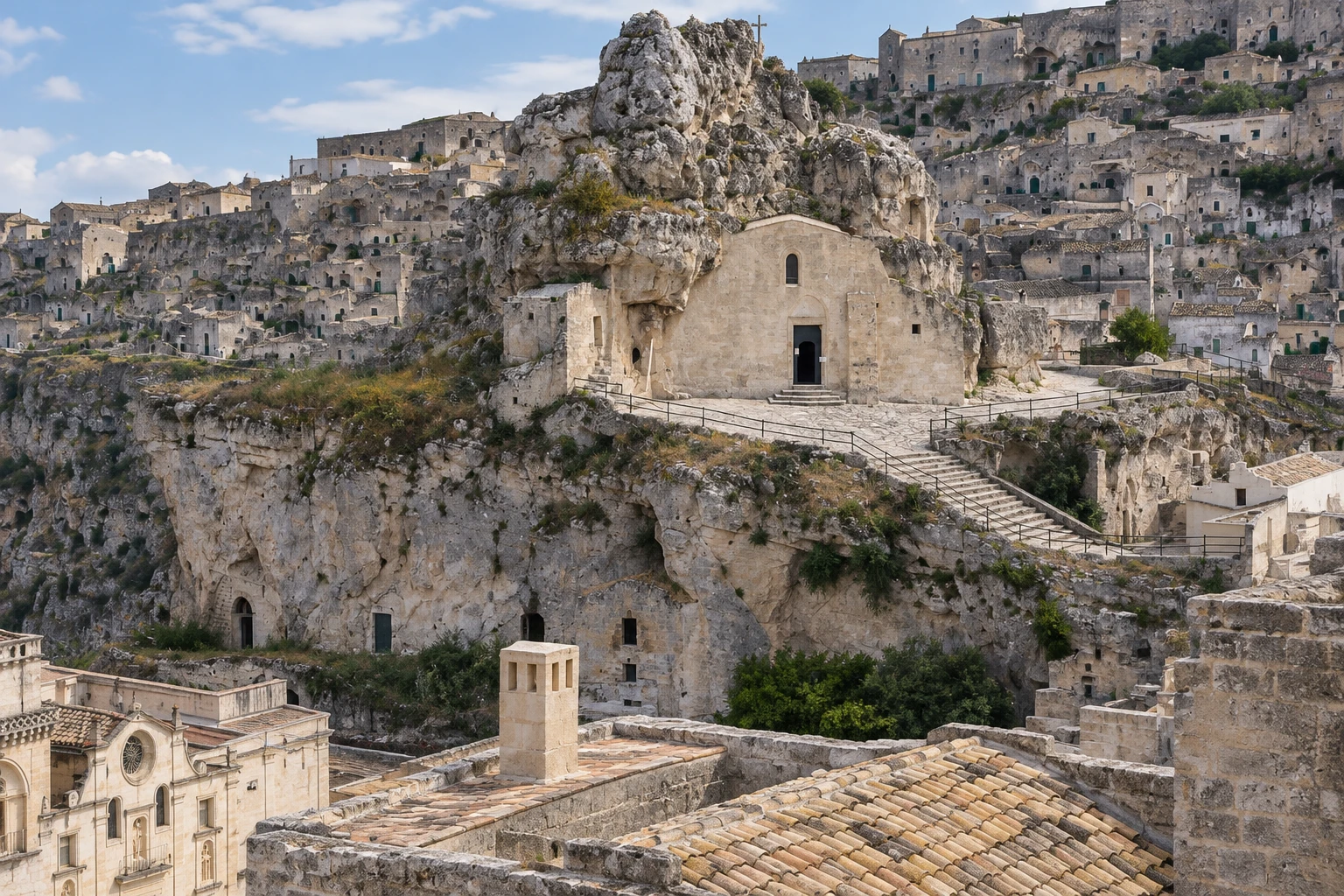
Sasso Caveoso
The oldest and most rustic of the two Sassi, with houses carved in steps like an amphitheater, the church of San Pietro Caveoso and, above, the rock churches of the Monterrone overlooking the Gravina ravine.
Antarctica
In the photo: Sasso Caveoso, Matera
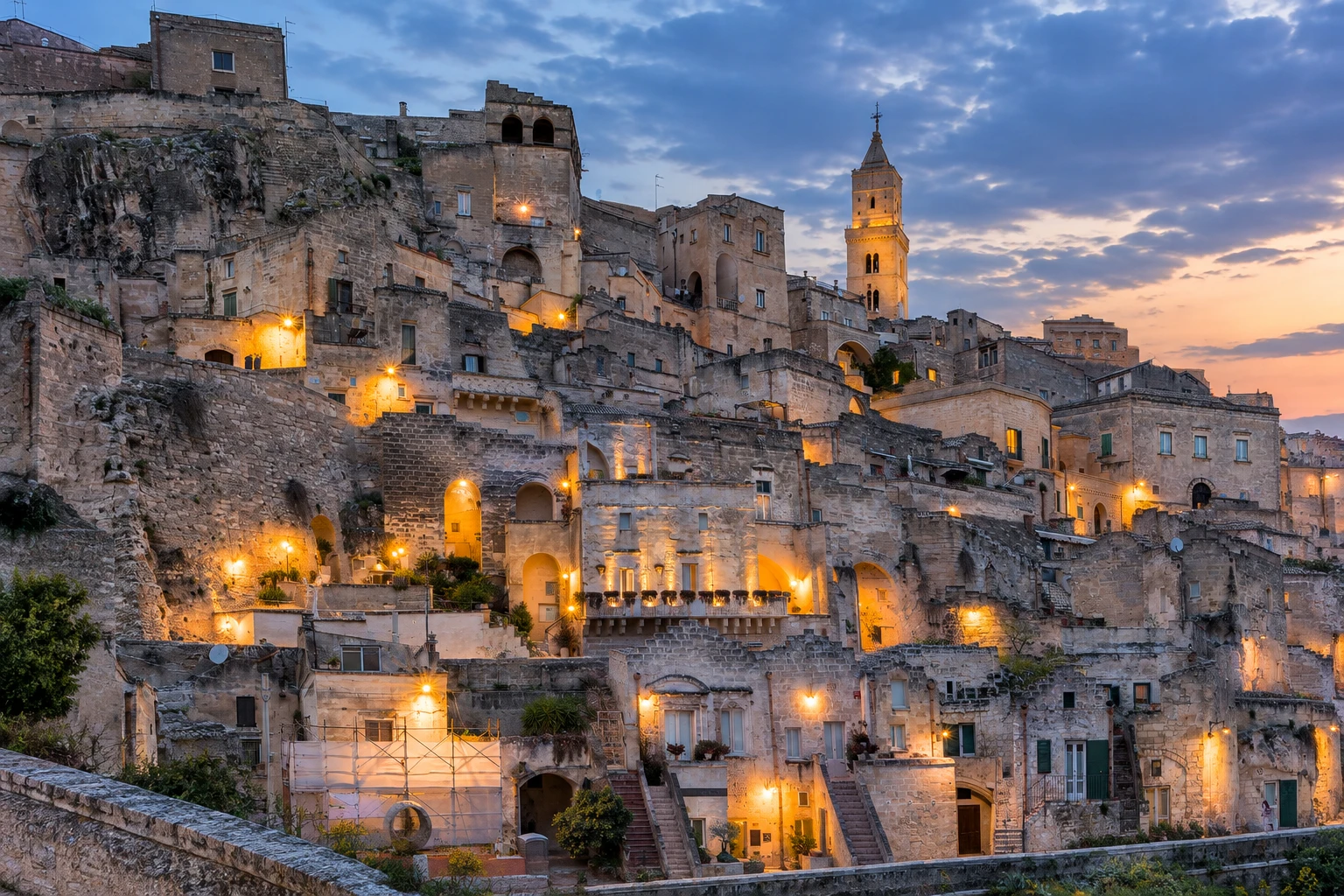
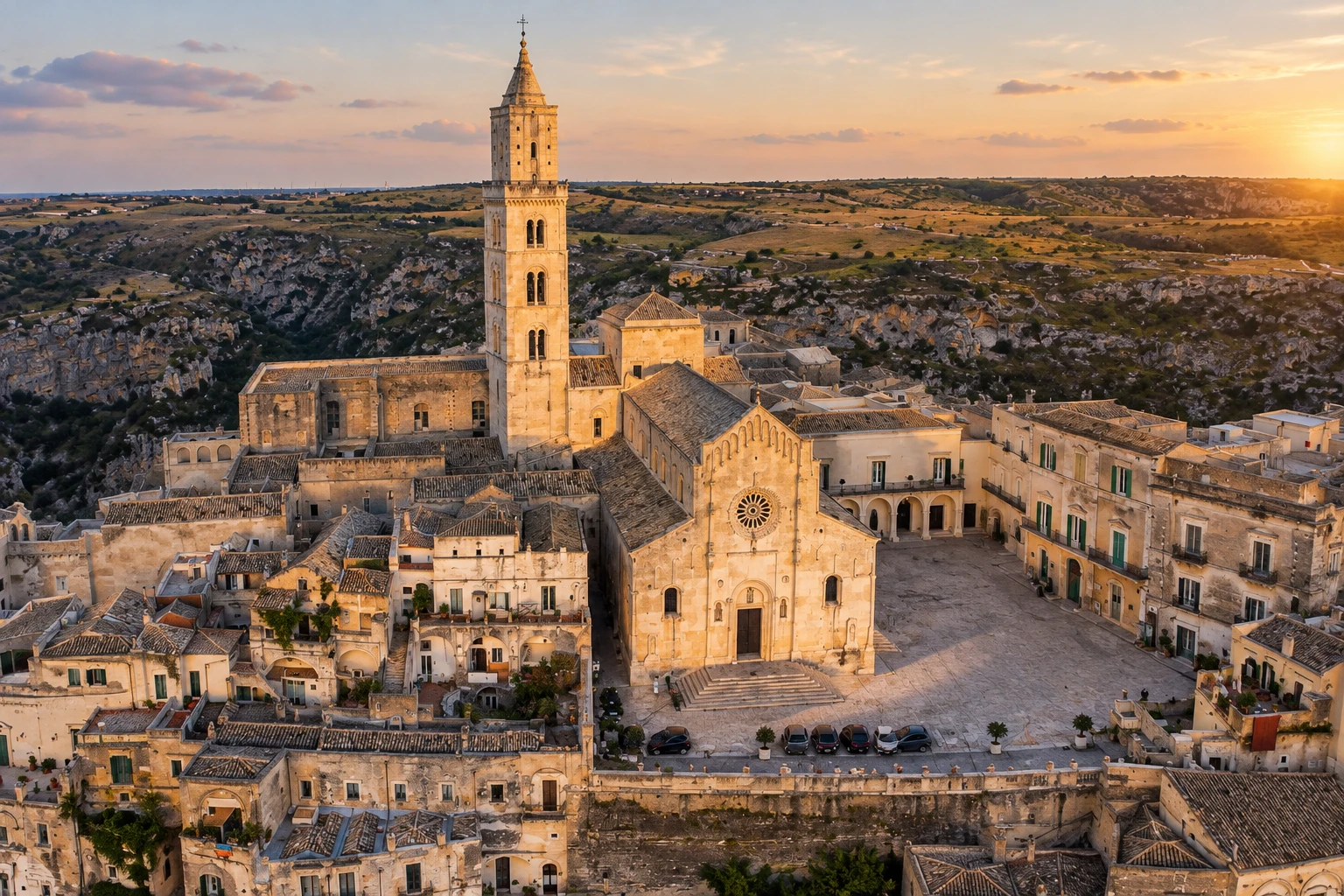
Illustrative images. The pictures in this guide are illustrations based on the real place, not photographs, and may differ from it.
The city
Matera, in the Basilicata region, near the border with Apulia, is known for the Sassi: the Sasso Caveoso and the Sasso Barisano, neighborhoods of houses and churches carved into the rock above the Gravina ravine, a UNESCO World Heritage Site since 1993. Between the two lies the Civita, with its Romanesque cathedral. There are rock-hewn churches with frescoes, the furnished Casa Grotta, the Palombaro Lungo cistern and viewpoints such as the one at Parco della Murgia Materana on the other side of the ravine.
Matera is in Basilicata, in southern Italy, about 400 meters above sea level and around 65 km from Bari, close to the border with Puglia. The old city was carved and built into the rim of a canyon, the Gravina, in a pale, easily worked rock called calcarenite. The two neighborhoods that descend the slope, Sasso Barisano and Sasso Caveoso, form a UNESCO World Heritage Site together with the park of the rock-cut churches. In 2019, Matera was a European Capital of Culture.
To get your bearings, think of the city in three parts. The Piano is the flat upper town, developed from the 17th and 18th centuries onward. It’s where you’ll find Piazza Vittorio Veneto, the Baroque churches, the national museums, the shops, and the train station. The Civita, the oldest part of the city, occupies the rocky spur in the middle, with the cathedral at the top. The two Sassi open out on either side of the Civita like a pair of amphitheaters facing the canyon. To the northwest is the Barisano, with more masonry facades and ornate doorways. To the south is the Caveoso, with its houses arranged in tiers, the church of San Pietro Caveoso on the cliff edge, and the rock-cut churches of the Monterrone.
What you see in the Sassi are not natural caves. These spaces were carved out by hand, then extended at the front with masonry facades, so that the roof of one house serves as a street or terrace for the one above. Cisterns and channels collected rainwater. Until the 1950s, entire families lived here with their animals. A 1952 law required residents to move to new neighborhoods, and restoration began decades later. Today the Sassi are home to residences, guest accommodations, restaurants, museums, and studios.
Across the Gravina lies the Murgia, a rocky plateau with low vegetation, rock-cut churches, Neolithic villages, and a viewpoint directly facing the whole city. You explore Matera on foot, along smooth stone steps and sloping streets. Visitors’ cars are not allowed in the Sassi.
Matera has a Mediterranean climate, tempered by its elevation. Summers are hot and dry, and afternoon temperatures can exceed 35 °C in July and August. The pale stone reflects the sun, and there’s little shade. Winters are cold by southern Italian standards, with wind and, on rare occasions, snow. Spring and fall bring mild days, good for exploring the stairways and hiking the trails of the Murgia.
Make time to see the Sassi at different hours: in the morning, when the streets are empty; in the late afternoon, from the viewpoints; and at night, when the lights are on. A furnished cave house, a rock-cut church with frescoes, the Palombaro Lungo, and the view from the Murgia round out a first visit.
30 places to stay in Matera.
30 places to eat in Matera.
1 lugar no mapa: onde ficar e onde comer, por bairro.
The local experience
The oldest and most rustic of the two Sassi, with houses carved in steps like an amphitheater, the church of San Pietro Caveoso and, above, the rock churches of the Monterrone overlooking the Gravina ravine.
The Sasso facing north, toward Bari, with houses that have elaborately worked facades, carved portals and the rock church of San Pietro Barisano, the largest in the city.
Romanesque cathedral of Apulia, built between 1230 and 1270 at the highest point of the Civita, between the two Sassi, dedicated to the Madonna della Bruna and Sant'Eustachio.
Rock-cut church atop the Monterrone, the rock in the middle of Sasso Caveoso, linked by a corridor to the crypt of San Giovanni in Monterrone, with frescoes dating from the 12th to the 17th centuries.
To choose before you go
Where each tour starts, how long it takes, how it is done, what is included and the price range.
Piazza Vittorio Veneto is the main square of the Piano district and the city's gathering place. On the east side, three arches open onto a small balcony, the Belvedere Luigi Guerricchio. From here, you can see all of Sasso Barisano, with the cathedral atop the Civita. For visitors arriving in the city, this is their first view of the Sassi. Beneath the square lies another city. When the old square was modernized in the late 19th century, a medieval market known as the fondaco di mezzo and clusters of houses built around wells were buried. Construction work in 1991 uncovered these spaces, along with an Aragonese tower, a section of the city walls, and the rock-cut church of Santo Spirito, which has ties to the Knights of Malta and retains fragments of medieval frescoes. The largest of these spaces is the Palombaro Lungo, Matera's main public cistern. Carved into the rock, it could hold more than 5 million liters. It collected spring water and rainwater and remained in use until the 1930s. Visitors explore it in small groups along walkways. Around the square are the former convents of San Domenico and the Annunziata. A few steps away, the 13th-century church of San Giovanni Battista has a carved side doorway and column capitals decorated with figures and foliage.
Stops: Piazza Vittorio Veneto, Belvedere Luigi Guerricchio, Palombaro Lungo, Ipogei di Piazza Vittorio Veneto, Chiesa di San Giovanni Battista.
Includes: The square, the viewpoint, and the churches are free to enter. Visits to the Palombaro Lungo require a separate ticket and take place in short time slots. Check the current rates.
Tip: Buy your ticket to the Palombaro when you reach the square, then visit the viewpoint and San Giovanni Battista while you wait. Return to the viewpoint at night to see the Sassi lit up.
Best time: Year-round.
Sasso Barisano is the neighborhood that faces toward Bari. Via D'Addozio is the main route in from the Piano. It leads to Via Fiorentini, the street on the valley floor from which the stairways climb. The houses here have more elaborate built facades, with portals and cornices that conceal rooms carved into the rock behind them. San Pietro Barisano is the city's largest rock-cut church. Its facade dates to 1755 and has a four-lobed rose window, but excavations beneath the floor revealed the medieval church. Inside are an altar with a high relief of the Madonna della Consolazione and a chapel with 16th-century frescoes. From the sacristy, you can descend to the catacombs dug in the 18th century for the burial of confraternity members and priests. Casa Cava is a former quarry discovered at the back of a home and converted into an underground auditorium. It seats about 140 people and is used for concerts and gatherings. The Museo laboratorio della civiltà contadina occupies about 500 m² of caves. It recreates a farmer's home, a wine cellar, and the workshops of traditional craftspeople, from blacksmiths to saddlers. It also has collections of bread stamps and toys. At the northern tip of the neighborhood, the convent of Sant'Agostino stands above the Gravina. Beside it, the Belvedere Emilio Colombo is a terrace overlooking Sasso Barisano, with a clear view of the cathedral.
Stops: Sasso Barisano, Via Fiorentini, Chiesa di San Pietro Barisano, Casa Cava, Museo laboratorio della civiltà contadina, Convento di Sant'Agostino.
Includes: The neighborhood is free to explore on foot. San Pietro Barisano, the museum, and visits to Casa Cava each have a separate admission fee. The church is usually included in a combined ticket with other rock-cut churches. Check current prices.
Tip: Walk down Via D'Addozio, then take the stairs back up to the Civita to continue on to the cathedral. Wear shoes with sturdy soles: the stone is smooth and slippery when wet.
Best time: Year-round; early in the morning in summer.
The Civita is the rocky spur between the two Sassi, the site of the old castle, the homes of noble families, and the cathedral. From Piazza del Sedile, follow Via Duomo uphill. The Palazzo del Sedile, built in 1575 and remodeled in 1759, housed the assembly that governed the city and later served as city hall. Today it houses the music conservatory. On the facade, between two bell towers, are statues of the four virtues of good government, with statues of St. Eustace and St. Irene above. The Romanesque cathedral was completed in 1270. Its facade has a rose window with sixteen spokes and 16th-century statues of the Madonna and Child and the patron saints. Inside, the nave and two side aisles retain their medieval columns and capitals, some carved with figures. Other highlights include the fresco of the Madonna della Bruna on an altar of inlaid marble, the Nativity Chapel dating to 1534, and a fresco of the Last Judgment. The diocesan museum next door displays sculptures in wood and polychrome stone, along with silver from the cathedral treasury. The square in front of the cathedral is like a balcony overlooking Sasso Barisano. A few steps away is Casa Noha, a tuff-stone house with vaulted ceilings that was donated to a heritage foundation. A film projected onto its walls tells the story of Matera from its origins to the present day. It’s a good place to start your visit.
Stops: Piazza del Sedile, Via Duomo, Matera Cathedral, MATA - Diocesan Museum, Casa Noha.
Includes: The cathedral has a visitor reception service and may charge admission. The diocesan museum and Casa Noha each charge a separate admission fee. Check current admission prices.
Tip: Watch the film at Casa Noha on your first day: it puts the rest of your visit in context. Visit the cathedral outside Mass times.
Best time: Year-round. The sun lights up the cathedral facade in the late afternoon.
Sasso Caveoso is the southern neighborhood, where the rock-cut parts of the buildings are more visible. The main route in is Via Bruno Buozzi, which ends at Piazza San Pietro Caveoso. The church that gives the square its name stands on the edge of the Gravina. It dates to the 14th century and was remodeled in the 18th. Inside are a wooden polyptych from 1540 and 16th-century stone reliefs. Above the square rises Monterrone, a rocky outcrop with two churches carved into it: Santa Maria de Idris and San Giovanni in Monterrone, linked by a passage. Farther along the hillside is Santa Lucia alle Malve, once the church of a community of Benedictine nuns. Its medieval frescoes include depictions of the Archangel Michael and the Madonna delle Grazie. Nearby, the Casa Grotta di Vico Solitario shows the home as it was in the 1950s: the masonry kitchen, the loom, the high bed with a mattress filled with wool and corn husks, the stable at the back, and the kind of stamp each family used to mark its bread before taking it to the communal oven. Behind a 13th-century Romanesque portal, the Convicinio di Sant'Antonio brings together four rock-cut churches that were converted into wine cellars in the 17th century, with wine presses and cisterns. Frescoes and vaulted ceilings with crosses in relief survive. In the upper part of the neighborhood, MUSMA displays contemporary sculpture in the courtyards and caves of a 17th-century palace.
Stops: Chiesa di San Pietro Caveoso, Chiesa rupestre di Santa Maria de Idris, Chiesa rupestre di Santa Lucia alle Malve, Casa Grotta di Vico Solitario, Convicinio di Sant'Antonio, MUSMA.
Includes: The streets and square are free to explore. The rock-cut churches, the cave house, the Convicinio, and MUSMA charge admission. A combined ticket covers some of the churches. Check current prices.
Tip: Some churches do not allow you to photograph the frescoes. In summer, visit this neighborhood early in the morning or late in the afternoon: there is almost no shade on the stairways.
Best time: Year-round; the heat is less of an issue from April through June and in September and October.
This walk explores the Piano, the Baroque upper town, and stays on level ground almost the entire way. Start at Piazzetta Pascoli, where the viewpoint overlooks Sasso Caveoso. Palazzo Lanfranchi, built between 1668 and 1672 as a seminary, is Matera's foremost example of 17th-century architecture. It houses one branch of the Museo Nazionale. Here you'll find sacred art from Basilicata dating from the 12th through the 18th centuries, the D'Errico collection of 17th- and 18th-century paintings, and works by Carlo Levi, including the panel Lucania '61. On the same street, the former convent of the Poor Clares houses the archaeological museum, founded in 1911 with the collection of archaeologist Domenico Ridola. Its archaeological finds range from prehistory to the time of the peoples of Magna Graecia. Highlights include painted pottery from Serra d'Alto, monumental red-figure vases, and the fossilized remains of a whale found in the area. As you continue toward the center, you'll come to the Chiesa del Purgatorio, built between 1726 and 1747 by a confraternity of shepherds. Its curved facade bears symbols of death and the brevity of life. The facade of San Francesco d'Assisi dates to 1751. Inside, nine panels from a Venetian polyptych dating to 1470 hang above the choir. On a hill beside the city center, you can view Castello Tramontano from the outside. A count began building the fortress in the early 16th century, but it was never finished.
Stops: Piazzetta Pascoli, Palazzo Lanfranchi, Museo archeologico nazionale Domenico Ridola, Chiesa del Purgatorio, Chiesa di San Francesco d'Assisi, Castello Tramontano.
Includes: The churches and the square are free to enter. Both branches of the national museum charge admission. Check current prices for individual and combined tickets.
Tip: The museums close one day a week, so check before you go. On hot or rainy days, this is the city's route for indoor sightseeing.
Best time: Year-round.
The two Sassi districts are linked by a road that runs below the Civita along the canyon rim. Houses and churches line one side. On the other, the Gravina drops away, and across the canyon rises the cliff face of the Murgia, dotted with caves. This stretch gives you the clearest sense of how the city sits on the edge of the precipice. Along the way is the rock-cut complex of Madonna delle Virtù and San Nicola dei Greci: two churches carved into the rock and a series of interconnected spaces spread over three levels. The complex hosts exhibitions of modern and contemporary sculpture, a tradition that began when artists filled the Sassi with their work to call for the protection of the landscape and historic town centers. You can start the walk at the convent of Sant'Agostino in Sasso Barisano and finish at Piazza San Pietro Caveoso. The Gravina stream flows along the canyon floor.
Stops: Convento di Sant'Agostino, Complesso rupestre Madonna delle Virtù e San Nicola dei Greci, Gravina di Matera, Piazza San Pietro Caveoso.
Includes: The road is public. There is a fee to enter the rock-cut complex, and it may vary depending on the exhibition. Check the current rates.
Tip: Walk this stretch in the late afternoon, when the light falls on the Murgia cliffs, and reach Sasso Caveoso in time for dusk. There is little shade.
Best time: Year-round; sculpture exhibitions usually take place during the warmer months.

Matera changes with the light, and the upper town has viewing terraces facing in different directions. A walking route links four of them without taking you down into the Sassi. The terrace on Piazzetta Pascoli, beside Palazzo Lanfranchi, looks out over Sasso Caveoso: you can see the rock-cut houses, the church of Santa Maria de Idris set into the cliff, and the Murgia in the distance. Follow Via Ridola and cross Piazza del Sedile on the way up to Piazza Duomo in the Civita, where the view from the balustrade takes in all of Sasso Barisano. Back in the Piano, the Belvedere Luigi Guerricchio, behind the three arches of Piazza Vittorio Veneto, offers a view of the same district from the opposite side, with the cathedral at the top. The last viewpoint is the Belvedere Emilio Colombo, near the church of Sant'Agostino, a west-facing terrace jutting out over the Barisano. As darkness falls, lights gradually come on in the windows and along the stairways. The whole scene begins to resemble a Nativity scene, a sight that made the city famous. Bars and restaurants with terraces line parts of the rim of the Sassi.
Stops: Piazzetta Pascoli, Piazza Duomo, Belvedere Luigi Guerricchio, Belvedere Emilio Colombo.
Includes: The viewpoints are free to visit.
Tip: Reach the first viewpoint an hour before sunset and finish at Piazza Vittorio Veneto, where the cafés are. If you visit outside the summer months, bring a warm layer: it gets windy on the canyon rim.
Best time: Year-round, when the sky is clear.
The park protecting the Murgia and its rock-cut churches was established in 1990 and covers about 8,000 hectares of plateau and canyons, including the Gravina di Matera. The most popular area is Murgia Timone, the hill facing the Sassi. To get there on foot, follow trail 406. It descends from the Sassi to the canyon floor, crosses the stream on a steel-cable suspension bridge 10 meters above the water, then climbs the opposite slope past caves and rock-cut churches to the Belvedere di Murgia Timone. From there, you can see all of Matera spread across the opposite canyon wall. On the plateau, the Neolithic village of Murgia Timone still has the rock-cut ditches that once surrounded the settlement, as well as a monumental Bronze Age tomb. Archaeologist Domenico Ridola began exploring the site in 1894. Near the viewpoint, the rock-cut church of Madonna delle Tre Porte preserves fragments of 13th-century frescoes and crosses carved by worshipers. If you prefer not to walk, you can drive to the park along the road to Taranto or take a guided e-bike ride along paths used since Neolithic times. In spring, the plateau is in bloom, and it is a good time to spot birds, including the lesser kestrel, a small falcon.
Stops: Parco della Murgia Materana, Ponte Tibetano, Belvedere di Murgia Timone, Villaggio neolitico di Murgia Timone, Madonna delle Tre Porte.
Includes: Access to the park and the viewpoint is free. There are separate fees for guided tours, bike rentals, and having the rock-cut churches opened for a visit. Check the current rates.
Tip: Bring water, a hat, and hiking shoes: there’s no shade and nowhere to buy supplies along the way. The bridge may close in rain or wind, or if the stream floods. Check before you set out. Don’t make the climb back up in the dark.
Best time: March through June and September through November. In summer, go only early in the morning or late in the day.
Both sites are in the countryside within Matera’s municipal boundaries, and you’ll need to arrange your own transportation. The Crypt of Original Sin, about 14 km from the city center, is a natural cave in the wall of the Gravina di Picciano ravine. Monks used it as a church, and for centuries afterward it sheltered shepherds and their flocks. It is considered the oldest of Matera’s churches. The frescoes date from the Lombard period. Three east-facing niches depict Saint Peter among the apostles, the Virgin Mary between two female saints, and Saint Michael among the archangels. The adjoining wall shows scenes from Genesis: the creation of light and darkness, the creation of Adam and Eve, and the temptation. Trees separate the scenes, which are set against a background of red flowers. Visits are guided and take place in small groups at scheduled times. The Sanctuary of Santa Maria di Picciano stands on a hilltop a few kilometers from the city. It once belonged to Benedictine monks, then to the Knights Templar, and later to the order that would become known as the Knights of Malta. Today a community of monks cares for it. The church has a 16th-century stone altarpiece, and pilgrims come to the sanctuary to honor the Virgin Mary. There is no regular public transportation to either site.
Stops: Crypt of Original Sin, Sanctuary of Santa Maria di Picciano, Gravina di Picciano.
Includes: There’s a fee to visit the crypt, and reservations are required. Check the current rates. Admission to the sanctuary is free.
Tip: Book your visit to the crypt a few days ahead and arrange transportation at the same time. If you’re driving, you can fit the visit in on your way into or out of Matera.
Best time: Year-round, by reservation.
Day by day
Suggestions to plan the trip. Change the order of the days according to the weather and tour availability.
Arrive early and start at Piazza Vittorio Veneto. Take in the view from the three arches and visit the Palombaro Lungo. Head down Via D'Addozio into Sasso Barisano, see San Pietro Barisano, and climb the steps to the Civita for the cathedral and the viewing terrace on Piazza Duomo. After lunch, enter Sasso Caveoso through Piazza San Pietro Caveoso. Visit the Casa Grotta di Vico Solitario and either one of the rock-cut churches on Monterrone or Santa Lucia alle Malve. Return along the road that follows the Gravina, with views of the Murgia on the other side. In the late afternoon, head up to Piazzetta Pascoli to see Sasso Caveoso from above. If you're heading back at night, wait for the lights to come on before you leave. Save the Murgia trail and the museums for an overnight stay.
Start with the film at Casa Noha in the Civita, which tells the story of the city, then visit the cathedral next door. Head down to Sasso Barisano to visit San Pietro Barisano, Casa Cava, and the museum of traditional trades. In the afternoon, return to the Piano. Visit Palombaro Lungo and the underground chambers of Piazza Vittorio Veneto, then San Giovanni Battista. Follow Via Ridola to the church of Purgatorio and Palazzo Lanfranchi. At sunset, follow the viewpoints from Piazzetta Pascoli to Belvedere Emilio Colombo, then have dinner in the Sassi.
Early in the morning, head down to Sasso Caveoso and follow Trail 406 to the canyon floor, across the suspension bridge, and up to Belvedere di Murgia Timone, where you can visit the Neolithic village and Madonna delle Tre Porte. Return the same way before it gets hot. If the bridge is closed, go by car or taxi. After lunch, explore Sasso Caveoso: San Pietro Caveoso, Santa Maria de Idris, Santa Lucia alle Malve, the cave house, and the Convicinio di Sant'Antonio. Follow the road along the rim of the Gravina and finish at MUSMA or the Madonna delle Virtù complex.
Start at Piazza Vittorio Veneto for the viewpoint and Palombaro Lungo, then visit San Giovanni Battista. Head down to Sasso Barisano for San Pietro Barisano and Casa Cava, then climb to the Civita for Casa Noha and the cathedral. In the late afternoon, enjoy the views from Piazza Duomo and Piazzetta Pascoli, then have dinner in the Sassi.
Take Trail 406 early in the morning, crossing the suspension bridge and climbing to Belvedere di Murgia Timone. In the afternoon, explore Sasso Caveoso itself: the churches of Monterrone, Santa Lucia alle Malve, the cave house, the Convicinio di Sant'Antonio, and MUSMA. Return to the Piano along the rim of the Gravina, stopping at Madonna delle Virtù and San Nicola dei Greci.
Set aside the morning for the Crypt of the Original Sin. Book a time and arrange transportation in advance, and stop at the sanctuary of Picciano on the way there or back. In the afternoon, visit the two national museums on Via Ridola: the archaeological museum, which explores the area's prehistory, and Palazzo Lanfranchi, with its sacred art and paintings by Carlo Levi. Finish with the churches of Purgatorio and San Francesco d'Assisi and a final stroll around Piazza Vittorio Veneto.
Best time to go
The seasons shown are the most usual ones; nature doesn't always follow the calendar.
Winter · The Sassi Without the Crowds
This is the coldest month. Regional figures, recorded in Bari, show an average temperature of 8.3 °C, highs around 12 °C, and about 51 mm of rain. Matera, at an elevation of 400 m, tends to be a little colder, with wind and, on rare occasions, snow. The days are short and the Sassi are quiet. It's a good month to visit museums and rock-cut churches without waiting in line, but check which days they're open, as there are fewer opening days.
Winter · Carnival in the Towns of the Province
The regional average is 8.7 °C, with about 37 mm of rain. Matera is a little colder. Carnival is a major event in nearby towns in the province, such as Montescaglioso, where traditional masks are part of the celebrations. Matera itself is quiet. The stone gets slippery when wet, so wear closed-toe shoes with a good grip and bring a coat for the wind along the canyon rim.
Early spring · Green fields in the Murgia
The regional average temperature rises to 10.9 °C, with about 41 mm of rain. The days grow longer, daylight saving time begins on the last Sunday of the month, and the Murgia turns green. By now, you can hike to the viewpoint in the middle of the day. During the Giornate FAI di Primavera, places that are normally closed to visitors often open their doors.
Holy Week · Easter
The regional average temperature is 13.9 °C, with about 42 mm of rain. During Holy Week, the Sassi and the Gravina form the backdrop to the religious ceremonies. On Good Friday, a figure of the dead Christ is carried through the streets in procession. Easter and the April 25 holiday draw crowds to the city, so book your accommodations and your visit to the Crypt of the Original Sin in advance. Flowers are in bloom on the plateau.
Spring · Flowers and birds in the Murgia
The regional average temperature is 18.5 °C, with about 30 mm of rain. The weather is generally settled, and temperatures are comfortable for walking all day. It’s a good time for hiking and birdwatching in the Murgia park, where you can look for the falcons that nest in the city and the canyon. Weekends are busy.
Early summer · Long days
The regional average temperature is 23 °C, with about 29 mm of rain. Afternoons in Matera are already hot, and the pale stone reflects the sun. Explore the Sassi and the Murgia in the early morning or late afternoon. Save the museums, underground chambers, and rock-cut churches for the middle of the day, as they stay cool. Evenings are pleasant on the terraces.
Festa della Bruna (July 2)
The regional average temperature is 25.4 °C, with just 18 mm of rain. In Matera, highs can exceed 35 °C. On July 2, the festival honoring the city’s patron saint lasts all day. It begins with the shepherds’ procession at dawn. Later, a triumphal float made of papier-mâché is paraded through the streets. Late that night, the crowd tears it apart in the square, and fireworks follow. The city is packed that day.
Summer · Ferragosto (August 15)
The regional average temperature is 25.4 °C, with about 13 mm of rain, making this the driest month. Afternoons are very hot, and the city is busy around the August 15 holiday, especially at night, when the Sassi fill with people. Book your accommodations in advance. For a day at the beach, head toward Metaponto on the province’s Ionian coast.
Saint Eustace and the September 21 commemoration
The regional average temperature is 21.2 °C, with about 42 mm of rain, mostly in brief storms. The city’s tourism website recommends September for its mild temperatures at all hours and smaller crowds than in summer. On September 20 and 21, Matera celebrates its patron saint, Saint Eustace, and commemorates the 1943 uprising against the occupation.
Fall · Freshly Pressed Olive Oil
The regional average is 17.2 °C, with about 54 mm of rain. Days are mild, and the low sun casts a golden light on the stone in the late afternoon. In the countryside, the olive harvest is underway, and freshly pressed oil is making its way to the table. Daylight saving time ends on the last Sunday of the month. It's a good time to explore the Murgia and visit the museums.
Fall · The Rainiest Month
The regional average is 13.2 °C, with about 62 mm of rain, the highest monthly total of the year. The city is quiet and the museums are empty. Plan some indoor visits: the two national museums, Casa Noha, Palombaro Lungo, and the rock-cut churches. When the stone is wet in the Sassi, walk slowly and take the streets rather than the steeper stairways.
Living Nativity in the Sassi · New Year's Eve in the Square
The regional average is 9.6 °C, with about 47 mm of rain. Nights are cold in Matera. The Sassi host a living Nativity, with a route through the caves where people act out Nativity scenes. Dates are announced each year. The city fills up between Christmas and New Year's, and there's usually a celebration in the square to ring in the new year.
Plan the journey
Matera has no airport. The nearest is Bari Airport (BRI), about 55 km away, with flights from several cities in Italy and elsewhere in Europe. If you’re coming from another continent, you’ll usually connect in Rome, Milan, or another European city.
Several companies run direct buses between the airport and Matera. Schedules change throughout the year, so check each operator’s website before you travel. Another option is to take a train or bus from the airport to Bari Centrale station, then continue by regional train to Matera.
Farther afield, Brindisi Airport is about 140 km away and Naples Airport is about 250 km away.
Ferrovie Appulo Lucane (FAL) operates a regional rail line from Bari to Matera via Altamura. The journey takes about 1 hour and 30 minutes. On some services, you need to change trains along the way. In Bari, the FAL station is not inside Bari Centrale: its entrance is next door on Corso Italia. In Matera, trains stop at Matera Centrale, a few minutes’ walk from Piazza Vittorio Veneto, as well as at Matera Sud and Villa Longo. On Sundays and public holidays, buses usually replace the trains, so check the schedule.
Trains on the national network do not reach the city. The nearest station on that network is Ferrandina Scalo Matera, on the line linking the Tyrrhenian and Ionian coasts. From there, you can take a connecting bus to Matera. Travelers coming from Rome, Naples, or the north generally prefer to take the train to Bari and change to the FAL line there.
Long-distance buses connect Matera with Bari, Naples, Rome, and Milan, among other cities. They offer a direct option if you want to avoid changing trains. Regional buses also run to Potenza, the capital of Basilicata, and to the Ionian coast.
Tour buses drop off and pick up passengers at Piazza Matteotti, near Matera Centrale station and a few minutes’ walk from the city center. Schedules vary by day and season, so check the operator’s website and buy tickets in advance for travel on public holidays or during the summer.
From Bari, about 65 km away, take the SS96 and SS99 via Altamura. The drive takes about an hour. If you’re coming along the Adriatic highway, take the Bari Nord exit. From Naples or Salerno, head via Potenza and follow the SS407 Basentana to the turnoff for Matera, past Ferrandina. From Calabria, take the SS106 Jonica and exit near Metaponto.
The Sassi and much of the historic center are either in a limited traffic zone or reserved for pedestrians. Unauthorized entry carries a fine. If you take the Matera Sud exit, park in the Via Lanera lot; if you take the Matera Centro exit, use the Via Saragat lot. The lot at Piazza della Visitazione is another option. From these lots, you can walk or take a city bus to the center. If you’re staying in the Sassi, check with your accommodations in advance about where to stop and how to get your luggage there.
You can explore Matera on foot. The Piano is flat, while the Sassi have stairways, slopes, and smooth stone paving. The two main routes into the Sassi are Via D’Addozio for Sasso Barisano and Via Bruno Buozzi for Sasso Caveoso. A road along the Gravina links the two districts below the Civita.
The Linea Sassi city bus runs at regular intervals between the Via Saragat parking lot and the Sassi. If you have luggage or limited mobility, taxis and transfer services can help, but only on routes and at times when vehicle access is allowed.
To reach the Belvedere di Murgia Timone on foot, follow trail 406 and cross the suspension bridge. By car, take the road toward Taranto. The Crypt of the Original Sin and the sanctuary of Picciano are outside the city, so you’ll need a car, a taxi, or a prearranged transfer. Guided walking tours leave from the city center and are a good way to get to know Matera on your first day.
Your questions
By Ferrovie Appulo Lucane train, departing from the station next to Bari Centrale, in about 1h30; some services require a change in Altamura. There are also buses from the city and Bari airport. By car it's about 65 km.
They are Matera's two historic neighborhoods, Sasso Caveoso and Sasso Barisano, made up of houses, churches and cisterns hewn into the rock. They were emptied in the 1950s and today contain homes, hotels, restaurants and museums.
Yes, with a full day. But staying overnight in Matera allows you to see the Sassi at night and visit the rock churches at a relaxed pace.
There are many stone steps and slopes, which become slippery in rain. Wear closed, comfortable shoes. Those with mobility difficulties should choose accommodation with street access and plan routes with fewer steps.
Because of its stony landscape, which resembles ancient Jerusalem. Pasolini's The Gospel According to St. Matthew and Mel Gibson's The Passion of the Christ were filmed there.
Two days with an overnight stay give you enough time to see both Sassi districts, the Civita and the viewpoints, and still hike across the canyon to the Murgia. With three days, you can also visit the national museums and the Cripta del Peccato Originale. In just one day, you can get a good feel for the city, but you’ll miss the night in the Sassi and the hike.
Start in Piazza Vittorio Veneto with the viewpoint framed by three arches and the Palombaro Lungo. Walk down into Sasso Barisano, climb up to the cathedral in the Civita, then head into Sasso Caveoso to see a furnished cave dwelling and a rock-cut church. In the late afternoon, go to the viewpoint in Piazzetta Pascoli. If you can, stay until the lights come on.
Sasso Barisano faces toward Bari and has more houses with built facades, as well as ornate doorways and plenty of places to stay and eat. San Pietro Barisano and Casa Cava are both here. In Sasso Caveoso, to the south, you can see more of the dwellings carved into the rock, with houses rising in tiers above the Gravina. You’ll also find the church of San Pietro Caveoso and the rock-cut churches of Monterrone here. The Civita, where the cathedral stands, lies between the two districts.
In the Sassi, you can sleep in a room carved into the rock or in a historic house, with the illuminated city right outside your door. The trade-off is that you’ll need to take stairs and park well away from where you’re staying. The Piano, the upper town, has level streets, easier parking, the station and shops, all just a few minutes’ walk from the viewpoints. If you have large bags or limited mobility, ask your host what the route to your accommodation is like.
Generally, no. The Sassi and much of the historic center are either restricted traffic zones or pedestrian areas, and drivers who enter without authorization are fined. Park on Via Lanera or Via Saragat, or at Piazza della Visitazione, and continue on foot or by city bus. If you’re staying in the Sassi, arrange your arrival with your host in advance.
Several companies run direct buses between Bari Airport and Matera. Schedules change throughout the year, so check each operator’s website. You can also travel from the airport to Bari Centrale and catch a Ferrovie Appulo Lucane regional train from its station next door. By car, the airport is about 55 km from Matera.
No. Matera is in neighboring Basilicata and is one of its two provincial capitals. Since it’s close to the regional border and about 65 km from Bari, it’s almost always included on Puglia itineraries. Rail and air connections are via Bari.
The viewpoint is the Belvedere di Murgia Timone, on the other side of the canyon. On foot, follow trail 406 down from the Sassi, across the suspension bridge over the stream and up the opposite slope. Allow about an hour each way and be prepared for a steep climb. By car, take the road toward Taranto to reach the park. Check that the bridge is open, as it closes in bad weather.
In the city, the Belvedere Emilio Colombo, near Sant’Agostino, and the terrace in Piazza Duomo overlook Sasso Barisano in the late afternoon light. Piazzetta Pascoli offers views of Sasso Caveoso and the Murgia. Across the canyon, the Belvedere di Murgia Timone looks out over the whole city, and you can watch the lights come on after sunset.
It’s the festival honoring Matera’s patron saint, the Madonna della Bruna, on July 2. The day begins at dawn with the shepherds’ procession, followed by a parade featuring a triumphal float made of papier-mâché and built anew each year. That night, before the fireworks, the crowd pulls the float apart in the square so people can take a piece home. The city gets very crowded, so book your accommodation well in advance.
Matera bread, made from durum wheat, is the hallmark of the local table, with its thick crust and yellow crumb. Also try the fava bean purée with chicory, handmade pasta, peperone crusco (a crisp, dried sweet pepper), sheep’s milk cheeses, and cured meats such as lucanica. The region’s best-known red wine is Aglianico del Vulture.
The main ones do. Santa Maria de Idris, Santa Lucia alle Malve, and San Pietro Barisano charge admission, and a combined ticket is available. The Convicinio di Sant'Antonio, the Madonna delle Virtù complex, and the Crypt of Original Sin each require a separate ticket. The crypt can only be visited by reservation. Several of the churches do not allow you to photograph the frescoes. Check current admission prices.
Many of Matera’s sights are indoors or carved into the rock: the Palombaro Lungo and the underground chambers beneath the square, Casa Noha, the cathedral, the two national museums on Via Ridola, MUSMA, the museum of traditional trades, and the rock-cut churches. Avoid the steeper stairways in the Sassi, which get slippery, and save the Murgia trail for another day.
In December, on dates that vary from year to year. The route passes through the old neighborhoods, where performers act out Nativity scenes in the caves. Admission is by ticket. Check the official schedule for the year and book your accommodations early, as the city fills up on those weekends.