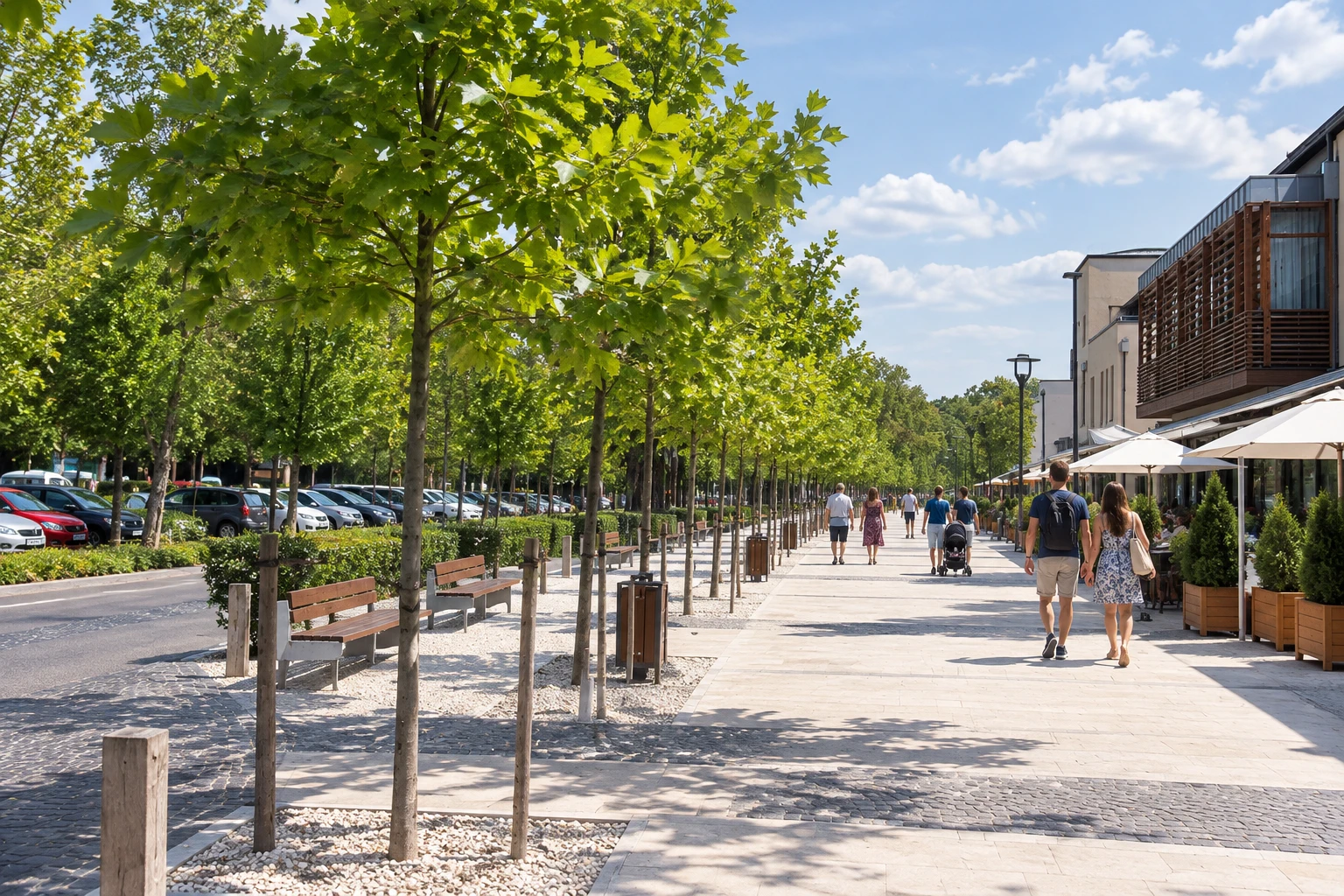
Balatonfüred · Hungary · Waterfront
Tagore Promenade
Tree-lined promenade in Balatonfüred, between the lake, gardens and the boat boarding area.

 Search
 Brazil
 Antarctica
 Argentina
 Bolivia
 Chile
 Colombia
 Ecuador
 Falkland Islands (Malvinas)
 French Guiana
 Guyana
 Paraguay
 Peru
 Suriname
 Uruguay
 Venezuela
 Austria
 Belgium
 Croatia
 Denmark
 Finland
 France
 Germany
 GreeceHungary
 Iceland
 Ireland
 Italy
 Luxembourg
 Norway
 Poland
 Portugal
 Slovakia
 Slovenia
 Spain
 Sweden
 Switzerland
 the Czech Republic
 the Netherlands
 the United Kingdom
 Turkey
 Bermuda
 Canada
 Greenland
 Mexico
 Saint Pierre and Miquelon
 the United States
 the Dominican Republic
 JapanTurkey
 Egypt
 South Africa
 Australia
 Fiji
 New Zealand
 Papua New Guinea
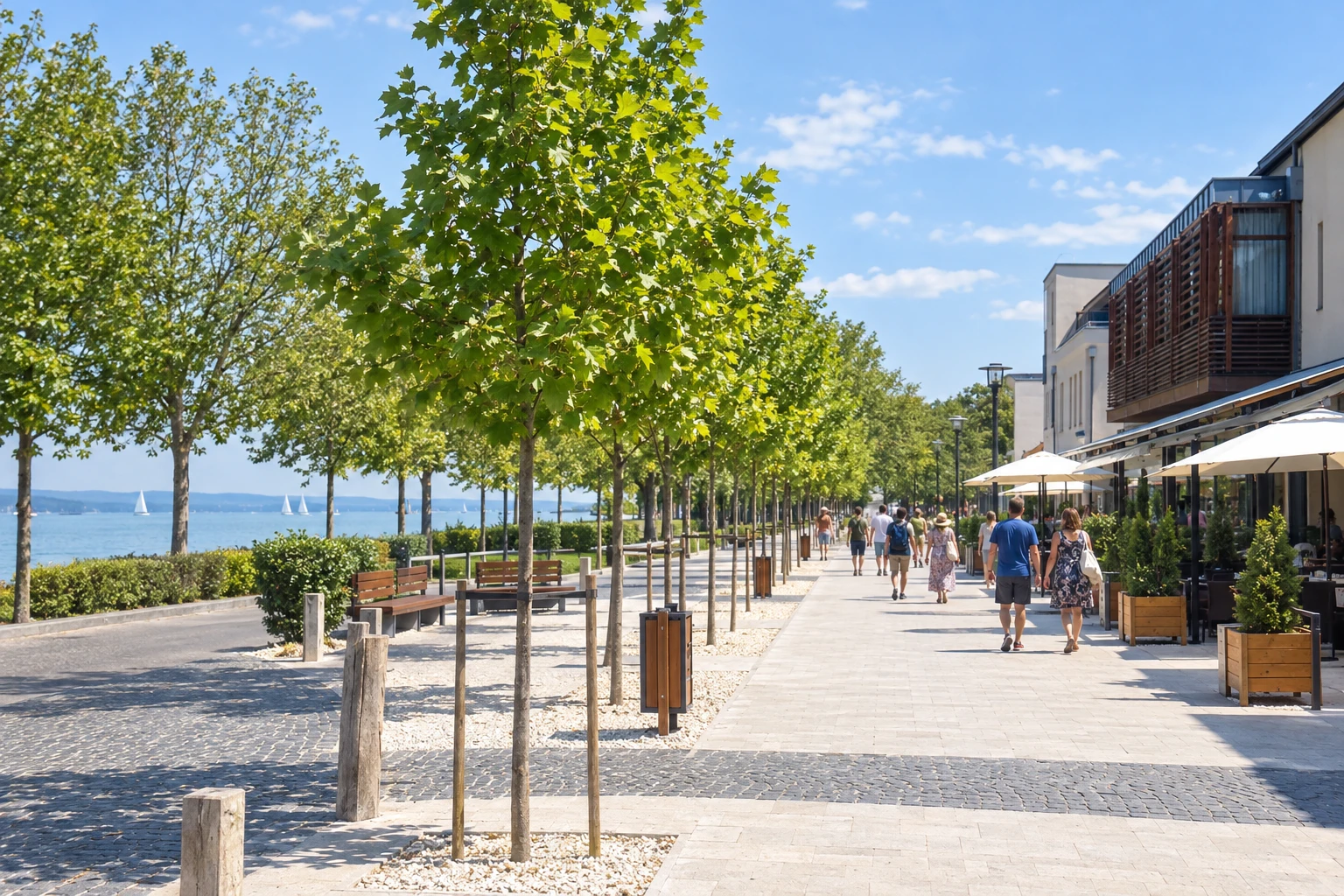
In the photo: Tagore sétány
Illustrative images. The pictures in this guide are illustrations based on the real place, not photographs, and may differ from it.

The city
Balatonfüred is a base on Balaton’s north shore. The Tagore sétány combines a waterside promenade, gardens and contact with boating activity. Train access makes it easy to reach from Budapest and continue to other stops in the region.
Balatonfüred stands on the northern shore of Lake Balaton in Veszprém County, about 140 kilometers by road from Budapest and 20 kilometers from Veszprém. It has around 13,500 residents and a long history as a resort. Its naturally carbonated mineral springs attracted guests long before lake bathing became fashionable, and it was recognized as a spa town in the 18th century. Locals simply call it Füred.
The town has two centers. Beside the water is the old spa district, Fürdőtelep, with Gyógy tér (Spa Square), the Lajos Kossuth spring pavilion, the State Hospital for Cardiology, the Round Church, 19th-century villas and Tagore sétány, a promenade following the lake for more than a kilometer beside the harbor. Higher up, away from the shore, the Óváros, or old town, has a red sandstone Catholic church, a white Reformed church, the former synagogue and low houses along Kossuth Lajos utca. To the northeast, Arács was a separate village until 1954 and is now a neighborhood at the foot of Tamás-hegy.
Füred’s heyday was the Reform Era in the first half of the 19th century, when Hungarian politicians and writers spent their summers here. That period gave the town the St. Anne’s Ball, or Anna-bál, first held in 1825 at Horváth-ház, and Transdanubia’s first stone theater, built in 1831. Six of its columns survive in Kiserdő park. Writer Mór Jókai built his villa in 1870. Indian poet Rabindranath Tagore came to the hospital for heart treatment in 1926 and planted a linden in the lakeside park, where other distinguished visitors later planted their own trees.
The lake sets the pace of the year. From June through August highs range from 26°C to 28°C, the town’s paid beaches open, boats run frequently and the calendar fills up. July brings the Kékszalag regatta and Anna-bál, August the Borhetek wine weeks. May and September have mild days, fewer people and boat service. November through March is cold, with highs between 3°C and 10°C. Beaches and the cave close, leaving museums, walks and wine cellars to explore.
The Balaton Uplands rise behind the town, with vineyards of the Balatonfüred-Csopak wine region, Lóczy Cave, the Jókai-kilátó lookout on Tamás-hegy and the Koloska-völgy valley. Across the bay you can see the Tihany Peninsula, less than 10 kilometers away by road and also accessible by boat in season.
One day covers the promenade, Spa Square and a house museum. With two or three days you can add the old town, a hike to the lookout, a beach or boat trip and a wine tasting. Almost everything is walkable. The railway station is about 2 kilometers from the shore.
30 places to stay in Balatonfüred.
30 places to eat in Balatonfüred.
Hotéis e restaurantes da cidade no mapa.
The local experience
Tree-lined promenade in Balatonfüred, between the lake, gardens and the boat boarding area.
To choose before you go
Where each tour starts, how long it takes, how it is done, what is included and the price range.
The lakeside promenade is a good introduction to town. Start on Vitorlás tér, the square facing the harbor. The statues of the Fisherman and the Ferryman were made by János Pásztor in 1937 to commemorate two old lake trades. Local tradition says that rubbing the figures’ boots ensures a return to Füred. From here, Tagore sétány runs for more than a kilometer between the lake and gardens, a broad promenade shaded by plane trees. Its name honors Nobel Prize-winning Bengali poet Rabindranath Tagore, who received treatment at the town’s cardiology hospital in 1926. When he recovered, he planted a linden in the park. The tree and a bust of the poet stand at the eastern end of the promenade. Around them grows a memorial grove planted by heads of state, scientists and writers, including Italian poet Salvatore Quasimodo and Hungarian Nobel laureates Jenő Wigner, János Harsányi and György Oláh. Bronze plaques on benches and beside the trees identify who planted each one. Two places along the way are worth a stop. The Vitorlázeum is an interactive exhibition on the history of sailing on Balaton, with a simulator and lake map. Bodorka Balatoni Vízivilág is the lake aquarium. Its 15 freshwater tanks hold local fish from the tiny bleak to the wels catfish. There are also two marine tanks and two terrariums. A drinking fountain on the promenade dispenses Füred’s naturally carbonated, tart-tasting mineral water, known as savanyúvíz.
Stops: Vitorlás tér, Statues of the Fisherman and the Ferryman, Tagore sétány, Memorial tree park, Vitorlázeum, Bodorka Balatoni Vízivilág.
Includes: The promenade and park are free. Vitorlázeum and the Bodorka Aquarium charge separately. Check current prices and opening days for each.
Tip: In summer, go early or in late afternoon, when shade covers the promenade and the Tihany peninsula stands out across the bay. During Borhetek wine weeks in August, producers' stalls fill the promenade.
Best time: Year-round. From May to September there are more boats and the gardens are in bloom.
Gyógy tér is the center of Fürdőtelep, the old spa district, a few steps from the lake. In the middle of the square is the Lajos Kossuth spring pavilion, a neoclassical pump house built in 1800 and remodeled in the mid-19th century. You can still taste the naturally carbonated mineral water that made the town famous. Around it are the buildings that shaped the resort. The State Hospital for Cardiology, built between 1869 and 1871 on the site of the old baths, uses spring water in its treatments. Horváth-ház, completed in 1798, was the area’s largest inn. At the first Anna-bál, or St. Anne’s Ball, held here on July 26, 1825, Anna Krisztina Szentgyörgyi Horváth met her future husband, Ernő Kiss, later one of the generals executed at Arad. The Anna Grand Hotel building served as the grand inn and spa assembly hall. The ball has been held here since 1957. Beneath its theater hall a covered gallery houses the Füred Pantheon, with plaques commemorating writers, scientists and musicians associated with the town. Uphill along Blaha Lujza utca is the villa where actress Lujza Blaha spent her summers, now a hotel. Nearby is Kerek templom, the Round Church, with a circular plan, dome and Ionic portico. Built in the 1840s, it was modeled on the Pantheon in Rome. Its lower level hosts exhibitions. Nearby Kiserdő is a 10-hectare park of old trees between Route 71 and the hospital. It preserves six columns from Transdanubia’s first stone theater, opened in 1831 at the initiative of poet Sándor Kisfaludy.
Stops: Lajos Kossuth Spring, State Cardiology Hospital, Horváth-ház, Anna Grand Hotel and Füred Pantheon, Kerek templom (Round Church), Blaha Lujza utca, Kiserdő.
Includes: The walk through the squares and streets is free. The hospital is closed to sightseeing. View Horváth-ház, now housing homes and shops, from the outside.
Tip: Bring a cup or bottle to taste the spring water. It's naturally sparkling and strongly flavored. Check the schedule for Mass and exhibitions at the Round Church.
Best time: Year-round. During the Anna Ball week in late July, the square hosts a stage and festival events.
This outing suits a rainy day or winter, when beaches close and boats stop running. Jókai’s house and the Vaszary Galéria stand opposite each other, and MOMŰ is a few blocks away. The Jókai Mór Emlékház is the villa that novelist Mór Jókai commissioned in 1870 and kept for twenty summers. Here he wrote Az arany ember (The Man with the Golden Touch), one of the most widely read novels in Hungarian literature, along with stories and articles about Balaton. The exhibition recreates the interiors with original furnishings and objects, including his writing desk, and explores the family’s daily life. Across the street, the Vaszary Galéria occupies a restored villa devoted mainly to the visual arts. It offers temporary exhibitions, concerts, literary events and workshops for children aged six and up, along with a café and bookstore. On Blaha Lujza utca, MOMŰ presents the Szöllősi-Nagy–Nemes collection, a private collection of modern and contemporary geometric art from Hungary and abroad that returned to town from Paris. Exhibitions alternate between art and photography. With more time, add the visitor center at Esterházy-kastély, a restored mansion whose exhibition recreates Reform Era travel, from arrivals at the spa by stagecoach and later by train to the steamboats that connected lakeside settlements.
Stops: Jókai Mór Emlékház, Vaszary Galéria, MOMŰ – Balatonfüredi Modern Műtár, Esterházy-kastély Látogatóközpont.
Includes: Each museum charges its own admission. Check current prices and opening days. The Esterházy-kastély visitor center usually opens only Friday through Sunday.
Tip: Begin at Jókai's house, cross the street to Vaszary Galéria, and leave MOMŰ for after lunch. Outside summer, check opening days before planning your route.
Best time: Year-round. In late April, Jókai Days (Jókai Napok) brings special events to the house museum.
The old town, the Óváros, sits above the spa district along the old route locals call the Roman road. Less visited than the waterfront, it preserves the village that existed before the spa guests arrived. Szent István tér is home to City Hall and the Catholic church, known as the Red Church for its exposed local red sandstone. The upper town also has the White Church, a neoclassical Reformed church from 1829. Kossuth Lajos utca descends from the old town between tightly spaced one- and two-story houses. It is home to the Helytörténeti Gyűjtemény, the local history collection, with documents, photographs and objects from the town’s past. Füred’s oldest monument stands on Bajcsy-Zsilinszky utca. This small vaulted place of worship has a history spanning three faiths. A medieval chapel stood here before the Reformed community built the present church in the 18th century. The Jewish community bought it in 1855 and used it as a synagogue until 1944. Today it is the Zsidó Kiválóságok Háza, the House of Jewish Excellence, with a digital exhibition on more than 130 scientists of Jewish heritage. Siske utca preserves traditional houses and ends at the woods, where a walking path begins. Outside the center on the road to Balatonszőlős are the ruins of the 12th-century Romanesque Church of St. Michael, built on the foundations of a Roman villa and destroyed during the Ottoman period. The site has open views of the lake.
Stops: Red Church (Catholic), White Church (Reformed), Kossuth Lajos utca, Zsidó Kiválóságok Háza, Helytörténeti Gyűjtemény, Siske utca, Ruins of St. Michael’s Church.
Includes: The streets, squares, and ruins are free. The House of Jewish Excellence and the local history collection charge admission and have their own opening days. Check ahead.
Tip: Go uphill by city bus or on foot from the station, located between the shore and the Old Town, then walk down to the lake. Churches usually open at service times.
Best time: Year-round. In October, the Füredi Szüret harvest festival brings a parade through the streets.
The hills behind town offer a half-day walk with a cave, a lookout and woodland. Lóczy Cave lies on the western slope of Tamás-hegy at the edge of Füred. It is named for geologist Lajos Lóczy, who studied Lake Balaton. Discovered in the late 19th century and opened to the public in 1934, it extends nearly 150 meters. Warm water rising from below hollowed out thin beds of Triassic limestone tilted by movements of the Earth’s crust. Electrically lit guided tours last about 25 minutes and take groups of up to 25 people. The temperature inside is around 12°C. The cave belongs to Balaton Uplands National Park. Follow the green stripe marks for about a 30-minute walk from the railway station, or drive about five minutes from the center. From the cave, the green triangle trail climbs to the summit of Tamás-hegy at 317 meters. The Jókai-kilátó is a three-story wooden tower overlooking the lake, town and Tihany Peninsula. The path, called Aranyember útja after Jókai’s novel, has benches and six panels about local geology, plants and wildlife. From the lookout, trails marked blue and green continue to Koloska-völgy and the Koloska rocks. The valley has the stone-framed Koloska spring, a small pond that dries up during droughts, picnic and barbecue areas, a wildlife park and a nature education trail. The uplands above town, at elevations of 250 to 300 meters, are covered by karst woodland with sub-Mediterranean vegetation.
Stops: Lóczy-barlang (Lóczy Cave), Tamás-hegy, Jókai-kilátó, Koloska-völgy, Koloska Spring.
Includes: Buy cave tickets on site. Check current prices. The trails, viewpoint, and valley are free.
Tip: The cave closes from early January to mid-March. Outside peak summer it opens only on certain days and for shorter hours. Check the national park calendar before climbing up. Bring a light layer for the cave, hiking shoes and water. Pets cannot enter.
Best time: April to October. In July and August, the cave usually opens daily.
At Lake Balaton, a beach is a strand, a fenced area of lawns and trees with paid admission in season, changing rooms, steps and piers into the water. In Füred, access to the lake is usually from piers and steps, with little or no sand. Esterházy strand sits on Tagore promenade beside the spa district. It has landscaped lawns, swimming piers, a lakebed prepared for easy entry and views of the Tihany Peninsula. Inside, the pools and slides of Esterházy Élményfürdő require a separate ticket sold at that section’s entrance. Outside the swimming season the grounds open as a free public park. Kisfaludy strand in the eastern part of town is the largest and busiest beach, with spacious grounds, courts, facilities and paid parking. City bus routes 30, 31, 32 and 40 serve it, and Balatonarács train stop is on this side of town. Aranyhíd strand is the third beach managed by the town. Széchenyi strand, within the campground, caters to sports and families, with sand courts and a children’s water park. The swimming season generally runs from June to late August. The town publishes a map showing the water quality rating for each beach.
Stops: Esterházy strand, Esterházy Élményfürdő, Kisfaludy strand, Aranyhíd strand, Széchenyi strand.
Includes: Each beach charges admission in season. The Esterházy pool park requires a separate ticket. Check current prices. Online sales are available.
Tip: Bring water shoes if you dislike walking on stones. Arrive early on July and August weekends for shade. Esterházy suits a quiet swim, while Kisfaludy has sports courts and more space.
Best time: June to August. Outside these months the beaches do not operate as bathing facilities.
Füred has one of the lake’s busiest harbors and a strong sailing tradition. The Hungária Yacht Club was founded here, and the Kékszalag round-the-lake regatta starts at the harbor. Seeing the town from the water complements a walk along the promenade. There are two types of boat trip. From spring to late fall, sightseeing boats make a circuit of around an hour and return to the same quay. From the deck you can see Füred’s waterfront, vineyard-covered hills and the Tihany Peninsula with the abbey towers above it. A sunset cruise serves sparkling wine and soft drinks on board. Scheduled boats provide transportation between lakeside towns during the sailing season. From Füred, services reach Tihany on the same shore and Siófok and Balatonföldvár on the southern shore. You can go by boat and return by bus or vice versa. Scheduled boats sail regardless of passenger numbers, while sightseeing departures need a minimum number. Strong winds or storms can cancel either. Bikes are accepted when space allows, and dogs must be muzzled and leashed. The season starts in spring with an April celebration at the harbor to welcome the first boat. Services grow more frequent through July and August. There are no regular winter sailings.
Stops: Balatonfüred Harbor, Füred Bay, Tihany Peninsula (seen from the lake).
Includes: Buy tickets per leg or outing at the pier or online. Check current fares and the day's departures.
Tip: Compare outbound and return schedules before boarding for Tihany or Siófok. Departures are limited outside July and August. It's windier on the lake than ashore, so bring a jacket even in summer.
Best time: May to September, with the most departures in July and August.
Füred is the center of the Balatonfüred-Csopak wine region, which covers lake-facing slopes in northeastern Balaton. Grapes have been grown here for around 2,000 years, with cultivation expanding after the lands passed to the Benedictine abbey of Tihany in 1211. The region includes 24 communities and dozens of registered wineries, and the town holds the title of International City of Grapes and Wine. White wine is the local specialty. Olaszrizling is the grape most closely associated with the region. Festivals also feature rizlingszilváni, tramini and muscats, and among the reds, zweigelt. There are two ways to taste. During Borhetek, the wine weeks held every August since 1932, producers set up wooden stalls along Tagore promenade and serve wine by the glass or bottle with snacks and music. The celebration lasts about three weeks and is the summer’s busiest event. In May, usually on Pentecost weekend, the Balaton Fish and Wine Festival (Balatoni Hal- és Borünnep) brings local wineries, a guest wine region and lake fish to the same promenade. The rest of the year, cellars and wine houses on the hills of Füred and Arács host tastings, many overlooking the lake. The town tourist office maintains a list. In January the cellars celebrate St. Vincent’s Day in honor of the patron saint of winegrowers.
Stops: Tagore sétány (Borhetek), Vineyards of Füred and Arács, Wine cellars of the Balatonfüred-Csopak region.
Includes: At festivals, pay by the glass. Cellars charge separately for tastings. Check prices and reservation requirements with each producer.
Tip: If you're tasting wine, leave the car behind. The hillside cellars are a short taxi ride from downtown. Friday and Saturday evenings are busiest at Borhetek. Weekdays are easier to navigate.
Best time: August for Borhetek, May for the Fish and Wine Festival, and October for the grape harvest.
Day by day
Suggestions to plan the trip. Change the order of the days according to the weather and tour availability.
From the station, head down to the lake, about 2 kilometers away on foot or by city bus. Begin at Vitorlás tér with the statues of the Fisherman and the Ferryman, then follow Tagore sétány to Tagore’s linden and the memorial grove. Return through Gyógy tér. Taste the Lajos Kossuth spring water, see Horváth-ház, where the Anna-bál began, the Pantheon beneath the Anna Grand Hotel hall and the Round Church. Have lunch in the spa district. Choose your afternoon according to the season. In summer, swim at Esterházy strand or take the one-hour sightseeing cruise. In colder months, visit Mór Jókai’s house museum and the Vaszary Galéria opposite. Finish on the promenade as the light falls over the Tihany Peninsula. Check the last train or bus time in advance.
Take a leisurely morning on Tagore sétány and around the harbor. See the memorial trees, visit the Bodorka aquarium if traveling with children and explore the Vitorlázeum sailing exhibition. After lunch, circle Gyógy tér for the Lajos Kossuth spring, Horváth-ház and the Round Church, then visit Mór Jókai’s house and the Vaszary Galéria. If you enjoy modern art, fit in MOMŰ on Blaha Lujza utca. From May through September, take the one-hour boat tour late in the afternoon or join the sunset sailing. Have dinner near the lake. In August, Borhetek stalls line the promenade.
Set out early for the hills. Tour Lóczy Cave at the first admission of the day if it is open, then follow the green triangle trail to Jókai-kilátó atop Tamás-hegy. If you feel energetic, continue to Koloska-völgy for a picnic by the spring. Otherwise, descend to town. Explore the old town in the afternoon, including the Red Church, White Church, Kossuth Lajos utca and the House of Jewish Excellence in the former synagogue. If time and transportation allow, visit the ruins of St. Michael’s Church overlooking the lake. Finish with a wine tasting arranged ahead at a cellar in the hills of Füred or Arács.
Spend the day in the lower town. In the morning, walk Tagore sétány and visit the harbor and memorial trees. Return through Gyógy tér for the Lajos Kossuth spring, Horváth-ház, the Füred Pantheon and the Round Church, then walk to the old theater columns in Kiserdő park. In the afternoon, visit Mór Jókai’s house and the Vaszary Galéria. End the day with a sunset cruise in season or stay on the promenade.
In the morning, visit Lóczy Cave, climb to Jókai-kilátó and extend the walk to Koloska-völgy if you like. Bring water and a snack, as you cannot count on shops along the trail. Descend through the old town in the afternoon, visiting the Red Church, White Church, local history collection and House of Jewish Excellence. The Esterházy-kastély visitor center is usually open on weekends. In the evening, take a taxi to a cellar for a tasting of wines from Balatonfüred-Csopak.
In summer, spend the morning at Esterházy strand or the roomier Kisfaludy strand with its sports courts. Bring water shoes and arrive early on weekends. From May through September, another option is a scheduled boat. Tihany is a short ride along the same shore and has its own guide to the abbey and peninsula trails. Siófok is across the lake. Check outward and return times at the quay, remembering that you can also return from Tihany by bus. Outside the boating and swimming season, spend the day at MOMŰ and the Bodorka aquarium or take a bus to Tihany, less than 10 kilometers away.
Best time to go
The seasons shown are the most usual ones; nature doesn't always follow the calendar.
St. Vincent’s Day in the wine cellars · City ice rink
The coldest month has lows near -2°C, highs near 3°C, little rain or snow and short days. In severe winters the lake edges can freeze. Beaches, the cave and boat services close. Museums, the town ice rink and wine cellars remain active, with St. Vincent’s Day celebrated in the cellars late in the month. Come if you want the town to yourself.
Arács Carnival · Winter
It is still winter, with lows near -1°C, highs near 5°C and little precipitation. Arács holds its carnival early in the month. Sunny days suit short walks on the promenade. Spend the rest of your time indoors at Jókai’s house, Vaszary Galéria and MOMŰ. Check opening days, which are more limited at this time.
Füred Spring Festival · Lóczy Cave reopens in midmonth
Early spring brings lows near 3°C, highs near 10°C and little rain. The Füred Spring Festival takes place around midmonth, and Lóczy Cave resumes tours, initially only on weekends. The Tamás-hegy trails are walkable with a warm layer. Scheduled boats and beaches have yet to open.
Welcoming the first boat into the harbor · Jókai Days
Mild days bring lows around 8°C, highs around 17°C and still little rain. The boating season opens with a celebration welcoming the first boat. Late in the month, Jókai Days brings events to the house museum and galleries. The hills are green and the trails quiet. Bring a jacket for the lake wind.
Sailing season opens · Balaton Fish and Wine Festival
Spring is in full swing, with lows around 13°C, highs around 22°C and more frequent showers. A harbor ceremony opens the sailing season. The promenade hosts a vintage car competition and, around Pentecost, the Balaton Fish and Wine Festival. Sightseeing boats are running, though the water is still cold for most swimmers.
Book, Wine and Jazz Festival · Night of Museums · Guitar Festival
Early summer has lows near 17°C, highs near 26°C and showers a few days each month. Beaches usually open for bathing, boats run more frequently and the cultural calendar picks up with a book, wine and jazz festival, Museum Night and an international guitar festival. Days are long, with fewer crowds than in July.
Kékszalag regatta · Anna-bál and St. Anne’s Festival
The warmest month has lows near 18°C, highs near 28°C and passing summer storms. This is the resort’s peak. The Kékszalag regatta starts and finishes in Füred. The Anna-bál takes place on the Saturday nearest St. Anne’s Day, July 26, with a weeklong festival on Gyógy tér. Book accommodations well ahead and get to the beaches early.
Borhetek Wine Weeks on the Tagore promenade
Summer heat brings lows near 18°C and highs near 27°C. This is the wettest month by volume, with rain concentrated in a few stormy days. Borhetek brings regional producers to the promenade for about three weeks. Beaches, boats and the cave operate daily.
Romantikus Reformkor festival · Quasimodo poetry competition
Late summer is mild, with lows near 13°C and highs near 22°C. Beaches close for the season, but boats continue with fewer departures. In midmonth the Romantikus Reformkor festival brings Reform Era dress and activities to the streets, and the town hosts the Salvatore Quasimodo poetry competition. It is a good time for walks and winery visits during the grape harvest.
Füredi Szüret grape harvest festival
Fall brings lows near 9°C, highs near 16°C, cool mornings and colorful woodland in the hills. A harvest festival features a parade and events on one weekend this month. The cave opens only a few days each week, and boat services taper off toward the end of the season. It is a good month for the lookout, old town and museums, with fewer people than in summer.
St. Martin’s Day · Start of Advent in Füred
Cold and damp, with lows near 4°C, highs near 9°C and short days. Scheduled boats stop, and the cave opens only on Saturdays. The Arács neighborhood celebrates St. Martin’s Day. Late in the month, Füred Advent begins with a Nativity scene outside the Red Church. Make time for museums and local food.
Advent in Füred · Ice rink opens · City New Year’s Eve celebrations
Winter brings lows around -1°C and highs near 4°C. Advent includes choir concerts in churches and at the convention center. The town ice rink opens early in the month and hosts the end-of-year celebration. The cave usually opens for a few days between Christmas and New Year. Dress warmly and plan for short daylight hours.
Plan the journey
Balatonfüred has no airport. The usual gateway is Budapest International Airport (BUD), the country’s main airport. Continue by train or bus via central Budapest, or rent a car. Budapest is about 140 kilometers from Füred by road.
At the western end of the lake, Hévíz–Balaton Airport (SOB) in Sármellék bills itself as the airport for Lake Balaton. Traffic is light and flights are concentrated in part of the year. Check the airport’s timetable before relying on it. From there, travel via Keszthely along the entire northern shore to Füred.
From Vienna or Bratislava you can also reach Balaton overland, changing trains or buses along the way.
From another continent, the trip usually involves a connection in a European city before Budapest. Confirm the connection before buying.
The train is the simplest way to arrive without a car. Balatonfüred is on the Budapest–Tapolca line along the northern shore, 132 kilometers from the capital and 52 kilometers from Tapolca. Trains leave Budapest-Déli station. Summer brings more direct services, while some other journeys require a change at Székesfehérvár. Check times and journey lengths in the Hungarian railway planner.
Balatonfüred station lies between the old town and the lake, beside the bus station, around 2 kilometers from the shore. There are taxis outside and city buses to the spa district. The town also has a stop at Balatonarács in the east, closer to Kisfaludy strand.
Use the same line to explore the northern shore, with stops such as Balatonalmádi to the east and Badacsony to the west. Trains to Keszthely require a change at Tapolca, and the bus is usually faster.
Trains to Balaton fill up on July and August weekends. Buy a ticket with a reserved seat when available.
The bus station stands opposite the railway station. Long-distance buses serve nearby resorts and Veszprém, the county seat 20 kilometers away and the most frequent connection. Other routes go to Budapest, Székesfehérvár, Győr and, along the northern shore via Badacsony, to Keszthely and Hévíz.
Regional buses to Tihany, less than 10 kilometers away, leave from the same station and are the alternative when boats stop running.
City buses are useful for the climb from the shore to the old town and for Kisfaludy strand, served by routes 30, 31, 32 and 40.
Schedules change between summer and the rest of the year and may be reduced on Sundays and holidays. Check the national transportation planner before setting out.
Balatonfüred stands on main road 71, which follows the northern shore of Lake Balaton, about 140 kilometers from Budapest. From the capital, take the M7 highway toward the lake, then Route 71. From Veszprém, 20 kilometers away, Route 73 descends to meet Route 71 in neighboring Csopak.
Hungarian highways require an electronic vignette purchased before entering. Check the rules and vehicle category.
Lakeside spaces are hard to find in summer. Kisfaludy strand has a large paid lot. The spa center and promenade are walkable. A car is mainly useful for Lóczy Cave, St. Michael’s ruins, hillside wineries and neighboring towns.
By road, Tihany is less than 10 kilometers away, Veszprém 20, Székesfehérvár around 65, and Keszthely and Hévíz just under 70 along the northern shore. Győr is around 100 kilometers away via the Bakony hills.
During the sailing season, scheduled boats run by the Balaton operator connect Füred harbor with Tihany on the north shore and Siófok and Balatonföldvár on the south shore. It is a way to arrive if you are staying across the lake or traveling by train via Siófok on the southern line.
The harbor is on Vitorlás tér at the start of Tagore promenade, a short walk from Spa Square. Scheduled boats carry passengers only, with bicycles accepted when space allows.
Drivers on the southern shore can take the vehicle ferry between Szántód and Tihany, then continue by road to Füred.
Sailings depend on the weather. Strong winds or storms cancel departures, and the operator takes no responsibility for missed rail or bus connections. Regular boats operate from spring to fall. Check the timetable for your travel year.
Your questions
The rail connection and buses to Tihany allow you to organize the north shore without driving.
The Tagore sétány, with gardens and sections close to the boating area.
Two nights help split Balatonfüred and Tihany, reducing round trips to the capital.
No. Hungarian summer runs from June to August; winter, from December to February, is usually cold.
Walk along the Tagore promenade and harbor, taste the water at the Lajos Kossuth Spring on Gyógy tér, see Horváth House and the Round Church, and visit the Mór Jókai Memorial House or Vaszary Gallery. In summer, finish with a swim at Esterházy Beach or a one-hour sightseeing cruise. In cold weather, spend more time in the museums.
One day covers the spa district and promenade. With two days, add Lóczy Cave, Jókai Lookout and the old town. Three days leave a full day for the lake, at the beach or on a boat. The town also makes a base for Tihany and other communities on the north shore.
June through August brings lake swimming, frequent boats and festivals. Highs range from 26 to 28 °C and the town is busy. May and September bring mild days, fewer people and boat service. From November through March, it’s cold, the beaches and cave close and boats stop running. Visit for the museums, short walks and wine cellars.
Yes. The managed beaches, called strandok, usually operate from June through late August and charge admission. They have lawns, piers and steps into the water, with no stretch of sand. Esterházy Beach is on the Tagore promenade. Kisfaludy Beach, on the east side, is the largest. The town publishes water quality ratings for each beach.
Tihany is less than 10 km away by road. During the boating season, scheduled boats run from Füred harbor to Tihany pier, where you can walk uphill to the abbey. Regional buses run year-round from the bus station beside the train station. You can also cycle along the lakeside bike path. Check return schedules before setting out.
Take the Budapest–Tapolca train from Budapest-Déli station. Füred is 132 km from the capital by rail. Long-distance buses also serve it. By car, it’s about 140 km via the M7 highway and Route 71. The train and bus stations are side by side, about 2 km from the lake.
It’s about 2 km from the shore, between the old town and the spa district. The walk is flat or gently downhill. City buses and taxis stop outside the station. If you’re going straight to Kisfaludy Beach, you can get off at Balatonarács on the east side of town.
It’s the St. Anne’s Ball, first held at Horváth House on July 26, 1825. Today it takes place at the Anna Grand Hotel on the Saturday closest to St. Anne’s Day. In the 19th century it was one of the country’s most elegant gatherings. The queen of the ball receives a golden apple and her attendants receive Herend porcelain vases. The ball requires a ticket. St. Anne’s Festival week also brings events to Gyógy tér and the Kisfaludy stage.
It takes place every August for about three weeks, a tradition dating to 1932. Producers from the Balatonfüred-Csopak wine region set up wooden stalls along the Tagore promenade, serving wine by the glass and bottle, especially local olaszrizling whites. Dates change each year. Check the town calendar.
Yes. Füred’s sparkling mineral water, savanyúvíz, is officially recognized as natural mineral water. Taste it at the Lajos Kossuth Spring pavilion on Gyógy tér or at a drinking fountain along the Tagore promenade, among other spots. It is naturally carbonated with a tart taste. The cardiology hospital uses the same water for bathing treatments.
Yes, for quiet streets, museums and wine. From December through February, highs range from 3 to 5 °C, the beaches and boat services close, and Lóczy Cave is closed for much of the period. Füred’s Advent celebrations, the city ice rink, house museums and wine cellars give you plenty to explore with few other visitors around.
Yes. The promenade is flat and car-free, Bodorka Aquarium displays fish from the lake, Kiserdő Park has a play area, and the guided visit to Lóczy Cave takes about 25 minutes. In summer, Esterházy Beach has pools and slides, and Széchenyi Beach has a children’s water park. There’s a wildlife park in the Koloska Valley.
It’s a sailing race around Lake Balaton, started in the 1930s by Füred’s Hungária Yacht Club. Boats leave Balatonfüred, sail more than 150 km around the lake without touching shore, and return to the starting point. The race takes place in summer, usually in July, with celebrations on the promenade and Gyógy tér. The date changes each year.
You can explore the spa district, promenade and museums on foot. City buses run uphill to the old town and out to Kisfaludy Beach. Trails from the station lead to Lóczy Cave and the lookout. A car or taxi is helpful for the hillside wine cellars and St. Michael’s ruins. Buses, trains and seasonal boats serve Tihany and other lakeside communities.
Routes in Hungary
From Balatonfüred to Balatonfüred, via the cycling ring that links the vineyard side to the beaches on the lake’s southern shore.