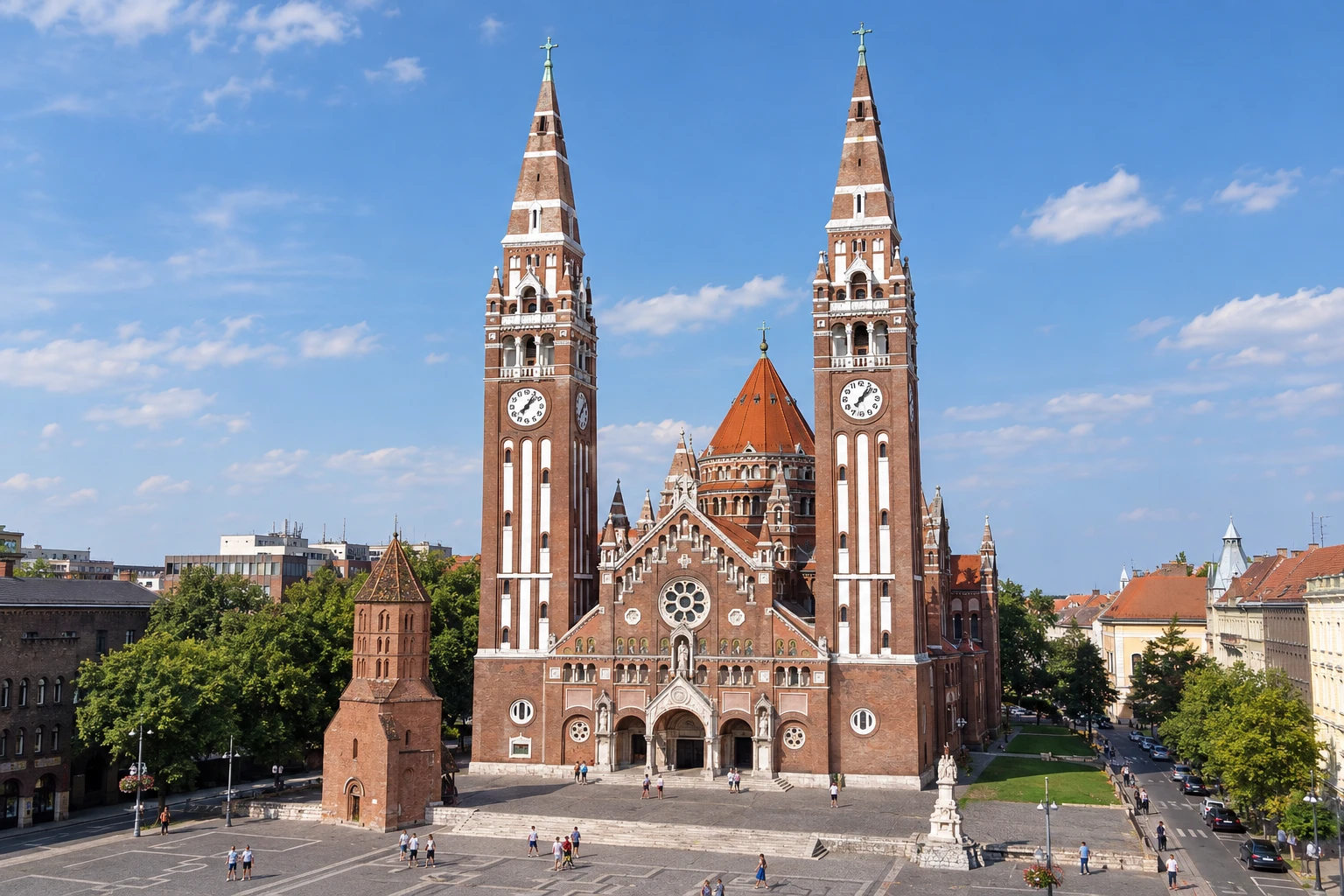
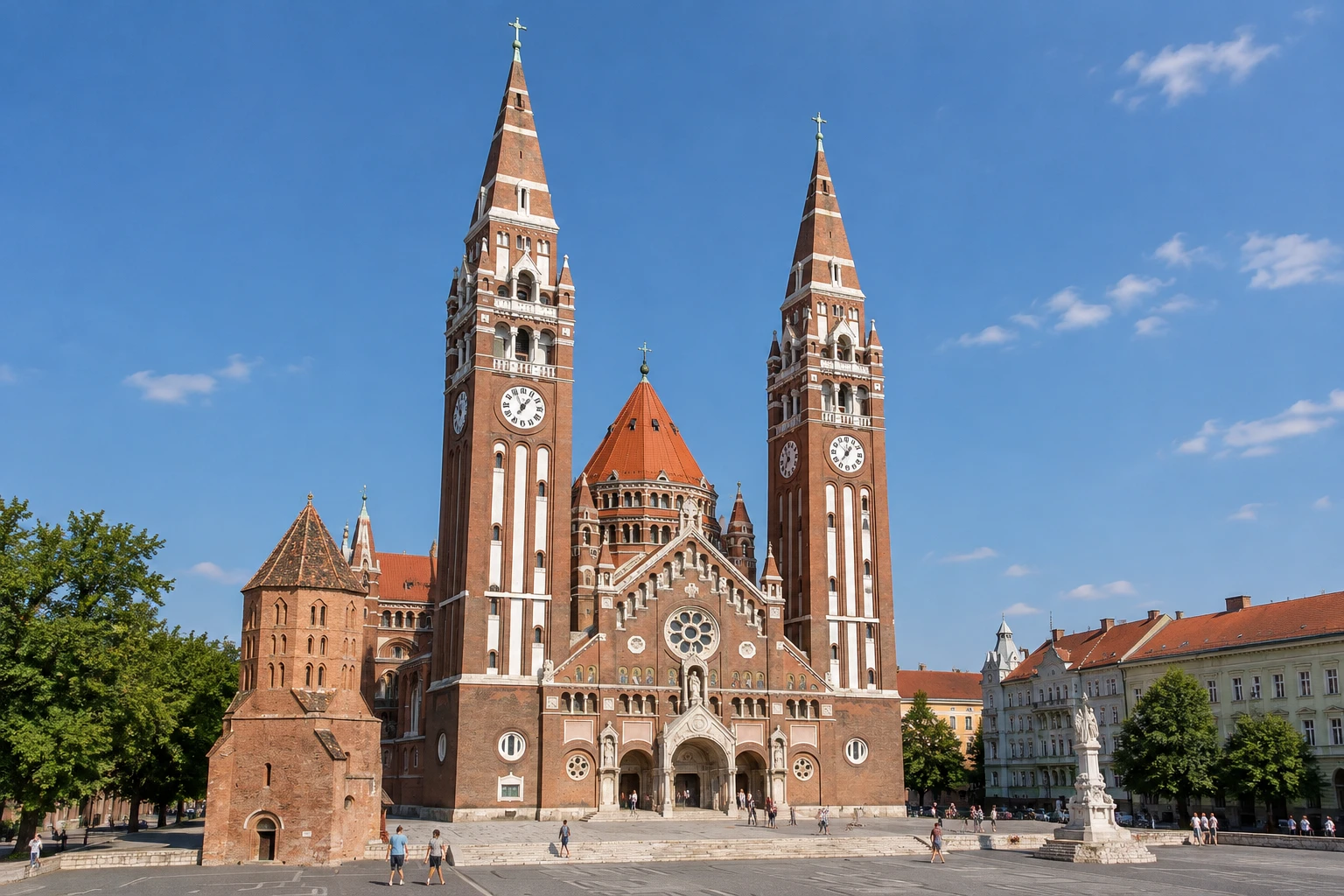
Dóm tér: the Votive Church, its tower and dome, and Dömötör Tower
From Dóm tér, downtown On foot 2 to 3 hours Morning or afternoon Easy, with 302 steps in the tower
After the 1879 flood, the city vowed to build a great Catholic church. Construction finally began in 1913, with Ernő Foerk adapting Frigyes Schulek’s design. The church was consecrated on October 24, 1930. Hungary’s fourth-largest church blends Romanesque, Gothic and Byzantine elements. Inside, look for the 9,040-pipe organ, János Fadrusz’s Christ on the Cross, which won a prize at the 1900 Paris World’s Fair, and the mosaic showing the Virgin in a shepherd’s felt cloak and embroidered Szeged slippers.
The visitor center is below ground. From here you can climb 302 steps with three rest landings to the west tower lookout at 46 meters. There is also an exhibition about the construction of the church and square, and the crypt houses the diocese’s liturgical collection, including metalwork and textiles from the 15th through 18th centuries. Tours to the dome lookout at 34 meters depart at set times and pass through the attic for a look at the roof structure.
In front of the church is Dömötör Tower, Szeged’s oldest building. Its foundations date to the 11th century, its Romanesque lower section to the 12th and its Gothic stories to the 13th. Conversion to a baptistery with frescoes by Vilmos Aba-Novák saved it from demolition. Above the door is the 12th-century Stone Lamb, the oldest sculpture in the city.
Béla Rerrich designed the 12,000-square-meter square, built between 1928 and 1930. Beneath the arcades, the National Pantheon has more than a hundred statues of figures from Hungarian history, science and the arts. Opposite the church entrance, a musical clock sends wooden professors and students on parade twice a day. On the north side, near the river, the Baroque Serbian church, consecrated in 1778, has a Rococo iconostasis.
Stops: Votive Church (Szegedi Dóm), Cathedral Visitor Center, Tower observation deck, Dome observation deck, Dömötör Tower, National Pantheon, Musical clock, Serbian Orthodox Church.
Includes: The church is free. The tower, dome lookout, Dömötör Tower, and exhibitions charge admission, with individual and combined tickets. Check current prices at the visitor center.
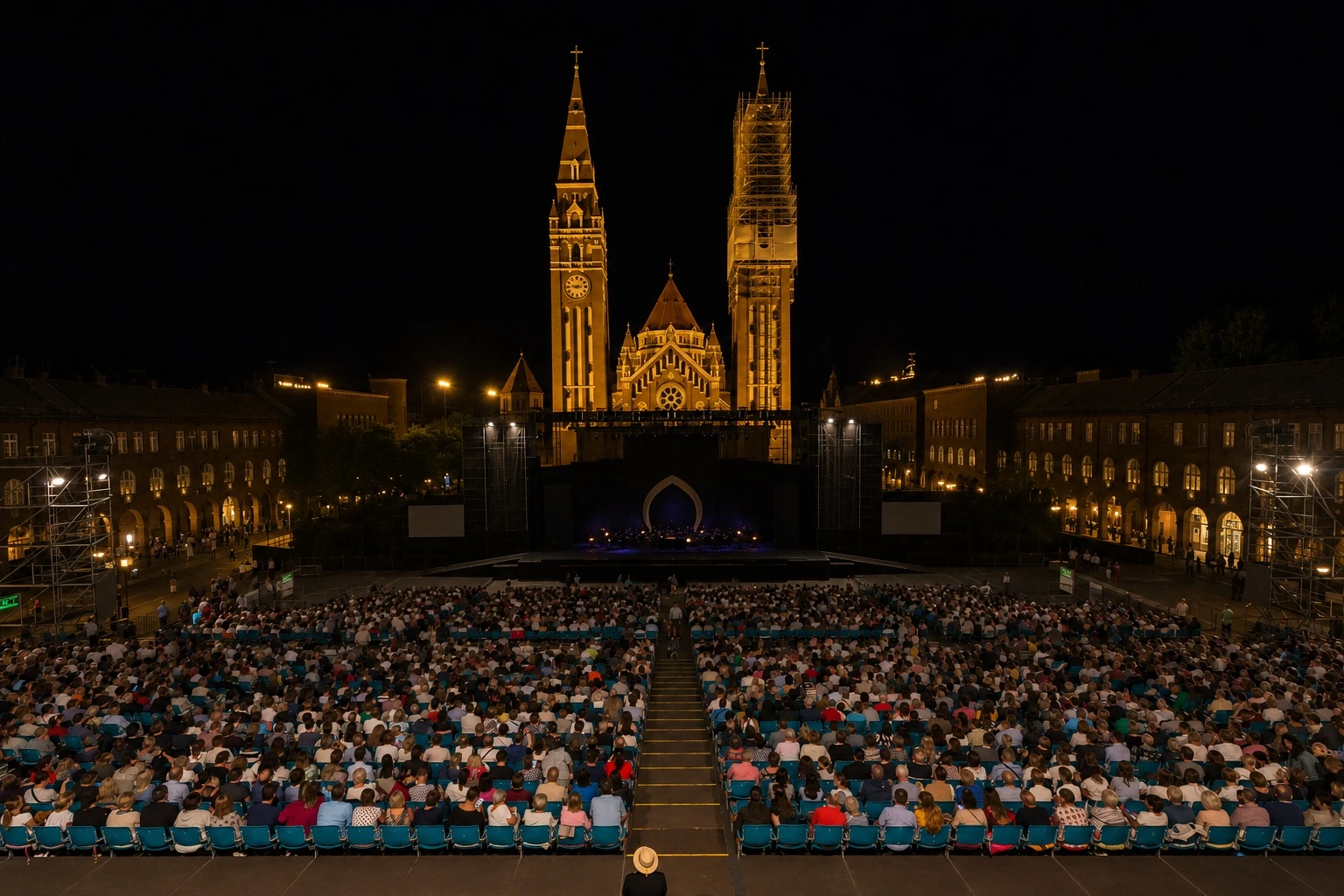
Tip: The visitor center closes Mondays. The musical clock stops during the Open-Air Festival, when temporary stands occupy the square. The Serbian Orthodox church opens only by phone appointment.
Best time: Year-round. In July and August the square hosts the festival stage. From late November to Christmas it hosts the Advent market.
Walking downtown via Széchenyi tér, Klauzál tér, Kárász utca and Dugonics tér
From Tourinform office on Széchenyi tér On foot About 2 hours Morning or afternoon Easy
Széchenyi tér, the largest square in the center, covers more than 50,000 square meters and has old plane trees, magnolias and statues. In the 13th century the castle walls ran through here, with a drill ground and market on the open land in front. The current City Hall is the third on the site. When the square was raised after the flood, the building sat too low, so Ödön Lechner and Gyula Pártos added a floor and the slender tower. Emperor Franz Joseph opened it in 1883. The center staircase window records his words that Szeged would be more beautiful than before. The phoenix on the pediment symbolizes the city’s rebirth, and the Bridge of Sighs was built for the emperor and his entourage on their visit to the rebuilt city.
Nearby on Stefánia, the Szeged National Theater of 1883 has a semicircular facade designed by the Viennese architects Fellner and Helmer.
The restoration of Klauzál tér and pedestrian Kárász utca earned a Europa Nostra award in 2004. The palaces blend Classicism, Eclecticism and Secession. A bronze statue of Lajos Kossuth on the square recalls his final speech in Hungary, delivered from the balcony of Kárász House. This is the stretch for pastry shops and cafés with outdoor tables.
Kárász utca ends at Dugonics tér, the university square. The statue of András Dugonics, author of the first Hungarian novel, was the city’s first statue in a public space. The fountain opposite, a local meeting place, marked the flood’s centenary. A statue of the poet Attila József, who studied here, stands outside the rector’s building. On the corner of Kárász utca, figures of dancing women crown the dome of Ede Magyar’s Ungár-Mayer Palace.
Stops: Széchenyi tér, City Hall (Városháza), Bridge of Sighs, Szeged National Theater, Klauzál tér, Kárász utca, Dugonics tér, Ungár-Mayer Palace.
Includes: Self-guided outing. The tourist office also arranges paid guided walks by reservation and Hungarian-language town hall tours with advance registration.
Tip: The town hall interior is accessible only by guided tour from the tourist office a few days each week. The office stores luggage during opening hours, handy if you're visiting for the day.
Best time: Year-round. Széchenyi tér hosts the Wine Festival in May, and the squares host Advent events in December.
The Secession trail: from Reök Palace to the water tower
From Dugonics tér On foot About 2 hours, without going inside the buildings Morning or afternoon Easy
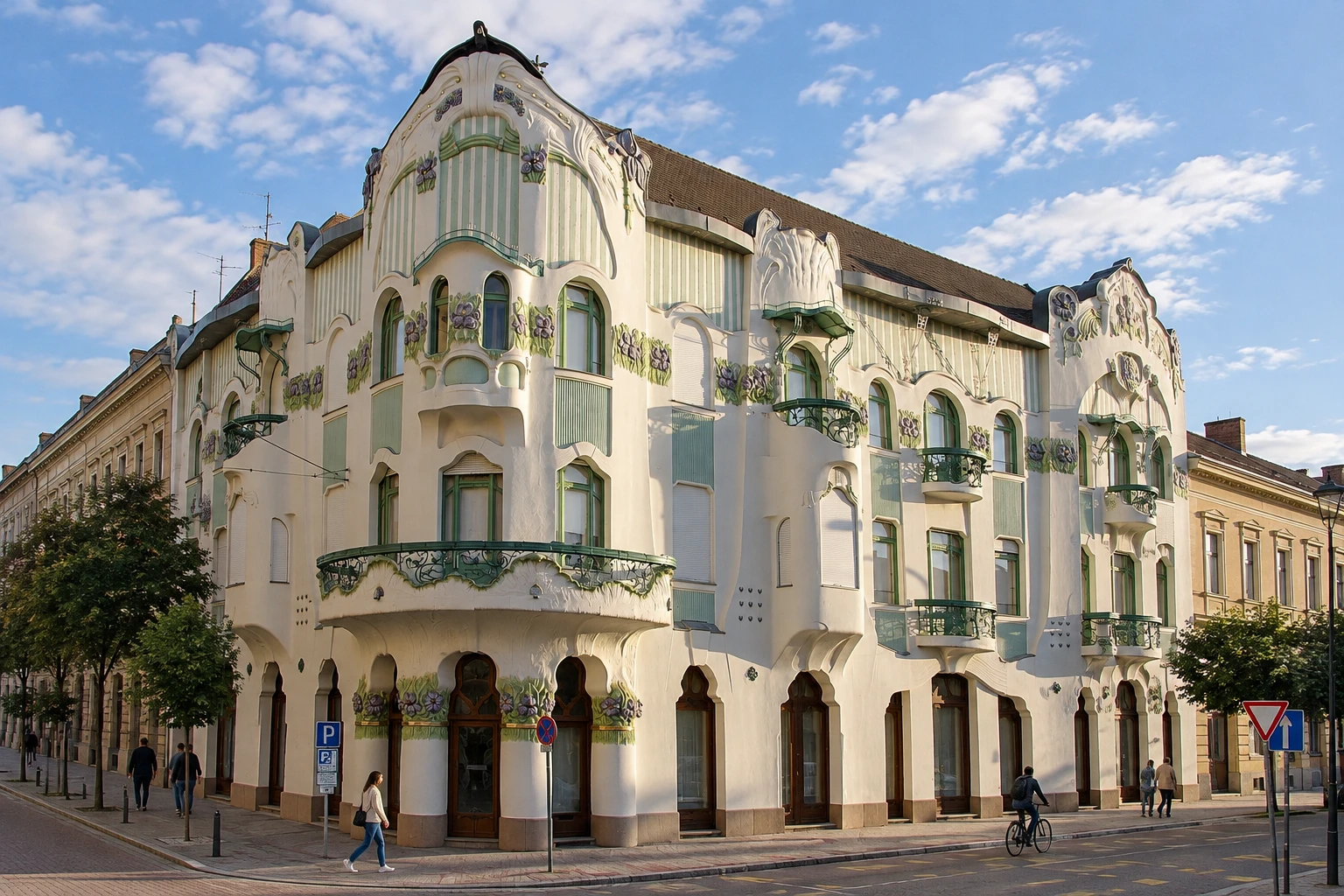
Rebuilding after the 1879 flood made Szeged a city of palaces. Around the turn of the century many followed the Secession style, the Hungarian version of Art Nouveau. The tourist office suggests a route of about two hours that you can follow independently.
Start at Ede Magyar’s Ungár-Mayer Palace, on the corner of Dugonics tér and Kárász utca. The same Szeged-born architect designed Reök Palace in 1907 for hydraulic engineer Iván Reök. Water inspired the blue water lilies on the white facade, balcony railings shaped like aquatic plants and undulating walls. Built as apartments, it now houses the Regional Arts Center, with temporary exhibitions, concerts and chamber theater. The exhibitions charge admission. A separate ticket covers the staircase and palace visit.
Continue to Lipót Baumhorn’s New Synagogue, passing Goldschmidt Palace, which lost its decoration in a 1950s renovation, and the Reformed Palace, also by Ede Magyar.
On Szent István tér stands a 1904 water tower designed by Szilárd Zielinski, the country’s first in reinforced concrete. It still works. Inside is a Foucault pendulum and at the top a lookout. Busts around it honor architects who transformed the city.
The final stretch takes in Móricz House, with Zsolnay ceramics and wrought-iron balconies, and Gróf Palace, with three facades and two towers, both by Ferenc Raichle. Mihály Erdélyi’s Deutsch Palace incorporates Hungarian folk art motifs.
Stops: Ungár-Mayer Palace, Reök Palace (Reök-palota), New Synagogue, Goldschmidt Palace, Reformed Palace, Water tower on Szent István tér, Móricz House, Gróf Palace, Deutsch Palace.
Includes: Self-guided walk to see the facades. Reök exhibitions, the synagogue interior and the water tower charge separate admission. The tourist office’s guided walk costs extra and must be booked a week ahead.
Tip: Reök Palace closes on Mondays. The water tower opens only on certain Saturdays from May through September. Check the date before visiting. Save the synagogue for a day when you can go inside.
Best time: Year-round. Morning and late-afternoon light bring out the facades.
New Synagogue and Old Synagogue
From Jósika utca, downtown On foot 1 to 1½ hours Morning Easy
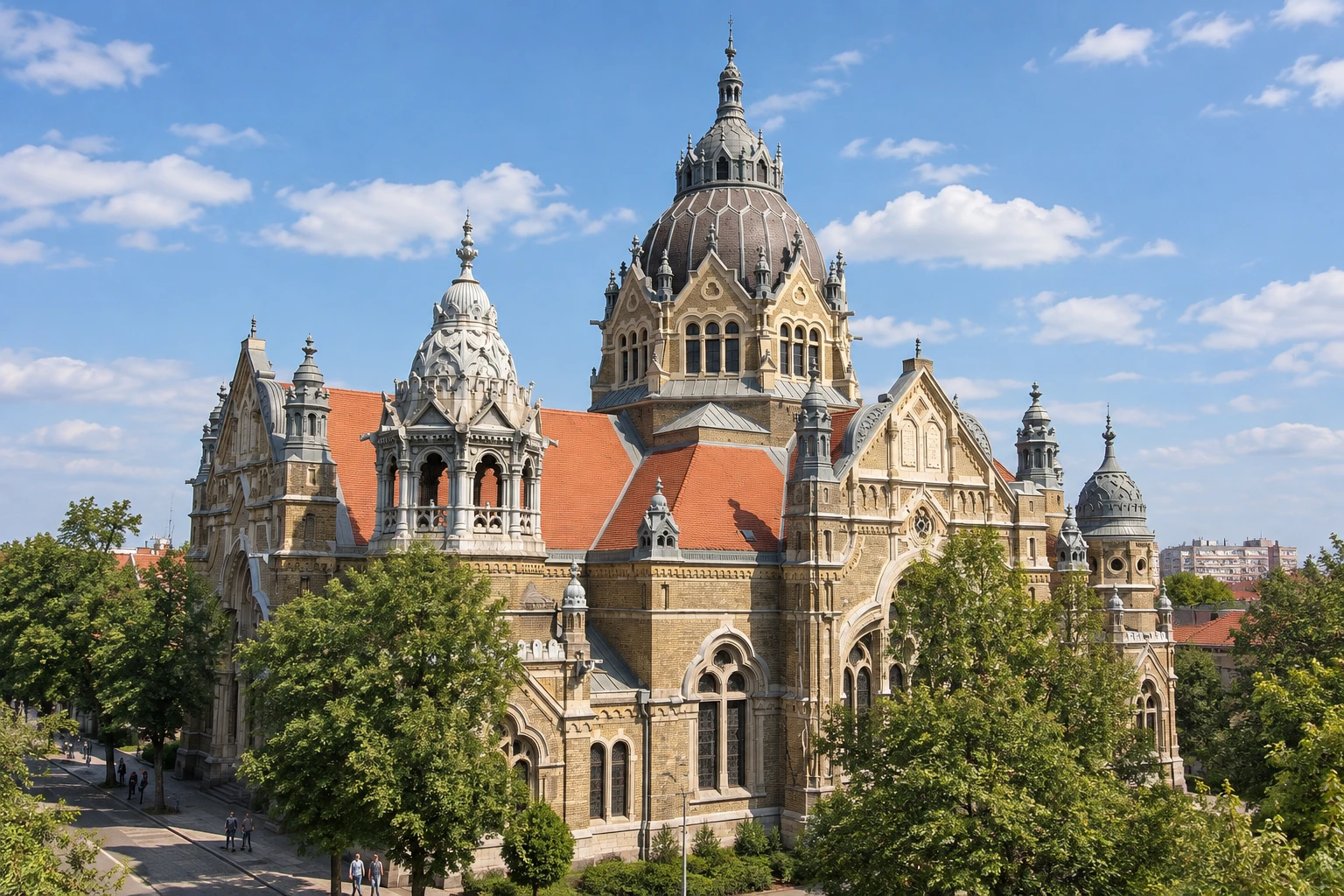
Architect Lipót Baumhorn designed the early 20th-century New Synagogue with guidance from the scholarly chief rabbi Immánuel Löw. Hungary’s second-largest synagogue seats 1,340 people beneath a dome 48.5 meters high. Its eclectic style draws heavily on Secession and Moorish design.
On the triumphal arch, the commandment to love your neighbor as yourself appears in Hebrew and Hungarian. Löw is credited with the inclusion of Hungarian. Ivory, gold and blue dominate the interior. Look up to see the centerpiece, a glass dome, and stained glass from Manó Róth’s workshop. Other details include the Jerusalem marble that caps the altar, the Ark door made of acacia from the Nile region, the candelabras and paintings of plants mentioned in the Bible. The acoustics make the synagogue a venue for organ concerts.
The garden opens with the building. A few steps away on Hajnóczy utca, the Lipovszky brothers built the Old Synagogue in the Classical style between 1837 and 1843. Beside the entrance, plaques in Hungarian and Hebrew mark the water level during the 1879 flood. They appear low because the street was raised afterward. The building now hosts performances, including the summer THEALTER theater festival.
Stops: New Synagogue (Szegedi Új Zsinagóga), Synagogue garden, Old Synagogue.
Includes: The New Synagogue charges admission. Check current rates. Guided tours in Hungarian or English cost extra and must be booked at least three days ahead.
Tip: The synagogue closes on Mondays, Saturdays and Jewish holidays and closes early on Fridays. Ticket sales end shortly before closing. Check the calendar before you go.
Best time: Year-round. It usually closes for a few days between Christmas and early January.
Móra Ferenc Museum, Castle Museum and Black House
From Roosevelt tér beside Belvárosi Bridge On foot 3 to 4 hours for all three Morning or afternoon Easy
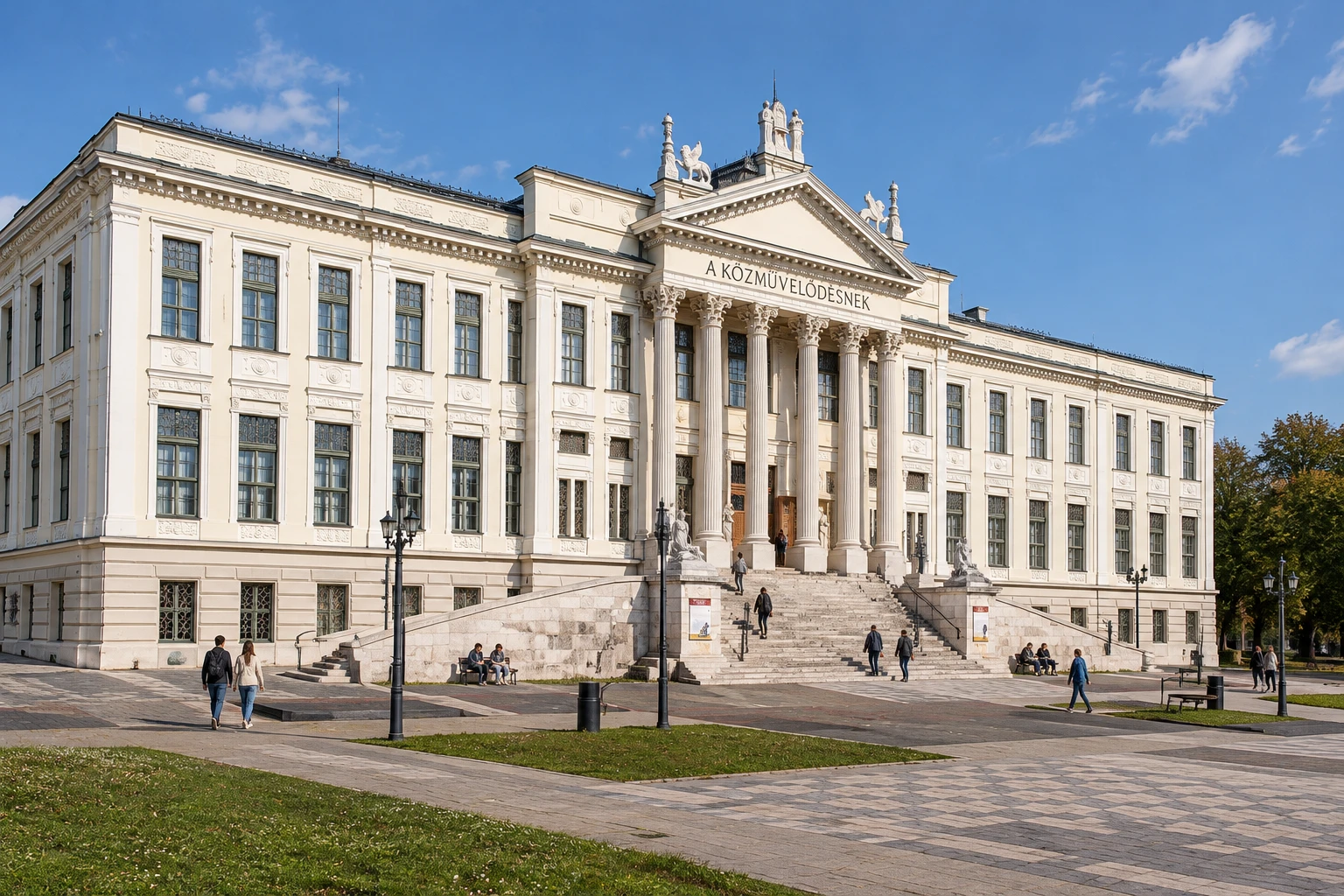
The Palace of Public Culture of 1896 is the most striking building from Szeged’s construction boom for Hungary’s millennium. The pale neoclassical building faces the Tisza, with Corinthian columns supporting a pediment above the entrance. Built for the city library and museum, it bears the name of Ferenc Móra, a writer and journalist who directed it from 1917 to 1934, conducted ethnographic fieldwork and excavated local archaeological sites. The museum displays ethnography, natural history and fine art from Szeged and the surrounding area, alongside major temporary exhibitions. A separate ticket gives access to the rooftop lookout.
Móra Park, in front of the steps, has a fountain and statues of two former directors, Móra and István Tömörkény.
Behind the museum are the remains of Szeged Castle. Built in the second half of the 13th century, it was the largest brick fortress on the Great Plain and the setting of the Peace of Szeged in 1444. It became a prison after the Turkish occupation. Following the flood, residents demolished it to reuse its bricks in reconstruction. The surviving section of the Maria Theresa Gate now houses the Castle Museum, with an exhibition on the fortress, witch trials, highwaymen and the great flood. The courtyard displays carved Romanesque, Gothic, Renaissance and Baroque stones. Its floor shows the city’s level before the ground was raised. The Kass Gallery is next door.
A few blocks away on the corner of Somogyi utca, the Black House of 1857 is an English Romantic building that served as a trading house and casino. Its name recalls its once-dark exterior. It houses the museum’s history exhibitions. All four corners of this intersection survived the flood.
Stops: Móra Ferenc Museum (Móra Ferenc Múzeum), Museum observation deck, Móra Park, Castle Museum (Vármúzeum), Kass Gallery, Black House (Fekete Ház).
Includes: Admission is charged. You can buy tickets for individual sites or a combined ticket for the museum, the Castle Museum and the Black House. Check current rates.
Tip: The museum houses usually open daily, with shorter hours on event days and closures for a few days around Christmas and New Year’s. They’re a good choice in rainy weather or intense heat.
Best time: Year-round.
The Tisza riverfront and Újszeged, from the bridge to Erzsébet liget and the river beaches
From Belvárosi Bridge, beside the Ferenc Móra Museum On foot or by bike 2 to 4 hours Afternoon Easy
The Tisza is Hungary’s longest river. It rises in the eastern Carpathians and joins the Danube in Serbia. Straightening its course in the 19th century made it navigable and drained the floodplain for farming. The water also flowed faster, and the 1879 flood became the greatest tragedy in Szeged’s history. The city’s rings and avenues date from the reconstruction.
Cross Belvárosi Bridge for views of the city center on one side and the trees of Újszeged on the other. Just beyond the bridge is Erzsébet liget, the city’s largest park at 15 hectares. The land lay wild until 1858, when an imperial officer and his soldiers made it into a garden. Large plane trees line the main axis, and old lindens, oaks and maples dot the lawns. There is a running track, exercise equipment, the smaller stage of the Open-Air Festival and, near the bridge, the neo-Gothic Church of St. Elizabeth.
The river beaches are on the Újszeged bank. Lapos has changing rooms, showers, loungers, beach volleyball courts and a café. Swim within the buoys under lifeguard supervision. Next door, Partfürdő combines a beach and campground. Farther upstream near the mouth of the Maros, Sárga beach has a marked swimming area, changing rooms and a bar. The Holt-Maros, a former arm of the Maros cut off in 1860, runs through the neighborhood, with more than 4 kilometers of reed-lined banks.
In season, sightseeing boats usually depart from the quay below Roosevelt tér to show you the city from the water and take you to the mouth of the Maros. On the downtown bank, Felső Tisza-part has kayak, canoe and board rentals.
Stops: Tisza River, Belvárosi Bridge, Erzsébet liget, St. Elizabeth’s Church, Lapos Beach, Partfürdő, Holt-Maros, Sárga Beach.
Includes: Self-guided outing. The park and Sárga Beach are free. Loungers, sightseeing boats, and kayak rentals cost extra.
Tip: The beaches operate in summer, depending on weather and river levels. Swim only within the marked areas. Sightseeing boats run seasonally. Check departures before relying on them.
Best time: May to September for the river. The park and bridge are worth seeing year-round, and the plane trees turn color in fall.


 Brazil
 Antarctica
 Argentina
 Bolivia
 Chile
 Colombia
 Ecuador
 Falkland Islands (Malvinas)
 French Guiana
 Guyana
 Paraguay
 Peru
 Suriname
 Uruguay
 Venezuela
 Austria
 Belgium
 Croatia
 Denmark
 Finland
 France
 Germany
 Greece
 Iceland
 Ireland
 Italy
 Luxembourg
 Norway
 Poland
 Portugal
 Slovakia
 Slovenia
 Spain
 Sweden
 Switzerland
 the Czech Republic
 the Netherlands
 the United Kingdom
 Turkey
 Bermuda
 Canada
 Greenland
 Mexico
 Saint Pierre and Miquelon
 the United States
 the Dominican Republic
 Japan
 Egypt
 South Africa
 Australia
 Fiji
 New Zealand
 Papua New Guinea