Pécs · Hungary · Cathedral
Cathedral of Saints Peter and Paul, Pécs
Four-towered cathedral in Pécs’s historic core, with a Neo-Romanesque exterior and religious interiors.

 Search
 Brazil
 Antarctica
 Argentina
 Bolivia
 Chile
 Colombia
 Ecuador
 Falkland Islands (Malvinas)
 French Guiana
 Guyana
 Paraguay
 Peru
 Suriname
 Uruguay
 Venezuela
 Austria
 Belgium
 Croatia
 Denmark
 Finland
 France
 Germany
 GreeceHungary
 Iceland
 Ireland
 Italy
 Luxembourg
 Norway
 Poland
 Portugal
 Slovakia
 Slovenia
 Spain
 Sweden
 Switzerland
 the Czech Republic
 the Netherlands
 the United Kingdom
 Turkey
 Bermuda
 Canada
 Greenland
 Mexico
 Saint Pierre and Miquelon
 the United States
 the Dominican Republic
 JapanTurkey
 Egypt
 South Africa
 Australia
 Fiji
 New Zealand
 Papua New Guinea
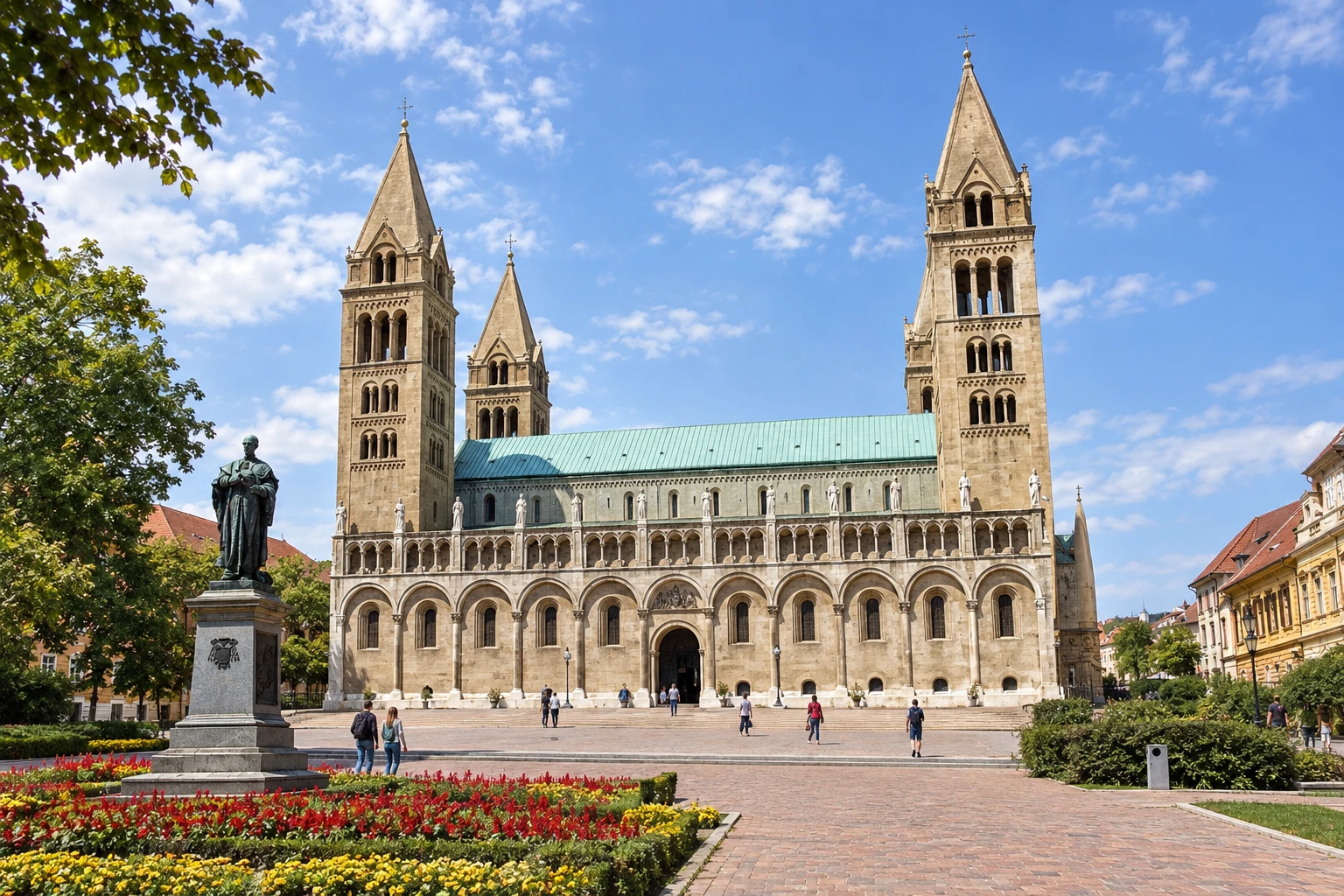
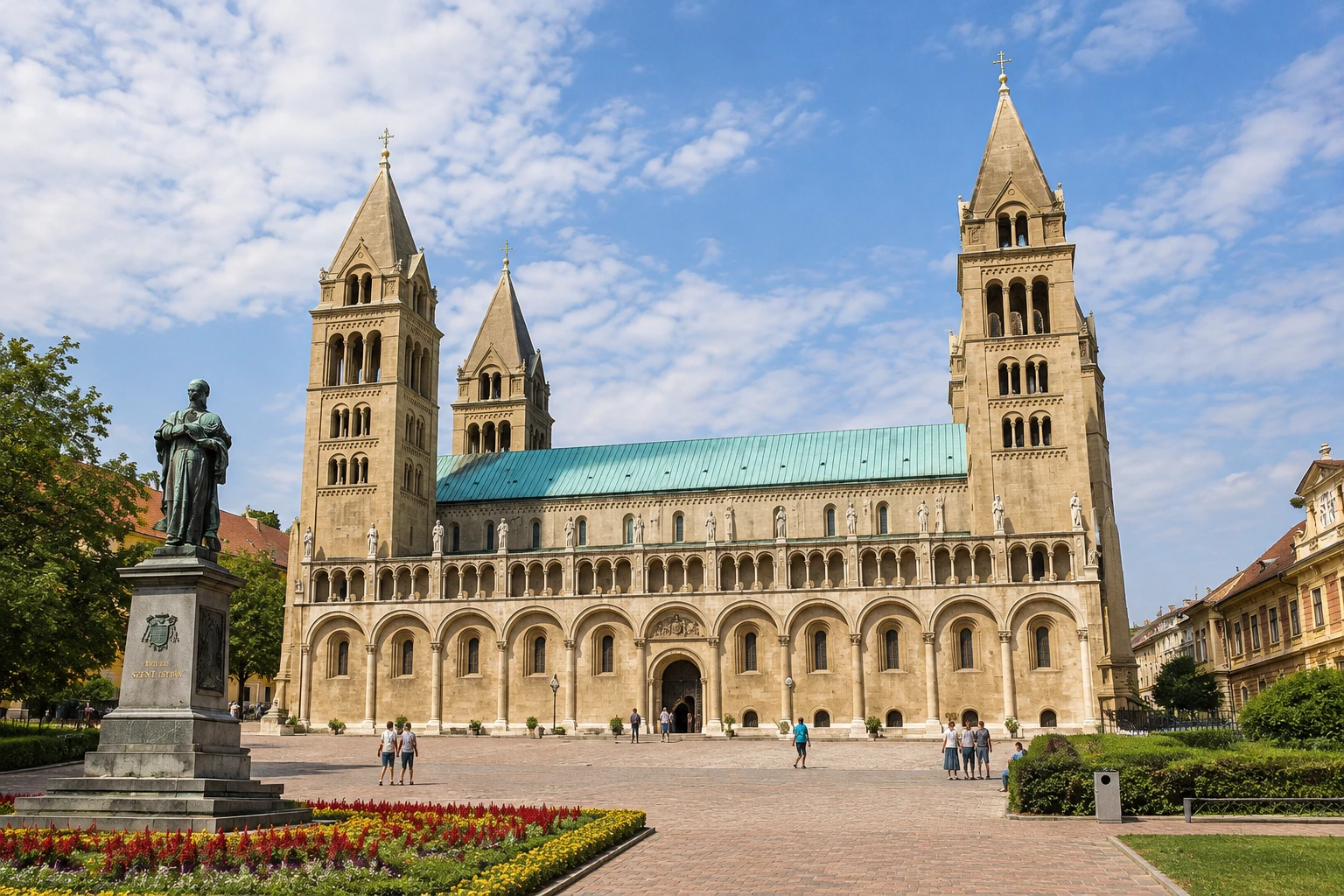
In the photo: Szent Péter és Szent Pál Székesegyház
Illustrative images. The pictures in this guide are illustrations based on the real place, not photographs, and may differ from it.

The city
Pécs brings together the early-Christian necropolis of Sopianae, the four-towered cathedral and the old mosque on Széchenyi Square. The Zsolnay Cultural Quarter adds industrial heritage and ceramic collections. As the seat of Baranya, it is possible to combine these layers in two days.
Pécs is the main city of southern Hungary and the seat of Baranya County. It lies at the foot of the southern Mecsek slopes, around 240 kilometers from Budapest. The sheltered location lends it a Mediterranean air, with figs, almonds and pomegranates growing in hillside gardens. As European Capital of Culture in 2010, it renovated the main square, museums and former Zsolnay factory complex.
Few Central European cities reveal so many layers within such a short walk. Beneath downtown lies Sopianae, the Roman city that served as administrative center of the province of Valeria in the fourth century. Its early Christian cemetery, with painted burial chambers, joined the World Heritage List in 2000. Above it rose the bishopric founded by King St. Stephen in 1009 and its four-towered cathedral. A university was founded here in 1367. The Ottoman occupation lasted until 1686, leaving two mosques, a pilgrimage tomb and the ruins of a bath. The Mosque of Pasha Gázi Kászim, now a Catholic church in the middle of Széchenyi Square, is the symbol of Pécs. In the 19th century the Zsolnay family established its ceramics factory, whose tiles, roof tiles and metallic-glazed fountains adorn the city’s buildings.
Think of the city in four areas. The historic center between Széchenyi Square and the cathedral is entirely walkable. The square, Káptalan utca or Museum Street, the necropolis and Dóm tér are a few minutes apart. The Zsolnay Cultural Quarter, around 2 kilometers east, occupies the 5-hectare former factory site with ceramics exhibitions, a planetarium, galleries and gardens. Tettye and Havihegy, on the first slopes above downtown, have Renaissance ruins, a tufa cave and lookouts. Higher up is the Mecsek itself, with the Misina television tower at 535 meters above sea level, the zoo and forest paths.
The climate is continental, with winters a little milder than in the rest of Hungary. Temperatures average near freezing in January and 22°C in July and August, with highs near 28°C. Rain is more frequent from May through July and in September. In early July, the Zsolnay Light Festival fills downtown for four nights.
Highlights include Széchenyi Square and the mosque, the cathedral and its tower climb, the painted chambers of the early Christian necropolis, the Csontváry Museum and at least half a day in the Zsolnay Quarter. With more time, climb to Tettye and the Misina tower for views over the city.
30 places to stay in Pécs.
30 places to eat in Pécs.
Hotéis e restaurantes da cidade no mapa.
The local experience
Four-towered cathedral in Pécs’s historic core, with a Neo-Romanesque exterior and religious interiors.
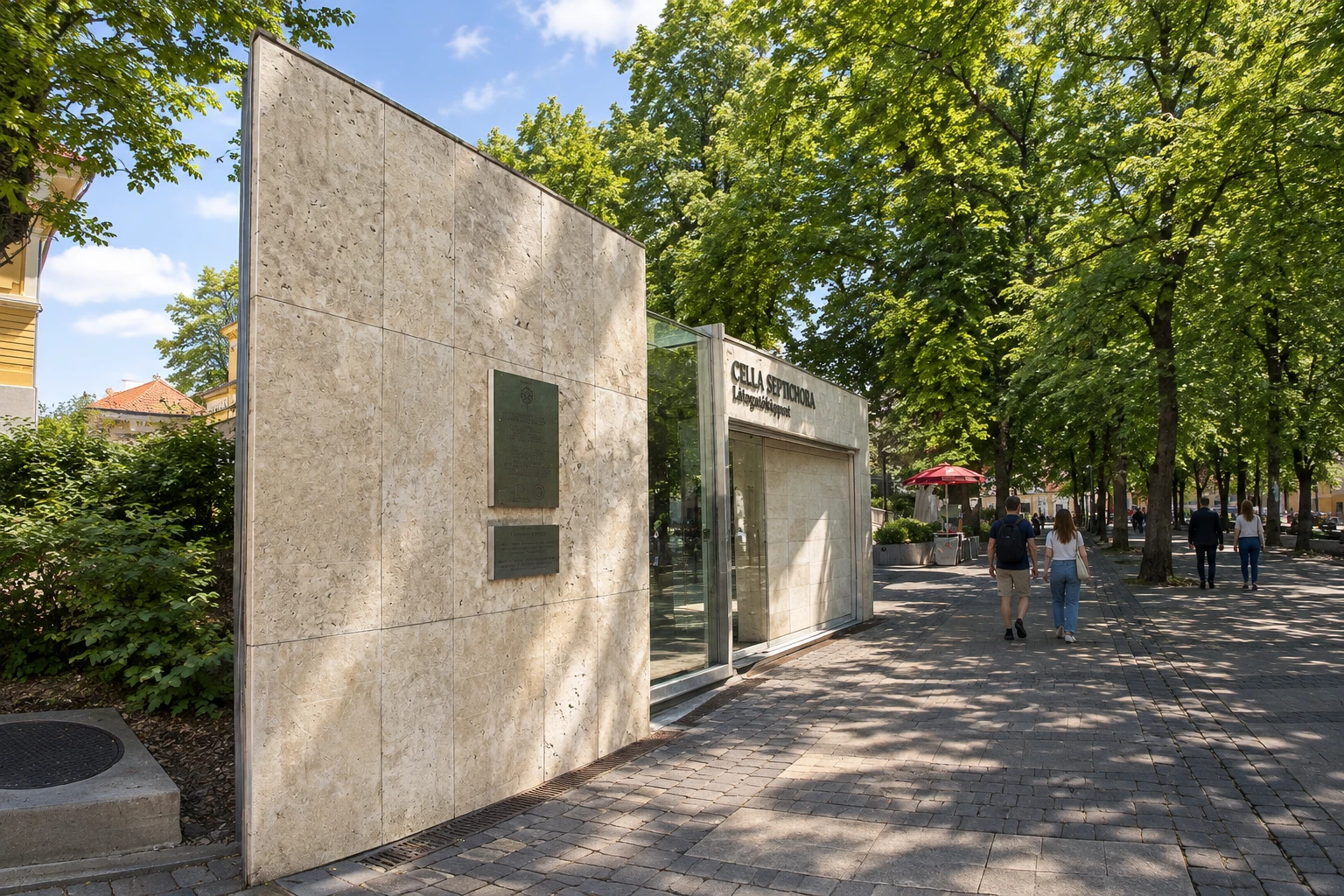
Visitor center of the Paleochristian necropolis of Sopianae, with Roman-period funerary structures beneath the center of Pécs.
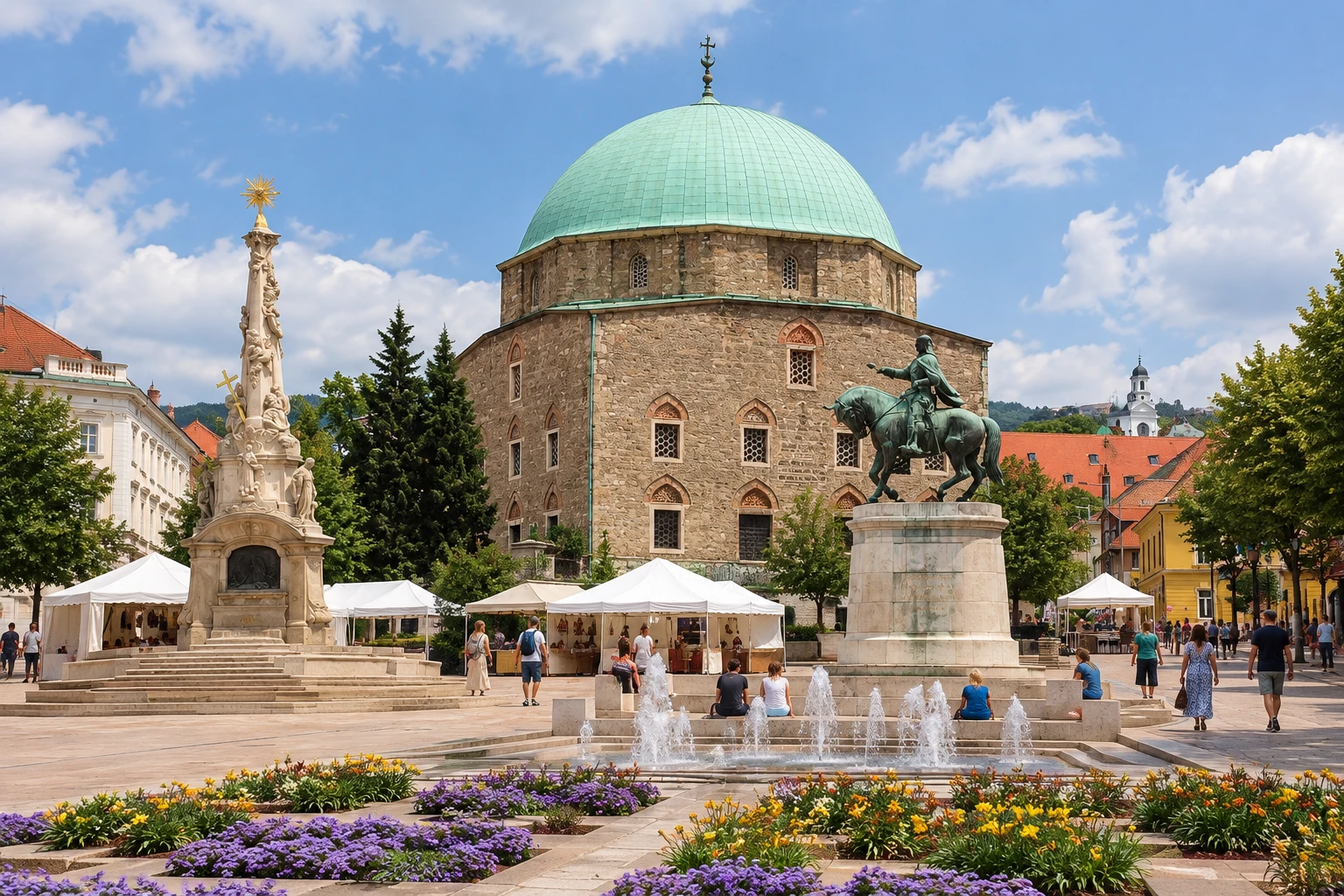
Former Ottoman mosque in Széchenyi Square, incorporated into a Catholic church and recognizable by its dome.
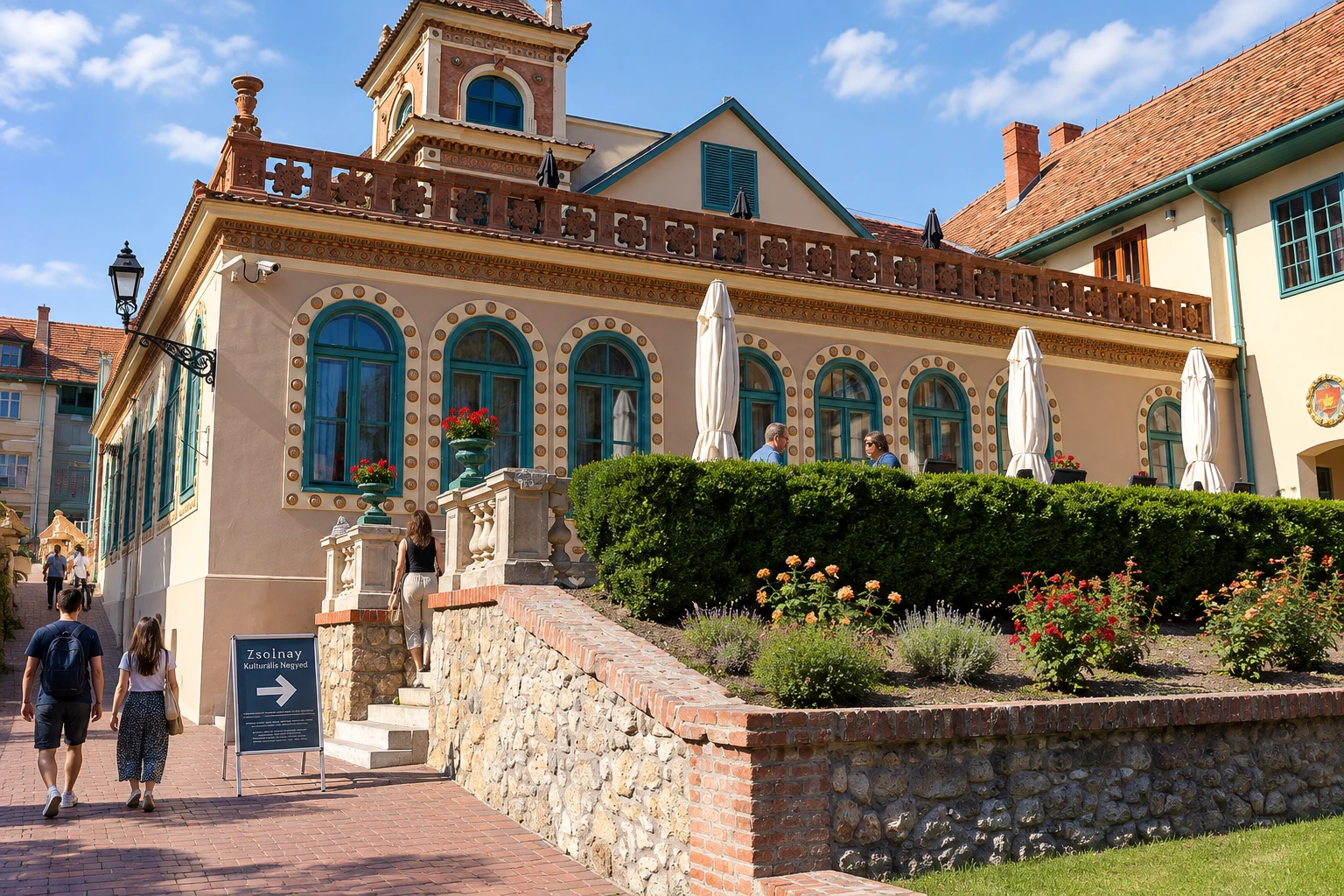
Former Zsolnay manufactory complex converted into a cultural quarter, with historic buildings, gardens, and ceramic collections.
To choose before you go
Where each tour starts, how long it takes, how it is done, what is included and the price range.
Pécs’s main square is broad, sloping and traffic-free. The new paving and pedestrianization date to its year as European Capital of Culture in 2010. Water runs along steps down the slope. On hot days the square is quiet in the afternoon and fills with young people at night. At the upper end stands the Mosque of Pasha Gázi Kászim, now the Catholic parish church of Candlemas. It is Hungary’s most important monument of Turkish-Islamic architecture. Greenish light enters through pointed ogee-arched windows. Inside, the mihrab, the prayer niche facing Mecca, and passages of Quranic calligraphy share the walls with the Catholic altar and images. Near the sacristies are ablution basins from the pasha’s former bath. Animations and interactive features show how the building looked in different periods. Beside it, the St. Bartholomew bell tower is a 21st-century moving sculpture. Three bells on columns rise from underground. Also on the square are the equestrian statue of János Hunyadi, a favorite meeting place, the Megyeháza or county hall decorated with Zsolnay tiles and ceramics, and the eclectic City Hall. At the lower end, in front of the church of the Brothers of Mercy, stands the Zsolnay fountain, Miklós Zsolnay’s gift to the city in memory of his father Vilmos. Made at the factory in 1912 and installed in 1930, it stands four meters high, with a pyrogranite body and yellow-green eosin glaze ornaments. Its ox-head spouts copy an object from the Nagyszentmiklós treasure. From late fall to early spring, a wooden cover protects the fountain.
Stops: Széchenyi tér, Gázi Kászim pasa dzsámija, Szent Bertalan harangtorony, Equestrian statue of János Hunyadi, Megyeháza, Városháza, Zsolnay-kút.
Includes: Self-guided outing. The mosque charges separate admission. Check current prices.
Tip: The mosque is an active church. Sunday visits start in the afternoon, and Mass takes place throughout the week. Check ahead.
Best time: Year-round. The Zsolnay Fountain is uncovered from April to October.
Dóm tér is the seat of the bishopric founded by King St. Stephen in 1009. A two-towered, three-aisled Romanesque basilica dates to the 11th century, with the crypt and four towers added in the 12th. The cathedral’s present form comes from a major 19th-century remodeling. When it was consecrated in 1891 in the presence of Emperor Franz Joseph, Budapest newspapers wrote that anyone wishing to see heaven should go to Pécs. Inside, a triumphal arch divides the space, and a canopy shelters the high altar. The four-manual, 6,101-pipe organ came from the old Angster factory in Pécs. The chapels have murals by Károly Lotz and Bertalan Székely. The 12th-century five-aisled crypt with groin vaults holds the tomb of Janus Pannonius, bishop of Pécs and humanist poet. The southeastern tower overlooks the entire city. Admission includes the nave, crypt, Sacred Heart Chapel and tower. The twelve apostles on the facade are the third set of statues made for the site. Károly Antal sculpted them, and they were consecrated in 1963. Two obelisks in the square bear the arms of Bishop Nándor Dulánszky. West of the cathedral, the Bishop’s Palace dates to the 12th century and has a 19th-century neo-Renaissance facade. A balcony statue of Franz Liszt recalls the composer’s concert in Pécs. Guided tours show studies and reception rooms from several periods and the tunnel linking the garden to the cellar, used as a discreet passage when the bishop’s residence was bugged. Nearby, the Episcopal Treasury displays paintings, metalwork and Roman coins from the bishopric’s collection. The lapidarium holds stone sculptures from the medieval cathedral. To the west, the barbican was part of the bishops’ castle walls. The round gate tower with moat and drawbridge was built under Bishop György Szatmári as the city prepared for the Turkish threat. In the garden, a bronze statue of Janus Pannonius stands beside an almond tree.
Stops: Dóm tér, Szent Péter és Szent Pál Székesegyház, Püspöki Palota, Püspöki Kincstár, Dóm Kőtár, Barbakán.
Includes: Visit the cathedral independently. The Bishop's Palace and Treasury open for guided visits only. Tickets cost extra. Check current prices.
Tip: The palace and treasury have only a few timed visits each day, and the lapidarium opens by appointment. Check the program before planning your day. The cathedral opens for Sunday sightseeing after morning Mass.
Best time: Year-round. Choose a clear day for the best views from the tower.
Sopianae, Roman Pécs, stood at a trading crossroads at the foot of the Mecsek. By the end of the third century it had become the civil administrative center of Valeria province and reached its height in the fourth century. The medieval and modern city completely covered the Roman one. For a long time only the graves proved its existence. The northern cemetery around today’s Dóm tér joined the World Heritage List in 2000. What makes the site rare is the concentration of stone structures, from small family chambers to larger communal buildings. The chambers had two levels, a crypt below and a memorial chapel above where relatives held ceremonies. Some have paintings of biblical scenes and Christian symbols. The underground visitor center brings together the Cella Septichora, a large seven-apsed building, and several chambers. In the Peter and Paul chamber, discovered in 1782, the two apostles point to the Christogram, the monogram of Christ. The ceiling with vines, peacocks and four portraits in medallions is an outstanding example of fourth-century Christian painting. The Wine Pitcher chamber takes its name from the pitcher and cup painted in a niche. A few steps away on Szent István tér, beside Sétatér, one of the country’s oldest public promenades with old chestnut and plane trees, stands the Early Christian Mausoleum, discovered in 1975. It has a chapel at ground level and a chamber below with three sarcophagi and paintings of Adam and Eve and Daniel among the lions. On Apáca utca a courtyard preserves another group of tombs accessible on accompanied visits at scheduled times in summer. Near the cathedral are the remains of the university founded in 1367 by a bull of Pope Urban V at the request of King Louis the Great. Modeled on Padua, it operated for a few decades with the bishop as chancellor. Visits are guided only.
Stops: Cella Septichora Látogatóközpont, Peter and Paul Burial Chamber, Wine Pitcher Burial Chamber, Ókeresztény Mauzóleum, Sétatér, Apáca utca, Középkori Egyetem.
Includes: Sites charge admission, with individual or combined tickets. Check current prices. Guided tours in English run on certain days.
Tip: The visitor center and mausoleum usually close on Mondays. Tickets for the medieval university and Apáca utca courtyard are sold at the Cella Septichora ticket office. Check ahead.
Best time: Year-round. The underground route is a good option on rainy or hot days.
Between the cathedral and Széchenyi Square, Káptalan utca and neighboring streets are home to the art museums of the Janus Pannonius Museum. The Csontváry Museum is dedicated to Tivadar Csontváry Kosztka (1853–1919), the great solitary figure of Hungarian painting. Its monumental early 20th-century canvases include Baalbek, described as the world’s largest painting made outdoors, Mary’s Well in Nazareth, the entrance to the Western Wall in Jerusalem, the Great Tarpatak waterfall in the Tatras and The Lonely Cedar, interpreted as a metaphorical self-portrait. The Zsolnay Museum occupies the city’s oldest known residential house. Exhibits trace architectural ceramics and pieces the factory took to world fairs, such as the Duck Fountain. Upstairs are decorative ceramics and Vilmos Zsolnay’s two inventions, porcelain faience and the eosin technique, as well as family furniture, portraits and keepsakes. Opposite, the Vasarely Museum presents Victor Vasarely, born in Pécs in 1906 and a founder of Op Art. He emigrated young to France and is represented across his career, from advertising posters to large optical paintings and tapestries. There are also works by his wife Claire and son Yvaral. The Modern Hungarian Gallery on Papnövelde utca surveys a century of Hungarian art, including Károly Ferenczy, József Rippl-Rónai, Lajos Gulácsy, the Group of Eight and artists associated with Pécs in the second half of the 20th century.
Stops: Csontváry Múzeum, Zsolnay Múzeum, Vasarely Múzeum, Modern Magyar Képtár, Káptalan utca.
Includes: Each museum charges admission. A 72-hour ticket covers all Janus Pannonius Museum exhibitions. Check current prices.
Tip: The museums close Mondays. If time is short, visit the Csontváry and one other. For more than two museums, the 72-hour ticket usually offers good value.
Best time: Year-round.
The Ottoman occupation left Pécs a rare group of monuments. In addition to the mosque on Széchenyi Square, three sites lie west of the center. On Ferencesek utcája are the ruins of Memi Pasha’s bath, demolished only around 1880. Excavations uncovered the heated floor, massage benches and fountain in the entrance hall. Turkish traveler Evliya Çelebi praised the bath and its attendants when he visited between 1660 and 1664. The open-air ruins stand opposite the Franciscan church. The medieval friary was destroyed during the occupation and part of it became Memi Pasha’s mosque. Construction of the present church began in 1715, incorporating remains of the earlier church in its walls. During Advent it displays a Nativity scene with life-size wooden figures. The Mosque of Pasha Jakováli Hasszán is the country’s best-preserved mosque with a minaret. Built in the 16th century, it has a square plan, octagonal dome and 23-meter minaret. It became a Christian chapel in the early 18th century. Restoration began in 1955, and in 1975 a Muslim prayer space was furnished with a gift from the Turkish government. Inside, look for the mihrab with its stalactite vault, botanical paintings, Quranic quotations and clay pots embedded in the dome and walls with their mouths facing out to improve acoustics. Higher on Rókus hill, in a former Ottoman cemetery, is the tomb of Idrisz Baba, dating to 1592. The octagonal domed building stands over the rock-cut grave of a man venerated as a saint and regarded as a healer and seer. For centuries residents knew it as the Chapel of St. Roch. Together with Gül Baba’s tomb in Budapest, it is one of two such tombs in Hungary and a Muslim pilgrimage site.
Stops: Memi pasa fürdője, Ferences templom, Jakováli Hasszán pasa dzsámija, Idrisz baba türbéje.
Includes: Self-guided visit. A separate ticket for the Mosque of Jakováli Hasszán also covers the tomb of Idrisz Baba.
Tip: The Mosque of Jakováli Hasszán closes Mondays. The tomb opens Wednesday through Sunday from April to September and by phone appointment the rest of the year. Check ahead.
Best time: April to September, when the tomb of Idrisz Baba is open
The Zsolnay family lived and worked here in the 19th and 20th centuries. The story began in 1853 when merchant Miklós Zsolnay bought a small earthenware workshop for his eldest son. His other son, Vilmos, expanded it. Its first success came at the 1873 Vienna World’s Fair. Paris brought international acclaim in 1900 for eosin, the metallic glaze whose name comes from the Greek word for dawn. The restored 5-hectare factory grounds became a cultural quarter, designated a hungarikum in 2014. Its courtyards and gardens feature 15 protected historic buildings and 88 Zsolnay sculptures alongside galleries, a concert hall, puppet theater, craft shops and cafés. The grounds are free to explore. Exhibitions and attractions charge admission. There are three ceramics exhibitions. The Golden Age of Zsolnay displays the collection László Gyugyi assembled in the United States and returned to the city, around 600 pieces from 1870 to 1910 spanning Historicism to Art Nouveau. The Pink Exhibition has more than a thousand handmade everyday objects from the factory’s early years. The family and factory exhibition occupies the oldest building on the site. A glass wall in the demonstration workshop lets you watch ceramicists at work. For children, the Labor interactive science center offers hands-on experiments in the former factory laboratory. The planetarium has an 8-meter dome and 50 seats. On a small hill nearby stands the Zsolnay Mausoleum, commissioned by Vilmos’s son after his death in 1900 on the spot where the founder liked to look over the factory. The neo-Romanesque building has a pyrogranite facade, a dark-green tiled dome, a chapel lined with colorful tiles and an eosin sarcophagus in the crypt. Forty-two lions guard the site.
Stops: Zsolnay Kulturális Negyed, The Golden Age of Zsolnay (Gyugyi Collection), Rózsaszín Zsolnay Kiállítás, Zsolnay Család- és Gyártörténeti Kiállítás, Zsolnay Látványmanufaktúra, Zsolnay Mauzóleum, Planetárium, Labor.
Includes: The grounds are free. Exhibitions, the mausoleum, planetarium, and Labor charge separate admission. Check current prices.
Tip: Several exhibitions, Labor, and the mausoleum open only Thursday through Sunday. The planetarium operates at set showtimes. Check ahead. The quarter itself recommends allowing a full day.
Best time: Year-round. Everything is open Thursday through Sunday.
Pécs Synagogue was built in 1868–1869 to a Romantic design by architects Frigyes Feszl, Károly Gerster and Lipót Kauser. It is western Hungary’s largest synagogue. Jews lived in the city before the Ottoman occupation, but their return after the Turks left was slow. In 1692 the mostly German residents swore to admit only Catholics. Nevertheless, the community grew, bought a cemetery, opened a prayer house and school and eventually built the great synagogue. The project owed much to community president Adolf Engel, who began as a peddler and was later ennobled by Emperor Franz Joseph. The main facade has three sections. A Hebrew biblical inscription in the center reads “A house of prayer for all peoples,” and above are the Tablets of the Law bearing the numbers of the Ten Commandments. The interior has three aisles and an upper gallery. Until the ghetto opened in May 1944, women sat in the gallery and men on the ground floor. The organ has industrial as well as musical significance. It was the first work of József Angster’s newly founded local factory, which later built the cathedral organ. Completed in 1869, it has two manuals, 24 stops and 1,534 pipes. The community, once numbering 4,000, lost most of its members in World War II. Now reduced to a few hundred, it more often uses the smaller prayer room, and the galleries are no longer occupied.
Stops: Pécsi Zsinagóga, Angster organ.
Includes: Self-guided visit with separate admission. Check current prices.
Tip: The synagogue is an active place of worship with specific visiting days and seasons. Check ahead.
Best time: Year-round on opening days
Tettye is the gateway to the central Mecsek, a plateau at 253 meters surrounded by hills on three sides, with the city below to the south. The 4.5-hectare park occupies a former quarry possibly used in Roman times. On the south side are the ruins of the summer palace Bishop György Szatmári commissioned between 1505 and 1520 in his hunting park. The U-shaped Renaissance villa had an upper story and a courtyard opening south. Under the Turks it served as a dervish lodge. The place name comes from the Turkish word for such a lodge. An explosion in 1714 completed its ruin. In summer the ruins become an open-air theater stage. Just below lies a rare tufa cave. Water from the Tettye spring carved cavities in a tufa deposit about ten thousand years old. Residents enlarged the passages and even lived in them. In the early 20th century the attraction was called the Gate of Hell, with a dragon to frighten visitors. Now reopened, it has an exhibition with sound and film. Next door, Pintér Garden is a protected arboretum at the foot of the Mecsek, begun in the 1920s by a retired banker. Native vegetation grows alongside introduced plants including one of Central Europe’s largest Arizona cypresses, laurels, figs, pomegranates and Judas trees. Peonies bloom in May. A paved walk links the park with the Chapel of Our Lady of the Snows on Havihegy at 230 meters. The simple Baroque chapel commemorates the plague of 1690 and was built with materials carried uphill by residents. It is visible from much of the city, and its forecourt overlooks the entire center.
Stops: Tettye, Ruins of the bishop’s summer palace, Tettyei Mésztufa-barlang, Pintér-kert Arborétum, Havihegyi kápolna.
Includes: Self-guided outing. The park and chapel are free. The cave and arboretum charge separately.
Tip: Bus 33 leaves the train station and stops at Tettye tér. Wear sturdy shoes for the hills between Tettye and Havihegy.
Best time: April to October, especially May for the peonies in Pintér Garden
The Mecsek begins at the edge of town. Walk uphill from downtown through the Mecsek-kapu, a stone arcaded gateway built in 1936 to mark the symbolic boundary between Pécs and the hills. The road climbs in hairpin bends beyond it. On top of Misina at 535 meters above sea level, the concrete television tower rises nearly 200 meters, Hungary’s tallest building. Built between 1968 and 1973, it replaced a lookout from 1908. On a clear day the panoramic terrace offers views of the Mecsek ridges as far as the Danube. To the south, the mosque and cathedral look the size of matchboxes. On the slope in a protected area, Pécs Zoo was built in 1960 by volunteer workers and students. It covers 4 hectares with more than a thousand animals of nearly 250 species, an aquarium and terrarium, and public feeding sessions. Next door is the departure point for the Mecsek narrow-gauge railway, opened in 1962. At 570 meters, with just two stops, the zoo and Dömörkapu, it is the country’s shortest railway. Farther out in Árpádtető, Mecsextrém Park is a forest adventure park with treetop ropes courses, a rail toboggan run with 25 carts, an eight-meter climbing wall, a pine maze and an indoor area for small children. It can fill a whole day with children.
Stops: TV-torony (Misina-tető), Pécsi Állatkert, Mecseki Kisvasút, Dömörkapu, Mecsek-kapu, Mecsextrém Park.
Includes: Self-guided outing. The tower terrace, zoo, miniature train, and adventure park cost extra. Check current prices.
Tip: Buses 35 and 35Y run from the station and covered market to the summit of Misina. Choose a clear day for the tower, as a band of haze often hangs over the city.
Best time: April to October. Come in fall for the forest colors.
Day by day
Suggestions to plan the trip. Change the order of the days according to the weather and tour availability.
Start in Széchenyi Square. Enter the Mosque of Gázi Kászim to see the mihrab and calligraphy alongside the Catholic altar, then walk down the square to the Zsolnay fountain. Follow Káptalan utca uphill and choose a museum, Csontváry for its monumental canvases or Zsolnay for ceramics. Continue to Dóm tér and visit the cathedral, including the crypt and southeastern tower climb. Have lunch downtown. In the afternoon, descend to the Cella Septichora visitor center for the painted fourth-century burial chambers and continue a few steps to the Early Christian Mausoleum on Sétatér. Pass the barbican with its statue of Janus Pannonius. Toward evening, walk past the ruins of Memi Pasha’s bath to the Mosque of Jakováli Hasszán and its minaret. If there is still daylight, take the bus up to Tettye for a view over town.
Spend the morning on Széchenyi Square at the Mosque of Gázi Kászim, then head to Dóm tér for the cathedral, crypt and tower. If a guided tour fits your schedule, include the Bishop’s Palace and its tunnel. After lunch, explore the early Christian necropolis at the Cella Septichora visitor center and mausoleum. Follow with one or two Káptalan utca museums, starting with Csontváry. In late afternoon, follow the Ottoman route west of downtown through Memi Pasha’s bath, the Mosque of Jakováli Hasszán and, if open, the tomb of Idrisz Baba.
Walk or take a bus to the Zsolnay Cultural Quarter in the morning. See the Gyugyi collection, Pink Exhibition and demonstration workshop. Explore the sculpture courtyards and climb to the lion-guarded mausoleum. With children, include Labor or a planetarium show. Have lunch in the quarter. Back downtown, visit the synagogue if open. In the late afternoon, take the bus up to Tettye for the summer palace ruins, tufa cave and path to the Havihegy chapel overlooking the entire center.
Visit Széchenyi Square and the Mosque of Pasha Gazi Kasim, the cathedral and its tower, the Bishop’s Palace if tours are available, the early Christian necropolis and the barbican. In the afternoon, visit the Csontváry Museum and follow the Ottoman route west of downtown, including the Mosque of Pasha Yakovali Hassan.
Spend the morning and lunch in the Zsolnay Cultural Quarter, with ceramic exhibitions, a demonstration workshop, the mausoleum and, for children, Labor and the planetarium. Back downtown in the afternoon, visit the Zsolnay and Vasarely museums on Káptalan utca and the synagogue.
To stay within the municipality, head up to the Misina tower in the morning for the panoramic terrace, then descend to the zoo and little train. Spend the afternoon in Tettye with the tufa cave, Pintér Garden and Havihegy chapel. For a trip outside the city, four nearby towns each suit a day or half day. Villány to the southeast is the red wine region’s capital, with cellars open year-round. Harkány to the south is a spa town known for medicinal water discovered in 1823. Orfű in the northwestern hills has lakes for swimming, rowing and fishing, a mill museum and a direct bus from Pécs bus station. To the northeast, Pécsvárad has the monastery-castle founded by St. Stephen in 998, also reachable by direct bus.
Best time to go
The seasons shown are the most usual ones; nature doesn't always follow the calendar.
Winter · Coldest and driest month
The coldest month. The 1991–2020 normals show an average of 0.4°C, highs near 3.5°C, lows near -2°C and about 31 mm of precipitation, the lowest annual monthly total, sometimes as snow. The city is quiet. Visit the cathedral, Káptalan utca museums and underground necropolis. A wooden cover protects the Zsolnay fountain, and several Zsolnay Quarter venues open only Thursday through Sunday. Bring a heavy coat.
Winter
It stays cold, averaging 2.1°C, with highs near 6°C, lows just below freezing and around 37 mm of precipitation. The days begin to lengthen. It is a good month for museums and the early Christian necropolis, with few visitors. The tomb of Idrisz Baba opens only by appointment, and Mecsek lookouts need clear skies.
Early spring · Windiest month
The average is 6.6 °C, with highs near 11.5 °C, lows near 2 °C and about 34 mm of rain. This is the windiest month. A coat is enough for downtown walks, and the climb to Tettye and Havihegy is pleasant in the sunshine.
Spring · Easter when it falls this month · Summer hours at monuments
Spring averages 11.9°C, with highs near 17°C, lows near 7°C and about 44 mm of rain. Monuments switch to summer hours, the tomb of Idrisz Baba reopens without appointments and terraces fill on Széchenyi Square and downtown streets. Bring a layer for mornings and evenings.
Spring · Peonies in Pintér Garden
Mild days average 16.4°C, with highs near 22°C and lows near 11°C. It is one of the wettest months, with about 81 mm in showers. Peonies bloom in Pintér Garden at Tettye and the Mecsek is green. The Bishop’s Palace offers more guided tours each day. Carry a raincoat and save museums for downpours.
Early summer · Wettest month
Early summer averages 20.2°C, with highs near 26°C, lows near 15°C and about 83 mm of rain, the largest monthly total, generally in late-afternoon storms. Days are long and the Tettye ruins host open-air theater in summer. Walk in the morning and leave the necropolis and museums for the afternoon.
Summer · Zsolnay Light Festival (early July)
The warmest month averages 22.0°C, with highs near 28°C, lows near 16.5°C and about 70 mm of rain in showers. In early July, the Zsolnay Light Festival fills the historic center and Zsolnay Quarter with projections and light installations for four nights. Accommodations are in demand. On hot days, head up to the Mecsek for forest shade.
Summer
As hot as July, averaging 22.0°C, with highs near 28°C and about 64 mm of rain. Széchenyi Square empties in the afternoon and fills at night. Combine a morning downtown with the zoo, Mecsek railway or adventure park in the afternoon. The burial courtyard on Apáca utca usually offers summer visits.
Late summer · Rainy month
Days are still warm, averaging 16.9 °C, with highs near 22 °C and lows near 12 °C. Rainfall rises again to about 72 mm. This is the last month of summer hours at the Tomb of Idris Baba and the Bishop’s Palace.
Fall · Fall colors in the Mecsek Hills
Fall averages 11.7°C, with highs near 17°C, lows near 7.5°C and around 57 mm of rain. The Mecsek forest turns color. On clear days, enjoy the views from the Misina tower and Havihegy chapel. The necropolis monuments keep summer hours through the end of the month. Bring a coat for evenings.
Late fall · Start of Advent
The weather cools to an average of 6.1°C, with highs near 10°C, lows near 3°C, about 52 mm of rain and fog. Monuments switch to winter hours and close earlier. Advent events begin late in the month with concerts and guided walks. The Zsolnay fountain is covered again for the cold.
Advent · Nativity scene at the Franciscan church
Winter averages 1.2°C, with highs near 4°C, lows near -1°C and around 48 mm of precipitation. During Advent the Franciscan church sets up a Nativity scene with life-size wooden figures, and churches and Kodály Hall host concerts. Zsolnay Quarter exhibitions close December 24, 25 and 26 and January 1. The park remains open. Check holiday hours.
Plan the journey
Pécs has a small airport, Pécs-Pogány, used mainly by small charter aircraft. Do not count on scheduled flights there.
The practical gateway is Budapest International Airport, about 240 kilometers away. Continue overland by car on the highway, about two hours from the capital, or by train from a Budapest station.
If traveling through southern Central Europe, you can also arrive overland from Croatia. Route 6 crosses Pécs and continues to the border at Barcs, and Route 58 leads south to Drávaszabolcs.
Pécs connects to Budapest by rail via Pusztaszabolcs, with direct trains to Mohács and Nagykanizsa. Check timetables and tickets through the Hungarian railway system.
The main station, Főpályaudvar, lies south of the center. Ferenc Pfaff designed the Renaissance-inspired eclectic building of 1900. Reliefs of James Watt and George Stephenson were made at the Zsolnay factory.
City buses leave the station for visitor attractions. Routes 4 and 4Y stop near the Árkád shopping center, a 500-meter uphill walk to Széchenyi Square. Route 44 stops on Szent István tér beside the cathedral and necropolis, 33 climbs to Tettye, and 35 and 35Y reach the summit of Misina.
The M6 highway, continuing as the M60, connects Budapest to Pécs in about two hours. Route 6 crosses town east to west. Route 57 goes to Mohács, Route 58 to Drávaszabolcs and Route 66 to Kaposvár.
The historic center has narrow streets and pedestrian areas. Széchenyi Square is closed to traffic. Driving onto Szent István tér or Apáca utca requires a permit bought in advance. The underground Kossuth Square garage serves Széchenyi Square. Paid spaces on the barbican square and neighboring streets are convenient for the cathedral and necropolis. There is also parking on Tettye tér, at the zoo and beside the Misina tower.
Explore the historic center on foot. Széchenyi Square is only a few minutes from the cathedral, with Museum Street along the way. The square and several streets slope uphill as the city rises toward the Mecsek.
City transportation is by bus. Trams stopped running in 1960. Routes leave the railway station and pass the covered market (Vásárcsarnok). Useful routes are 4 and 4Y for downtown, getting off at Árkád, and 44 for the cathedral. Take 2, 30, 34 or 36 to Kórház tér for the Mosque of Jakováli Hasszán, 33 to Tettye, 31 or 33 to Havihegy, 34 or 34Y to Dömörkapu near the zoo, and 35 or 35Y to the Misina tower.
The Zsolnay Quarter is about 2 kilometers east of Széchenyi Square. Walk or take a bus depending on your pace. Confirm route numbers and stops before boarding, as routes change.
Pécs is a natural base for Baranya County, and neighboring towns are accessible by regional bus or car.
Pécsvárad, northeast along Route 6, has direct buses from Pécs bus station. Orfű and its lakes to the northwest also have a direct bus. By car, take Route 6 and then the Magyarürög road. For Villány to the southeast, use Route 58 and the M60. Harkány to the south is accessible by road. Mohács has direct trains and Route 57.
Regional buses leave from Pécs bus station. For winery visits in Villány, use public transportation or arrange a driver.
Your questions
The inscription refers to the early-Christian necropolis of ancient Sopianae, in structures distinct from the cathedral.
Half a day allows selecting collections and walking the former industrial complex.
The historic building was adapted to Catholic use, retaining Ottoman references.
Transport and the variety of visits justify two nights or at least two days of itinerary.
One day covers the downtown highlights: the mosque on Széchenyi Square, the cathedral, the early Christian necropolis and one museum. With two days, add the Zsolnay Cultural Quarter, which takes half a day to a full day on its own, and the climb to Tettye. With three, visit the Misina tower and zoo in the Mecsek Hills or take a trip to Villány, Harkány, Orfű or Pécsvárad.
By car, take the M6 and then the M60. The drive is about 240 km and takes around two hours. By rail, take the line through Pusztaszabolcs to the main station south of downtown. From there, buses 4 and 4Y stop within 500 m of Széchenyi Square. Bus 44 stops beside the cathedral.
Yes. Pécs-Pogány is a small airport used mainly by small charter aircraft. In practice, travelers arriving by air usually fly to Budapest and continue by car or train.
Yes. Cathedral admission includes the nave, the 12th-century crypt, the Chapel of the Sacred Heart and the climb up the southeast tower overlooking the city. On Sundays, visits start after morning Masses. The Corpus Christi Chapel is open for prayer free of charge.
There are four viewpoints. Downtown, climb the southeast tower of the cathedral. On the lower slopes, a paved walk links the Tettye plateau at 253 m and the Havihegy chapel grounds at 230 m. High in the Mecsek Hills, the terrace of the Misina TV tower, at 535 m above sea level, has views reaching the Danube on a clear day. Buses 35 and 35Y run up there.
They come from the factory the Zsolnay family ran in Pécs from 1853. It became famous for eosin, a glaze with a metallic sheen, and pyrogranite, used in roof tiles and architectural ornaments. Street-level examples include the Zsolnay Fountain on Széchenyi Square and the tiles on County Hall. For collections, visit the Zsolnay Museum on Káptalan utca and the Zsolnay Cultural Quarter, with the Gyugyi Collection, the Pink Exhibition, a demonstration workshop and the family mausoleum.
There are four. The Mosque of Pasha Gazi Kasim on Széchenyi Square is now a Catholic church. The Mosque of Pasha Yakovali Hassan, with a 23 m minaret, is the country’s best preserved. The 1592 Tomb of Idris Baba is a Muslim pilgrimage site. The ruins of the Baths of Pasha Memi are outdoors opposite the Franciscan church. The ticket for the Yakovali Hassan Mosque also covers the tomb.
The Zsolnay Light Festival takes place in early July and runs for four nights. Facade projections and light installations form a trail through the historic center and the Zsolnay Quarter. It’s the most popular time of year to visit, so check the festival dates and book accommodations early.
The Zsolnay Quarter has Labor, a science center with hands-on experiments, a planetarium and a puppet theater. The Mecsek Hills have a zoo with more than 1,000 animals, a miniature train that runs 570 m from the zoo to Dömörkapu, and Mecsextrém Park with ropes courses and a rail-mounted sled ride. In Tettye, the limestone tufa cave has a sound and film exhibition.
Downtown museums including the Csontváry, Zsolnay and Vasarely museums and the Modern Hungarian Gallery close on Mondays, as do the necropolis visitor center and the Yakovali Hassan Mosque. In the Zsolnay Quarter, several exhibitions open only Thursday through Sunday. The cathedral and the mosque on Széchenyi Square open daily, with shorter hours on Sundays. Check before visiting.
Yes. Villány, the center of the red wine region, is southeast of Pécs at the foot of the Villány Hills. You can reach it by car via Route 58 and the M60. Wine cellars welcome visitors year-round. Arrange return transportation before you leave if you plan to taste wine.