Kossuth Square and the Great Reformed Church: the interior and the climb up the towers
From Kossuth Square (Kossuth tér) On foot 1 hour 30 minutes to 2 hours Morning Easy, with stairs in the towers
Kossuth Square is Debrecen’s center and meeting place. It has a group of statues honoring Lajos Kossuth, the Millennium Fountain and, underfoot, the city coat of arms in a mosaic of 180,000 pieces of Venetian glass. The pedestrian area around the square hosts street festivals and, at the end of the year, the Christmas market.
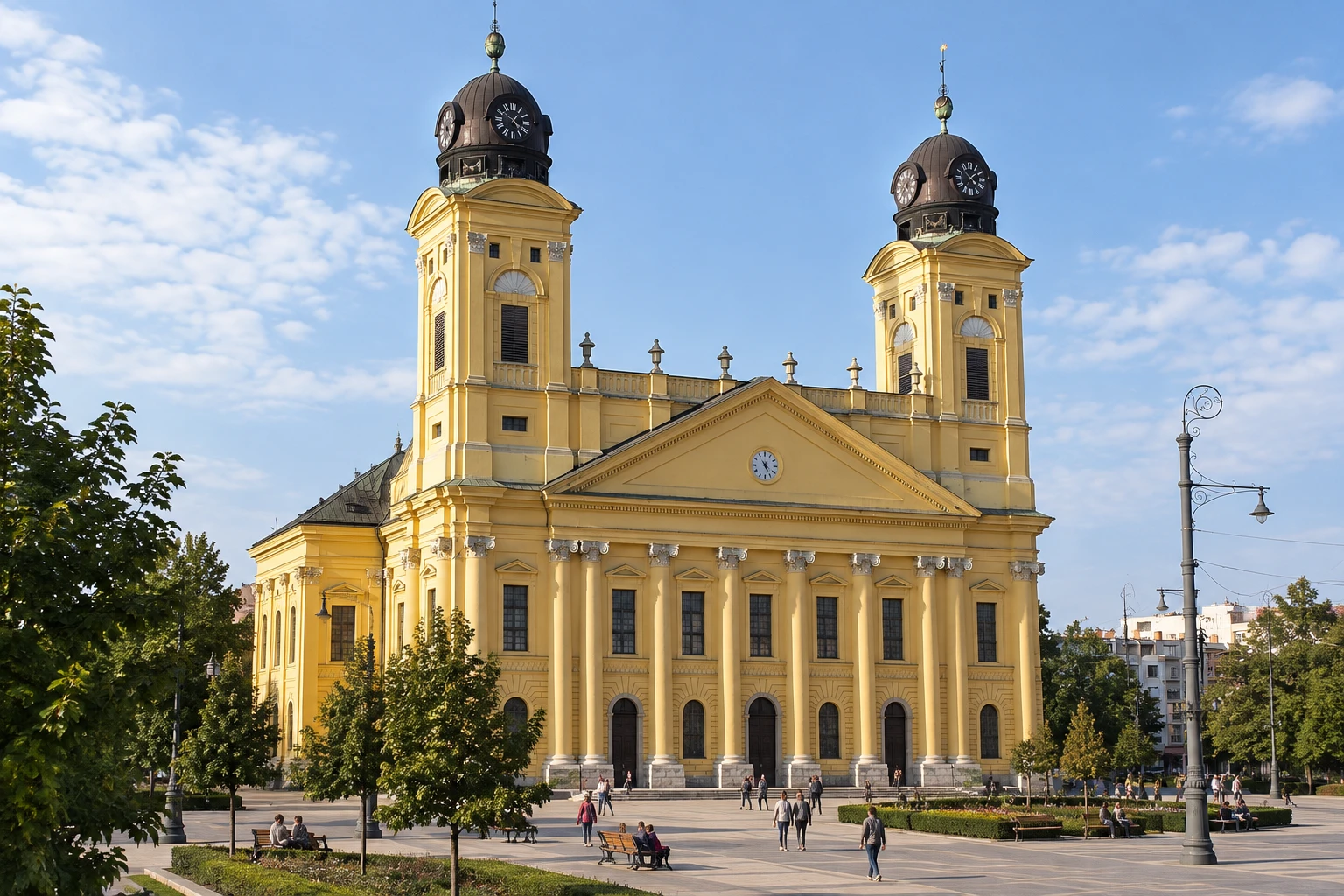
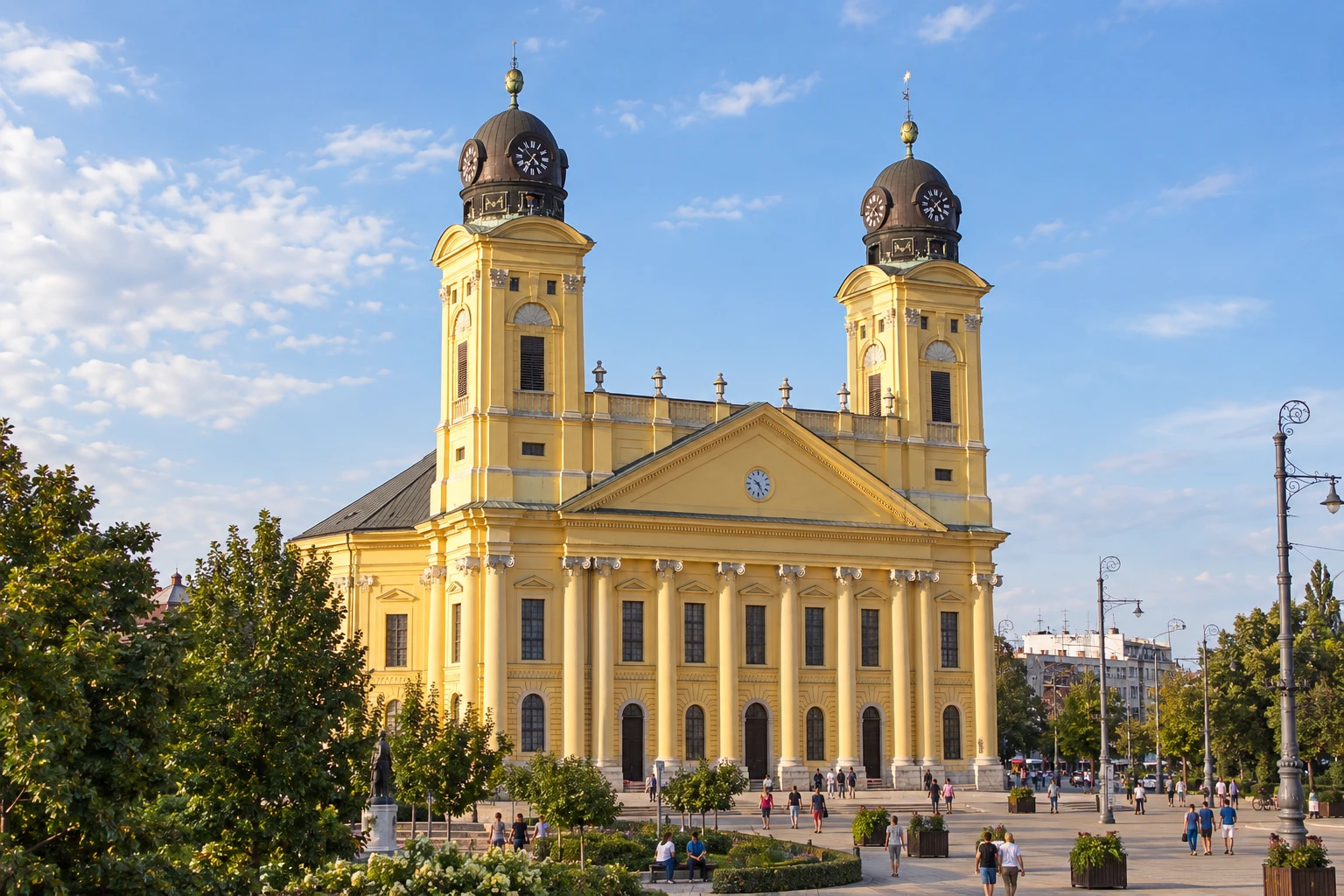
At the far end stands the Great Reformed Church, the city’s symbol and one of Hungary’s largest Reformed churches. The neoclassical building rose between 1805 and 1821 after the great fire of 1802, on the site of the Gothic Church of St. Andrew. Here on April 14, 1849, Lajos Kossuth read the declaration of independence dethroning the Habsburgs. The armchair he used that day is among the relics kept inside. The church is a national monument and a site of Hungarian national remembrance.
The interior is restrained in keeping with Calvinist tradition. Two visitor routes are available. One stays at nave level for exhibitions on the history of the church and congregation. The other climbs to the galleries and towers, taking in a display of models illustrating Bible history, the attic, the 4.6-ton Rákóczi bell, the panoramic walkway connecting the towers and the west tower lookout. From the top you can see the whole length of Piac utca and the surrounding plain. An elevator serves part of the route.
The church also holds regular services, organ concerts and occasional evening openings of the walkway.
Stops: Kossuth tér, Református Nagytemplom, Panoramic walkway between the towers, Rákóczi Bell, Lajos Kossuth Monument, Mosaic of the city’s coat of arms.
Includes: Self-guided visit. Tickets vary by route: nave only, or nave and towers. Check current prices.
Tip: Sunday visits begin after morning worship, and Saturday visiting hours usually end earlier. Check ahead. On clear days choose the route that includes the towers.
Best time: Year-round. Choose a clear day for the best view from the top.
Reformed College and Memorial Garden: the library, the Oratory, and the Reformation tree
From Kálvin tér, behind the Great Church On foot 1 hour 30 minutes to 2 hours Morning Easy
Between the Great Church and the Reformed College lies the Memorial Garden, a tree-shaded block with two monuments. The 1906 statue of István Bocskai, prince of Transylvania, commemorates the defender of Protestant religious freedom who settled the Hajdú warriors around Debrecen. A column erected in 1895 honors Protestant pastors condemned to the galleys for their faith and freed by Dutch admiral Michiel de Ruyter. In 1991 Pope John Paul II laid flowers here as a gesture of reconciliation between Christian churches.
Debrecen’s Reformed College has operated continuously since 1538 and educated many Hungarian thinkers. Its 19th-century neoclassical building now houses the Reformed theological university, the Great Library and museums. A staircase covered with murals leads to the library, with more than 600,000 volumes, the Csokonai Room and the Oratory. The lower house of Hungary’s National Assembly met in the Oratory from January to May 1849, approving on April 13 the declaration of independence read the following day in the Great Church. Permanent exhibitions explore the school’s history, student life and Reformed religious art from the region beyond the Tisza.
At the corner of Múzeum and Füvészkert streets grows the lícium tree, a shrub associated with a theological debate during the Reformation. According to tradition, the Catholic participant stuck a branch into the ground and declared that the new faith would amount to something only when the branch grew into a tree.
Stops: Emlékkert (Memorial Garden), Statue of István Bocskai, Column commemorating the pastors condemned to the galleys, Debreceni Református Kollégium, Great Library, Oratory, Líciumfa (lycium tree).
Includes: Self-guided visit. The college museum charges separate admission. Check current prices.
Tip: The college museum usually opens only on weekdays. Plan a weekday visit and check before going.
Best time: Year-round.
The museum district: Déri Museum, Déri Square, MODEM, and the House of Literature
From Déri tér, a short walk from the Great Church On foot 3 to 4 hours Afternoon Easy
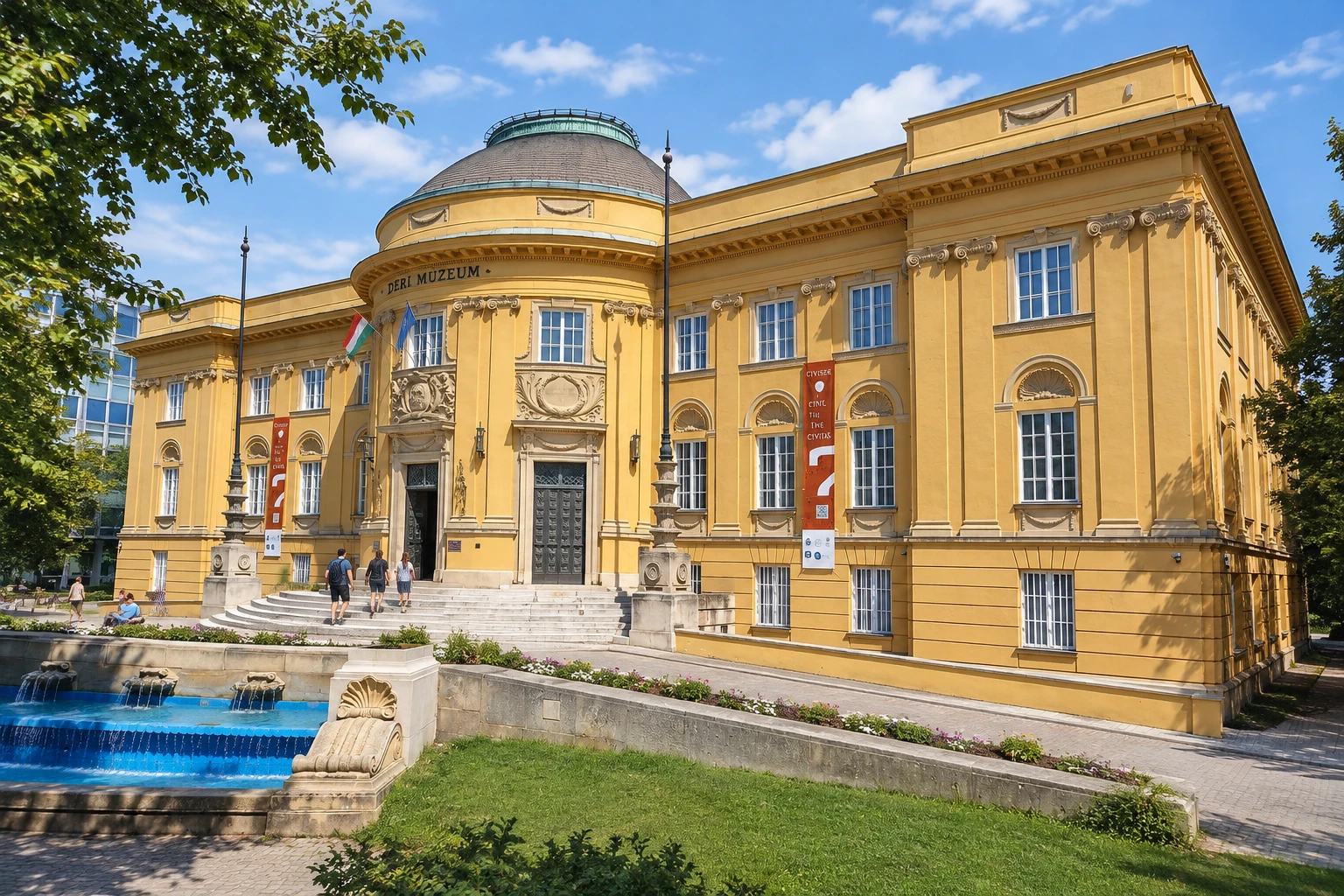
Déri Square is one of downtown’s quieter corners. Once a small lake, then a botanical garden used for Reformed College classes, it took its present shape in 1928 when the museum was built. The garden lies just below street level, with a fountain and four large allegorical bronzes by Ferenc Medgyessy depicting Ethnography, Art, Science and Archaeology. They won awards at the 1937 Paris World’s Fair. Other sculptures by the same artist stand on the square, including a seated figure of writer Zsigmond Móricz.
The Déri Múzeum is known for Mihály Munkácsy’s Christ Trilogy, displayed together in one room: Christ Before Pilate from 1882, Golgotha from 1884 and Ecce Homo from 1896. The other exhibits draw on Frigyes Déri’s collection and local holdings, covering art, archaeology and city history. A three-part arms collection represents Christian Europe from the 15th through 18th centuries, the Ottoman Empire and Persia, and the Far East, with Japanese pieces from the Edo period. Allow half a day to explore.
A short walk away, MODEM, the modern and contemporary art center opened in 2006, hosts temporary exhibitions. On Péterfia Street, the Debrecen House of Literature traces the city’s literary history through manuscripts, objects and virtual games. The Ferenc Medgyessy Memorial Museum displays the sculptor’s most important works.
Stops: Déri tér, Déri Múzeum, MODEM Modern és Kortárs Művészeti Központ, Debreceni Irodalom Háza, Medgyessy Ferenc Emlékmúzeum.
Includes: Self-guided visit. Each museum charges its own admission. Check current prices.
Tip: If time is short, focus on the Déri Museum and the square. Check each museum's opening days before visiting.
Best time: Year-round. A good choice on cold or rainy days.
Piac utca on foot: from the Small Church to Kossuth Square via Hal köz and Csapó Street
From Révész tér, on Piac utca On foot About 2 hours Morning or afternoon Easy
Piac utca is Debrecen’s main street. From the 16th century it hosted the fairs that made the city prosperous for 300 years. The merchant houses you see today went up around the turn of the 20th century. Look for the pink former First Savings Bank at Kossuth Street and the twin copper-towered buildings on the corner of Simonffy Street. In the 1600s a raised wooden walkway 650 meters long carried people across the muddy street. A section of this “mud bridge” is on display beside the square.
Begin at the Little Reformed Church on Révész Square. A storm in 1907 took the onion dome off the Baroque church, and a crenellated parapet replaced it. Locals have called it Csonka, the truncated church, ever since. The tower occasionally opens for climbing.
Farther along is the neoclassical Old City Hall. It housed the national defense committee during the 1848–1849 war of independence and sheltered Hungary’s Holy Crown. The tourist information office occupies the same building. In a courtyard off the street, a bicycle museum displays around 100 pieces from a private collection.
Two short detours are worthwhile. Hal köz, formerly the fish and dairy market, is a small square of cafés, terraces and fountains. Csapó utca, among the city’s oldest streets, takes its name from 15th-century wool workers. Its pedestrian section has shops, the main market and the flower market. On Kossuth Street, the Csokonai National Theatre opened in 1865. Statues of the muses and Hungarian writers decorate its Romantic facade.
Stops: Piac utca, Református Kistemplom (Csonkatemplom), Régi Városháza, Hal köz, Csapó utca, Csokonai Nemzeti Színház, Kerékpár Múzeum.
Includes: Self-guided outing. Any museum and tower admission fees are separate.
Tip: The tourist office in the old town hall offers maps, guided walks, and bike rentals. The tram runs along the street. Watch the tracks when crossing.
Best time: April to October for the terraces, or Advent for the lights and market
Other faiths in Debrecen: St. Anne's Cathedral, the Pásti Street synagogues, and the Red Church
From Szent Anna utca, one block from Piac utca On foot 2 to 3 hours Afternoon Easy
Other faiths have also left their mark on the “Calvinist Rome,” all within a short walk of Piac utca.
Cardinal Imre Csáky commissioned St. Anne’s Cathedral from Milanese architect Giovanni Battista Carlone in the early 18th century. The Baroque church was dedicated to St. Anne in 1746 and raised to cathedral status by Pope John Paul II in 1993. Light draws the eye toward the altar and painted ceiling. Three statues on the facade depict St. Emeric, St. Stephen and the Virgin and Child, with a relief of the cardinal over the entrance. A certified replica of the Shroud of Turin is on display.
Debrecen has Hungary’s largest Jewish community outside the capital. The restored late 19th-century Orthodox synagogue on Pásti Street serves as a place of worship, a cultural center and a place to learn about the history, faith and traditions of the city’s Jews. In its courtyard, a concrete and black metal wall is engraved with the names of around 6,000 Jews from Debrecen murdered in the Holocaust. The complex also includes a study house, the former ritual bath and a former butcher’s shop now used for exhibitions. The synagogue on Kápolnási Street, built in 1909–1910, is used for major holidays.
The neo-Byzantine Greek Catholic church on Attila Square dates to 1910 and unusually has no iconostasis. Mosaics decorate the altar and pulpit. On Méliusz Square, the Red Church is a neo-Gothic brick Reformed church by Samu Petz. Its murals of biblical symbols painted by Jenő Haranghy in 1936 are unique among Calvinist churches.
Stops: Szent Anna Székesegyház, Pásti Street Orthodox Synagogue, Holocaust Memorial, Kápolnási Street Synagogue, Greek Catholic church on Attila Square, Verestemplom (Red Church).
Includes: Self-guided visit. The synagogues charge separate admission. Check current prices.
Tip: Churches and synagogues have their own visiting hours and close to visitors during services and on religious holidays. Check ahead.
Best time: Year-round.
Nagyerdő, the Great Forest: Lake Békás, the water tower, the university, and the botanical garden
From Tram 1 stop in Nagyerdő Tram and walking 3 to 4 hours Afternoon Easy
Nagyerdő was Hungary’s first nature conservation area and serves as the city park, around ten minutes by tram from downtown. Landscaped paths beneath century-old oaks pass works of land art made from materials found in the forest itself.
Lake Békás, created in 1932, is surrounded by lawns, benches and paths and hosts summer food, wine, jazz and beer festivals. The open-air theater is beside it. Near the stadium, the Mist Theater operates from spring to fall. By day, a 30-meter water jet alternates with a curtain of mist 30 meters wide, with stepping stones across the reflecting pool. At night from May through September, the mist becomes a screen for a film about Debrecen.
Still in service after more than a century, the Nagyerdő water tower has become a recreation center with a café, garden, climbing wall, exhibitions, outdoor concerts and a lookout more than 30 meters above the park and stadium. A 1,100-meter elevated walkway and running track circle the 20,000-seat Nagyerdei Stadion several meters above ground. On Medgyessy promenade, a sculpture park honors writers associated with the city.
Across the forest stands the main University of Debrecen building, completed in 1932 in an eclectic, neo-Baroque style. It has a glass-roofed ceremonial courtyard and a formal French garden with a fountain in front. Beside it is the Reformed university church. Behind it, the 13.7-hectare botanical garden, founded in 1928, has greenhouses, a palm house and one of Central and Eastern Europe’s largest cactus and succulent collections.
Stops: Nagyerdei park, Békás-tó, Ködszínház (Mist Theater), Nagyerdei Víztorony, Nagyerdei Stadion, Medgyessy sétány, Debreceni Egyetem, Botanikus Kert.
Includes: Self-guided outing. The park is free. The water tower lookout, botanical garden, and attractions cost extra.
Tip: From April to early November, a sightseeing train connects downtown with Nagyerdő on a roughly one-hour ride via the university. Tram 1 follows the same route year-round.
Best time: May to September for the Fog Theater, or fall for the colors in the woods


 Brazil
 Antarctica
 Argentina
 Bolivia
 Chile
 Colombia
 Ecuador
 Falkland Islands (Malvinas)
 French Guiana
 Guyana
 Paraguay
 Peru
 Suriname
 Uruguay
 Venezuela
 Austria
 Belgium
 Croatia
 Denmark
 Finland
 France
 Germany
 Greece
 Iceland
 Ireland
 Italy
 Luxembourg
 Norway
 Poland
 Portugal
 Slovakia
 Slovenia
 Spain
 Sweden
 Switzerland
 the Czech Republic
 the Netherlands
 the United Kingdom
 Turkey
 Bermuda
 Canada
 Greenland
 Mexico
 Saint Pierre and Miquelon
 the United States
 the Dominican Republic
 Japan
 Egypt
 South Africa
 Australia
 Fiji
 New Zealand
 Papua New Guinea

 August