

 Brazil
 Antarctica
 Argentina
 Bolivia
 Chile
 Colombia
 Ecuador
 Falkland Islands (Malvinas)
 French Guiana
 Guyana
 Paraguay
 Peru
 Suriname
 Uruguay
 Venezuela
 Albania
 Austria
 Belgium
 Croatia
 Denmark
 Finland
 France
 Germany
 Hungary
 Iceland
 Ireland
 Italy
 Luxembourg
 Norway
 Poland
 Portugal
 Slovakia
 Slovenia
 Spain
 Sweden
 Switzerland
 the Czech Republic
 the Netherlands
 the United Kingdom
 Turkey
 Bermuda
 Canada
 Greenland
 Mexico
 Saint Pierre and Miquelon
 the United States
 the Dominican Republic
 Japan
 Egypt
 South Africa
 Australia
 Fiji
 New Zealand
 Papua New Guinea
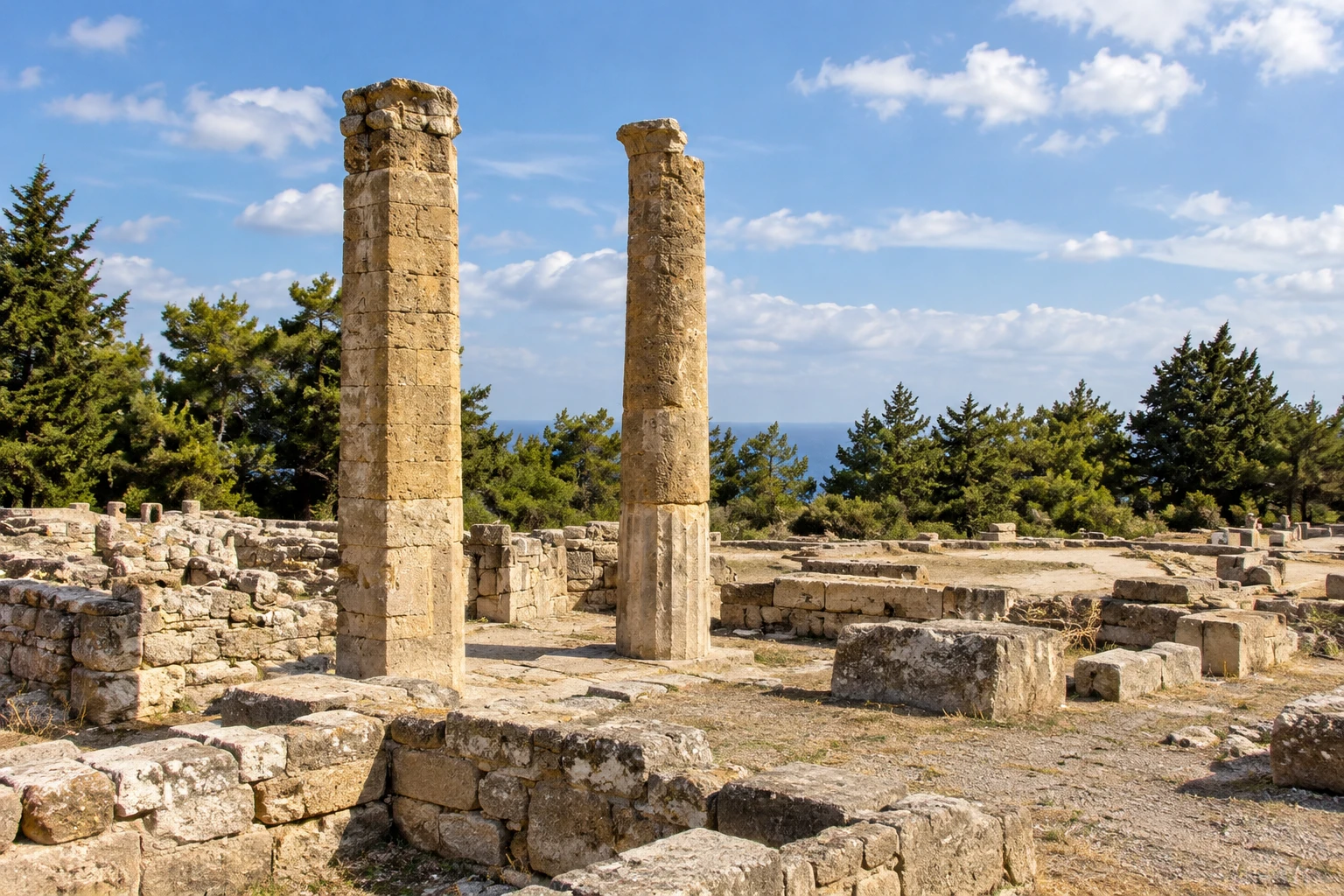
Archaeological site · Rhodes, Greece
Ancient Kamiros (Archaia Kamiros)
Ruins of one of the three ancient cities of Rodes, on a slope overlooking the sea 35 km from the city: an agora, a Doric temple, houses with peristyles, grid streets and the acropolis stoa above a 6th-century BC reservoir.
Illustrative images. The pictures in this guide are illustrations based on the real place, not photographs, and may differ from it.

Discover
About Ancient Kamiros (Archaia Kamiros)
Kamiros (Kameiros) was, along with Lindos and Ialysos, one of the three ancient cities of Rodes until the foundation of the common capital in 408 BC. The ruins sit on a sea-facing slope on the northwest coast, about 35 km from the city of Rodes and 3 km from the village of Kalavarda. Two earthquakes, in 226 BC and 142 AD, destroyed the city; it was rebuilt after the first and gradually abandoned after the second; there are no modern buildings on top, so the urban plan is largely intact.
The site has three levels. At the lowest are the agora, a Doric temple likely dedicated to Apollo, the house of the spring with columns and the enclosure of altars devoted to various gods. In the middle is the residential town, with parallel streets and blocks of Hellenistic houses, some with columned courtyards (peristyles), baths and ceramic water pipes still visible. At the top the acropolis preserves the foundations of the temple of Athena Kameiras and a stoa of about 200 metres, with two rows of Doric columns, built over a water reservoir of roughly 600 cubic metres, from the 6th century BC.
The first excavations, in 1859–1864, sent many finds to the British Museum; the Italian school excavated and restored the site from 1928. The pieces that remained on the island are in the Archaeological Museum of Rodes.
It is a ticketed site with reduced winter hours and almost no shade. From the acropolis you can see the sea and, on clear days, the neighboring islands.
Before you go
Practical information
Cidade Turismo reviews its information regularly, but something may have changed. Check with the place before planning your trip.
How much time to set aside
About one to one and a half hours.
Best time
Early in the morning or late in the afternoon: the slope is exposed and summers are hot. The site usually closes one day a week in winter and on some holidays; check before you go.
How to get there
By car, about 35 km along the west coast road, with a signed turn after Kalavarda and parking at the entrance. West coast regional buses stop on the road, with a walk to the site and few departures per day; check at the terminal. West coast tours include Kamiros.
Tip
Start at the lower part and walk up to the stoa along the main street, to see the town as its inhabitants did. Bring water and a hat. Combine with Filerimos and the Vale das Borboletas the same day by car, and finish at a fish taverna in Kamiros Skala, farther south.
Official website
Your questions
Frequently asked questions about Ancient Kamiros (Archaia Kamiros)
Why is Kamiros called the Pompeii of Rodes?
Because the city was abandoned after the earthquakes and never had modern construction on top, so the layout of streets, houses and temples remained intact. There is no relation to a volcano.
Where are the artifacts found in Kamiros?
Some went to the British Museum in London during 19th‑century excavations. What remained on the island is in the Archaeological Museum of Rodes, in the medieval city.
Can Kamiros be visited without a car?
Yes, but with planning: west‑coast buses stop on the road, a walk from the site, and have few departures per day. Tours and a rental car are easier.