

 Brazil
 Antarctica
 Argentina
 Bolivia
 Chile
 Colombia
 Ecuador
 Falkland Islands (Malvinas)
 French Guiana
 Guyana
 Paraguay
 Peru
 Suriname
 Uruguay
 Venezuela
 Albania
 Austria
 Belgium
 Croatia
 Denmark
 Finland
 France
 Germany
 Hungary
 Iceland
 Ireland
 Italy
 Luxembourg
 Norway
 Poland
 Portugal
 Slovakia
 Slovenia
 Spain
 Sweden
 Switzerland
 the Czech Republic
 the Netherlands
 the United Kingdom
 Turkey
 Bermuda
 Canada
 Greenland
 Mexico
 Saint Pierre and Miquelon
 the United States
 the Dominican Republic
 Japan
 Egypt
 South Africa
 Australia
 Fiji
 New Zealand
 Papua New Guinea
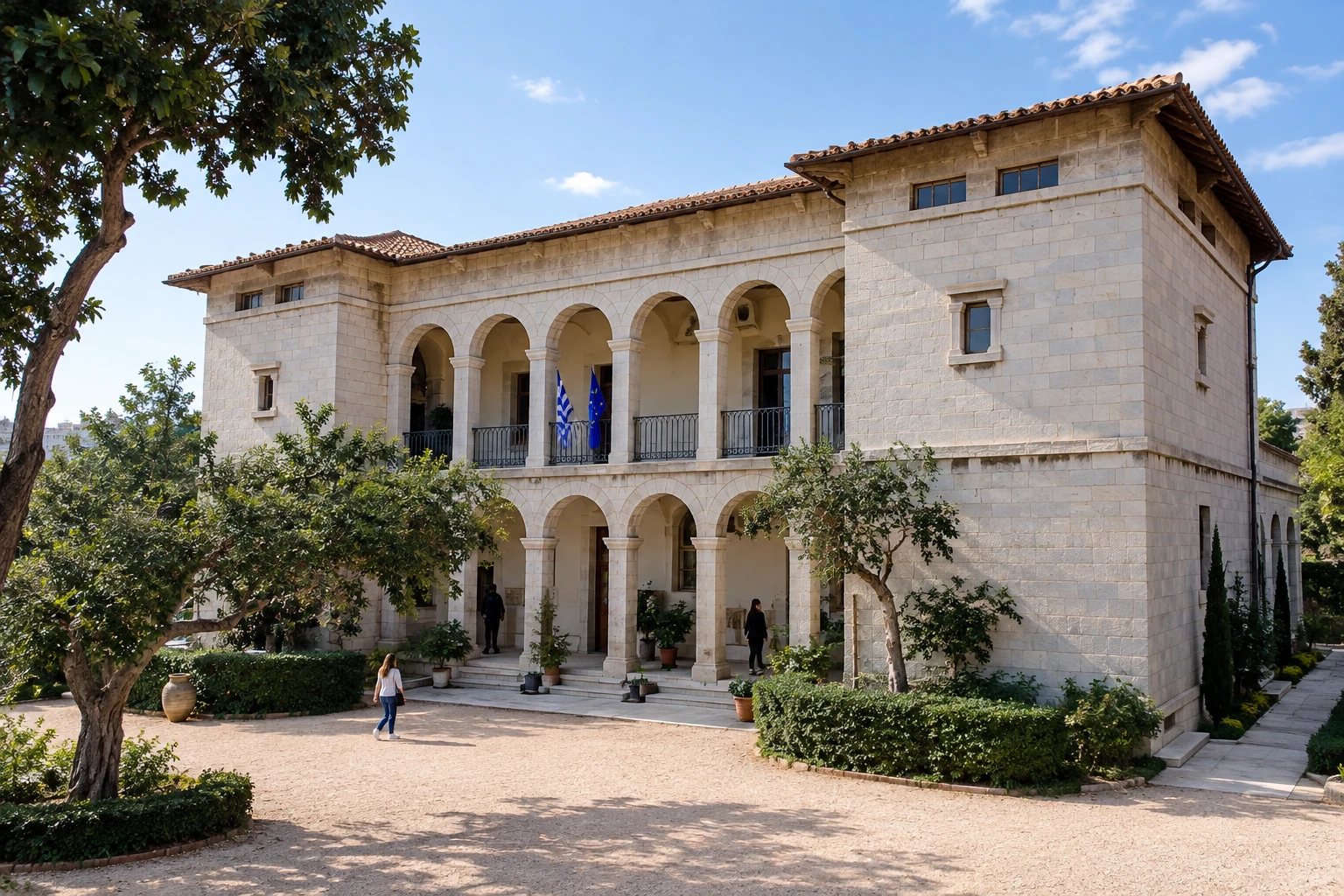
Museum · Athens, Greece
Byzantine and Christian Museum (Vyzantino kai Christianiko Mouseio)
Icons, mosaics, frescoes and devotional objects from the 3rd to the 19th century, in a modern museum beneath the gardens of a Florentine villa from 1848 on Vasilissis Sofias avenue.
Illustrative images. The pictures in this guide are illustrations based on the real place, not photographs, and may differ from it.

Discover
About Byzantine and Christian Museum (Vyzantino kai Christianiko Mouseio)
The Museu Bizantino e Cristão houses more than 25,000 pieces of Greek Christian art, from late Antiquity to the 19th century: painted icons, mosaics, frescoes removed from ruined churches, marble sculptures, illuminated manuscripts, embroidered textiles and liturgical objects in silver and gold. Founded in 1914, since 1930 it has occupied the Villa Ilissia, a Florentine-style house built in 1848 by architect Stamatios Kleanthis for the Duchess of Plaisance, a French aristocrat who lived in Athens, with a courtyard and a garden on Vasilissis Sofias avenue.
The permanent exhibition is in modern rooms built beneath the garden, in two large blocks. The first, 'Do mundo antigo a Bizâncio', shows how Christian art arose from Greek and Roman art, with sculptures, floor mosaics and reconstructions of an early Christian basilica. The second, 'O mundo bizantino', covers the Greek Middle Ages and the centuries after the fall of Constantinople, with a collection of icons that includes works from the Cretan school and painters of the 16th and 17th centuries, and with whole frescoes from Greek chapels reassembled in the galleries.
The villa's garden, with olive trees and remains of an ancient aqueduct, is open and serves as a resting spot on the museum circuit. There is a café and a shop. Next door, on the same block, is the Museu da Guerra; across the avenue is the Evangelismos metro station.
Before you go
Practical information
Cidade Turismo reviews its information regularly, but something may have changed. Check with the place before planning your trip.
How much time to set aside
About an hour and a half to two hours for the permanent exhibition. More if you include temporary exhibitions and the garden.
Best time
Any weekday; it's a quiet museum. Reduced hours in winter and closed one weekday; check ahead. Combine it with the Benaki and the Cicládico on the same avenue in an afternoon.
How to get there
Metro line 3, Evangelismos station: the exit opens onto Vasilissis Sofias avenue, in front of the museum. From Syntagma square it's a 15-minute walk along the avenue, passing the Jardim Nacional and the Benaki.
Tip
Start with the block 'Do mundo antigo a Bizâncio', in the basement on the left, to understand the shift from pagan to Christian art; the icons are in the second block. Look closely at the double-sided icon and the reassembled frescoes. The garden is a good place to pause, with benches in the shade.
Official website
Your questions
Frequently asked questions about Byzantine and Christian Museum (Vyzantino kai Christianiko Mouseio)
Do I need to know Byzantine art to enjoy the museum?
No. The exhibition is chronological and explains, in Greek and English, how Christian art developed out of Greek and Roman art. Visitors to churches in Greece later recognize the icons and the frescoes.
Are the icons originals taken from churches?
Yes. Many came from ruined churches or from regions that Greece lost in the 20th century, such as Asia Minor, brought by refugees in 1922. The frescoes were detached from the walls and reassembled in the rooms.
What is the Villa Ilissia?
The 1848 house that forms the entrance to the museum, built in Florentine style for the duchess of Plaisance, a Frenchwoman who lived in Athens in the 19th century. Today it houses temporary exhibitions and services; the permanent collection is in new rooms beneath the garden.