

 Brazil
 Antarctica
 Argentina
 Bolivia
 Chile
 Colombia
 Ecuador
 Falkland Islands (Malvinas)
 French Guiana
 Guyana
 Paraguay
 Peru
 Suriname
 Uruguay
 Venezuela
 Albania
 Austria
 Belgium
 Croatia
 Denmark
 Finland
 France
 Germany
 Hungary
 Iceland
 Ireland
 Italy
 Luxembourg
 Norway
 Poland
 Portugal
 Slovakia
 Slovenia
 Spain
 Sweden
 Switzerland
 the Czech Republic
 the Netherlands
 the United Kingdom
 Turkey
 Bermuda
 Canada
 Greenland
 Mexico
 Saint Pierre and Miquelon
 the United States
 the Dominican Republic
 Japan
 Egypt
 South Africa
 Australia
 Fiji
 New Zealand
 Papua New Guinea
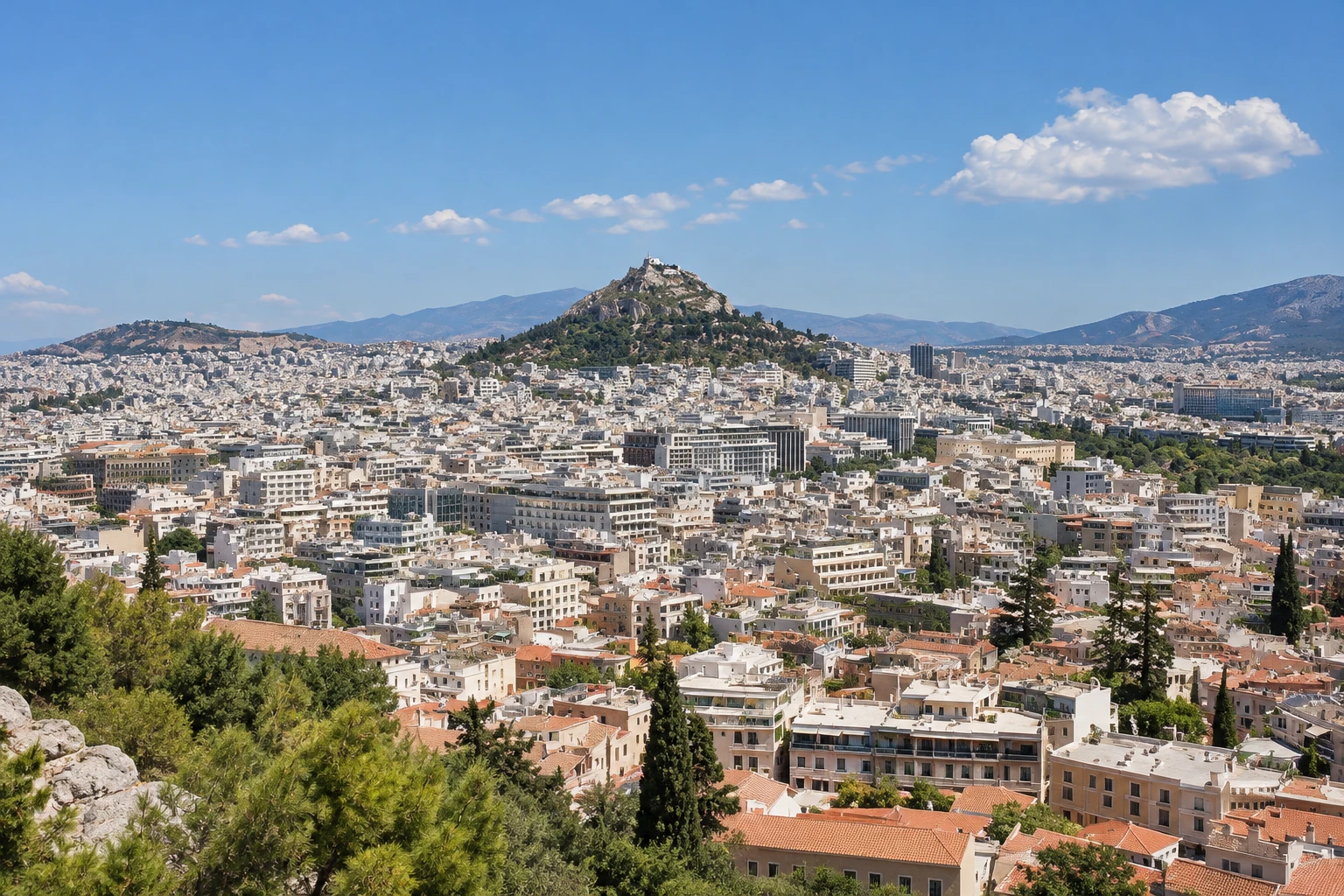
Viewpoint · Athens, Greece
Mount Lycabettus (Lykavittos)
The 277-metre hill that dominates central Athens, with the white chapel of São Jorge at the top and views across the whole city to the sea and the Acrópole. You can climb on foot or take the cable car.
Illustrative images. The pictures in this guide are illustrations based on the real place, not photographs, and may differ from it.

Discover
About Mount Lycabettus (Lykavittos)
Mount Licabeto (Lykavittos) is the highest point in central Athens, at 277 metres, and the viewpoint from which the city is seen whole: the Acrópole amid the buildings, the Pireu and the sea to the south, the hills that enclose the Attica basin and, on clear days, the islands of the Saronic Gulf. At the top are the chapel of São Jorge (Agios Georgios), from the 19th century, a café-restaurant and a stone terrace.
There are two ways up. On foot, via a zigzag path with steps starting from the upper part of the Kolonaki neighbourhood, among pines and cypresses, taking about 20 to 30 minutes of steady ascent. Or by cable car (teleferik), a tunnel tram that departs from Aristippou street, in upper Kolonaki, and reaches the top in a few minutes; it has no view during the ride, only on arrival. It usually operates year-round, at regular intervals; check before relying on it.
On the mid-slope on the north side is the Teatro do Licabeto, an open-air amphitheatre that hosts shows in summer. The area around the hill is a pine park with trails and a rest spot with a café halfway up, on the Kolonaki side. The chapel at the summit lights a cross at night and can be seen from across the city.
Before you go
Practical information
Cidade Turismo reviews its information regularly, but something may have changed. Check with the place before planning your trip.
How much time to set aside
One to one and a half hours, including the climb and some time on the terrace. More if you stay at the café until the end of the day.
Best time
The last hour of light is the most popular: the city gradually lights up and the Acrópole is illuminated. Early morning has cleaner air and fewer people. In summer, avoid walking up between 11:00 and 17:00. On days of high fire risk the hill may be closed; check ahead.
How to get there
Metro line 3, Evangelismos station, and a 15-minute uphill walk through Kolonaki to the start of the trail at the end of Aristippou street, or to the cable car station on the same street. From Kolonaki Square it's a 10-minute uphill walk. Taxis reach the cable car station; cars don't go up to the top.
Tip
Take the cable car up and walk down, to enjoy the view on the descent without the tiredness. Bring a jacket even in summer: it's windy at the top. The café at the top is expensive; many people bring water and stay on the terrace. The trail is rocky and slippery after rain.
Your questions
Frequently asked questions about Mount Lycabettus (Lykavittos)
Is the Licabeto funicular operating?
It usually operates year-round, departing from Aristippou Street in Kolonaki at regular intervals. Like any equipment, it can stop for maintenance: check on the day and have the walk up as an alternative.
Is the walk up difficult?
It's steady but short: about 20 to 30 minutes via a paved path and stairs, with benches along the way. Closed shoes are required. It is not recommended for people with walking difficulties; in that case, use the funicular.
Can you see the sunset from Licabeto?
Yes, the summit terrace faces the city and the west, where the sun sets behind the hills. It's the busiest time; arrive early.
Licabeto or Colina de Filopapo: which viewpoint to choose?
Licabeto is higher and shows the whole city, with the Acrópole in the distance. Colina de Filopapo is lower and faces the Acrópole up close, at the same level. If you have time do both; with limited time, go to Filopapo to photograph the Acrópole and to Licabeto to view Athens.