

 Brazil
 Antarctica
 Argentina
 Bolivia
 Chile
 Colombia
 Ecuador
 Falkland Islands (Malvinas)
 French Guiana
 Guyana
 Paraguay
 Peru
 Suriname
 Uruguay
 Venezuela
 Austria
 Belgium
 Croatia
 Denmark
 Finland
 France
 Germany
 Hungary
 Iceland
 Ireland
 Italy
 Luxembourg
 Norway
 Poland
 Portugal
 Slovakia
 Slovenia
 Spain
 Sweden
 Switzerland
 the Czech Republic
 the Netherlands
 the United Kingdom
 Turkey
 Bermuda
 Canada
 Greenland
 Mexico
 Saint Pierre and Miquelon
 the United States
 the Dominican Republic
 Japan
 Egypt
 South Africa
 Australia
 Fiji
 New Zealand
 Papua New Guinea
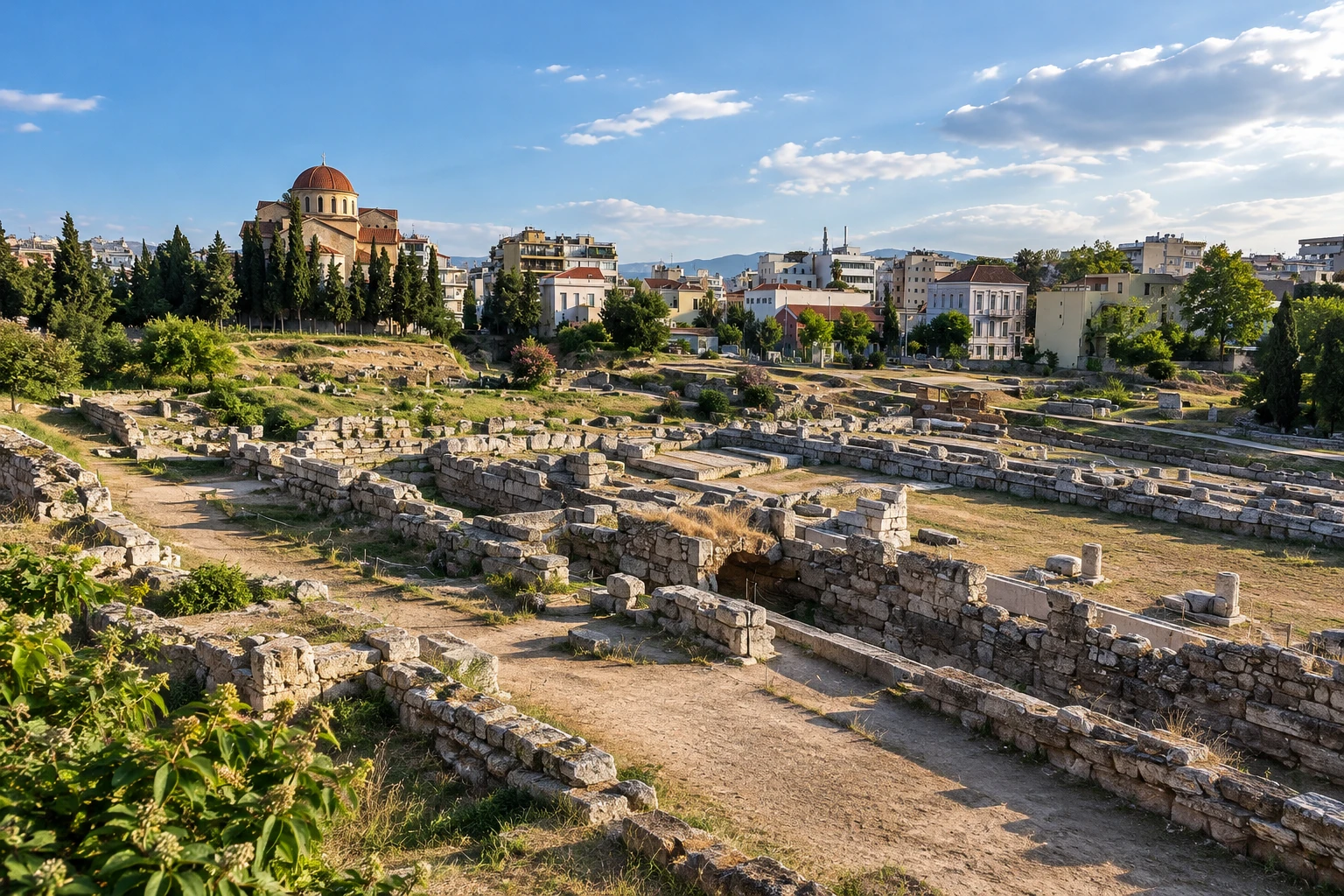
Archaeological site · Athens, Greece
Kerameikos
The cemetery of ancient Athens, at the end of rua Ermou, with the two gates of Temístocles' wall, the Via Sacra, funerary monuments and a small museum with stelae and vases.
Illustrative images. The pictures in this guide are illustrations based on the real place, not photographs, and may differ from it.

Discover
About Kerameikos
The Kerameikos was the potters' quarter (kerameis, from which the word "ceramics" comes) and the main cemetery of ancient Athens, outside the wall, in the northwest of the city. The site is at the end of rua Ermou, after Monastiraki and Psiri, on low ground crossed by the Eridanos stream, and is one of the calmest and least visited places in the centre.
The wall of Temístocles, erected in 478 BC after the Persian invasion, crosses the site, and it had the city's two most important gates: the Porta Dípilo, the double gate, through which the road to Plato's Academy left and by which the Panathenaic procession entered, and the Porta Sagrada, through which the Via Sacra to Eleusis departed. Between them stood the Pompeion, the building where the procession was prepared. Outside the gates, along the roads, Athenians buried their dead in family tombs with statues, stelae and large marble vases.
The Rua dos Túmulos (Odos ton Tymvon) preserves in situ copies of the most famous monuments, such as the relief of Dexileos, a horseman killed in 394 BC, and the marble bull from the tomb of Dionísio de Colito. The originals are in the site's small museum, near the entrance, together with geometric vases from the 8th century BC, figurines and the sculptures found in the excavations, among them a kouros and a sphinx. This was also the place for the collective graves of war dead, where Pericles delivered the funeral oration narrated by Thucydides.
The grounds are lawned and tree-filled, full of turtles, and have explanatory panels in Greek and English.
Before you go
Practical information
Cidade Turismo reviews its information regularly, but something may have changed. Check with the place before planning your trip.
How much time to set aside
From one hour to an hour and a half, including the museum.
Best time
Morning, when the sun hasn't yet become strong and the site is empty. In spring the grounds turn green and flowery. Reduced hours in winter; confirm.
How to get there
Metro line 3, Kerameikos station, a 5-minute walk; or line 1, Thissio station, 7 minutes. The entrance is at rua Ermou 148, at the end of the street, after walking through Psiri from Monastiraki (about 12 minutes).
Tip
Check if there is a combined ticket with the Acrópole and the central sites. See the museum before the grounds, so you can recognize the originals when you pass the copies on the Rua dos Túmulos. Combine it with the Gazi neighborhood, on the other side of rua Pireos, where Technopolis and the Museu Benaki de Arte Islâmica are located.
Your questions
Frequently asked questions about Kerameikos
Is the Kerameikos just a cemetery?
It is the cemetery and the best-preserved stretch of the Athens wall, with the two main city gates, the Dípilo and the Sagrada. It was also the potters' quarter. The site's museum houses sculptures and vases found there.
Are the funerary monuments original?
Those on the site are copies; the originals, to protect them from rain and pollution, are in the site's museum near the entrance, and the larger ones are in the Museu Arqueológico Nacional.
Is the site calm to visit with children?
Yes. It's flat, grassy, with some shade and many free-roaming turtles, which usually delights children. The museum is small.