

 Brazil
 Antarctica
 Argentina
 Bolivia
 Chile
 Colombia
 Ecuador
 Falkland Islands (Malvinas)
 French Guiana
 Guyana
 Paraguay
 Peru
 Suriname
 Uruguay
 Venezuela
 Albania
 Austria
 Belgium
 Croatia
 Denmark
 Finland
 France
 Germany
 Hungary
 Iceland
 Ireland
 Italy
 Luxembourg
 Norway
 Poland
 Portugal
 Slovakia
 Slovenia
 Spain
 Sweden
 Switzerland
 the Czech Republic
 the Netherlands
 the United Kingdom
 Turkey
 Bermuda
 Canada
 Greenland
 Mexico
 Saint Pierre and Miquelon
 the United States
 the Dominican Republic
 Japan
 Egypt
 South Africa
 Australia
 Fiji
 New Zealand
 Papua New Guinea
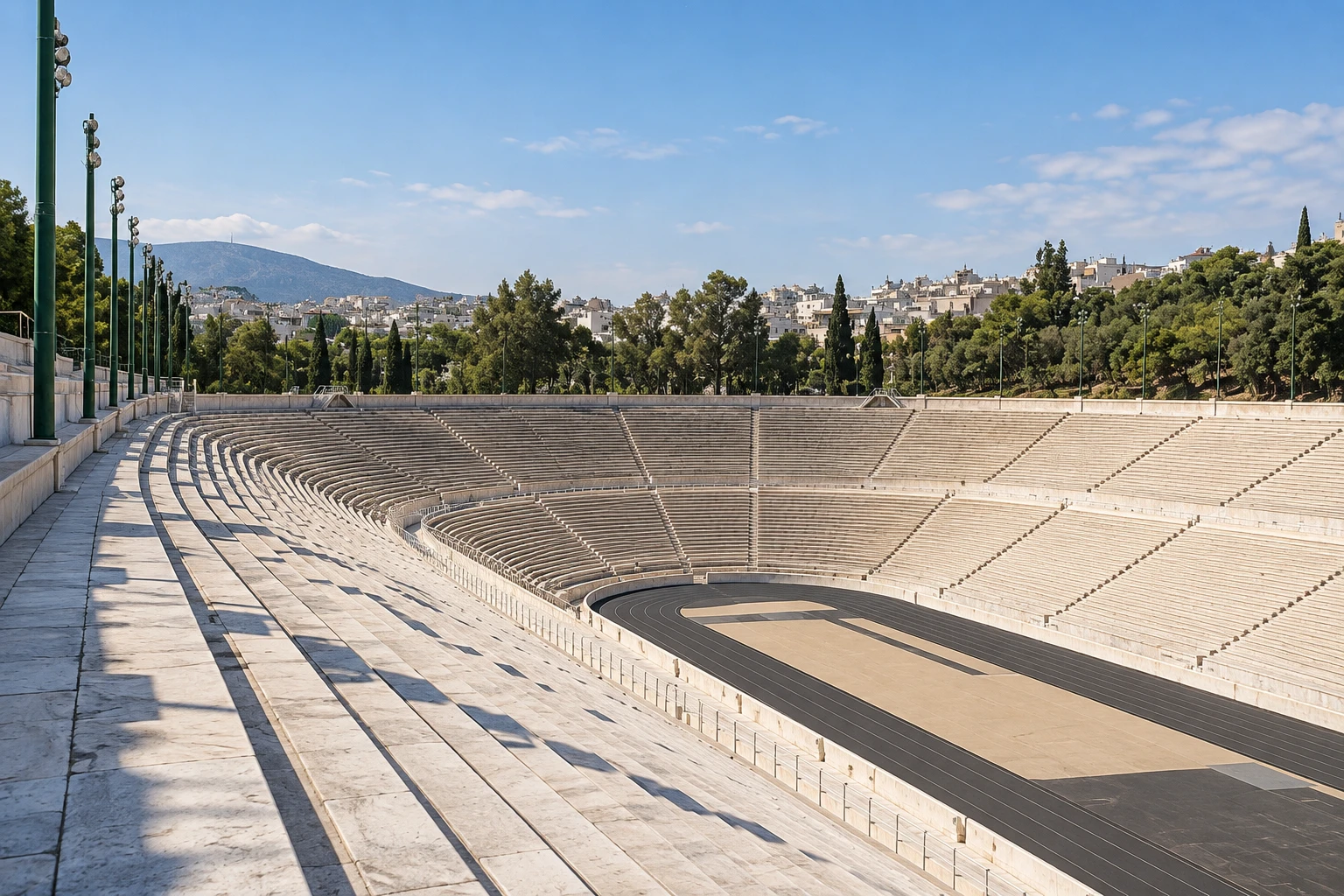
Stadium · Athens, Greece
Panathenaic Stadium (Panathinaiko Stadio)
A stadium entirely of white marble, rebuilt over the ancient stadium for the first modern Olympic Games in 1896. Called Kallimarmaro by the Athenians.
Illustrative images. The pictures in this guide are illustrations based on the real place, not photographs, and may differ from it.

Discover
About Panathenaic Stadium (Panathinaiko Stadio)
The Estádio Panatenaico was built in the 4th century BC for the Panathenaic Games, competitions in honour of Athena, and was rebuilt in marble in the 2nd century AD by the wealthy Athenian Herodes Atticus. Abandoned for centuries, it was excavated in the 19th century and remade in Pentelic marble to host the first Olympic Games of the modern era in 1896, funded by a donation from businessman Georgios Averoff. Athenians call it Kallimarmaro, something like "the beautiful marble."
The stadium has the elongated U-shape of ancient stadia, with the track closed in a tight curve at the far end, and about 50,000 seats in marble tiers. It is nestled between two hills, facing avenida Vasileos Konstantinou and the Jardim Nacional. In 1896 it hosted the opening and closing ceremonies, athletics, gymnastics, weightlifting and wrestling. In 2004 it was the finish of the Olympic marathon and the venue for archery.
Today it is the finish for the Maratona de Atenas in November and the place where the Olympic flame is handed to the country that will host the next Games. The visit includes the track, the stands, the athletes' entrance tunnel and a small exhibition with the posters and torches from all editions of the modern Games, installed in the galleries under the steps. You can climb to the top row for views of the Acrópole and Lycabettus, and run on the track.
Before you go
Practical information
Cidade Turismo reviews its information regularly, but something may have changed. Check with the place before planning your trip.
How much time to set aside
About 45 minutes to an hour, with the torch display and the climb to the top row.
Best time
Early morning or late afternoon: the marble reflects the sun and the stadium has no shade. At the end of the day the light comes in through the U-shaped opening and the Acrópole appears in the background. On event days the stadium closes to visitors; check ahead.
How to get there
A 10-minute walk from Syntagma Square, crossing the Jardim Nacional and passing by the Zappeion. Metro line 2, Akropoli station, a 12-minute walk via Vasilissis Olgas street. Tram and buses stop on Vasileos Konstantinou avenue, in front.
Tip
The ticket includes an audio guide in several languages, with explanations by numbered points: it's worth listening to the section about 1896 while seated on the steps. Go up to the top row on the left side for the photo with the Acrópole. Those who want to run on the track may do so, at an easy pace.
Official website
Your questions
Frequently asked questions about Panathenaic Stadium (Panathinaiko Stadio)
Is the stadium the original from Antiquity?
The layout and the site are original; the marble you see is from the late 19th-century reconstruction, built on the ancient foundations for the 1896 Games, following the shape of the stadium of Herodes Ático.
Can I run on the track?
Yes. Visitors can walk and run on the track during the visit. There is also a morning running program for locals and visitors, with sign-up on site; confirm availability.
Where is the finish of the Athens Marathon?
Inside the Estádio Panatenaico. The race, held in November, starts in the city of Maratona, about 42 km away, and finishes on the marble track, as in 1896 and 2004.