

 Brazil
 Antarctica
 Argentina
 Bolivia
 Chile
 Colombia
 Ecuador
 Falkland Islands (Malvinas)
 French Guiana
 Guyana
 Paraguay
 Peru
 Suriname
 Uruguay
 Venezuela
 Albania
 Austria
 Belgium
 Croatia
 Denmark
 Finland
 France
 Germany
 Hungary
 Iceland
 Ireland
 Italy
 Luxembourg
 Norway
 Poland
 Portugal
 Slovakia
 Slovenia
 Spain
 Sweden
 Switzerland
 the Czech Republic
 the Netherlands
 the United Kingdom
 Turkey
 Bermuda
 Canada
 Greenland
 Mexico
 Saint Pierre and Miquelon
 the United States
 the Dominican Republic
 Japan
 Egypt
 South Africa
 Australia
 Fiji
 New Zealand
 Papua New Guinea
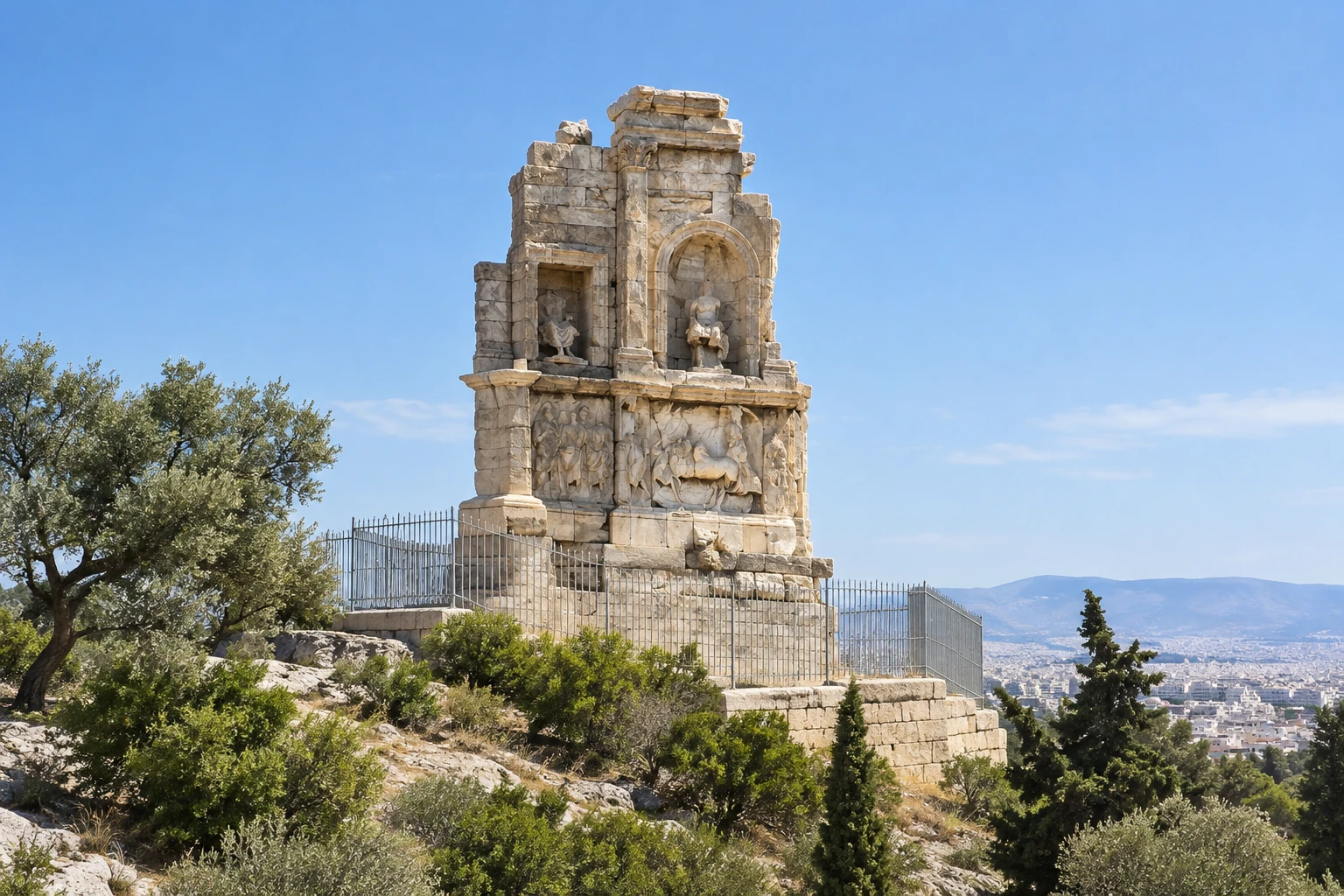
Viewpoint · Athens, Greece
Philopappos Hill (Lofos Filopappou)
The tree-covered hill facing the Acrópole, with the Roman Monument of Filopapo at the top, stone paths designed by Dimitris Pikionis and the most photographed view of the Partenon.
Illustrative images. The pictures in this guide are illustrations based on the real place, not photographs, and may differ from it.

Discover
About Philopappos Hill (Lofos Filopappou)
The Colina de Filopapo (Lofos Filopappou), also called Colina das Musas (Mouseion), lies southwest of the Acrópole, separated from it only by the pedestrian street Dionysiou Areopagitou. It is a park of pines and olive trees, open and unfenced, with stone paths that rise to 147 metres above sea level. From the top you can see the Acrópole head-on, at the same height, and on the other side the Pireu and the sea.
At the summit stands the Monument of Filopapo, a 12-metre marble mausoleum erected between 114 and 116 AD for Gaius Julius Antiochus Epiphanes Filopappus, a prince of the kingdom of Commagene, in present-day Turkey, who lived in Athens and served as a Roman consul. What remains is the curved façade with his seated statue and the relief of the consular procession.
The stone paths that climb the hill from Dionysiou Areopagitou were designed by architect Dimitris Pikionis between 1954 and 1957, using stones and ancient fragments fitted into an irregular mosaic, and are considered a work of art in themselves. Along the way are the little church of Agios Dimitrios Loumbardiaris, from the 16th century, restored by Pikionis, and the so-called Prisão de Sócrates, three chambers cut into the rock that were actually houses or ancient cisterns. The neighbouring hill, the Pnyx, was the site of the people's assemblies of Athens in the 5th century BC, and the speaker's platform is still there.
Before you go
Practical information
Cidade Turismo reviews its information regularly, but something may have changed. Check with the place before planning your trip.
How much time to set aside
One to two hours, including the climb via Pikionis' path, the monument and the return via the Pnyx.
Best time
Late afternoon is the busiest time, to see the Acrópole lit after sunset. Early morning brings light to the face of the Partenon that faces the hill. In summer there is shade along the paths, but not at the top. Avoid climbing alone after dark: the park has no lighting.
How to get there
Metro line 1, Thissio station, and a 5-minute walk along Apostolou Pavlou street to the start of Pikionis' path, opposite the main entrance of the Acrópole. Or metro line 2, Akropoli station, and a 10-minute walk along Dionysiou Areopagitou. There is no admission.
Tip
Climb via Pikionis' path, passing the church of Agios Dimitrios, and descend on the Pnyx and Observatório Nacional side down to Thissio to dine on Apostolou Pavlou street. Bring water: there is nowhere to buy any at the top. Wear closed shoes because Pikionis' stones are smooth.
Your questions
Frequently asked questions about Philopappos Hill (Lofos Filopappou)
Is the Colina de Filopapo paid?
No. It's an open public park, without fences or a ticket office. Only the Acrópole, on the other side of the street, requires a ticket.
Is the Prisão de Sócrates real?
No. The three chambers carved into the rock on the hillside acquired that popular name, but they were part of houses or ancient cisterns. Socrates was arrested and probably died in the prison of the Ágora Antiga.
Where is the classic photo of the Acrópole taken from?
From the top of the Colina de Filopapo, next to the monument, and from the clearings along the path up. The Acrópole sits opposite, at the same level, with the Partenon in profile and the Licabeto in the background.