

 Brazil
 Antarctica
 Argentina
 Bolivia
 Chile
 Colombia
 Ecuador
 Falkland Islands (Malvinas)
 French Guiana
 Guyana
 Paraguay
 Peru
 Suriname
 Uruguay
 Venezuela
 Albania
 Austria
 Belgium
 Croatia
 Denmark
 Finland
 France
 Germany
 Hungary
 Iceland
 Ireland
 Italy
 Luxembourg
 Norway
 Poland
 Portugal
 Slovakia
 Slovenia
 Spain
 Sweden
 Switzerland
 the Czech Republic
 the Netherlands
 the United Kingdom
 Turkey
 Bermuda
 Canada
 Greenland
 Mexico
 Saint Pierre and Miquelon
 the United States
 the Dominican Republic
 Japan
 Egypt
 South Africa
 Australia
 Fiji
 New Zealand
 Papua New Guinea
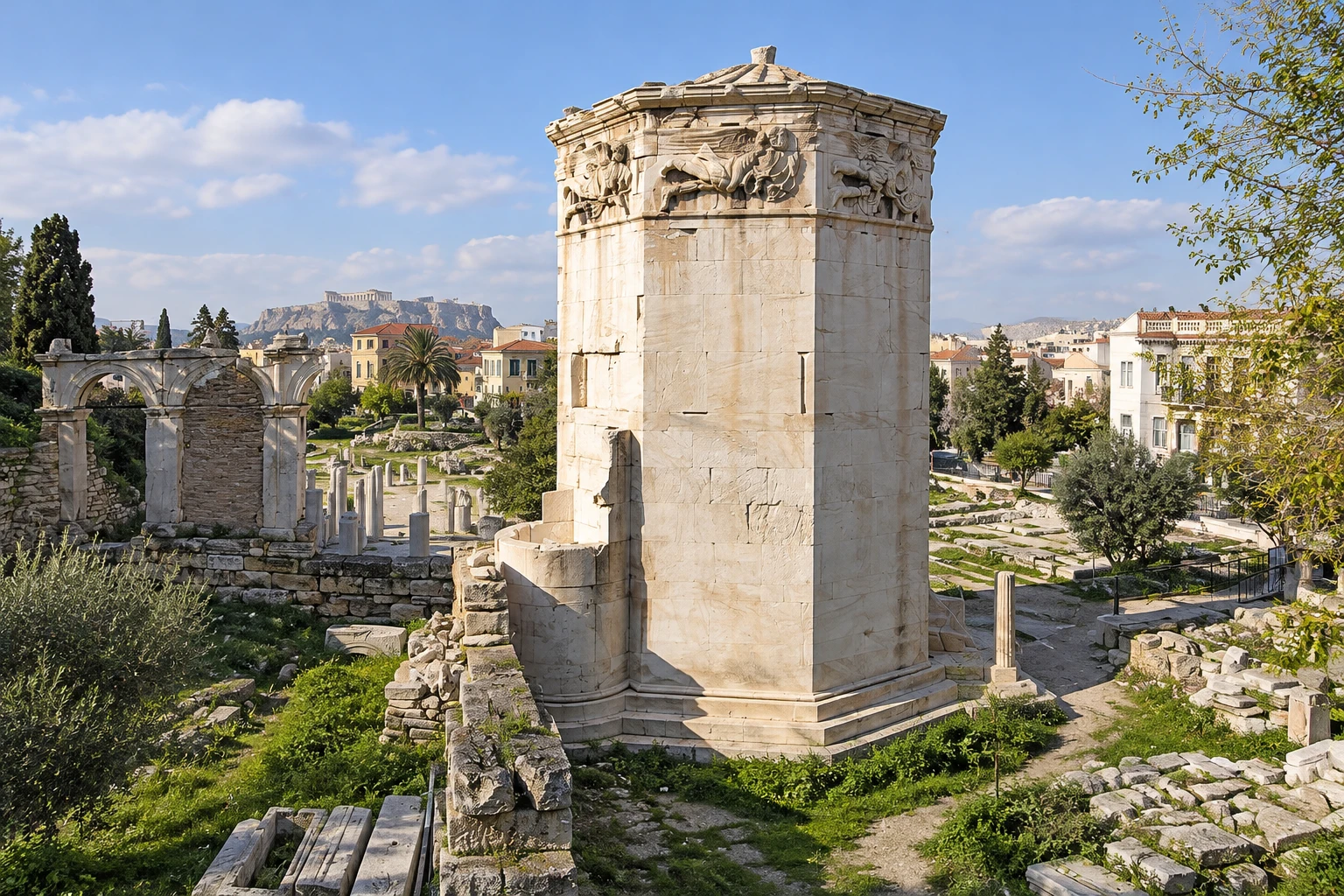
Archaeological site · Athens, Greece
Roman Agora and Tower of the Winds (Romaiki Agora kai Aerides)
The market built in Athens in the time of Augustus, with the Gate of Atena Arquegetis and the Torre dos Ventos, a water clock and sundial from the 1st century BC with the eight winds carved.
Illustrative images. The pictures in this guide are illustrations based on the real place, not photographs, and may differ from it.

Discover
About Roman Agora and Tower of the Winds (Romaiki Agora kai Aerides)
The Ágora Romana (Romaiki Agora) was built between 27 and 17 BC with funds from Júlio César and Augusto as a market enclosed by colonnades, east of the Ancient Agora and just below the north side of the Acropolis. What remains are the rectangular courtyard, stretches of the colonnades, shops and public latrines, and the west entrance, the Porta de Atena Arquegetis, with four standing Doric columns and an inscription of Emperor Hadrian regarding the olive tax.
In the east corner of the courtyard stands the Torre dos Ventos (Aerides, 'the winds', as Athenians call it), a 12‑metre high octagonal marble tower built around 50 BC by the astronomer Andrônico de Cirro. Each face has, at the top, a relief of the wind that blows from that direction, with its name and attributes, and below it the lines of a sundial. Inside there was a water clock fed by a spring from the Acropolis; the mechanism has been lost, but the channels in the floor remain. It is considered the first meteorological station in the world. During the Ottoman centuries it was used as a tekke, a house for whirling dervishes.
In the northwest corner of the site is the Mesquita Fethiye, from the 17th century, restored and open for exhibitions on some days. The surroundings—the streets of Plaka and the Anafiotika neighborhood—are all pedestrian. The Torre dos Ventos can also be seen from outside, from rua Aiolou, without an entrance fee.
Before you go
Practical information
Cidade Turismo reviews its information regularly, but something may have changed. Check with the place before planning your trip.
How much time to set aside
30 to 45 minutes. It's a small site.
Best time
Late afternoon, when the low sun brings out the reliefs of the winds on the tower. There is no shade in the courtyard; in summer avoid midday. Reduced hours in winter. The mosque opens only on certain days; check in advance.
How to get there
A 4‑minute walk from Monastiraki station (metro lines 1 and 3), heading up rua Areos or Aiolou. The entrance is on rua Polignotou, at the side of the Porta de Atena Arquegetis, on the border between Plaka and Monastiraki.
Tip
Check whether there is a combined ticket with the Acropolis and the central sites before buying a single admission. If time is short, view the tower from rua Aiolou, from outside the fence. Inside, walk around the tower and identify the eight winds: Bóreas, the north wind, is the old bearded man; Zéfiro, the west wind, carries flowers.
Your questions
Frequently asked questions about Roman Agora and Tower of the Winds (Romaiki Agora kai Aerides)
Can you go inside the Torre dos Ventos?
The tower is inside the Ágora Romana site and is included with the same ticket. Access to the interior may be open or closed depending on the season; from outside you can see the wind reliefs and the marks of the sundials.
What did the Torre dos Ventos do?
It marked the hours in two ways: sundials on the eight faces for clear days, and a water clock inside for cloudy days and nights. The reliefs at the top indicate the direction of each wind; for that reason it is called the first meteorological station.
Is the Ágora Romana worth visiting if I've already seen the Ágora Antiga?
Yes, for the Torre dos Ventos, which has no parallel. The site is small and quick to visit, and lies on the way between Monastiraki and Plaka.