

 Brazil
 Antarctica
 Argentina
 Bolivia
 Chile
 Colombia
 Ecuador
 Falkland Islands (Malvinas)
 French Guiana
 Guyana
 Paraguay
 Peru
 Suriname
 Uruguay
 Venezuela
 Austria
 Belgium
 Croatia
 Denmark
 Finland
 Germany
 Greece
 Hungary
 Iceland
 Ireland
 Italy
 Luxembourg
 Norway
 Poland
 Portugal
 Slovakia
 Slovenia
 Spain
 Sweden
 Switzerland
 the Czech Republic
 the Netherlands
 the United Kingdom
 Turkey
 Bermuda
 Canada
 Greenland
 Mexico
 Saint Pierre and Miquelon
 the United States
 the Dominican Republic
 Japan
 Egypt
 South Africa
 Australia
 Fiji
 New Zealand
 Papua New Guinea
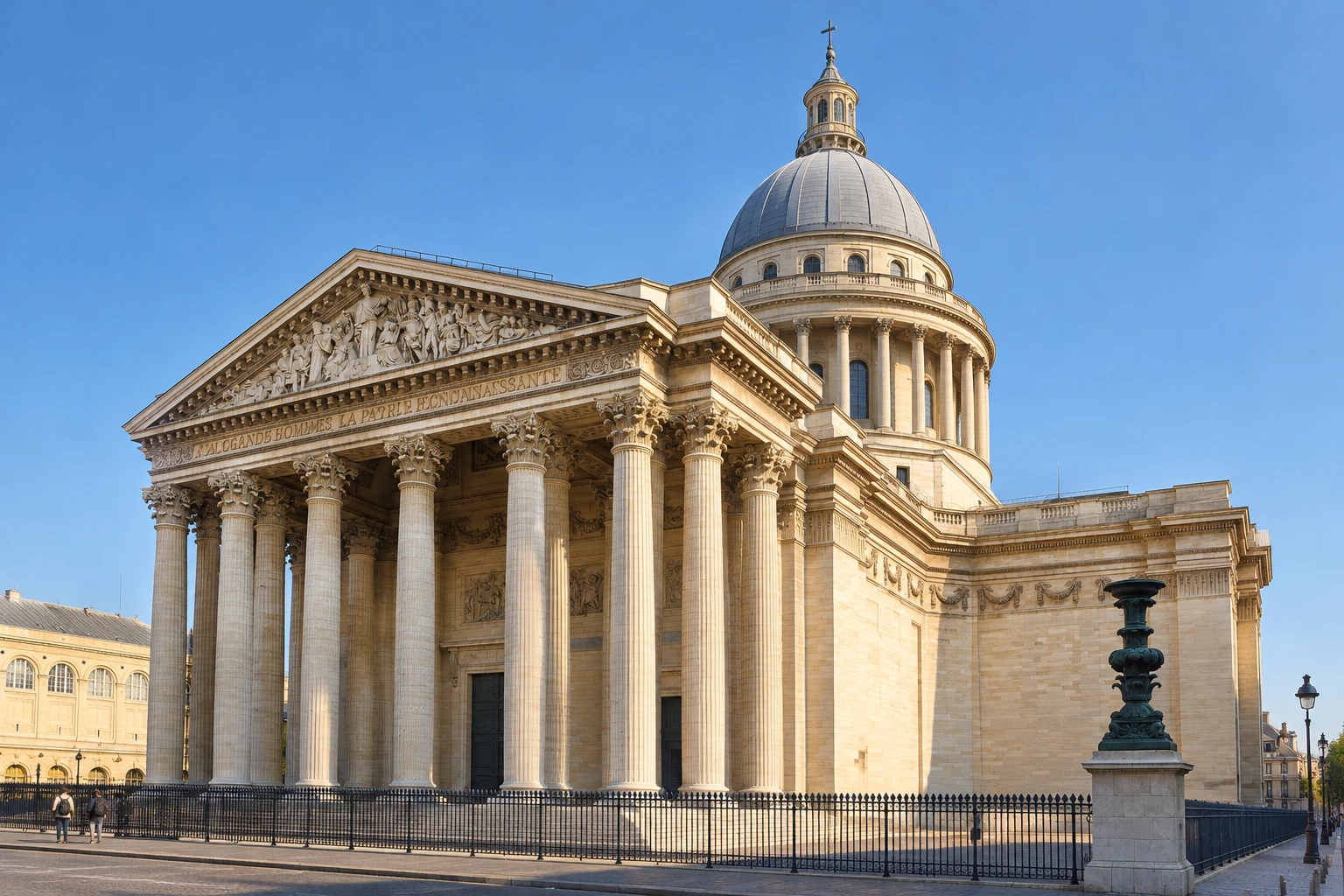
Monument · Paris, France
Panthéon
A neoclassical temple on the top of the Quartier Latin where Voltaire, Victor Hugo, Émile Zola and Marie Curie are buried, with the Foucault pendulum under the dome. Around it are the Sorbonne and rue Mouffetard.
Illustrative images. The pictures in this guide are illustrations based on the real place, not photographs, and may differ from it.

Discover
About Panthéon
The Panthéon began as a church dedicated to Saint Genevieve, patron saint of Paris, commissioned by Louis XV. The design is by Jacques-Germain Soufflot; construction began in 1758 and finished in 1790, under Jean-Baptiste Rondelet. During the French Revolution the building was converted into a mausoleum for the nation’s leading figures.
In the crypt are Voltaire, Rousseau, Victor Hugo, Émile Zola, Marie Curie and Simone Veil, among others. Josephine Baker has a cenotaph there, an honor without the body. Beneath the dome swings a copy of the pendulum with which Léon Foucault demonstrated the Earth's rotation in 1851.
In the European summer the upper part of the monument often opens to visitors, offering 360-degree views over Paris. Access is separate and limited; check whether it is open at the time of your trip.
The Panthéon sits atop the Montagne Sainte-Geneviève, in the heart of the Quartier Latin, the university quarter since the Middle Ages. Within a few steps are the Sorbonne, the church Saint-Étienne-du-Mont and the rue Mouffetard, a sloping street with a market, bakeries, cheese shops and simple restaurants. The Jardin du Luxembourg is about a 5-minute walk away.
Before you go
Practical information
Cidade Turismo reviews its information regularly, but something may have changed. Check with the place before planning your trip.
How much time to set aside
About 1 hour for the interior and the crypt. Add 1 to 2 hours to walk around the Quartier Latin and go down rue Mouffetard.
Best time
In the morning, to see the Panthéon at a relaxed pace and then head to the rue Mouffetard market, which is busiest Tuesday through Sunday mornings. The upper viewing area usually only opens in the European summer (roughly June to August).
How to get there
By RER B, Luxembourg station, about a 5-minute walk. By metro, line 10, Cardinal Lemoine station. From Notre-Dame it’s about a 15-minute walk uphill through the Quartier Latin.
Tip
Combine it with the Jardin du Luxembourg and the Musée de Cluny, which are in the same neighborhood. For cheap lunch options, rue Mouffetard and the streets around place de la Contrescarpe have crêperies and bistros. Keep in mind that many restaurants close their kitchens between lunch and dinner.
Official website
Your questions
Frequently asked questions about Panthéon
Who is buried in the Panthéon?
Figures from French history, such as Voltaire, Rousseau, Victor Hugo, Émile Zola, Alexandre Dumas, Marie Curie and Simone Veil. Josephine Baker has a cenotaph, an homage without the body.
Can you go up the Panthéon?
The upper part, with views over Paris, is usually open only in the European summer and with limited slots. Check if it's open on your travel dates and book in advance.
What is the Quartier Latin?
It's the university quarter on the left bank of the Seine, dating back to the Middle Ages. The name comes from Latin, the language of students at the time. It includes the Sorbonne, the Panthéon, the Musée de Cluny, bookstores, independent cinemas and simple restaurants.
Can you visit the Sorbonne?
The Sorbonne is an active university and the interior is not open to free visits. You can see the façade and the Sorbonne square. Check whether guided tours are offered during your travel dates.