

 Brazil
 Antarctica
 Argentina
 Bolivia
 Chile
 Colombia
 Ecuador
 Falkland Islands (Malvinas)
 French Guiana
 Guyana
 Paraguay
 Peru
 Suriname
 Uruguay
 Venezuela
 Austria
 Belgium
 Croatia
 Denmark
 Finland
 Germany
 Greece
 Hungary
 Iceland
 Ireland
 Italy
 Luxembourg
 Norway
 Poland
 Portugal
 Slovakia
 Slovenia
 Spain
 Sweden
 Switzerland
 the Czech Republic
 the Netherlands
 the United Kingdom
 Turkey
 Bermuda
 Canada
 Greenland
 Mexico
 Saint Pierre and Miquelon
 the United States
 the Dominican Republic
 Japan
 Egypt
 South Africa
 Australia
 Fiji
 New Zealand
 Papua New Guinea
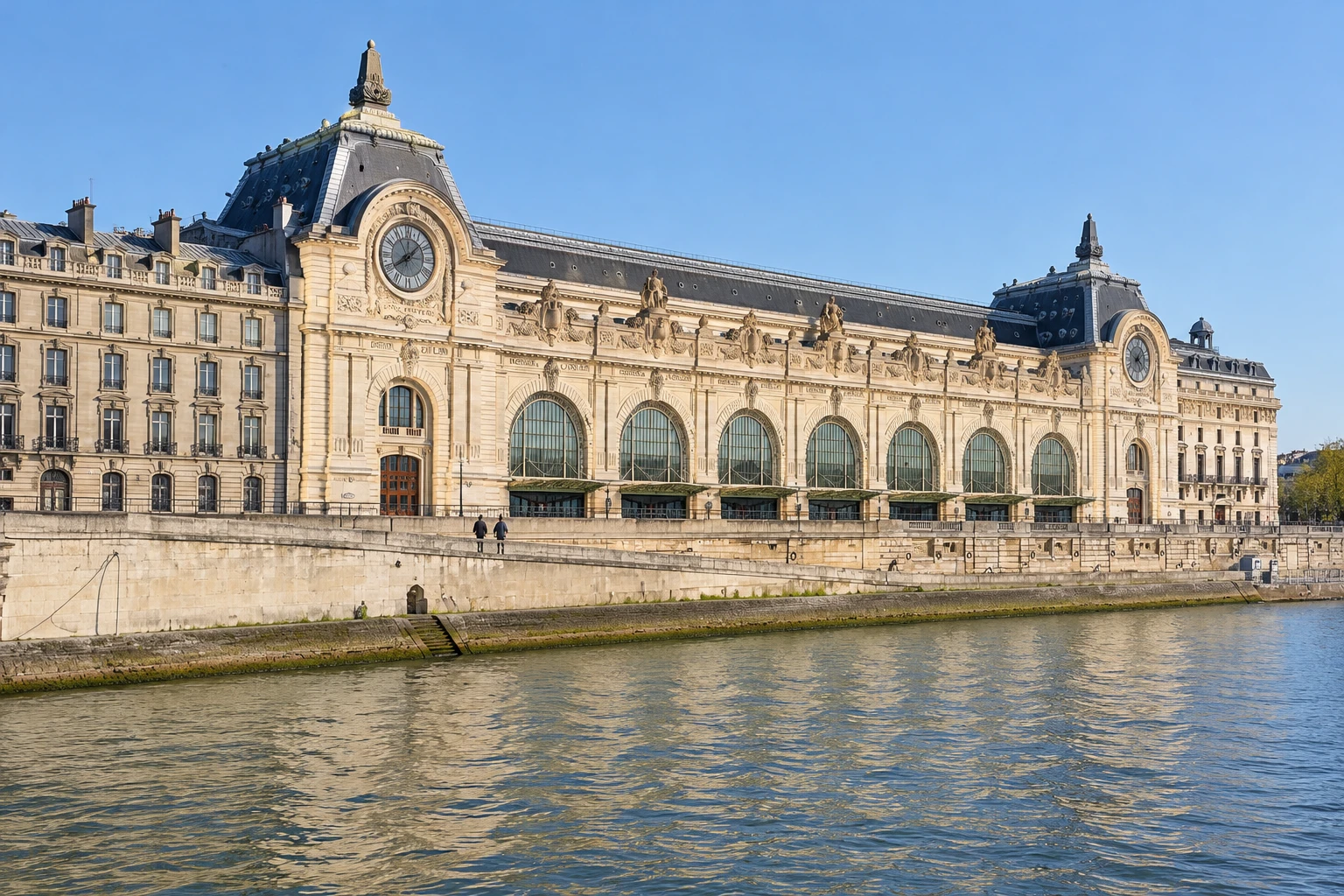
Museum · Paris, France
Musée d'Orsay
Former railway station on the banks of the Seine that houses the world's largest collection of Impressionists: Monet, Renoir, Degas, Manet, Van Gogh, Cézanne and Gauguin, with French art from 1848 to 1914.
Illustrative images. The pictures in this guide are illustrations based on the real place, not photographs, and may differ from it.

Discover
About Musée d'Orsay
The Musée d'Orsay occupies the former Gare d'Orsay, a railway station built between 1898 and 1900 for the 1900 Exposition Universelle. The building became a museum in December 1986. The central nave, with its glass roof and the large clock from the train era, is part of the visit.
The collection covers French art from 1848 to 1914: painting, sculpture, photography, furniture and decorative arts. It is the largest collection of Impressionist and Post-Impressionist works in the world, with Monet, Manet, Degas, Renoir, Cézanne, Seurat, Sisley, Berthe Morisot, Gauguin and Van Gogh.
The Impressionist rooms are on the top floor. There you can also see the giant façade clock from inside, with views over the Seine and the Louvre on the opposite bank. On the ground floor are the sculptures and 19th-century academic painting.
The museum is in the 7th arrondissement, on the left bank of the Seine, facing the Jardim das Tulherias. A pedestrian footbridge, the Passerelle Léopold-Sédar-Senghor, links the two banks and makes it easy to combine Orsay and the Louvre in the same day.
Before you go
Practical information
Cidade Turismo reviews its information regularly, but something may have changed. Check with the place before planning your trip.
How much time to set aside
2 to 3 hours to see the Impressionists and the main parts of the central hall. Art lovers can spend half a day.
Best time
Right at opening or late in the afternoon, when lines are smaller. On late-opening nights (usually Thursdays; check) the museum is quieter. During the European summer (June to August) and on public holidays visitor numbers are much higher. The museum is usually closed on Mondays.
How to get there
By RER C, get off at Musée d'Orsay station, which is next to the museum. By metro, take line 12 to Solférino station, about a 5-minute walk. On foot it's roughly 10 minutes from the Louvre, crossing the Seine via the pedestrian footbridge.
Tip
Buy a timed-entry ticket online before you go: a reserved time helps avoid the queue. Start on the top floor, where the Impressionists are, before the rooms fill up. The café behind the giant clock has views of the Seine.
Official website
Your questions
Frequently asked questions about Musée d'Orsay
What's the difference between the Louvre and the Orsay?
The Louvre covers from Antiquity up to the mid-19th century. The Orsay starts where the Louvre ends: French art from 1848 to 1914, with a focus on Impressionism. Visitors with limited time who like Monet and Van Gogh often prefer the Orsay, which is smaller and easier to get through.
Can you visit the Louvre and the Orsay on the same day?
Yes, since they're opposite each other across the Seine. But it's tiring. Do one in the morning and the other in the afternoon, with a lunch break, and select only the main rooms of each.
Do you need to buy tickets in advance?
It's recommended. Purchasing tickets in advance with a timed entry greatly reduces waiting at the entrance, especially in the European summer and on weekends. Check the booking rules before you go.
Does the Orsay open every day?
No. The museum usually closes on Mondays and on certain holidays. Check the calendar before planning your itinerary.