Carcassonne and Toulouse

Occitanie

Carcassonne and Toulouse

The brick city on the banks of the Garonne and the medieval walled city on the Aude, connected by train in about an hour and by the Canal du Midi.

South

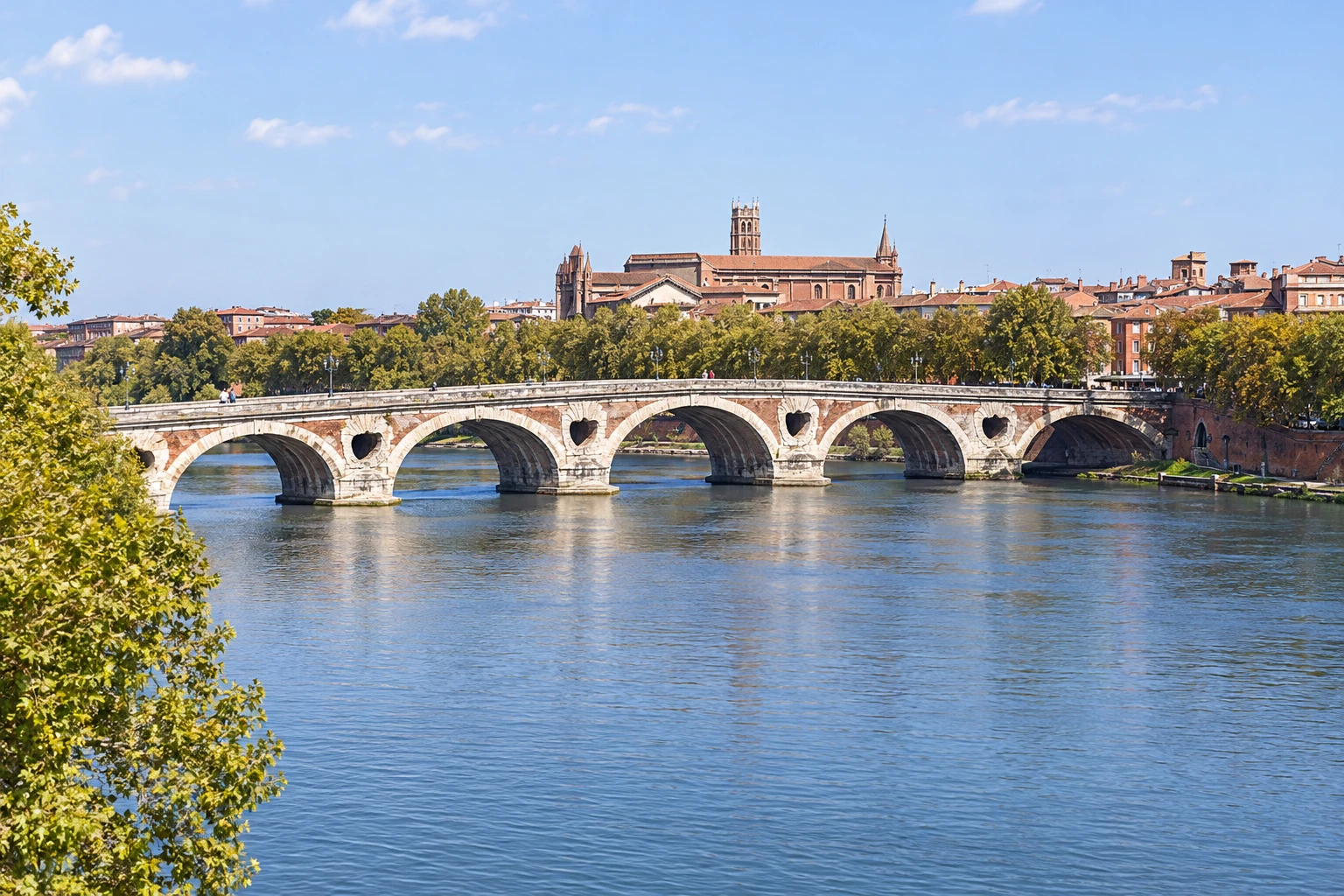
In the photo: Pont-Neuf de Toulouse, France.

Illustrative images. The pictures in this guide are illustrations based on the real place, not photographs, and may differ from it.

Get it on Google Play

Get to know the place

A region to enjoy
at your own pace.

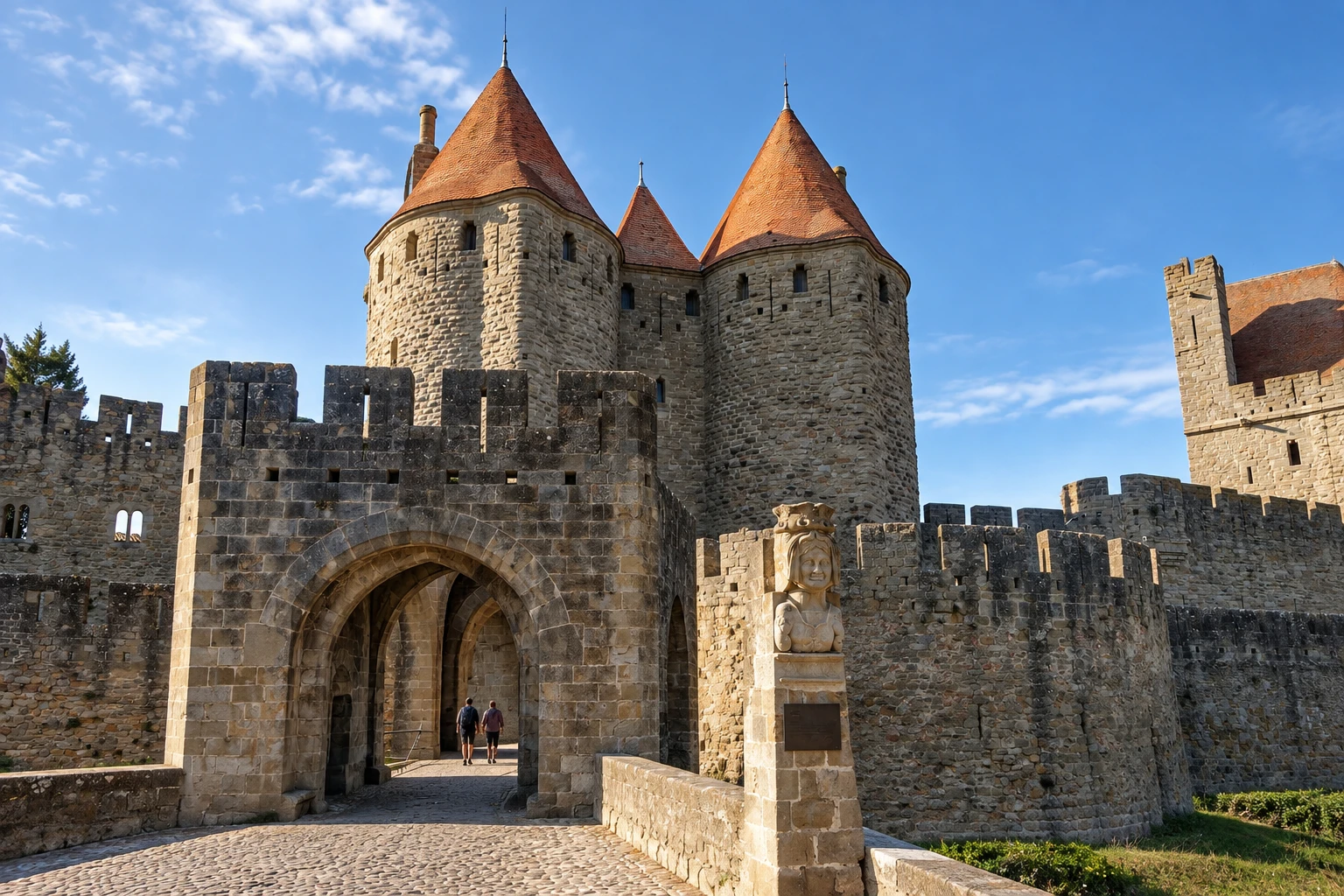
Toulouse and Carcassonne are in Occitanie, in southern France, about 90 km from each other. Toulouse is the regional capital and the fourth-largest city in the country; Carcassonne is much smaller and known worldwide for the Cité, the medieval city surrounded by a double wall with 52 towers.

Toulouse has the nickname ville rose, the pink city, because of the brique foraine, the fired clay brick that dominates churches, townhouses and houses in the centre and takes on a pinkish or orangey hue depending on the light. The Basilique Saint-Sernin, the Capitole and the Couvent des Jacobins are there. The city is also home to Airbus and is one of Europe’s main aerospace centres, which explains the Cité de l'espace and the Aeroscopia museum.

Carcassonne has two parts: the Cité, on top of the hill, a UNESCO World Heritage Site since 1997, and the Bastide Saint-Louis, the lower town with a grid of streets, where the train station and shops are. Around it, in the Corbières and the Montagne Noire, lie ruined castles linked to the history of the Cathars, such as Lastours, Peyrepertuse and Quéribus.

What links the two cities is the Canal du Midi, opened in the 17th century to connect Toulouse to the Mediterranean and a World Heritage Site since 1996. On the table, the region’s dish is cassoulet, a stew of white beans with meats, cooked in an earthenware pot called a cassole.

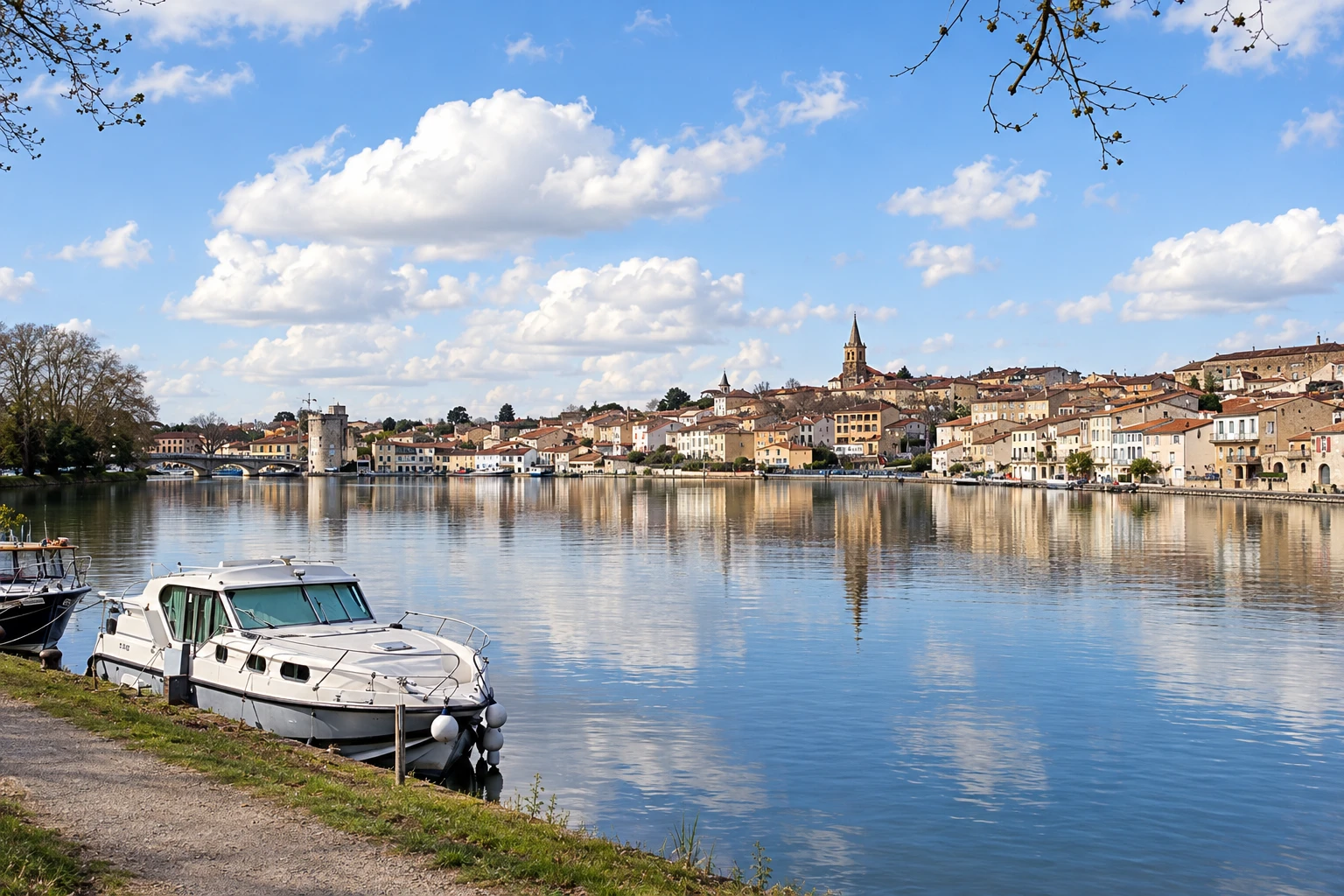
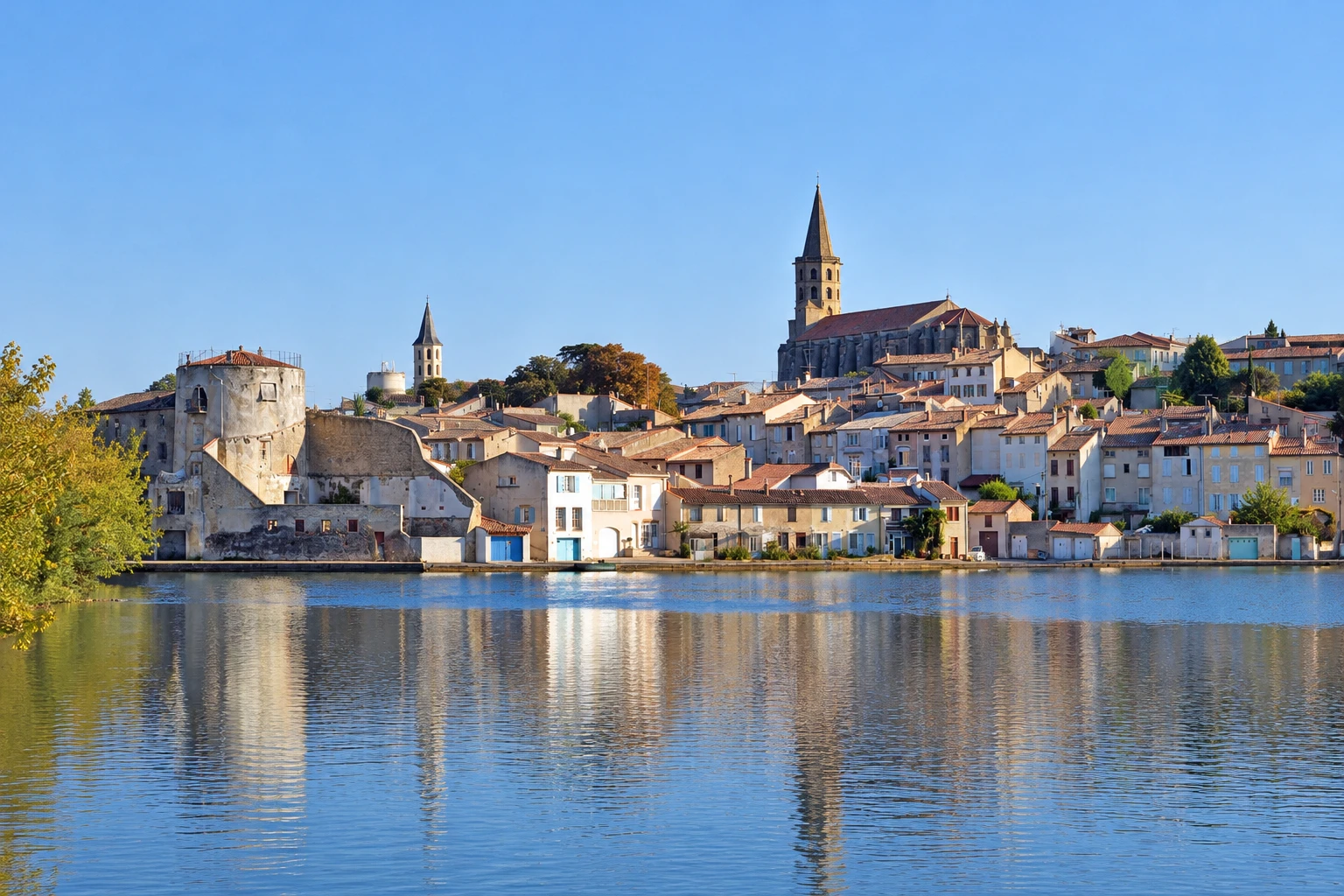
This destination brings together 3 cities: Toulouse, Carcassonne, Castelnaudary.

Share: WhatsApp
Traveler, share your experiences through photos Up to 5 photos of each place you visited.

One destination, many paths

The cities on this trip

Start with one city or combine several in your itinerary.

Where Carcassonne and Toulouse is The star marks the capital, Toulouse.
ToulouseCarcassonneCastelnaudary

Outlines: © IGN, ADMIN EXPRESS, Licence Ouverte 2.0. Adapted by Cidade Turismo.

How to get there: Carcassonne and Toulouse

Aéroport Toulouse-Blagnac (TLS), in Blagnac · 10 km to Toulouse

The gateway is Toulouse-Blagnac airport (TLS). Flights from Brazil usually involve a connection in another city. Check before buying. From Paris, the TGV reaches Gare de Toulouse-Matabiau in just over 4 hours. Between Toulouse and Carcassonne, regional and long-distance trains take from 45 minutes to about 1 hour.

Suggested arrival point: Toulouse

The local experience

Things to do in Carcassonne and Toulouse

Toulouse · Occitanie · Square

Place du Capitole

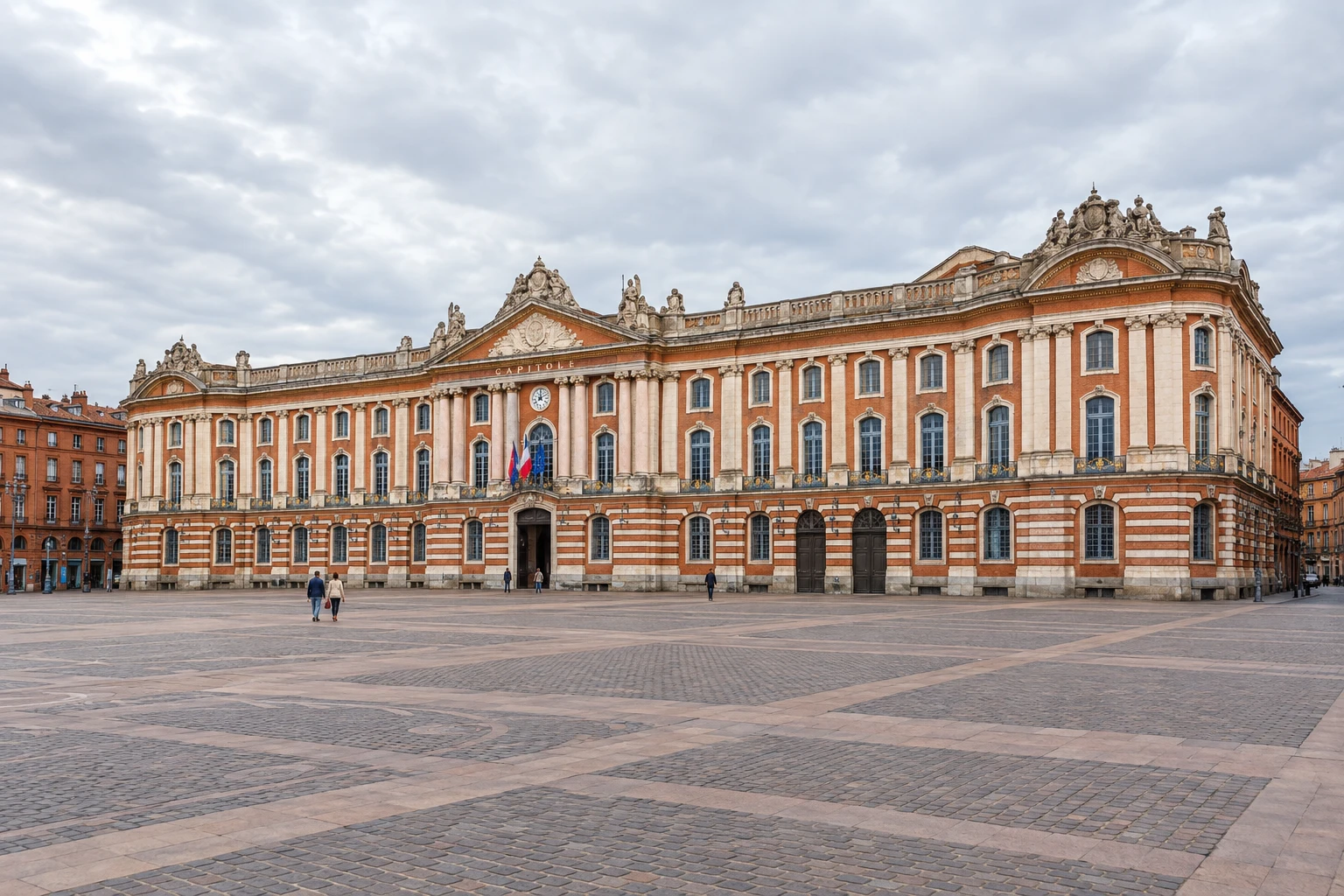
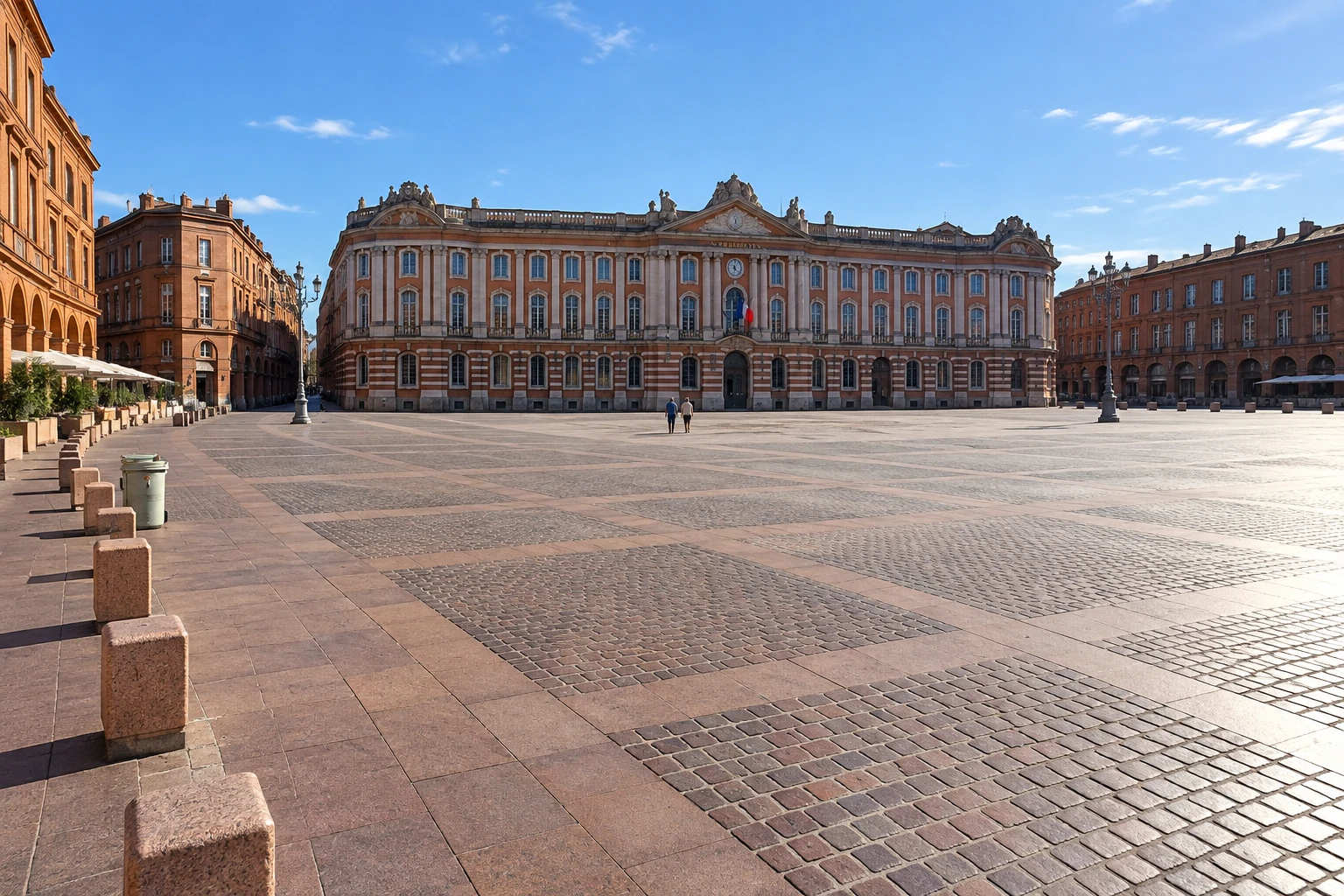
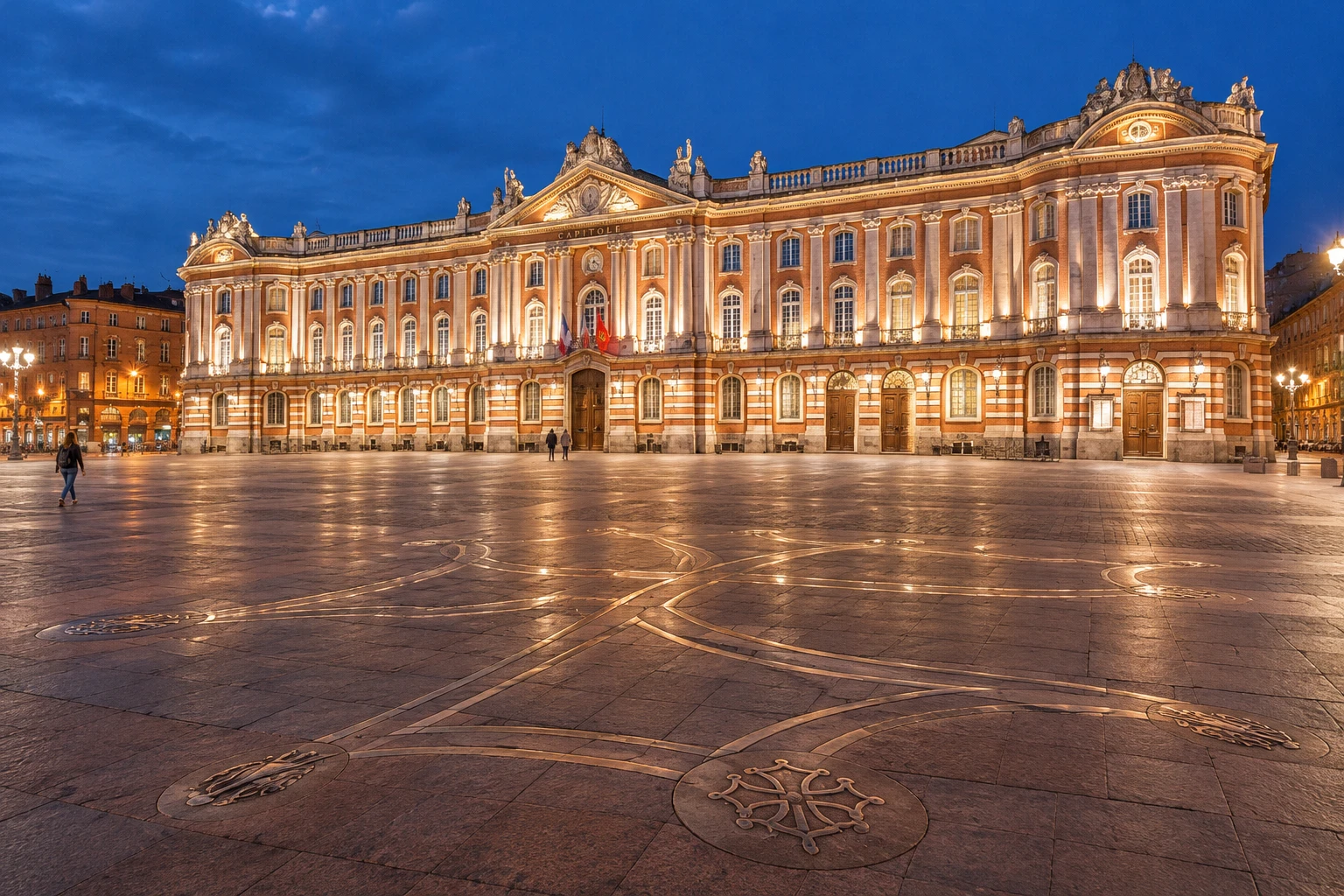
The central square of Toulouse, facing the brick-and-stone façade of the Capitole, with the Occitan cross drawn on the paving and cafés around it.

Explore Place du Capitole

See 22 more places in Carcassonne and Toulouse

To choose before you go

Tours in Carcassonne and Toulouse

Where each tour starts, how long it takes, how it is done, what is included and the price range.

La Cité de Carcassonne: ramparts, lices, Porte Narbonnaise and Basilique Saint-Nazaire

From Carcassonne (Porte Narbonnaise or Porte d'Aude) On foot, on your own or with a guided tour about 3 hours morning or afternoon easy (ascent and cobbled streets)

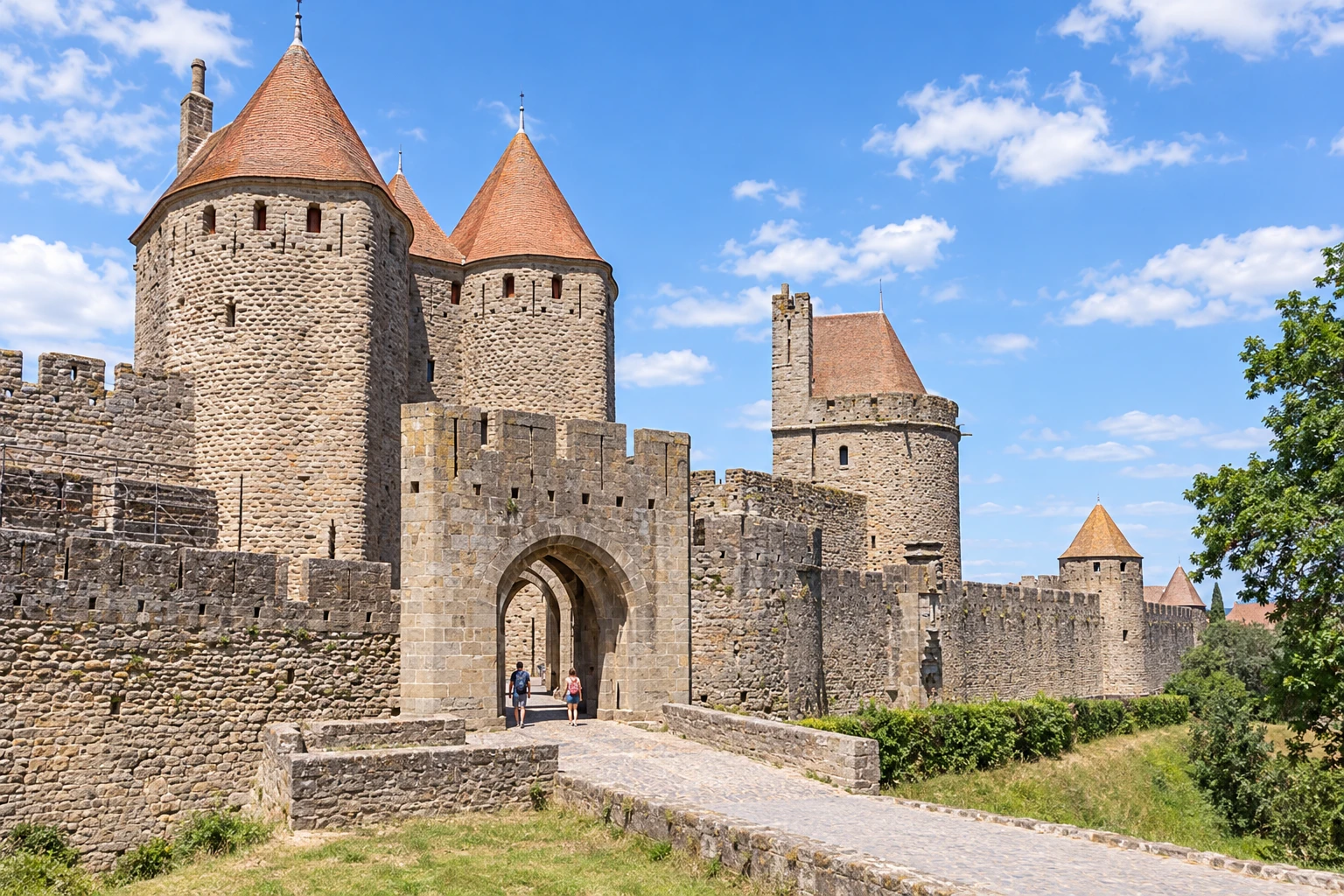
La Cité is the fortified medieval town of Carcassonne, atop a hill on the right bank of the Aude, southeast of the lower town. It has a double ring of ramparts about 3 km long and 52 towers, and has been a UNESCO World Heritage Site since 1997. Its origins come from a Gallic settlement and the Gallo-Roman town; the Marquière and Moulin d'Avar towers still preserve sections of the ancient wall. The main entrance is the Porte Narbonnaise to the east; on the west side, the Porte d'Aude climbs from the lower town by a steep path. Between the two ramparts is the lice, a flat strip that served for defense and is now the quietest promenade of the Cité: it runs outside the inner wall, with views of the towers. Inside, the stone streets lead to the Place du Château and the Basilique Saint-Nazaire, the former cathedral: the nave is Romanesque, from the 12th century, and the choir and transept are Gothic, built between 1269 and 1330, with stained glass from the 13th and 14th centuries and two large rose windows. In the 19th century the Cité was in ruins and was restored under Viollet-le-Duc; the conical slate roofs of the towers date from that restoration and still prompt debate today. The Cité is a residential neighborhood, open day and night.

Stops: Cité de Carcassonne, Porte Narbonnaise, Porte d'Aude, Lices, Basilique Saint-Nazaire.

Includes: Access to the Cité, the lices and the basilica is free. The castle and the walk along the ramparts require separate tickets. The Tourist Office sells daytime guided tours and a paid nighttime visit with lanterns; check the current rate table.

Tip: Enter through the Porte Narbonnaise and exit via the Porte d'Aude to walk down to the Pont-Vieux and the Bastide Saint-Louis. Early in the morning and at the end of the day there are fewer people on the streets. At night, with the ramparts illuminated, it’s worth returning for a stroll along the lices.

Best time: All year. From April to June and in September and October the heat is milder and the streets are less busy than in July and August.

Château comtal and the ramparts of Carcassonne: the castle and the walk on the walls

From Cité de Carcassonne (Place du Château) Visit with ticket, self-guided or guided about 1½ to 2 hours morning or afternoon easy (stairs in the towers)

The Château comtal is the castle within the Cité, managed by the Centre des monuments nationaux. It began as the palace of the Trencavel viscounts around 1130, on the Gallo‑Roman wall, and was fortified during the Albigensian Crusade from 1209. The Tour Pinte, the highest tower of the fortress, was raised in that phase. In 1226 the Cité came under the king of France, and the castle became the residence of the seneschal, the king’s representative; in the 13th century a second wall completed the defenses. The self-guided visit passes through the castle rooms and ramparts walk and the archaeological store, with items such as the sculpture of Dame Carcas and a mural painting. It then continues along a stretch of the wall, with views over the lower town, the plain of the Carcassès, the Montagne Noire and, on clear days, the Pyrenees; at the top of the Tour-Porte Saint-Nazaire there is an orientation table. The castle and walls are part of the Forteresses royales capétiennes du Languedoc ensemble, inscribed as a UNESCO World Heritage site along with seven regional castles, including Lastours, Peyrepertuse and Quéribus.

Stops: Château comtal, Remparts de Carcassonne, Tour Pinte, Tour-Porte Saint-Nazaire.

Includes: There is an entrance fee, with different prices for high and low season; booking a timed slot is recommended. An audio guide is available in French, English and Spanish and guided tours (Découverte, about 1 hour, and the Privilège visit, with towers closed to the public) are extra. Check the current pricing.

Tip: Buy a timed ticket in summer. Avoid the last time slot of the day: areas close gradually and a full visit may not fit. The monument is closed on January 1, May 1 and December 25.

Best time: All year. In summer the opening hours extend into early evening; from October to March the monument closes earlier.

Toulouse on foot: Place du Capitole, Basilique Saint‑Sernin and Couvent des Jacobins

From Place du Capitole (metro A, Capitole station) On foot, independently or with a guided tour about 4 hours morning or afternoon easy

Toulouse is called the "Ville rose" (pink city) because of the fired clay brick, the traditional local material that gives façades tones ranging from pink to orange. The walk starts at Place du Capitole, with a 12‑point Occitan cross and the signs of the zodiac in the pavement. The Capitole, seat of the town hall for more than eight centuries, has a 1750 façade of brick and stone with eight columns that recall the first eight capitouls, the city’s magistrates. Inside are the town hall and the Théâtre du Capitole; the state rooms on the first floor, such as the Salle des Illustres with paintings about Toulouse’s history, can be visited. Behind, in the former Donjon, is the Office de Tourisme. To the north, the Basilique Saint‑Sernin, built between the 11th and 13th centuries, is one of the largest Romanesque churches in Europe and a UNESCO World Heritage site as part of the Routes of Santiago de Compostela in France. Notice the octagonal bell tower of 65 m, the Porte Miègeville from the early 12th century, and the crypts with reliquaries. Beside it, the Musée Saint‑Raymond displays Toulouse archaeology, including Roman sculptures. The walk ends at the brick Couvent des Jacobins, from the 13th–14th centuries: in the choir a column fans into 22 ribs up to 28 m high, the "palmier"; under the altar are the relics of Saint Thomas Aquinas, and the cloister contains a garden.

Stops: Place du Capitole, Capitole of Toulouse, Salle des Illustres, Donjon du Capitole, Basilique Saint‑Sernin, Musée Saint‑Raymond, Couvent des Jacobins.

Includes: The Couvent des Jacobins and the Musée Saint‑Raymond charge admission; also check what is charged for the crypts at Saint‑Sernin. The Office de Tourisme sells guided tours that are paid separately; check the current price list.

Tip: For lunch, the city’s dish is cassoulet: white beans slow-cooked with duck confit and Toulouse sausage, served in the cassole, the earthenware pot that gives the dish its name. The Pass Tourisme, sold at the Donjon, bundles museum and monument entries for 1 to 3 days.

Best time: All year. In summer, start early and save interiors for the hottest hours.

Pont Neuf and the Garonne banks: Quai de Tounis, Prairie des Filtres and Hôtel-Dieu

From Toulouse center (Place du Pont-Neuf) On foot about 2 hours afternoon easy

The Pont Neuf, despite its name, is Toulouse’s oldest bridge over the Garonne. Construction began in 1544 at the initiative of King Francis I and was only completed in 1632 after several floods; the piers have circular openings to relieve the force of the water. On the right bank, the Quai de Tounis and the riverside ramps are the meeting place for Toulousans at the end of the afternoon. Crossing the bridge to the left bank, in the Saint-Cyprien district, the 18th-century Cours Dillon was built as a quay; below it lies the Prairie des Filtres, a public garden with views of the Pont Neuf and the Quai de Tounis. On the same bank are the Hôtel-Dieu Saint-Jacques, the former pilgrims’ hospital on the Camino de Santiago, with its brick façade by the water, and the dome of the La Grave hospital, the Dôme de la Grave. Back on the right bank, a few steps from the bridge, the Hôtel d'Assézat, a 1555 Renaissance townhouse with a cour d’honneur, home to the Collection Bemberg, shows the wealth that the pastel trade—the plant that produced blue dye—brought to Toulouse in the 16th century.

Stops: Pont-Neuf, Garonne, Quai de Tounis, Prairie des Filtres, Cours Dillon, Hôtel-Dieu Saint-Jacques, Dôme de la Grave, Hôtel d'Assézat.

Includes: Walk without ticket: the courtyard of the Hôtel d'Assézat and the gardens on the Garonne bank are open. Museums and exhibitions along the way charge separately.

Tip: Go at late afternoon to see the sunset over the Garonne and the brick façades change color. In summer there are riverside bars (guinguettes) and activities along the banks.

Best time: From April to October, with longer days; in summer, late afternoons are most pleasant.

Cité de l'espace: Ariane 5 rocket, Mir space station and planetarium

From Toulouse (east of the city) Metro and Linéo L12 bus, or car full day (the park suggests 2 days) morning and afternoon easy

The Cité de l'espace is a science park about space, opened in 1997 in the east of Toulouse, a city at the heart of the French aerospace industry. It covers 4 hectares of gardens with full-scale exhibits: a replica of the Ariane 5 rocket, 53 m tall; a Soyuz capsule; the Apollo lunar module; satellites and a lunar rover. One highlight is the engineering model of the Mir space station, with original equipment, which you can enter to see how astronauts lived and worked. The pavilions feature exhibits on the Moon, the Solar System, Earth as seen from orbit, rocket launches (including a Vulcain engine from the Ariane 5), and a control centre that follows International Space Station missions. The planetarium seats 280 and has a hemispherical screen; there is also an IMAX theatre and a smaller planetarium for children. The park recommends two days to see everything; if you only have one day, choose the exhibits and sessions before you arrive.

Stops: Cité de l'espace, Ariane 5, Station spatiale Mir, Planetarium, IMAX.

Includes: There is an admission fee, available for advance purchase online; planetarium and IMAX sessions follow the day’s program. Check the current schedule and opening calendar.

Tip: Check session times in the park app two days in advance. By metro: line A to Roseraie or line B to Rangueil, then the Linéo L12 bus to the Cité de l'espace stop. Bag checks are performed at the entrance.

Best time: All year; a good option for rainy days or very hot weather. Visitor numbers are higher during French school holidays and in July and August.

Aeroscopia and Airbus visit in Blagnac: Concorde, A380 and the assembly line

From Toulouse (Blagnac, next to the airport) Tram T1 to Beauzelle-Aeroscopia, or by car about 4 to 5 hours morning or afternoon easy

Aeroscopia is the aviation museum in Blagnac, opposite the Airbus factories and next to the airport. The main hangar, 8,000 m², houses commercial, military and experimental aircraft, including two Concordes, an Airbus A300 and the Super Guppy, the cargo plane that carried aircraft parts between factories. In the outdoor apron there is an A380 that can be visited internally. There is also a restoration workshop where volunteers recover vintage aircraft. The Airbus visit is by reservation and departs from the museum: a guide leads the group to part of the Blagnac industrial complex; some programs include the A350 and A321 production lines. Visits are offered in French, English or Spanish according to the schedule. If you combine the museum and the Airbus visit on the same day, you do the factory visit at the reserved time and the museum whenever you like.

Stops: Musée Aeroscopia, Concorde, Airbus A380, Super Guppy, Airbus.

Includes: The museum requires an admission ticket; the Airbus visit is paid separately or as part of a combined ticket with the museum on the same day. Check the current pricing schedule.

Tip: Book the Airbus visit at least two business days in advance; slots often sell out, so check the ticket office two to three weeks before. For non–European Union visitors only the original passport is accepted. Cameras and phones for photography are not allowed during the Airbus visit. The museum hangar has no air conditioning or heating.

Best time: All year. In high summer and winter, dress with the non-climatized hangar in mind.

See 11 more tours

Halle de La Machine and the Minotauro ride, on the Piste des Géants

From Toulouse (Montaudran neighborhood) Linéo L12 bus, regional train to Montaudran or bicycle about 2 to 3 hours morning or afternoon easy

The Halle de La Machine is the 4,000 m² shed where the company La Machine, led by François Delarozière, stores and operates the machines used in its street performances. It is in Montaudran, next to the Piste des Géants, the former runway of the aerodrome from which Aéropostale flights departed. The star is Astérion, the Minotaur, created for Toulouse: made of wood and steel, weighing 47 tons and 14 m tall, it gallops, rears and can carry up to 49 passengers on its back for roughly 30-minute rides along the Piste des Géants. Inside the Halle, the visit is self-guided: the machinists, who are actors, musicians and builders, run the machines in front of the public, and there are scheduled demonstrations during the day. In the same shed are the giant spider Ariane and the Manège Carré Sénart carousel, with mechanical buffalo and insects. The visit appeals to children and to anyone interested in mechanics and street theatre.

Stops: Halle de La Machine, Astérion le Minotaure, Piste des Géants, Montaudran.

Includes: There is an entrance fee for the Halle and a separate ticket for the Minotauro ride, with a combined offer on the same day. Seats on the Minotauro are limited and online reservation is recommended. Check the current fees.

Tip: The Halle is open Tuesday through Sunday and closed in January. From the center you can reach it by bicycle following the Canal du Midi. In summer there are night trips on the Minotauro on Fridays and Saturdays.

Best time: From February to December; in summer and school holidays the program is longer and there are more Minotauro departures.

Canal du Midi in Toulouse: Port de l'Embouchure, Ponts-Jumeaux and cycling on the greenway

From Toulouse (gare Matabiau or Port de l'Embouchure) On foot or by bicycle (VélôToulouse or rental) 2 hours to half a day morning or afternoon easy (flat)

The Canal du Midi links Toulouse to the Étang de Thau, near Sète on the Mediterranean: it is 241 km, built between 1666 and 1681 under the direction of Pierre-Paul Riquet, who brought water from the Montagne Noire to the seuil de Naurouze, the canal's highest point. It has been a UNESCO World Heritage Site since 1996. In Toulouse the canal runs in front of Matabiau station, shaded by plane trees. The classic starting point is Port de l'Embouchure, where three canals meet: the Canal du Midi, the Canal de Brienne, which connects it to the Garonne, and the Canal latéral à la Garonne, which continues toward Bordeaux. Between the Ponts-Jumeaux, the twin bridges, there is a Carrara marble bas-relief made by François Lucas between 1773 and 1775. Those who want to cycle farther can follow the greenway of the old towpath: it is 50 km of flat terrain from Toulouse to Avignonet-Lauragais, about 3½ hours by bike, with locks, bridges and brick villages along the way. Riquet died in 1680, before the inauguration, and is buried in the Cathédrale Saint-Étienne.

Stops: Canal du Midi, Port de l'Embouchure, Ponts-Jumeaux, Canal de Brienne, Canal latéral à la Garonne.

Includes: The towpath along the canal is open and does not require an entrance fee. VélôToulouse bikes and rentals are paid separately; check the current price list.

Tip: For a short outing, walk from Matabiau station to Port de l'Embouchure along the canal bank and return via the Canal de Brienne. Bring water in summer: there is shade, but it gets hot.

Best time: From April to October. In spring and early autumn temperatures are milder for cycling.

Boat on the Canal du Midi in Carcassonne: locks, aqueduct and view of the Cité

From Port de Carcassonne (in front of the train station) Sightseeing boat with commentary about 1.5 to 2 hours morning or afternoon easy

In Carcassonne, the Canal du Midi runs north of the lower town, between the train station and the André-Chénier garden, next to the Bastide Saint-Louis. Sightseeing boats with commentary depart from Port de Carcassonne, such as those of Lou Gabaret, on routes of 1.5 to 2 hours. The boat passes through locks, which show how the canal overcomes changes in elevation, the Épanchoir de Foucaud, a spillway, and an aqueduct where the boat crosses a river above it. In some stretches the silhouette of the Cité appears in the distance. There are also boat rentals without a license for those who want to spend several days on the canal, departing from Carcassonne toward Castelnaudary or the Mediterranean. The canal has 63 locks in total and has been a UNESCO World Heritage Site since 1996.

Stops: Canal du Midi, Port de Carcassonne, Écluse de Carcassonne, Épanchoir de Foucaud.

Includes: Boat tours are paid separately, with fares for adults and children. In July and August there is also a tour with a stop for a picnic in a garden and a visit to a lock keeper's house. Check the current rates.

Tip: The port is a few steps from the station: you can take the boat tour on arrival or before catching the train. Book in July and August.

Best time: The sightseeing boat season generally runs from April to October; July and August have more departures.

Bastide Saint-Louis and Pont-Vieux: the lower town of Carcassonne

From Carcassonne (Place Carnot) On foot about 2 hours morning or afternoon easy

The Bastide Saint-Louis, or lower town, is the everyday center of Carcassonne, founded in the 13th century on the other side of the Aude, opposite the Cité. The streets form a right-angle grid around a central square, Place Carnot, where the market takes place; several streets are pedestrian. The boulevards surrounding the neighborhood follow the line of the old walls, demolished in 1764. The wealth from the woolen cloth trade left townhouses (hôtels particuliers) and churches throughout the neighborhood. To go to the Cité, walk across the Pont-Vieux, a pedestrian bridge over the Aude with a direct view of the ramparts, then through the Trivalle quarter. At number 77 Rue Trivalle, the Maison de la Laine et du Drap tells the story of Carcassonne’s textile industry, from merino sheep wool to dyeing, including the Carcassonne blue. From the Bastide to the Cité is about a 15-minute walk; from the Canal du Midi to the Cité via the Pont-Vieux is about 25 minutes.

Stops: Bastide Saint-Louis, Place Carnot, Pont-Vieux, Trivalle, Maison de la Laine et du Drap.

Includes: Walk without an entrance fee. The Maison de la Laine et du Drap has a separate admission fee; check the current rates.

Tip: Take the Pont-Vieux route late in the afternoon, when the light hits the ramparts. In the Bastide, try the cassoulet at restaurants: the region contests with Castelnaudary and Toulouse the origin of the dish.

Best time: All year. On market days, Place Carnot is busier.

Musée des Augustins: fine arts in a Gothic convent in Toulouse

From Toulouse center (metro A, Esquirol station) Visit with admission about 2 hours morning or afternoon easy

The Musée des Augustins is Toulouse’s fine arts museum, opened in 1795 in the former Augustinian convent, built from the 14th century. It is one of the oldest museums in France. The complex mixes brick and stone: the Gothic church, with a single nave, and the large cloister with garden are part of the visit. The collection holds over 4,000 works, from the Middle Ages to the early 20th century, including paintings and sculptures. The highlight is the room of Romanesque capitals, one of the most important collections of carved capitals in Europe, presented with a colored light installation by the artist Jorge Pardo. The monumental staircase created by Viollet-le-Duc and Denis Darcy in the 19th century, the Escalier Darcy, leads to the painting galleries, where large canvases from the 17th and 18th centuries sit alongside sculptures.

Stops: Musée des Augustins, Grand cloister, Escalier Darcy, Room of Romanesque capitals.

Includes: There is an admission fee; entry is included in the Toulouse Pass Tourisme. Check the current rate table.

Tip: Some rooms may be closed: check in advance what is open. Combine it with the Hôtel d'Assézat and the Collection Bemberg, a few minutes' walk away.

Best time: All year round; a good option for rainy days or very hot weather.

Collection Bemberg at the Hôtel d'Assézat: Bonnard and European painting

From Toulouse center (Place d'Assézat) Visit with ticket about 1 hour 30 minutes morning or afternoon easy

The Collection Bemberg (formerly Fondation Bemberg) is housed in the Hôtel d'Assézat, a Renaissance townhouse commissioned in 1555 by the merchant Pierre d'Assézat, who made his fortune from woad, the plant that produced blue dye. The design is by Nicolas Bachelier, a Renaissance architect in Toulouse; the ceremonial courtyard has facades with the three classical orders superimposed, a loggia and a tower topped by a lantern. The collection was assembled by the Argentine Georges Bemberg and lent to the city in 1994: paintings, sculptures, furniture and art objects from the 15th century to the mid-20th century. The highlight is the group of more than thirty canvases by Pierre Bonnard; there are also works from different European schools, a Venetian room and a Renaissance gallery occupying the entire north wing of the building. The museum underwent renovation and gained space for temporary exhibitions.

Stops: Hôtel d'Assézat, Collection Bemberg.

Includes: There is an entrance fee; entry is included with the Toulouse Pass Tourisme. The courtyard of the Hôtel d'Assézat can be seen without a ticket. Check the current schedule.

Tip: It’s just steps from the Pont Neuf: can be combined the same day with a walk along the banks of the Garonne.

Best time: All year.

Châteaux de Lastours: four castles above the Orbiel valley

From Carcassonne (to the north, in the Montagne Noire) By car about 4 hours, round trip morning or afternoon moderate (trail with uphill)

The Châteaux de Lastours are four ruined castles aligned on a rocky spur above the village of Lastours, north of Carcassonne in the Montagne Noire, between the Orbiel and Grésillou valleys. From north to south: Cabaret, the main castle; the Tour Régine, the smallest and most recent, built by the king’s order; Surdespine; and Quertinheux, isolated on a peak. In the time of the Cathars, Cabaret belonged to Pierre Roger de Cabaret, an ally of the Trencavel; the castles were besieged several times and surrendered in 1229. After the conquest they became part of the king’s defenses and today are included in the Forteresses royales capétiennes du Languedoc, a UNESCO World Heritage site. There are two ways to visit: the trail that climbs and crosses the four castles, about 2.5 hours, and the Belvédère, a viewpoint on the opposite side of the valley, accessible to everyone and offering a view of the whole ensemble.

Stops: Châteaux de Lastours, Cabaret, Tour Régine, Surdespine, Quertinheux, Belvédère de Lastours.

Includes: Visiting the castles and the belvédère requires an admission ticket. Check the current schedule/prices.

Tip: Wear sneakers with good soles; the trail has stones and steep sections. In summer climb early and carry water. Without a car, access is difficult: there are agencies and drivers in Carcassonne that run the excursion.

Best time: From April to October. In winter opening hours are shorter and there may be closures on bad-weather days.

Cathar castles of the Corbières: Peyrepertuse and Quéribus

From Carcassonne By car, via the Citadelles du vertige route about 9 hours full day moderate (ascents and rock steps)

Peyrepertuse and Quéribus are castles high in the Corbières, southeast of Carcassonne, called Cathar because of the history of the Albigensian Crusade; after that conflict they became royal fortresses on the border with the Kingdom of Aragon until 1659. The Office de Tourisme route leaves Carcassonne via Lagrasse and Villerouge-Termenès to Cucugnan, about 74 km and 1 hour 40 minutes by road. Quéribus is 3.7 km from Cucugnan, on a peak at 728 m altitude, with views over the plain of Roussillon, the sea and the Pyrenees. The donjon contains a Gothic chamber with a single central pillar that supports the vault, and from the high terrace you can see the whole region. Peyrepertuse lies nearby above Duilhac-sous-Peyrepertuse, on a limestone crest at about 800 m: the fortress is 300 m long, shaped like a ship of stone. From the car park, a path of about 15 minutes leads to the entrance; inside, the Saint Louis stairway, carved into the rock, climbs to the donjon Sant Jordi, the highest part. Both castles are part of the Forteresses royales capétiennes du Languedoc, a UNESCO World Heritage site.

Stops: Château de Peyrepertuse, Duilhac-sous-Peyrepertuse, Château de Quéribus, Cucugnan, Lagrasse, Villerouge-Termenès.

Includes: Each castle has its own ticket. Agencies and drivers based in Carcassonne run the tour; transportation and entrance fees are paid separately. Check the current pricing.

Tip: Wear closed shoes. On stormy days or in strong winds, the ascent to Peyrepertuse is often closed and the Saint Louis stairway becomes slippery: check the forecast beforehand. On the return, the route continues through the Gorges de Galamus and past Limoux.

Best time: From April to June and in September and October. In July and August, start early because of the heat; in winter the opening hours are limited.

Albi: Cathédrale Sainte-Cécile, Palais de la Berbie and Musée Toulouse-Lautrec

From Toulouse (Gare Matabiau) liO regional train to Albi-Ville about 8 hours, including the train full day easy

Albi is northeast of Toulouse, on the banks of the Tarn River. The regional train departs from Gare Matabiau and reaches Albi-Ville in 55 minutes to 1 hour 15 minutes. The Cité épiscopale, the historic brick center, has been a UNESCO World Heritage Site since 2010, and the city is nicknamed the "ville rouge" for the color of its buildings. The Cathédrale Sainte-Cécile, built between 1282 and 1480, is a brick fortress on the outside; inside, the walls and vaults are covered with paintings, including the large Last Judgment painting and Renaissance frescoes. Beside it, the Palais de la Berbie, the former fortified palace of the bishops from the 13th century, houses the Musée Toulouse-Lautrec, with more than a thousand works by the painter, who was born in Albi: paintings, drawings, lithographs and Paris cabaret posters. The palace garden overlooks the Tarn. The visit is completed by the Collégiale Saint-Salvi with its cloister, the streets of the center and the Pont-Vieux, from which you can see the cathedral and palace complex over the river.

Stops: Albi, Cité épiscopale d'Albi, Cathédrale Sainte-Cécile, Palais de la Berbie, Musée Toulouse-Lautrec, Collégiale Saint-Salvi, Pont-Vieux d'Albi, Tarn.

Includes: The Musée Toulouse-Lautrec requires an admission ticket, and parts of the cathedral also charge; the train is paid separately. Check the current pricing schedule.

Tip: From Albi-Ville station to the historic centre you can walk. Visit the museum in the morning and leave the cathedral and the banks of the Tarn for the afternoon. By car you can combine it with Cordes-sur-Ciel.

Best time: All year. In spring and autumn the heat is milder for walking around the centre.

Cordes-sur-Ciel: medieval hilltop village overlooking the Cérou valley

From Albi or Toulouse By car, or on regional bus liO 707 from Albi about 3 hours in the village morning or afternoon moderate (steep slopes)

Cordes-sur-Ciel is a bastide, a medieval new town, founded in 1222 by Count Raymond VII of Toulouse on a hilltop above the Cérou valley in the Tarn. The village was an important center in the time of the Cathars and retains medieval houses along winding streets that rise and fall with the terrain, between 159 m and 320 m in elevation. The visit is on foot, climbing the streets to the upper part, with views over the valley. Without a car, access is by regional bus liO 707, which links Cordes to Albi; the nearest train station, Vindrac, is 4.7 km away. By car, Cordes fits well on the same day as Albi. On July 14 the village hosts the medieval Grand Fauconnier festival.

Stops: Cordes-sur-Ciel, Cérou valley, Albi.

Includes: Walkable without an entrance fee. Museums and exhibitions in the village charge separately; check the current fee schedule.

Tip: Wear sturdy footwear: the streets are stone and steep. In summer, go early in the morning or late in the afternoon, when it is cooler and less crowded.

Best time: From April to October; on July 14 the Grand Fauconnier festival fills the village.

Corbières: Lagrasse and the Abbaye de Fontfroide

From Carcassonne By car about 8 hours full day easy

Lagrasse is a village in the Corbières, east of Carcassonne, at the bottom of the Orbieu valley, and carries the Les Plus Beaux Villages de France label. From Carcassonne, the route heads toward Narbonne, exits at Trèbes and continues via Fontiès-d'Aude. The Abbaye de Lagrasse, founded in the time of Charlemagne in 779, was the largest abbey in the Aude department. The visit displays structures from the 8th to the 18th century: the abbatial palace courtyard, the cellar, chapels, the pre-Romanesque tower, the ceremony hall and the dormitory. From the bridge over the Orbieu you can see the abbey in front of the village. In the afternoon, continue to the Abbaye de Fontfroide, 10 minutes from Narbonne: founded in 1093 and Cistercian from 1144, it sits isolated in a valley of the Corbières. The abbey is privately owned; in 1908 it was bought by artist and patron Gustave Fayet, who hosted musicians and painters there, such as Odilon Redon, and commissioned stained glass for the church. The visit goes through the cloister, the church and the monastery buildings, and includes the rose garden and the grounds, classified as a Jardin Remarquable.

Stops: Lagrasse, Abbaye de Lagrasse, Orbieu, Abbaye de Fontfroide, Narbonne.

Includes: Both abbeys require tickets; the Abbaye de Fontfroide sells visits online. Check the current schedule.

Tip: Without a car, the outing is difficult: there are agencies and drivers in Carcassonne that run tours through the Corbières. To return, the A61 motorway connects Narbonne to Carcassonne.

Best time: From April to October, with longer days suited for the drive.

Day by day

2, 3 and 5-day itinerary in Carcassonne and Toulouse

Suggestions to plan the trip. Change the order of the days according to the weather and tour availability.

2 days · Toulouse and Carcassonne in 2 days: Capitole, Saint‑Sernin and the medieval Cité

For For those short on time who want the essentials of both cities, all on foot and by train · Based in Toulouse (1 night) and Carcassonne (1 night)
  1. Day 1 · Arrival and Toulouse on foot

    For travelers arriving from Brazil: the overnight flight lands in the morning at Charles de Gaulle. Continue the same day to Toulouse on a domestic flight to Toulouse‑Blagnac, or reach Toulouse directly with a connection in a European city. From the airport, the Navette Aéroport takes you to the center and Matabiau station in under 25 minutes. In the afternoon, do Toulouse on foot: Place du Capitole, Basilique Saint‑Sernin and Couvent des Jacobins. At the end of the day, go down to Pont Neuf and the banks of the Garonne. Have a cassoulet for dinner. If you prefer to arrive rested, spend the first night in Paris and take the TGV from Paris‑Montparnasse the next morning.

  2. Day 2 · Train to Carcassonne: Cité, castle and Bastide

    In the morning, take the train from gare Matabiau to Carcassonne, 45 minutes to 1 hour. Leave your luggage and climb to the Cité de Carcassonne via Pont-Vieux. Visit the Château comtal and the ramparts with a timed ticket and then walk the lices and Basilique Saint-Nazaire. Late afternoon, descend to the Bastide Saint-Louis and Place Carnot. In the evening return to the Cité to see the walls illuminated. The next day continue by train or go back to Toulouse for your flight.

3 days · Toulouse and Carcassonne in 3 days: pink city, aviation and the Cité
For For those who want to see Toulouse at a relaxed pace, include Airbus or the Cité de l'espace and spend a full day in Carcassonne · Based in Toulouse (2 nights) and Carcassonne (1 night)
  1. Day 1 · Arrival and Toulouse city center

    For travelers arriving from Brazil: overnight flight to Charles de Gaulle and, the same day, a domestic flight to Toulouse‑Blagnac, or a European connection directly to Toulouse. From the airport, the Navette Aéroport to the center. In the afternoon, Place du Capitole and Basilique Saint‑Sernin; at the end of the day, Pont Neuf and the banks of the Garonne. If you prefer, spend the first night in Paris and continue by TGV the next day, shortening day 2.

  2. Day 2 · Toulouse aerospace or museums

    In the morning visit Aeroscopia and the Airbus tour in Blagnac, reachable by tram T1, with advance reservation and passport on hand. In the afternoon see Halle de La Machine and the ride on the Minotaur at Montaudran (closed Mondays and in January). With children or astronomy fans, swap the day for the Cité de l'espace. Those who prefer art can do Couvent des Jacobins, Musée des Augustins and the Collection Bemberg, ending at the Canal du Midi.

  3. Day 3 · Carcassonne: Cité, castle and canal

    Morning train from gare Matabiau to Carcassonne, 45 minutes to 1 hour. Go up to the Cité de Carcassonne, visit the Château comtal and the ramparts and have lunch inside the walls. In the afternoon descend via Pont-Vieux to the Bastide Saint-Louis. From April to October finish with the boat on the Canal du Midi, which departs in front of the station. Stay overnight in Carcassonne to see the Cité at night, or return to Toulouse by train.

5 days · Toulouse, Albi, Carcassonne and the Cathar castles in 5 days
For For those who want the complete itinerary, with a return train trip to Albi and a day by car among the castles of the Corbières · Based in Toulouse (3 nights) and Carcassonne (2 nights)
  1. Day 1 · Arrival and Toulouse on foot

    If you arrive from Brazil: the overnight flight lands in the morning at Charles de Gaulle; the same day take a connecting flight to Toulouse-Blagnac or arrive via a European connection direct to Toulouse. Navette Aéroport to the city center. In the afternoon visit Place du Capitole, Basilique Saint-Sernin and Couvent des Jacobins. End the day at Pont Neuf. Another option is to spend the first night in Paris and take the TGV from Paris-Montparnasse the next day, about 4 hours 20 minutes travel time.

  2. Day 2 · Museums, Garonne and Canal du Midi

    In the morning, Musée des Augustins and Collection Bemberg at the Hôtel d'Assézat. In the afternoon choose between Aeroscopia and Airbus (reservation and passport), the Cité de l'espace or Halle de La Machine. At the end of the day walk or cycle along the Canal du Midi to the Port de l'Embouchure and the Ponts-Jumeaux.

  3. Day 3 · Day trip to Albi

    Train from gare Matabiau to Albi-Ville, 55 minutes to 1 hour 15 minutes. Visit Cathédrale Sainte-Cécile, the Palais de la Berbie with the Musée Toulouse-Lautrec and the banks of the Tarn from Pont-Vieux. With a rental car continue in the afternoon to Cordes-sur-Ciel and return to Toulouse in the evening.

  4. Day 4 · Carcassonne: Cité, castle, Bastide and canal

    Train from Toulouse to Carcassonne in the morning. Cité de Carcassonne, Château comtal and ramparts, lices and Basilique Saint-Nazaire. In the afternoon Pont-Vieux and Bastide Saint-Louis; from April to October boat on the Canal du Midi. Pick up the rental car in town at the end of the day for the following day.

  5. Day 5 · Cathar castles by car

    Drive day through the Corbières: Peyrepertuse and Quéribus via the route of the Citadelles du vertige, passing through Lagrasse. If you prefer a shorter day do the Châteaux de Lastours in the morning, north of Carcassonne, and in the afternoon Abbaye de Fontfroide or Lagrasse. Return to Carcassonne at night; the next day take the train to Toulouse and your return flight, or continue to Montpellier and the Mediterranean.

Best time to go

When to go: Carcassonne and Toulouse month by month

From April to June and from September to October the weather is usually mild and good for walking. July and August are hot, often above 30 °C, and the Cité of Carcassonne becomes very crowded. In winter, from December to February, it’s moderately cold and the days are short, but museums and churches remain open.

The seasons shown are the most usual ones; nature doesn't always follow the calendar.

January Some rain

cold · short days

Winter. In Toulouse, averages range from 3 °C to 10 °C, with about 9 days of rain in the month; Carcassonne is similar. Frost is possible and it may occasionally snow. Days are short and the Corbières castles have reduced hours. La Halle de La Machine closes in January; museums, the Cité de Carcassonne and the Cité de l'espace remain on the itinerary. On the first Sunday of the month, admission to the Château comtal is free. New Year’s Day is a holiday on January 1.

February Low rain

cold · little activity

End of winter. Averages from 3 °C to 11 °C in Toulouse and about 8 days of rain. Few people in the Cité and the museums. During France’s winter school holidays in February there are more families at the science parks. Days are still short for the castles; favor cities and museums. On the first Sunday of the month, admission to the Château comtal is free.

March Low rain

spring · days lengthening

Early spring. Averages from 6 °C to 15 °C and about 8 days of rain. At the end of March France moves the clock forward (daylight saving time) and the days become longer. A good month for Toulouse and Carcassonne with little crowding. Easter can fall in March or April, with a holiday on Monday.

April Some rain

spring · boats return

Spring. Averages from 8 °C to 18 °C and about 9 days of rain. The sightseeing boat season on the Canal du Midi in Carcassonne begins. The Corbières castles extend their opening hours, and the Château comtal switches to summertime hours on April 1. During spring school holidays there are more people. A good month for cycling along the canal.

May Some rain

spring · holidays

Late spring. Averages from 11 °C to 21 °C in Toulouse, with about 10 days of rain, generally showers. Holidays on May 1 (the Château comtal is closed that day), May 8 and Ascension, which fill cities on long weekends. One of the most pleasant months for the castles of Lastours, Peyrepertuse and Quéribus.

June Low rain

heat begins · long days

Early summer. Averages from 15 °C to 26 °C and about 7 days of rain. Days are the longest of the year, with light late into the night. A good month for the castles and for the Canal du Midi, before European holidays. There can be very hot days at the end of the month. Start outdoor outings early.

July Low rain

heat · European holidays

Summer and high season. Averages from 17 °C to 28 °C in Toulouse and nearly 29 °C maximum in Carcassonne, with about 6 days of rain, often in storms. Heat waves above 35 °C occur. School holidays in France: the Cité de Carcassonne fills up; book the Château comtal, Airbus and the Minotaur. More boat departures on the canal. National holiday on July 14; in Cordes-sur-Ciel, the Grand Fauconnier festival.

August Low rain

heat · crowded

Mid-summer. Averages from 17 °C to 29 °C and about 6 days of rain. Strong heat in the afternoon: do the Cité, castles and hikes in the morning and leave museums and the Cité de l'espace for the hotter hours. Peak movement from European holidays continues until the end of the month. Holiday on August 15 (Assumption). Book timed visits.

September Low rain

end of summer · fewer people

End of summer. Averages from 14 °C to 25 °C and about 7 days of rain. With school holidays over, crowds thin and the heat eases: a good month for Carcassonne, the castles and the Canal du Midi. On the third weekend of the month, during the European Heritage Days, several monuments open free of charge.

October Low rain

autumn · mild temperatures

Autumn. Averages of 11 °C to 20 °C in Toulouse and about 8 days of rain. Last weeks for sightseeing boats in Carcassonne; at the end of the month the Château comtal switches to winter hours, shorter opening times. On the last Sunday in October France sets the clock back. During autumn school holidays there are more families in the parks.

November Some rain

autumn · rain

End of autumn. Averages from 6 °C to 14 °C and about 10 days of rain; the month with the most rainy days. Short days; castles on reduced hours. Little activity in the Cité and the museums. Holidays on November 1 and November 11. A month for cities, museums, the Cité de l'espace and regional cuisine.

December Some rain

cold · year-end holidays

Winter. Averages from 4 °C to 10 °C in Toulouse and about 9 days of rain. Short days. Cities have markets and Christmas decorations. The Château comtal closes on December 25 and several sites have reduced hours between Christmas and New Year’s; check ahead. A good time for museums and for cassoulet.

Plan the journey

How to get there: Carcassonne and Toulouse

From Brazil by plane

There are direct flights from Brazil to Paris, at Charles de Gaulle Airport (CDG), from São Paulo (Guarulhos) and Rio de Janeiro (Galeão), and also from Fortaleza and Salvador, with frequencies that vary by season. From other Brazilian cities the trip requires a connection. Confirm before booking. From Paris to Toulouse, the fastest option is a domestic flight: Toulouse-Blagnac (TLS) has flights from both Paris airports, Charles de Gaulle and Orly. Another option is to fly from Brazil with a connection in a European city that has direct flights to Toulouse, such as Lisbon, Madrid or Amsterdam. By train, the TGV departs Paris-Montparnasse and takes about 4 hours 20 minutes on the fastest services; for that you must travel from the airport to the station, which makes for a long day. Carcassonne has no flights from Paris: go via Toulouse.

By train from Paris

The TGV departs from Paris-Montparnasse and arrives at Toulouse-Matabiau, calling at Bordeaux; the fastest services take about 4 hours 20 minutes. There are TGV inOui trains and low-cost Ouigo trains. There are also Intercités trains from Paris-Austerlitz via Limoges and Brive-la-Gaillarde that are slower, and an Intercités de nuit night train between Paris-Austerlitz and Toulouse. To reach Carcassonne from Paris you generally change trains, usually in Toulouse. Between Toulouse and Carcassonne there are regional liO (TER) trains, Intercités and some TGVs; the journey takes 45 minutes to 1 hour. Carcassonne station is opposite the Canal du Midi, about a 25-minute walk from the Cité. Buy tickets via SNCF Connect.

From Toulouse-Blagnac airport to the center, and Carcassonne airport

Toulouse-Blagnac Airport (TLS) has direct flights to more than 80 destinations in France, Europe and other continents, including Paris-Charles de Gaulle, Paris-Orly, Lyon, Nice and Marseille. From the airport, the Navette Aéroport express bus departs every 15 minutes for the city center, stopping at Compans-Caffarelli and Jeanne d'Arc (metro B) and terminating at the Matabiau hub (train station and metro A), in under 25 minutes depending on traffic; it does not run on May 1. Tram T2 also serves the airport when in operation; check in advance. Taxis and app-based cars make the trip. Carcassonne Airport, west of the city, only receives low-cost international flights by Ryanair, with a bus to the center.

By car

From Paris to Toulouse, the route runs via motorways A10 and A71 to Vierzon, then A20, called L'Occitane, via Limoges and Brive-la-Gaillarde, and A62 to Toulouse. A20 is toll-free for about 270 km, from Vierzon to south of Brive; other sections are tolled. From Toulouse, A61, the Autoroute des Deux Mers, continues to Carcassonne, 95 km away, and to Narbonne. Carcassonne is about 770 km from Paris. Within Toulouse, a car is more hindrance than help: leave it in a P+R parking by the metro. A car makes sense for the Cathar castles (Lastours, Peyrepertuse, Quéribus), the abbeys of the Corbières and Cordes-sur-Ciel; hire one in Carcassonne or Toulouse only for those days.

Getting around Toulouse and Carcassonne

In Toulouse, the Tisséo network includes two automated metro lines, A and B, trams, buses and Linéo buses, all using the same ticket. Metro A stops at Marengo-SNCF (Matabiau station), Jean-Jaurès, Capitole and Esquirol; tram T1 goes to Blagnac and Aeroscopia; Linéo L12 serves Cité de l'espace and Halle de La Machine. The Téléo cable car, 3 km long, crosses the Garonne in the southern part of the city in 10 minutes. There are shared bicycles VélôToulouse, and the historic center is best on foot. The Pass Tourisme, valid 1 to 3 days, bundles admissions and can include transport trips. In Carcassonne, everything is walkable: 15 minutes from the Bastide to the Cité and 25 minutes from the canal to the Cité. City buses go up to the Cité (line 3 to the Porte Narbonnaise), and in summer small electric shuttle buses run in the Bastide. Between Toulouse, Carcassonne and Albi, use the regional liO train.

Documents and time zone

Brazilian citizens enter France with a valid passport. Entry requirements for Europe can change: confirm before travel. For minors, check requirements in advance. Carry the original passport on excursions: the Airbus visit requires the physical document. Time zone: France is 4 or 5 hours ahead of Brasília depending on the time of year (it changes with European daylight saving time, from the end of March to the end of October).

Tickets and reservations

The Cité de Carcassonne is open day and night and access to its streets and lices is free; the Château Comtal and the ramparts require admission, with limited capacity and reservations recommended. On the first Sunday of the month from January to March, and during the European Heritage Days in September, entry to the Château Comtal is free. The Airbus visit requires booking at least two working days in advance and the original passport. Cité de l'espace sells tickets online, and the Minotauro ride has limited places. The castles of Lastours, Peyrepertuse and Quéribus and the abbeys of Lagrasse and Fontfroide charge admission on site or online. In Toulouse, the Pass Tourisme grants entry to museums and monuments and discounts at other attractions; check what is included and the current rates.

Before you go

Practical information

A little planning leaves more time to enjoy the journey.

When to go

From April to June and from September to October the weather is usually mild and good for walking. July and August are hot, often above 30 °C, and the Cité of Carcassonne becomes very crowded. In winter, from December to February, it’s moderately cold and the days are short, but museums and churches remain open.

The seasons shown are the most usual ones; nature doesn't always follow the calendar.

How many days to stay

Three days work well: two in Toulouse, with the historic centre one day and the space and aviation sites the other, and one in Carcassonne, with the Cité and the lower town. With four or five days and a car, you can include the castles of Lastours, Peyrepertuse and Quéribus. Carcassonne can also be a day trip by train from Toulouse.

Which city to stay in

In Toulouse, the centre between the Place du Capitole, the Place Wilson and the Garonne leaves almost everything within walking distance; the Gare Matabiau area is convenient for those arriving and departing by train; Saint-Cyprien, on the other side of the river, is more residential. In Carcassonne, staying inside the Cité lets you see the walls empty at night, but the streets are cobbled and cars stay outside; the Bastide Saint-Louis, near the station, has more restaurants and price options.

Respect the place

Take your trash with you, follow the signs and support local businesses. In natural areas, follow the visiting guidelines.

Beyond the guide

Your questions

Frequently asked questions about Carcassonne and Toulouse

Which airport should I use to get to Toulouse and Carcassonne?

The main one is Toulouse-Blagnac (TLS), about 10 km from Toulouse centre. Flights from Brazil usually involve a connection in another city. Check before buying. Carcassonne has a small airport (CCF), with flights from other European cities, many of them seasonal.

Can you do Carcassonne as a day trip from Toulouse?

Yes. The train takes from 45 minutes to about 1 hour to Gare de Carcassonne, and from the station to the Cité is about 2 km, on foot or by bus. A full day covers the Cité, the castle and the ramparts and a stroll through the lower town.

Do I need a car?

For Toulouse and Carcassonne, no: train, metro, tram and walking will do. A car only makes a difference for the Cathar castles in the mountains, like Peyrepertuse and Quéribus, which don’t have practical public transport.

What's the best time to go?

Spring (April to June) and early autumn (September and October). The European summer, June to August, is usually hot and very busy in Carcassonne; winter, December to February, is colder and has short days.

How long is the train from Paris?

The TGV from Paris-Montparnasse to Toulouse-Matabiau takes just over 4 hours. For Carcassonne there are direct trains or ones with a change in Toulouse or Narbonne; check the connection when booking.

What is the time difference compared to Brazil?

France is 4 or 5 hours ahead of Brasília, depending on the time of year.

Explore other destinations Search by state and city