

 Brazil
 Antarctica
 Argentina
 Bolivia
 Chile
 Colombia
 Ecuador
 Falkland Islands (Malvinas)
 French Guiana
 Guyana
 Paraguay
 Peru
 Suriname
 Uruguay
 Venezuela
 Austria
 Belgium
 Croatia
 Denmark
 Finland
 France
 Germany
 Greece
 Hungary
 Iceland
 Ireland
 Italy
 Luxembourg
 Norway
 Poland
 Portugal
 Slovakia
 Slovenia
 Sweden
 Switzerland
 the Czech Republic
 the Netherlands
 the United Kingdom
 Turkey
 Bermuda
 Canada
 Greenland
 Mexico
 Saint Pierre and Miquelon
 the United States
 the Dominican Republic
 Japan
 Egypt
 South Africa
 Australia
 Fiji
 New Zealand
 Papua New Guinea
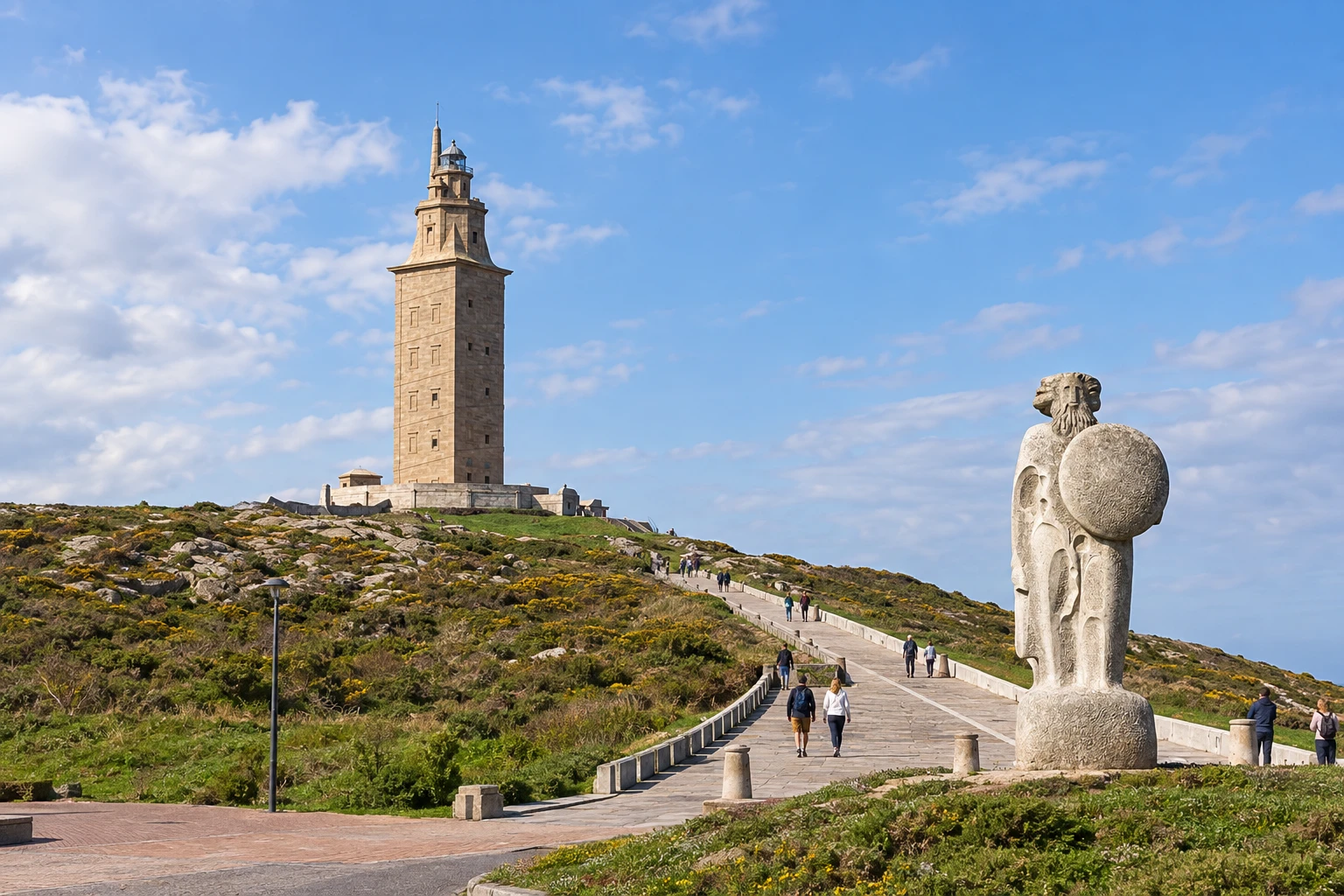
Route · Galicia
English Way (Camino Inglés) to Santiago on foot
The route taken by pilgrims who arrived by sea: from Ferrol or A Coruña to Santiago de Compostela in under a week, along Galicia’s northern coast.
In the photo: Tower of Hercules, A Coruña
Illustrative images. The pictures in this guide are illustrations based on the real place, not photographs, and may differ from it.
The route
What the English Way (Camino Inglés) to Santiago on foot is
The English Way is named for the pilgrims who came by ship from northern Europe (England, Ireland, Flanders and Scandinavia) and landed at the ports of Ferrol and A Coruña to continue on foot to Santiago. It is a short route entirely within Galicia, with two starting points that meet at Hospital de Bruma.
The Ferrol departure is the more common. It is about 117 km over 5 stages, via Neda, Pontedeume, Betanzos and Hospital de Bruma, passing rías, woodlands and medieval towns. It is the only one of the two that exceeds the 100 km required for the Compostela, the pilgrimage certificate.
The A Coruña departure is about 75 km, in 3 to 4 stages, via Sergude to Hospital de Bruma. Because it does not reach 100 km, by itself it does not qualify for the Compostela. The Pilgrim’s Office accepts some special cases, such as recognized route sections completed previously in the pilgrim’s home country, and there are specific rules for city residents: check with the Office before you start.
The map
4 cities along the way
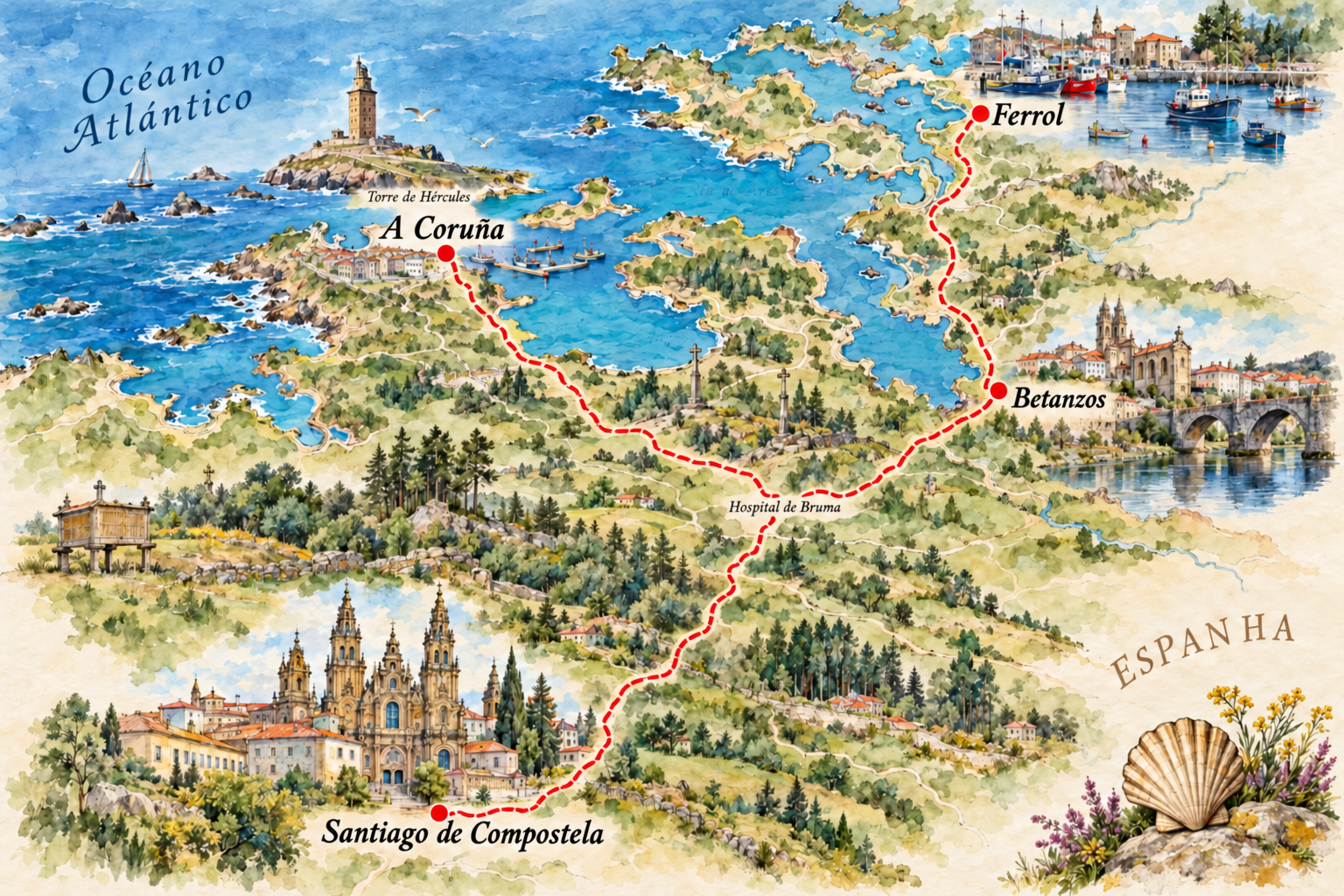
Outlines: IGN/CNIG, unidades administrativas, CC BY 4.0. Adapted by Cidade Turismo.
The journey
City by city
Distances and times are approximate: check before you set off.
-
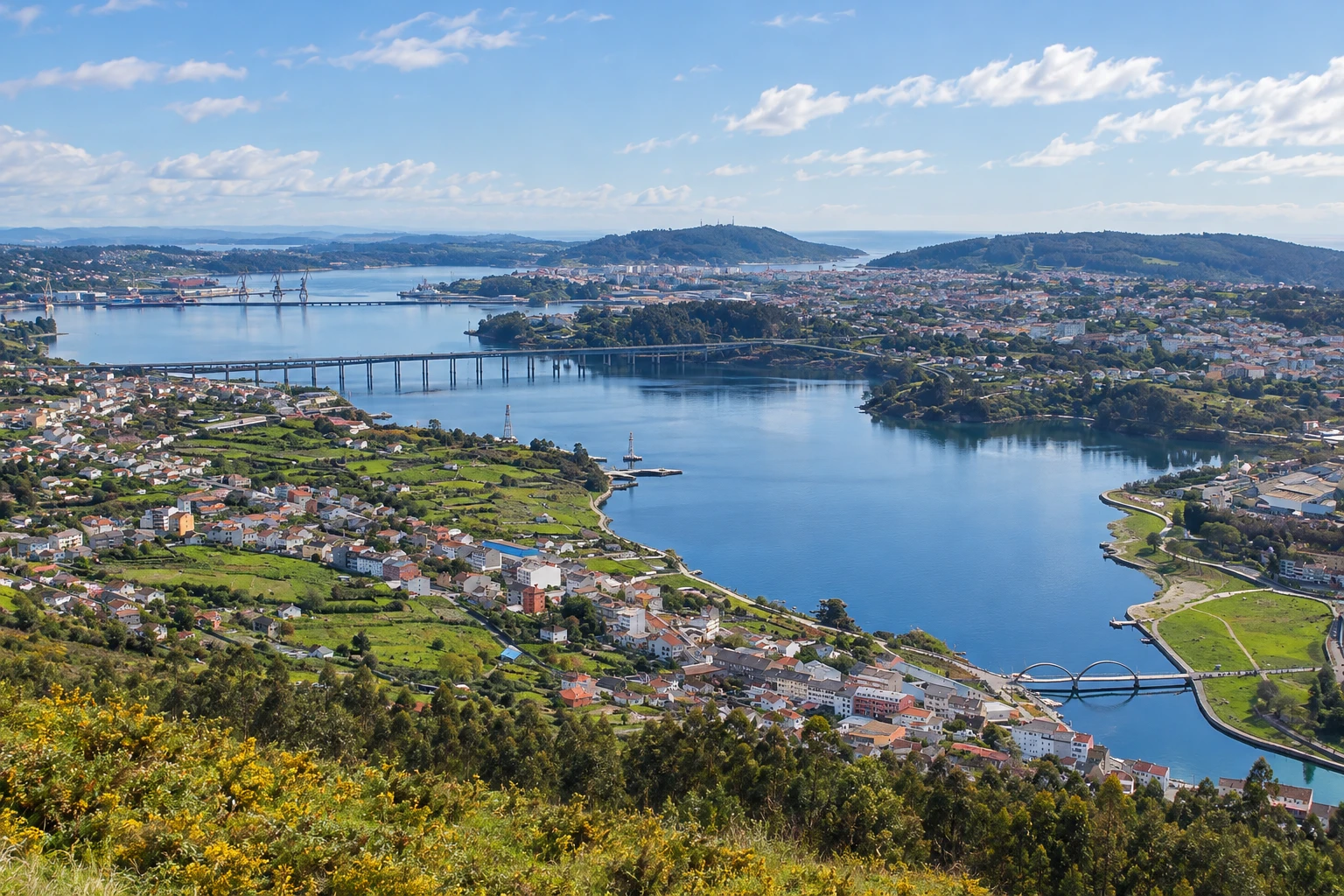 1 · Galicia
Ferrol
The route begins at the Curuxeiras quay in the port of Ferrol, where there is a kilometre zero marker. The city has the Magdalena district, with its 18th-century layout, and the shipyards on the ria. The first stage skirts the ria via Neda to Pontedeume, with its medieval bridge and the Andrade tower.
→ Betanzos about 49 km about 2 days on foot Ferrol–Pontedeume (about 29 km, which can be split at Neda) and Pontedeume–Betanzos (about 20 km).
-
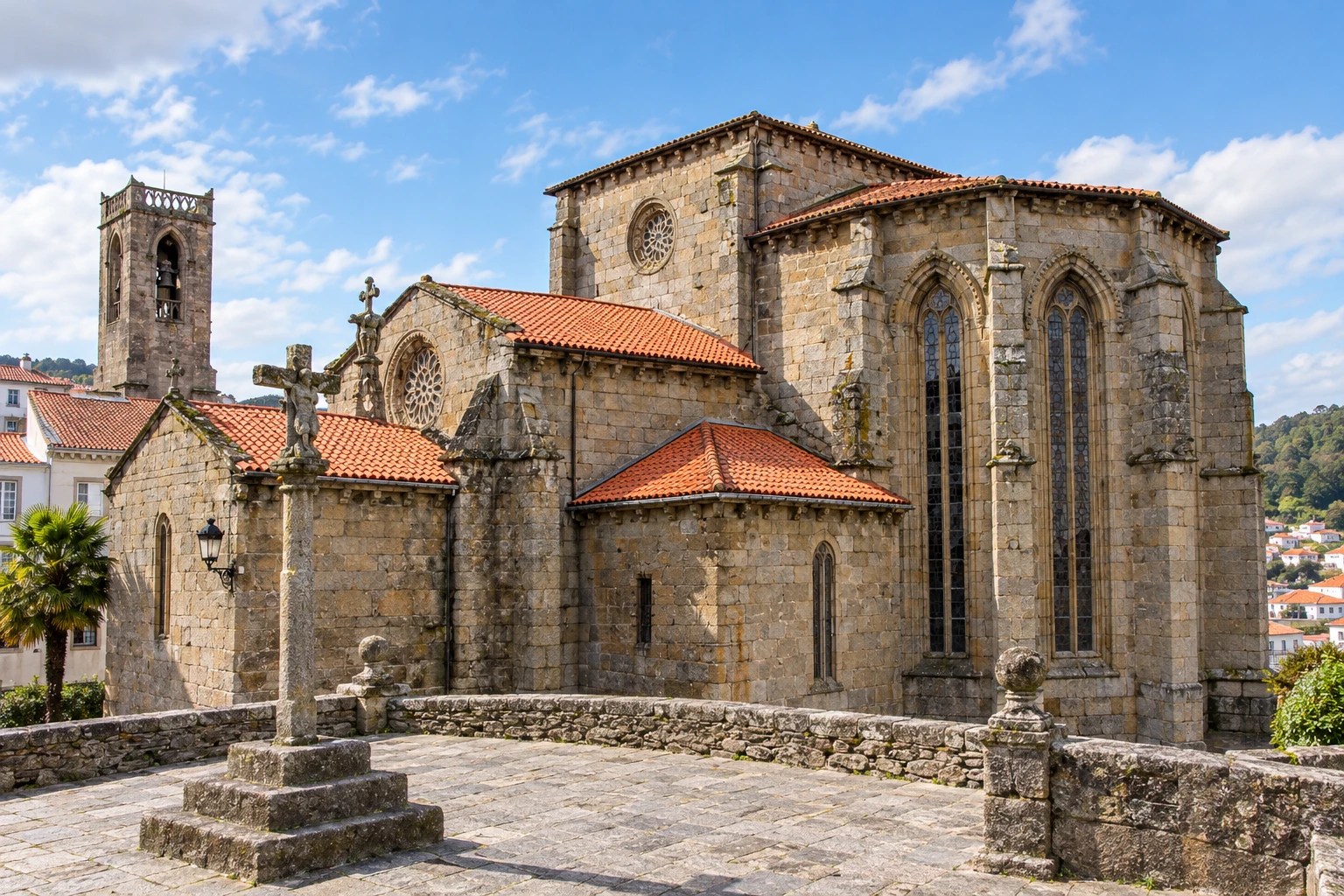 2 · Galicia
Betanzos
Betanzos is a medieval town at the meeting of the Mandeo and Mendo rivers, with the Gothic churches of Santa María do Azougue and San Francisco and squares lined with houses with glazed balconies. It is known for its tortilla de patata. After Betanzos, the route climbs steeply toward Hospital de Bruma.
→ Santiago de Compostela about 68 km about 3 days on foot Betanzos–Hospital de Bruma (about 23 km, with the steepest climb), Hospital de Bruma–Sigüeiro (about 25 km) and Sigüeiro–Santiago (about 20 km).
-
 3 · Galicia
A Coruña
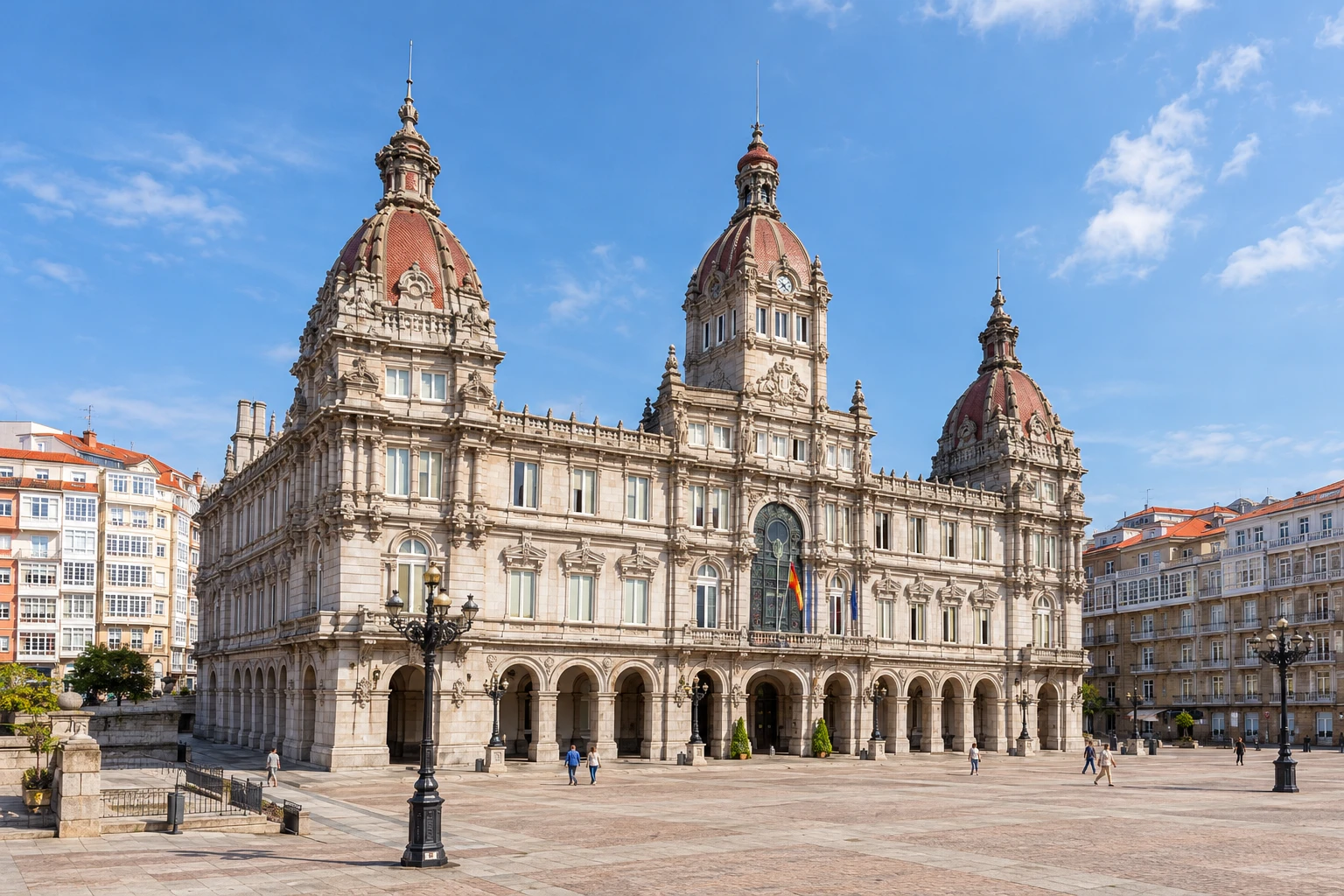
Those starting from A Coruña begin near the church of Santiago in the old town. The city features the Tower of Hercules, a Roman lighthouse and World Heritage site, the waterfront with the glazed galleries of the Marina, and María Pita square. The route continues via Sergude and joins the Ferrol line at Hospital de Bruma.
→ Santiago de Compostela about 75 km about 3 to 4 days on foot A Coruña–Hospital de Bruma (about 29 km, via Sergude, which can be split), Hospital de Bruma–Sigüeiro (about 25 km) and Sigüeiro–Santiago (about 20 km). It does not reach the 100 km required for the Compostela.
-
 4 · Galicia
Santiago de Compostela
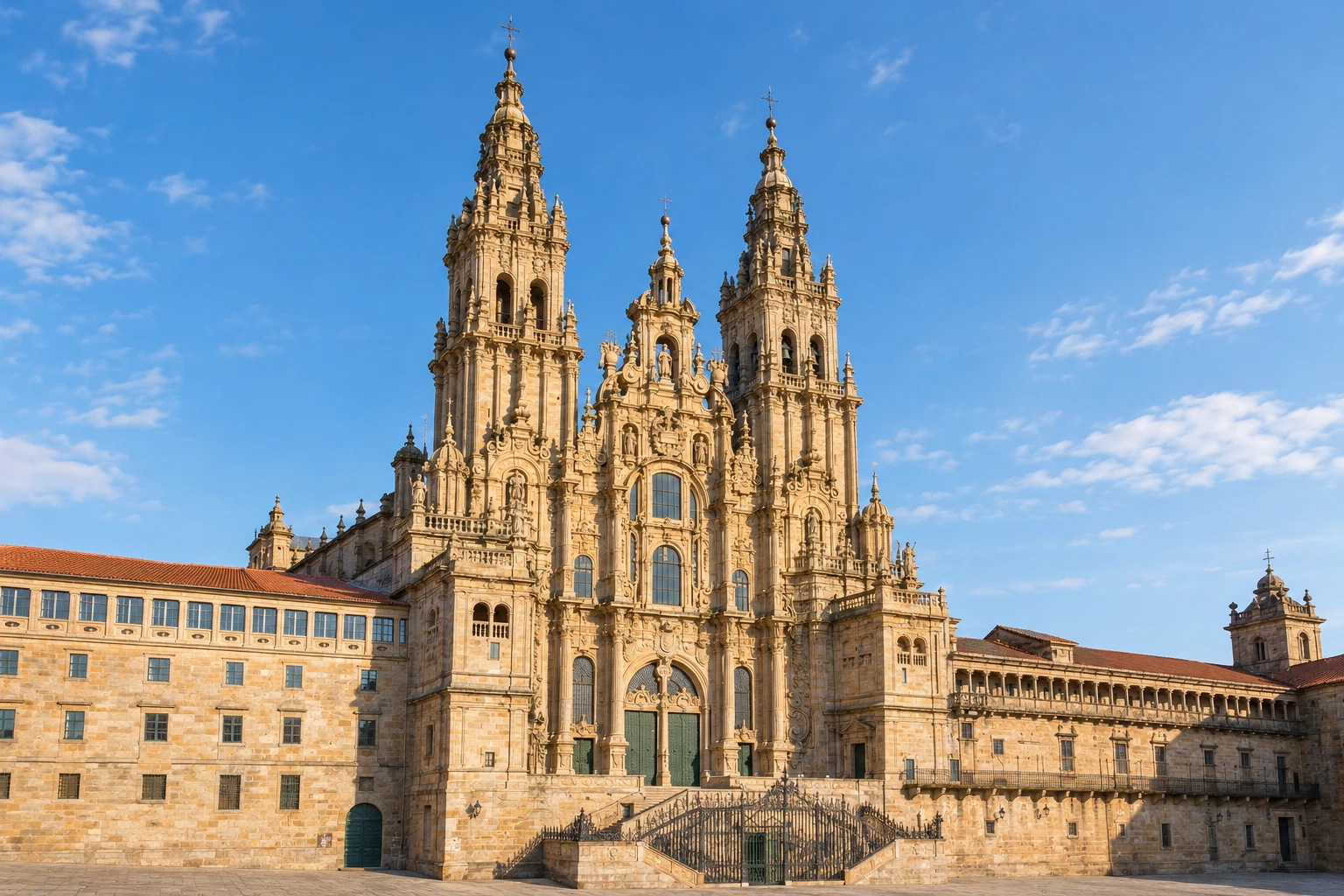
After Hospital de Bruma and Sigüeiro, the route enters Santiago from the north and crosses the old town to the Obradoiro square. The Pilgrim’s Office, near the cathedral, issues the Compostela.
How many days
From Ferrol, 5 to 6 days on foot. From A Coruña, 3 to 4 days. Allow an extra day in Santiago on arrival.
Best time to go
From May to September, with more dry days in Galicia. July and August are the busiest months, but the English Way remains much less crowded than the French Way. From November to March it rains a lot and some hostels close.
The seasons shown are the most usual ones; nature doesn't always follow the calendar.
How to travel it
On foot, following the yellow arrows, carrying your backpack or using a luggage transfer service between stages. Stages range from 20 to 29 km; the first, from Ferrol to Pontedeume, can be split at Neda. There are steep climbs on the section leaving Betanzos.
Who it's for
For those with only a week who want the Compostela, for those who prefer a quieter route, and for those who want to explore the rías and towns of northern Galicia.
Your questions
Frequently asked questions about English Way (Camino Inglés) to Santiago on foot
Why is it called the English Way?
Because it was the route used by pilgrims who sailed from the British Isles and northern Europe and landed in Ferrol or A Coruña to continue on foot to Santiago.
Which departure qualifies for the Compostela?
The Ferrol route, at about 117 km. The A Coruña route is about 75 km and by itself does not reach the 100 km required by the Pilgrim’s Office. For special cases, check with the Office before you start.
How many days does the English Way take?
From Ferrol, 5 to 6 days on foot. From A Coruña, 3 to 4 days.
Where do the two departures meet?
At Hospital de Bruma, about 45 km from Santiago. From there the two routes are the same.
Is the English Way difficult?
It is short, but includes stages of 20 to 29 km and steep climbs, especially on the section leaving Betanzos. With preparation, it is a good first Camino.
Do you need to book hostels?
There are fewer hostels than on the French Way, and some are small. Public albergues usually operate on a first‑come, first‑served basis; in summer, book private ones.