Illustrative images. The pictures in this guide are illustrations based on the real place, not photographs, and may differ from it.
The city
What to expect from Mérida.
Mérida is the capital of Extremadura and was the Augusta Emerita of the Romans, capital of Lusitania. The modern city coexists with the ruins: the theatre and the amphitheatre, the Templo de Diana amid the streets, the roughly 800-metre bridge over the Guadiana and the Museu Nacional de Arte Romana by Rafael Moneo. The archaeological ensemble is a UNESCO World Heritage Site.
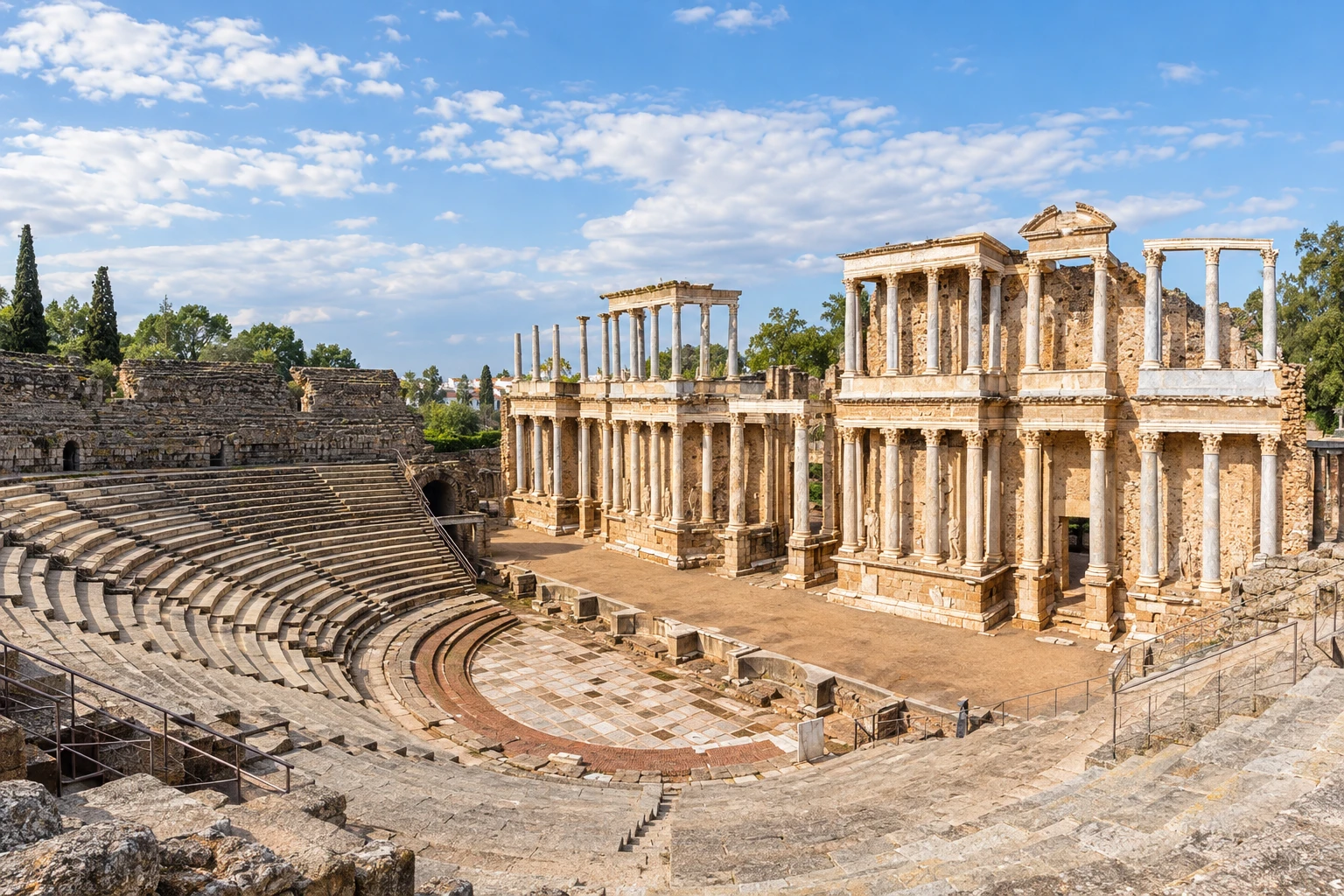
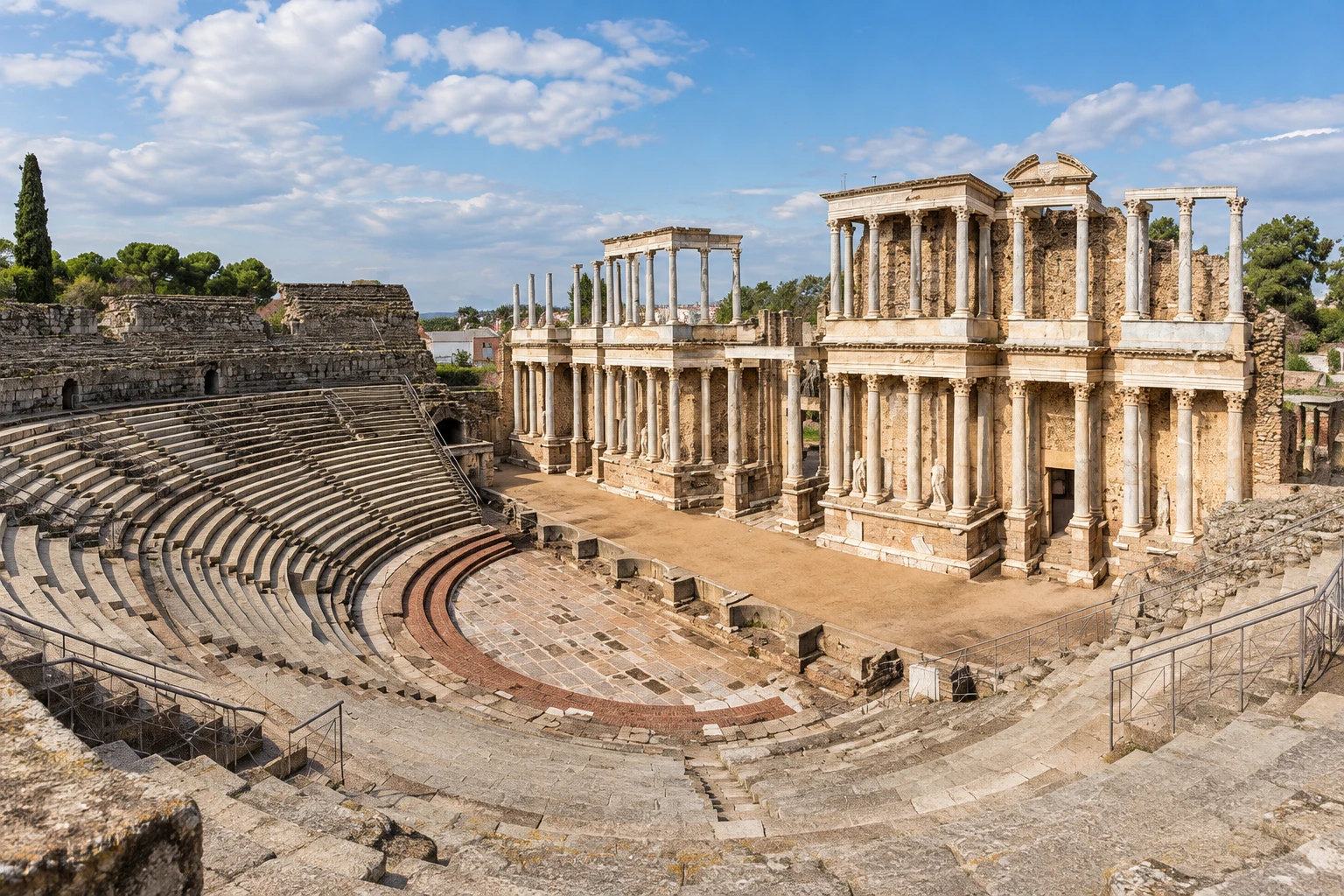
Theatre from the late 1st century BC, with a scaenae frons of two orders of marble columns reconstructed, seating for about 6,000 people and the Classical Theatre Festival in summer.
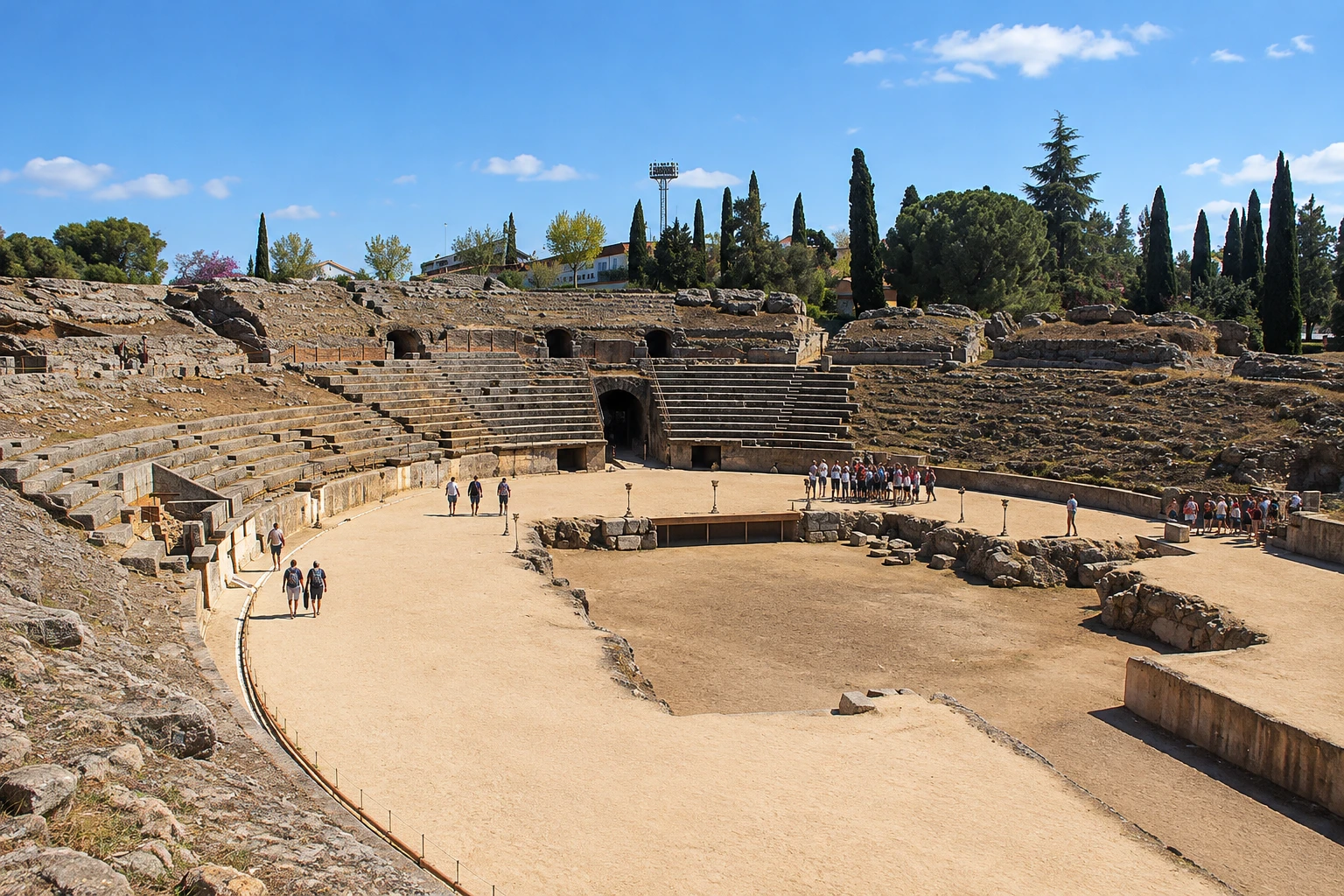
Amphitheatre from 8 BC, next to the theatre, where about 15,000 people watched gladiatorial and animal combats, with the arena and central trench exposed.
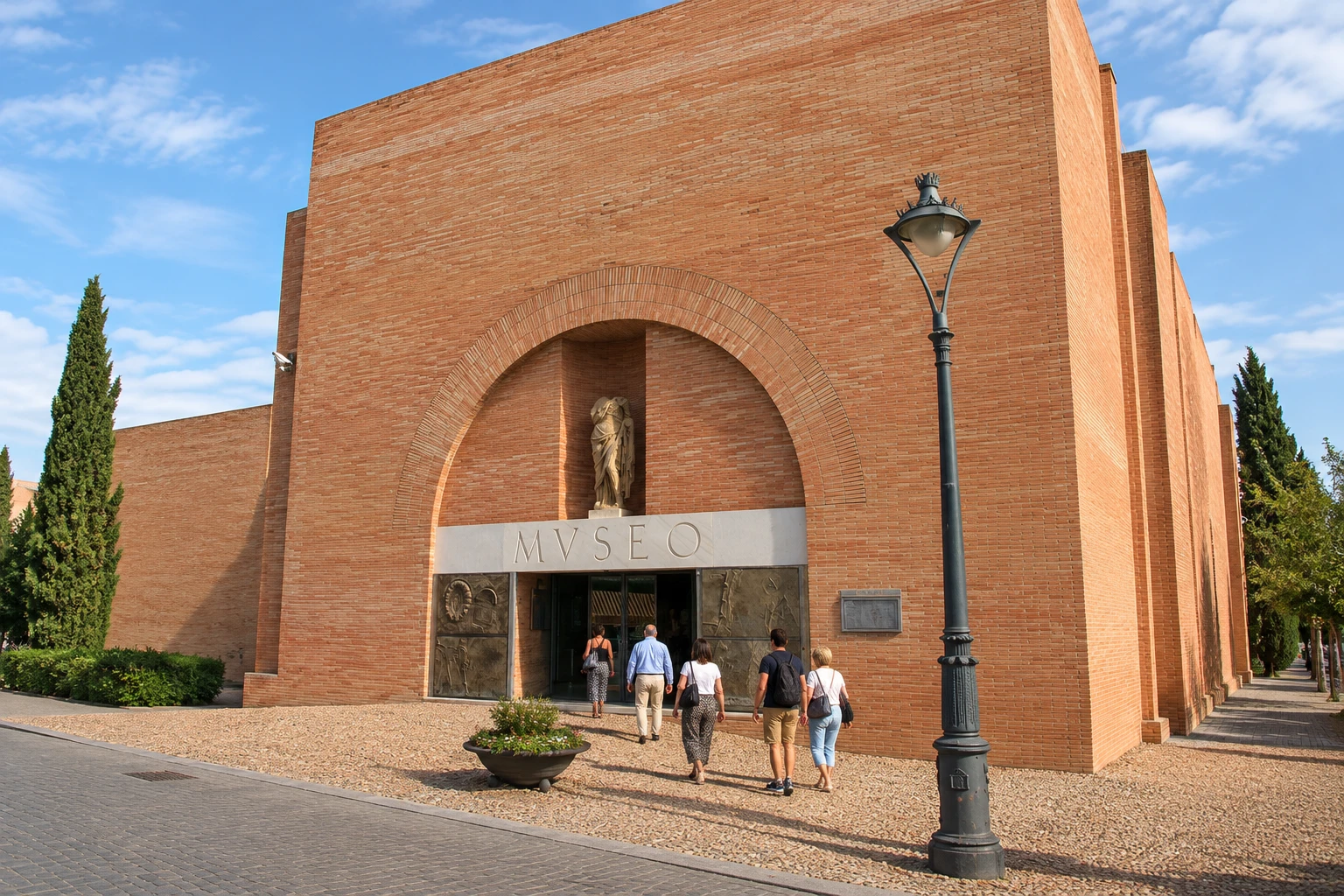
Museu de Rafael Moneo, dating from 1986, with large brick arches that recall Roman architecture, mosaics, theatre statues and everyday objects from Augusta Emerita.
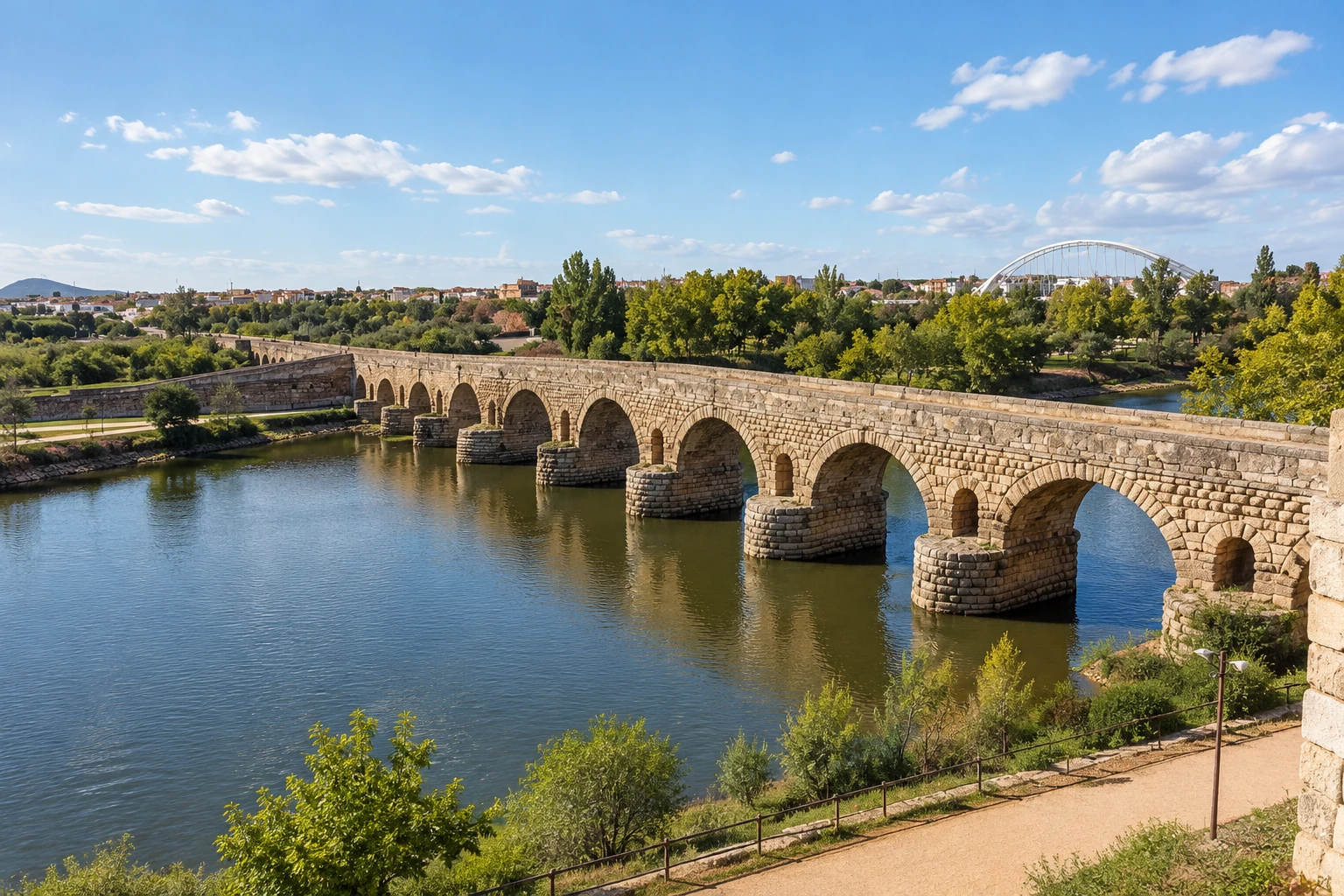
Granite bridge from the 1st century BC over the river Guadiana, about 790 metres long with 60 arches, now pedestrian-only, with views of the Alcazaba and the ponte de Calatrava.
Aeropuerto de Badajoz (BJZ)Talavera la Real · 50 km
Aeroporto Humberto Delgado (LIS)Lisboa (Portugal) · 290 km
Estación de Mérida1 km
Estación de Autobuses de Mérida2 km
Approximate distances. Check flights and bus, train or boat schedules before you travel.
Connections with Brazil usually require a change in another city. Confirm before buying. From Madrid, the train takes 3h30 to 4 hours to Mérida station, with few departures per day; not all trains stop in the city. From Cáceres, train or bus take about 1 hour. Badajoz airport is around 60 km away. From Lisbon it’s about 290 km by road via Évora and Badajoz.
How many days
A full day for the theatre, the amphitheatre, the museum, the Templo de Diana, the Roman bridge and the Alcazaba. With one night, there’s time left for the aqueduct of Los Milagros, the circus and the Casa do Mitreo, or for a play at the summer festival.
When to go
Spring and autumn, from March to May and from October to November, usually have the best weather for the open‑air ruins. From June to September it gets very hot; July and August bring the theatre festival. Winter is cool and dry.
The seasons shown are the most usual ones; nature doesn't always follow the calendar.
Do you need a car?
No. The monuments are a few minutes' walk from one another, and the train and bus stations are close to the centre. A car only helps if you continue on to Cáceres, Trujillo or Évora, though there are buses.
Suggested itinerary
An order that works
Built with the places on this page. No rush: it's paced so you have time to see them.
One day in Mérida
manhã
Theatre and amphitheatre
Start with the Roman theatre and amphitheatre at opening time, before the heat and the tour groups.
tarde
Museu de Arte Romana
Cross the street to the Museu Nacional de Arte Romana and have lunch in the center.
fim de tarde
Templo de Diana e Alcazaba
See the Templo de Diana, the forum portico and the Arco de Trajano, then walk on to the Alcazaba.
noite
Roman bridge
Walk along the Roman bridge over the Guadiana at the end of the afternoon and dine near the Plaza de España.
2 days in Mérida
Day 1
manhã
Theatre and amphitheatre
Roman theatre and amphitheatre at opening.
tarde
Museum
Museu Nacional de Arte Romana, with the mosaics and the theatre statues.
fim de tarde
Foro and Diana
Templo de Diana, forum portico and Arco de Trajano, on foot through the center.
noite
Plaza de España
Dinner and activity at the Plaza de España, Mérida's central square.
Day 2
manhã
Alcazaba and bridge
Arab Alcazaba, with the cistern, and the Roman bridge in the morning.
tarde
Casa do Mitreo
Lunch and afternoon at the Casa do Mitreo, with the cosmic mosaic.
fim de tarde
Los Milagros
Late afternoon at the aqueduct of Los Milagros, with storks on the arches.
noite
Roman circus
Pass by the Roman circus and finish the day in the center.
Check before you go. Opening hours and days change, and places may close for renovations, holidays or events. This itinerary is a suggestion from Cidade Turismo, not a commitment: plan yours by checking directly with each place you intend to visit.
Before you go
Frequently asked questions
Is there a single ticket for the monuments of Mérida?
Yes. The Consórcio da Cidade Monumental usually sells a combined ticket for the theatre, the amphitheatre, the Alcazaba, the circus, the Casa do Mitreo and other sites. The national museum has a separate ticket. Check the conditions.
Is Mérida far from Cáceres?
About 70 km. Train or bus take about 1 hour, and by car it’s roughly 50 minutes via the A-66 motorway.
Is it very hot in Mérida in summer?
Yes. In July and August, highs often exceed 35 °C. Visit the ruins early and leave midday for the museum.
Is Mérida the capital of Extremadura?
Yes. Since 1983 it has been the seat of the government and parliament of the autonomous community of Extremadura.
What to eat in Mérida?
Jamón ibérico, migas, torta del Casar, lamb and the wines of the Ribera del Guadiana, in the bars around the Plaza de España.
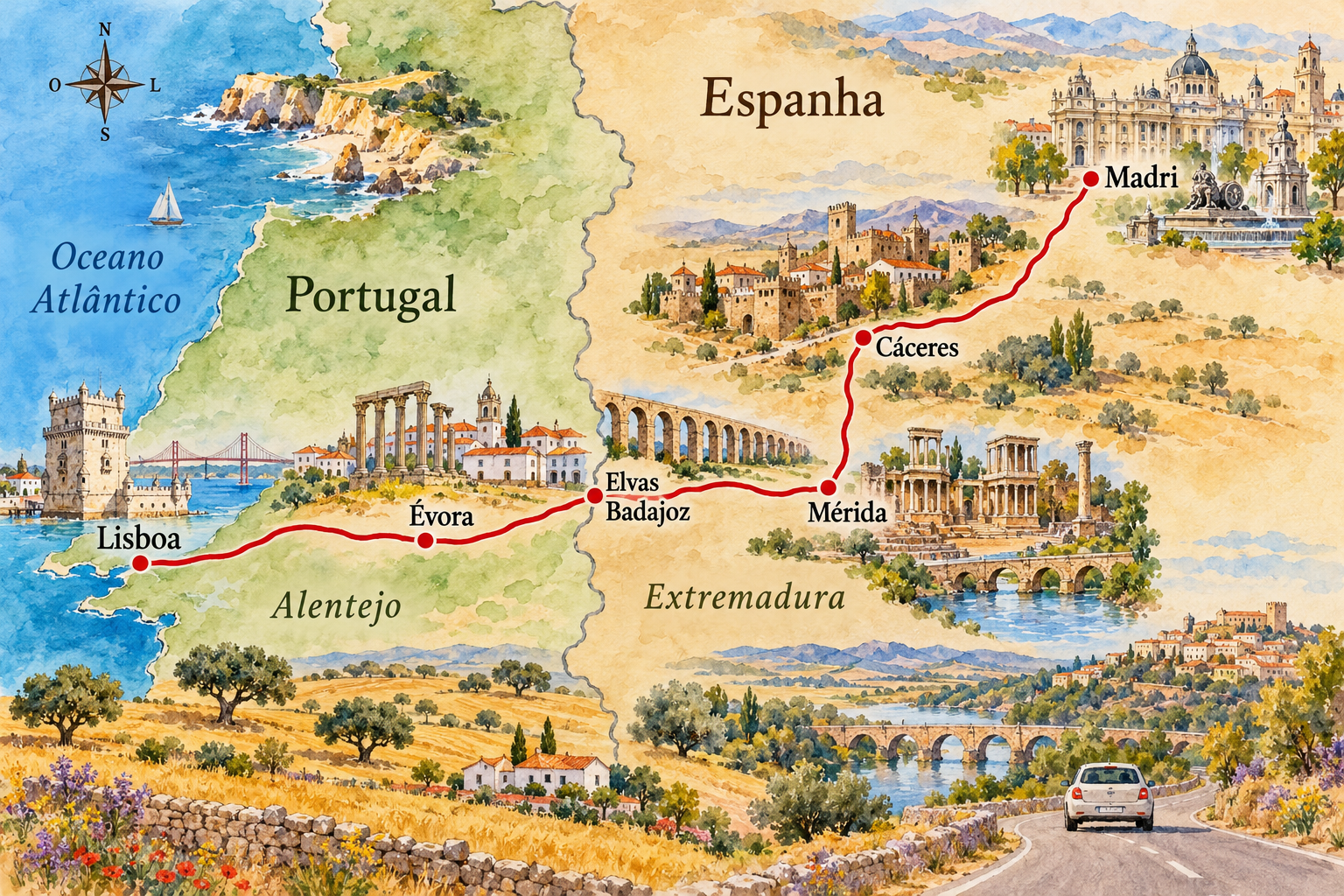
Mérida is part of the Lisbon–Évora–Mérida–Cáceres–Madrid by car
By car between the two capitals of the peninsula: the Alentejo around Évora, Roman Mérida and medieval Cáceres on the route from Lisbon to Madrid.
Illustrative map, not to scale. Tap a city to open its page.
Routes in Spain
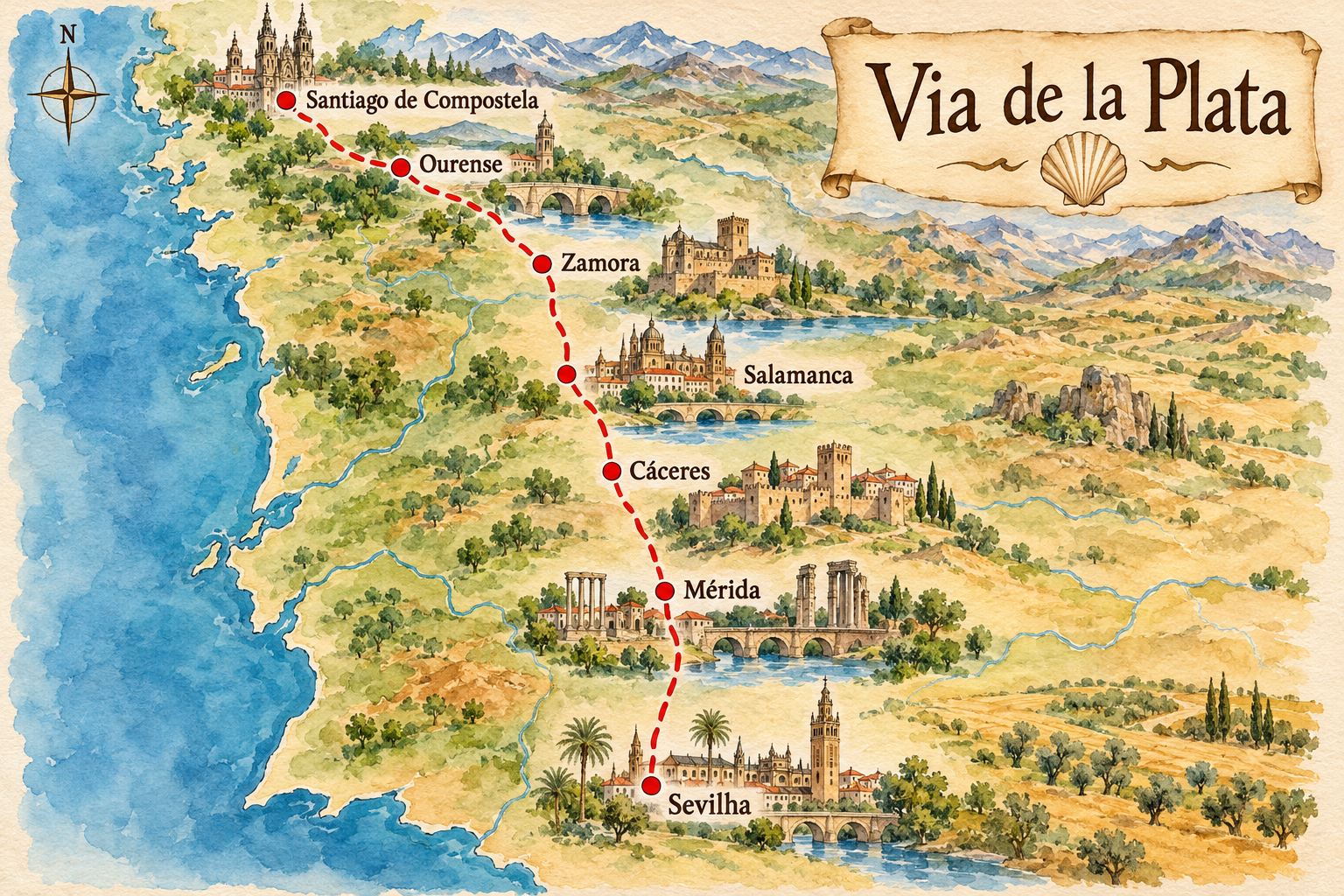
Mérida is part of the Vía de la Plata from Seville to Santiago on foot
The longest Camino de Santiago in Spain: from Seville to Santiago de Compostela along the country’s west, following the old Roman road, via Mérida, Cáceres, Salamanca, Zamora and Ourense.
Illustrative map, not to scale. Tap a city to open its page.


 Brazil
 Antarctica
 Argentina
 Bolivia
 Chile
 Colombia
 Ecuador
 Falkland Islands (Malvinas)
 French Guiana
 Guyana
 Paraguay
 Peru
 Suriname
 Uruguay
 Venezuela
 Austria
 Belgium
 Croatia
 Denmark
 Finland
 France
 Germany
 Greece
 Hungary
 Iceland
 Ireland
 Italy
 Luxembourg
 Norway
 Poland
 Portugal
 Slovakia
 Slovenia
 Sweden
 Switzerland
 the Czech Republic
 the Netherlands
 the United Kingdom
 Turkey
 Bermuda
 Canada
 Greenland
 Mexico
 Saint Pierre and Miquelon
 the United States
 the Dominican Republic
 Japan
 Egypt
 South Africa
 Australia
 Fiji
 New Zealand
 Papua New Guinea