

 Brazil
 Antarctica
 Argentina
 Bolivia
 Chile
 Colombia
 Ecuador
 Falkland Islands (Malvinas)
 French Guiana
 Guyana
 Paraguay
 Peru
 Suriname
 Uruguay
 Venezuela
 Austria
 Belgium
 Croatia
 Denmark
 Finland
 France
 Germany
 Greece
 Hungary
 Iceland
 Ireland
 Italy
 Luxembourg
 Norway
 Poland
 Portugal
 Slovakia
 Slovenia
 Sweden
 Switzerland
 the Czech Republic
 the Netherlands
 the United Kingdom
 Turkey
 Bermuda
 Canada
 Greenland
 Mexico
 Saint Pierre and Miquelon
 the United States
 the Dominican Republic
 Japan
 Egypt
 South Africa
 Australia
 Fiji
 New Zealand
 Papua New Guinea
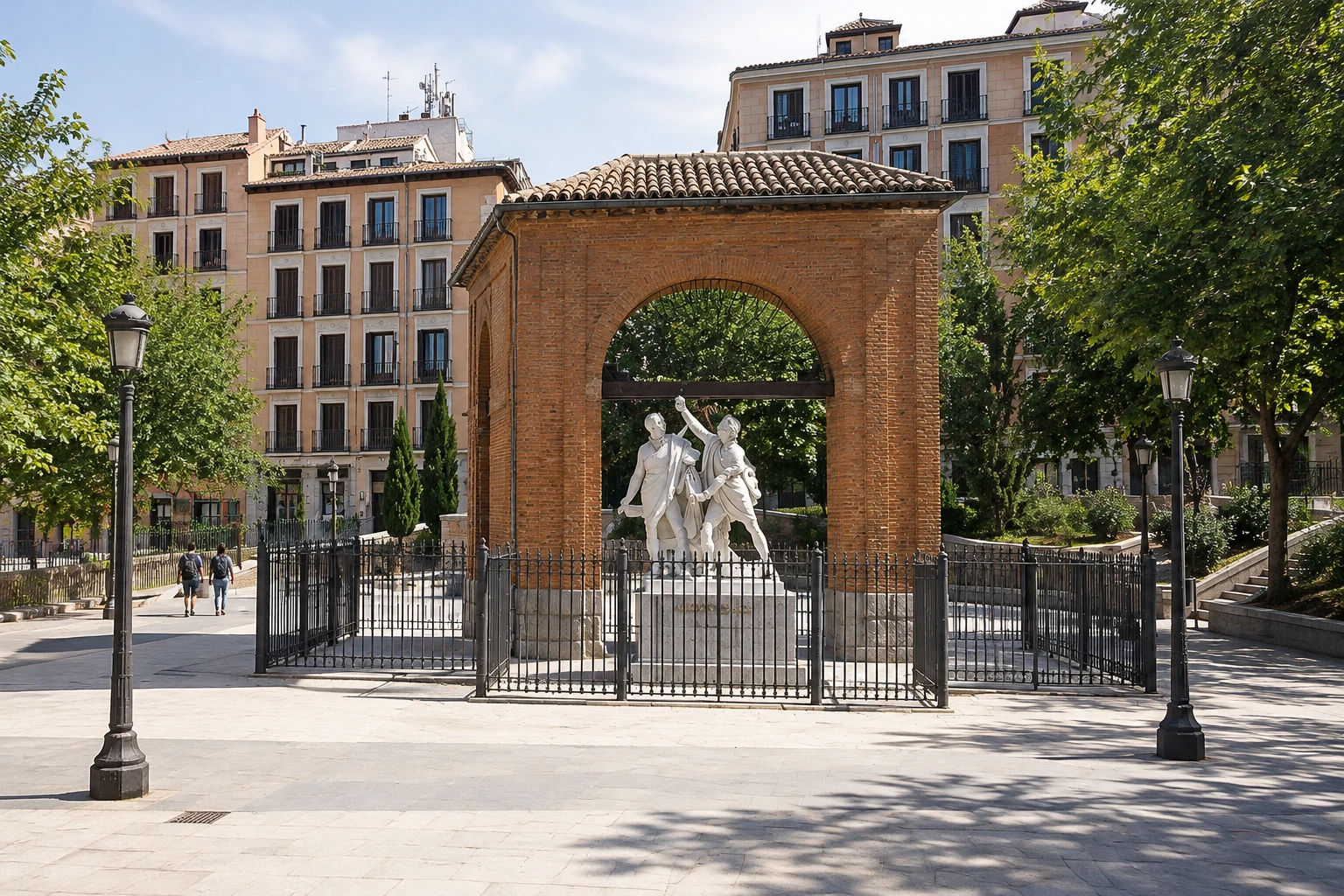
Neighborhood · Madrid, Spain
Malasaña
Neighborhood north of the Gran Vía, birthplace of the Movida madrileña of the 1980s. It has the Plaza del Dos de Mayo, vintage shops, cafés and bars, on streets of low-rise buildings with wrought-iron balconies.
Illustrative images. The pictures in this guide are illustrations based on the real place, not photographs, and may differ from it.

Discover
About Malasaña
Malasaña occupies the block between Gran Vía to the south, Calle de Fuencarral to the east, Calle de Carranza to the north and Calle de San Bernardo to the west. The name recalls Manuela Malasaña, a 15-year-old who lived on Calle de San Andrés and was killed by French troops after the uprising of May 2, 1808.
The heart of the neighborhood is the Plaza del Dos de Mayo, opened in 1869 on the site of the Monteleón artillery park, one of the uprising's focal points. The plaza contains the arch of the former barracks and the monument to Captains Daoíz and Velarde, sculpted in marble by Antonio Solá in 1830. On one corner stands the church of Santos Justo y Pastor, known as the iglesia de las Maravillas.
In the 1980s the neighborhood was the center of the Movida, the cultural movement that took Madrid after the end of the dictatorship. Pedro Almodóvar filmed scenes from his early films here. The legacy appears in record shops, vintage stores and music bars.
Buildings generally have four to six floors, with painted facades and iron balconies. On the eastern edge, on Calle de Fuencarral, is the Museo de Historia de Madrid, in the former Real Hospicio de San Fernando.
Before you go
Practical information
Cidade Turismo reviews its information regularly, but something may have changed. Check with the place before planning your trip.
How much time to set aside
Two to three hours to stroll the streets, browse the shops and stop at a café. In the evening, roughly the time of a dinner.
Best time
In the afternoon, when shops are open, and at night, when the bars fill up. On weekends there is often a craft fair in the Plaza del Dos de Mayo. Many small shops close on Sundays.
How to get there
It's just north of the Gran Vía, about a 15-minute walk from the Puerta del Sol. The nearest metro stations are Tribunal (lines 1 and 10), Noviciado (line 2) and Bilbao (lines 1 and 4).
Tip
Start at the Plaza del Dos de Mayo and walk the streets of San Andrés, Velarde and Espíritu Santo. Combine it with the Museo de Historia de Madrid during the day and return at night for dinner.
Your questions
Frequently asked questions about Malasaña
Why is the neighborhood called Malasaña?
Because of Manuela Malasaña, a young woman killed by French troops after the uprising of May 2, 1808. Before, the neighborhood was known as Maravillas.
What was the Movida madrileña?
A cultural movement of the 1980s, after the end of the dictatorship, that brought together music, film, fashion and art. Malasaña was at the center of that scene.
Is Malasaña good for going out at night?
Yes. The neighborhood has many bars, cafés and restaurants, which tend to fill up after 9 pm, especially from Thursday to Saturday.