Postojna Cave, from the town center to the underground train
From Postojna Cave Park entrance Electric train and guided walk About 1 hour 30 minutes inside the cave Morning or afternoon Easy
Postojna Cave (Postojnska jama) is the town's main draw for travelers. You can walk there: it's about 1.5 km from the bus station and 2 km from the train station.
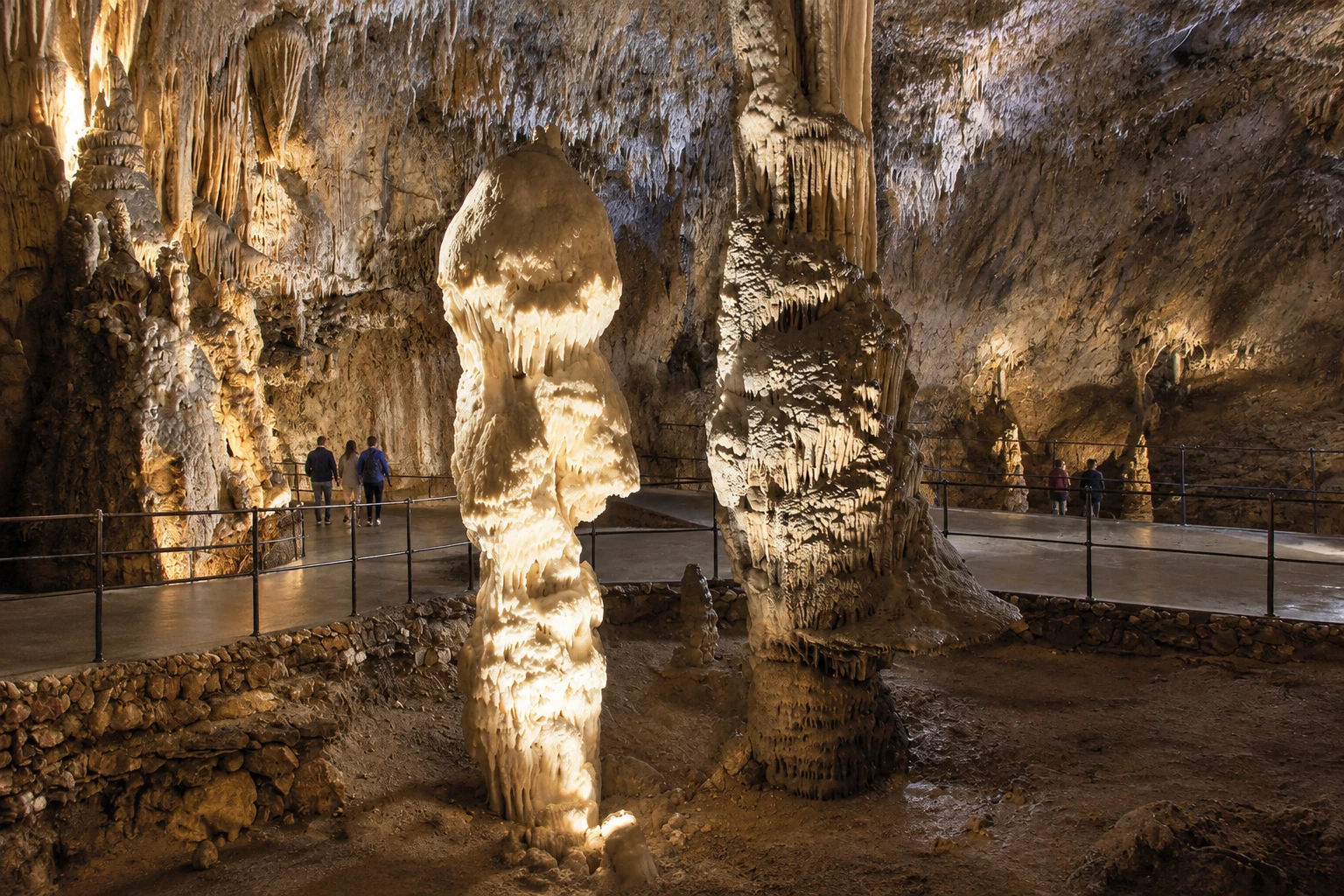
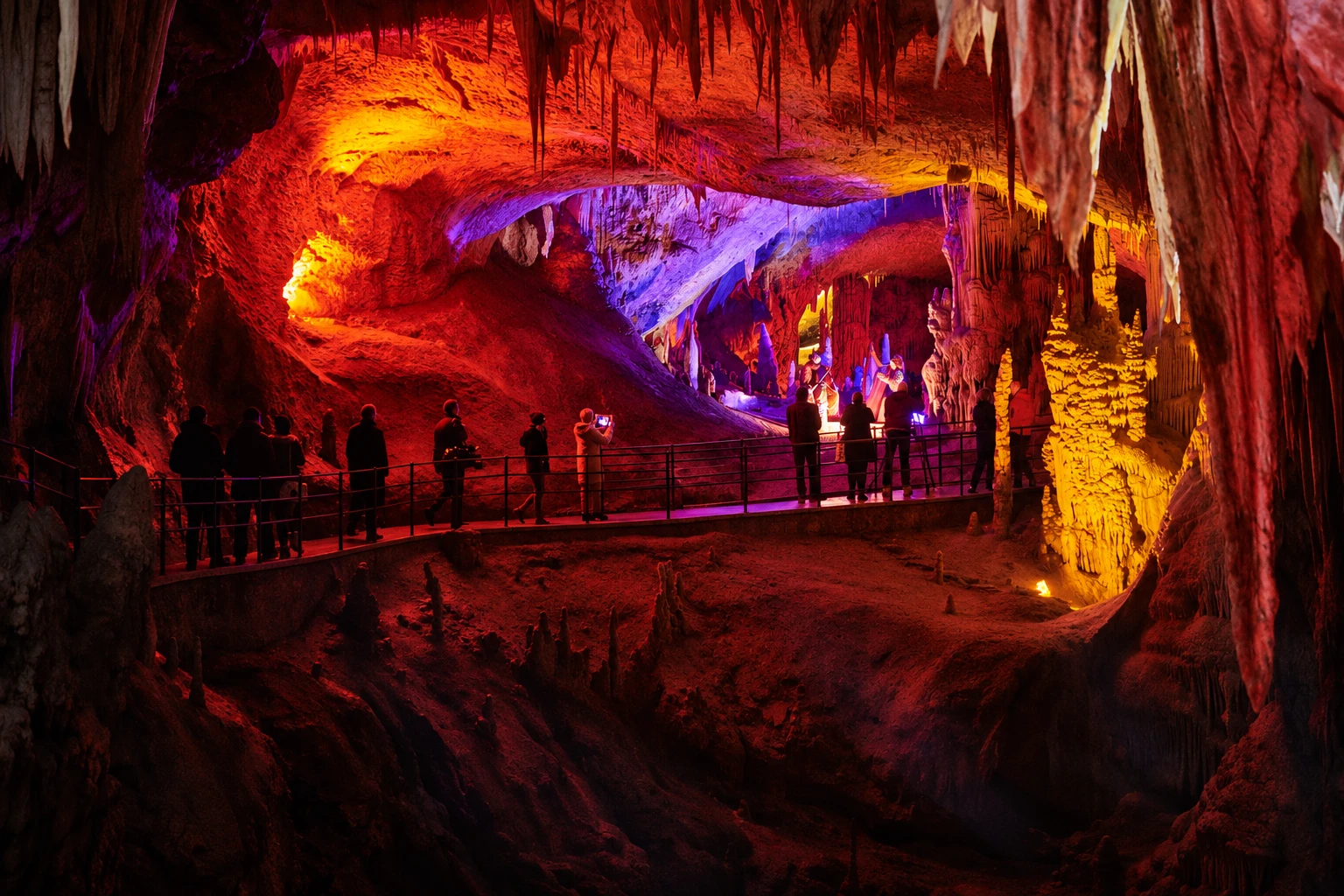
Visits are guided and timed. The tour lasts about an hour and a half and covers 5 km of the 24 km of passages carved by the Pivka River. You travel 3.7 km on an electric train that runs on a double-track railway through the rock and walk the rest on an easy path. The cave's first railway dates to 1872. Luka Čeč, a local man who worked as a guide, discovered the inner chambers in 1818.
The train passes through the Dance Hall with its Murano glass chandeliers. On foot, your group crosses large chambers to reach the Brilliant, a five-meter white stalagmite that has become the cave's symbol. You'll also see the olm (Proteus anguinus), the pale, blind amphibian of the Karst's underground waters.
Guides lead tours in Slovenian, Italian, English, and German. Audio guides are available in other languages. The temperature stays around 10°C in every season.
To go beyond the main visitor route, book the three-cave traverse. This small-group outing takes three to four hours and uses basic caving equipment to link Postojna Cave with Črna jama and Pivka jama.
Stops: Postojna Cave, Dance Hall, Brilliant stalagmite.
Includes: Buy a separate dated, timed ticket. Packages combine the cave with other park attractions and Predjama Castle. Check current prices. The park charges for parking.
Tip: Arrive at the park half an hour early. Train boarding starts 15 minutes before your ticket time. Bring a warm layer and closed-toe shoes even in summer. Overnight visitors can choose the first morning slot.
Best time: Year-round. The cave opens daily. In July and August, buy tickets ahead.
Beyond the cave train: the Vivarium, EXPO, and Modrijan Mill
From Postojna Cave Park Self-guided walk 1 hour 30 minutes to 2 hours Morning or afternoon Easy
There's plenty to see in the park around the cave entrance before or after the train ride, or while you wait for your entry time.
The Vivarium occupies a side passage fifty meters from the entrance. Half is a research laboratory and half an exhibition on animals that live in darkness. The highlight is a close look at the olm. It measures 25 to 30 centimeters, lives in the dark, and can go years without food. Its neighbors include the slender-necked beetle Luka Čeč found in 1831, a discovery that helped launch the study of cave life.
EXPO Cave Karst is an interactive exhibition about the origins of karst landscapes and two centuries of tourism in the cave, with activities for children.
Outside, the Pivka River runs through the park to a sinkhole where it disappears into the rock. Just before it stands Modrijan's Mill (Modrijanov mlin), a complex with a mill, a house, and a water-powered sawmill. The wheels have turned here for five centuries, and the stone doorframe bears the date 1593. A tree-lined promenade links the cave entrance to the river.
In the woods beside the park, an adventure park with treetop courses and zip lines opens from spring through fall.
Stops: Vivarium, EXPO Cave Karst, Modrijan Mill, Pivka River.
Includes: Vivarium and EXPO have separate tickets or are included in park packages. Arrange a visit inside Modrijan Mill from April to September. Walking in the park and seeing the sinkhole are free.
Tip: Tickets for the park's other attractions can be used on a different day from the cave visit, within the period given at the ticket office. Overnight visitors can split the visit across two days.
Best time: Year-round. After rainy weather, the Pivka carries more water into the sinkhole.
Predjama: the castle, the village and Erasmus’s linden tree
From Postojna Cave, 9 km away Car, taxi or summer shuttle bus 2 to 3 hours, including travel time Morning Easy, with stairs
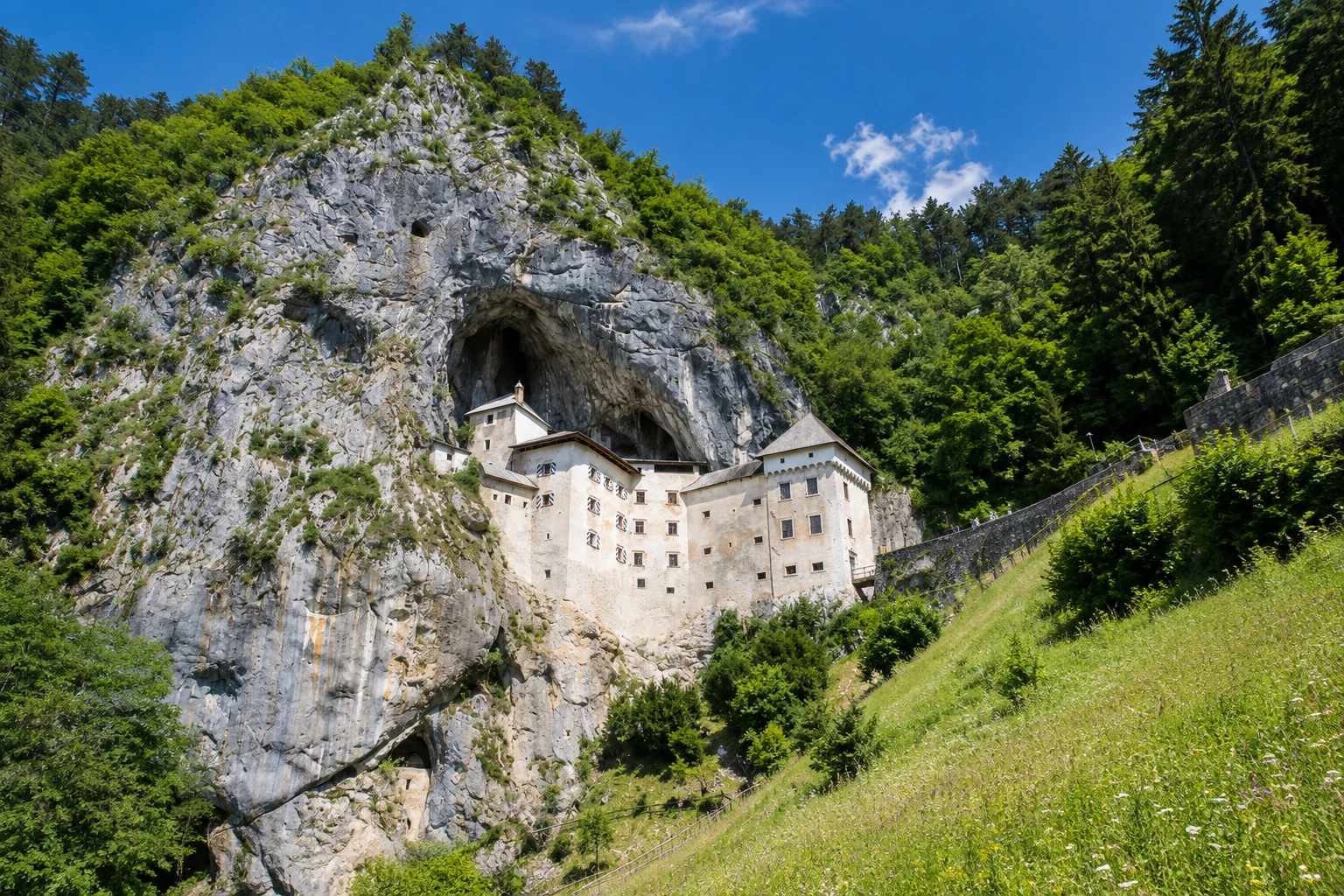
Predjama is a village in the municipality of Postojna, 9 km from the cave entrance along a local road through fields and hamlets. Its name means “in front of the cave.” The reason is clear on arrival: for over 800 years, Predjama Castle (Predjamski grad) has occupied the mouth of a cave halfway up a 123-meter cliff.
Tour the castle with the app included in admission or with an audio guide. The route climbs through narrow rooms between the built walls and the rock, taking in the armory, chapel, kitchen, torture chamber, and attic, with medieval armor and weapons and views of the valley. The guides tell the story of Erasmus (Erazem) of Predjama, the rebellious knight who withstood a siege for more than a year, supplied through a secret tunnel, until a servant betrayed him and he was killed.
The castle ticket also includes the Stara Dama Museum in the adjacent visitor center. One exhibition covers World War I and the Isonzo Front, another hunting and the wildlife of the Notranjska forests.
In the village, Enea Silvio Piccolomini, then bishop of Trieste and later Pope Pius II, consecrated the small Gothic Church of Our Lady of Sorrows around 1450. A stone bell gable serves as its belfry, and fragments of Gothic frescoes survive inside. Beside it stands the old linden tree under which Erasmus is said to be buried.
From May through September, guides lead flashlight tours of the cave beneath the castle. Allow about an hour.
Stops: Predjama Castle, Stara Dama Museum, Church of Our Lady of Sorrows, Cave beneath Predjama Castle.
Includes: Castle tickets are sold separately or in a package with Postojna Cave and include the Stara Dama Museum. The cave beneath the castle has its own ticket. The summer shuttle and parking by the castle cost extra.
Tip: Go early. Predjama's parking lot is small and fills up in summer. Without a car, use the seasonal shuttle or ask for a taxi at the cave ticket office. Once a year the village hosts Erasmus' Knights' Days, with a medieval camp and mock battles. Check the date.
Best time: Year-round. The castle opens daily. Come May through September to include the cave beneath it.
Postojna on foot, from Majlont and St. Stephen’s Church to the Karst Museum
From Titov trg, the main square On foot 2 to 3 hours, including the museum Morning or afternoon Easy
Travelers who come just for the cave often miss Postojna's small center. It's worth a morning or an afternoon.
Start at St. Stephen's, the parish church built in the 18th century when the town was growing around the main square. The saint is the patron of horses, a reminder of the days when hauling goods by cart supported the local economy. On the outside wall is a tombstone of the Nicoletti family, who owned a nearby manor and much of the land between the church and the cave entrance. Through their efforts, Postojna gained its first resident priest in 1645.
Above the church is Majlont, the oldest part of town. Its narrow streets and traditional houses were rebuilt several times after fires. The trails up Sovič Hill start here.
In a downtown park, the outdoor exhibition Faces of Our History uses photographs and text panels to introduce 19th- and 20th-century figures who shaped the Pivka valley. The park has a children's play area.
The Ozbič Barbershop is one of Slovenia's best-preserved prewar barbershops. Restored, it doubles as an exhibition and a working shop. With luck you'll catch the barber at work.
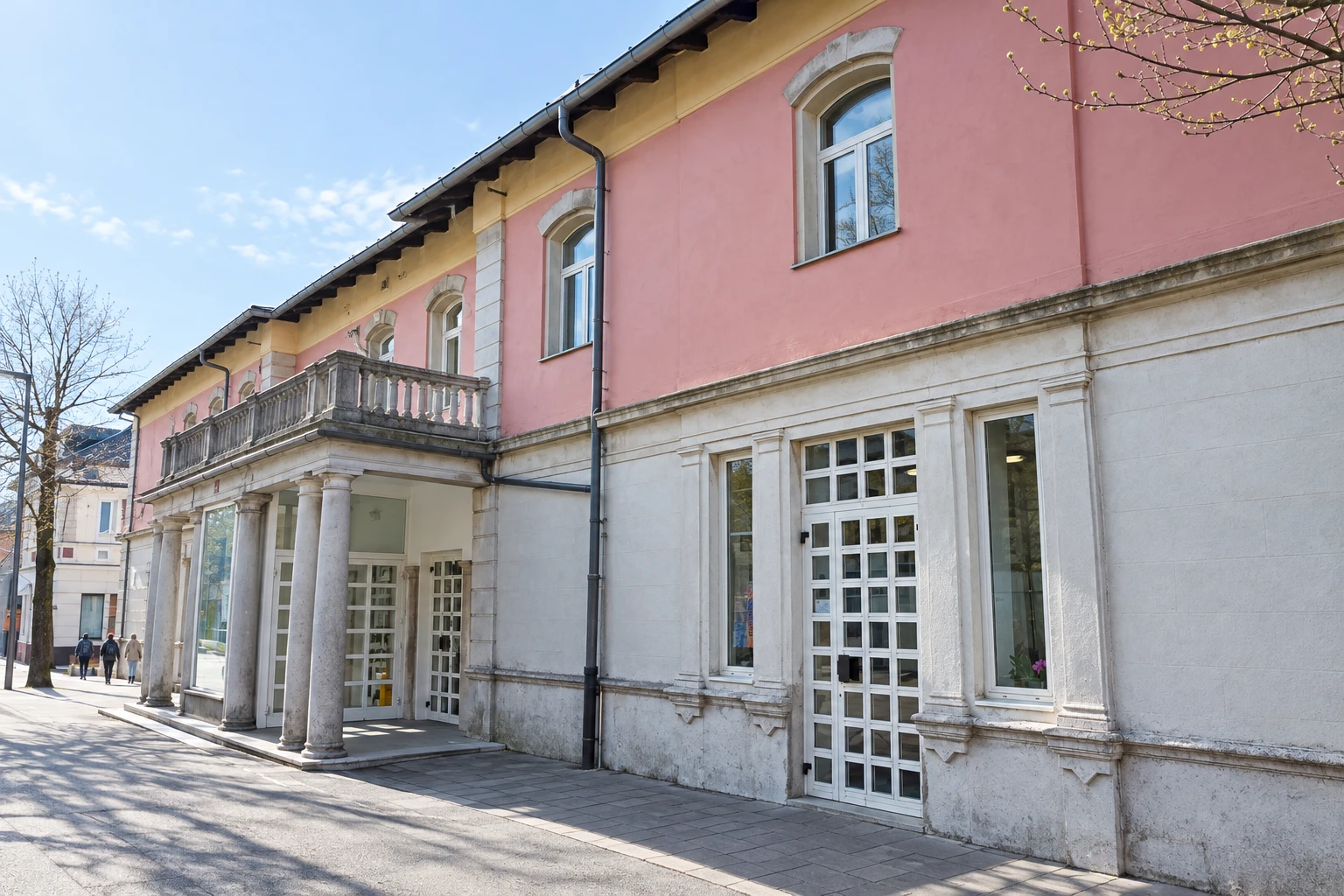
Finish at the Notranjski muzej Postojna. The Karst Museum exhibition explains how caves formed in the limestone, introduces Ice Age animals and traces of Neanderthals, and displays the Predjama Castle treasure. It lay hidden in the cellar for centuries until restoration work in 1990–1993 brought it to light. There are microscopes, a stalactite you can touch, and a puzzle game for teams of up to five, ages ten and up.
Stops: Titov trg, St. Stephen’s Church, Majlont, Faces of Our History exhibition, Ozbič Barbershop, Notranjski muzej Postojna.
Includes: Self-guided outing. The museum and puzzle game charge separately. The park exhibition and the streets of Majlont are free to explore.
Tip: The visitor center on Trg padlih borcev has hiking and cycling maps and stores luggage during opening hours. Check opening days for the museum and barbershop before visiting.
Best time: Year-round. The museum is the town’s main indoor option on a rainy day.
Sovič hill, the ruins of Adelsberg Castle and the town viewpoint
From Majlont, the old town On foot along a forest trail 1 to 2 hours round trip Morning or late afternoon Easy, with a short, steep climb
Forested Sovič Hill rises 677 meters above sea level just above the old center. At the top are the ruins of Postojna Castle, called Adelsberg in German records and also known as the Old Castle. The counts of Andechs were its first recorded owners in the 12th century, and the fortress is believed to be even older. From here its lords controlled the Karst passes and administered the extensive Postojna estate.
Two marked paths climb from Majlont. The History Trail, marked with a chalice, is shorter and steeper. In about 400 meters it passes traces of a prehistoric settlement, the former castle chapel dedicated to St. Ursula, and trenches and a military shelter from the 20th century. The Nature Trail, marked with a leaf, climbs more gently for about 1 km. It identifies 26 species of trees and shrubs and is the better choice for families with young children.
There are two viewing platforms along the way. From the summit you can see the town's rooftops, the Pivka River plain, the cave entrance, and, on the horizon, Nanos and the neighboring plateaus. Military tunnels lie beside the ruins.
You can climb one trail and return on the other. Behind the hill, two other easy paths start at Čukovca: the 1 km Shepherd Jakob Forest Trail and a walking loop that passes the lookout over the village of Veliki Otok.
Stops: Sovič Hill, Ruins of Postojna Castle (Adelsberg), Majlont.
Includes: Free, self-guided outing. The path to the ruins is open year-round.
Tip: Wear sneakers or hiking shoes even for this short trail. The historic path is steep and slippery after rain.
Best time: Year-round. From April to October the forest is in leaf. In snow or ice, choose the Nature Trail.
Along the Pivka to the cave and the Shepherd Jakob Forest Trail
From Central Postojna, by the Pivka River On foot 1 to 2 hours Morning or afternoon Easy
For a pleasant walk from town to the cave, follow the Pivka Riverside Trail. It runs for 1.5 km on pavement and gravel from Vilharjeva Street to the cave park, following the river through a protected area in Europe's Natura 2000 network. The well-kept path has benches, rest areas, and play equipment, and ends on the tree-lined promenade to the entrance.
If you're traveling with children, add the Shepherd Jakob Forest Trail. It starts at Čukovca at the foot of Sovič Hill. Along 1 km of gravel and forest floor, eleven stops with wooden sculptures and games introduce local trees and animals and share stories about the cave. There's a playground in the woods. Your guide is the shepherd Jakob, a local folk hero. Legend says he defeated the cave dragon by filling a calfskin with quicklime. The dragon swallowed it, drank water, and burst. The townspeople are said to have made bags from its hide, earning the people of Postojna the nickname torbarji, or bag makers.
From Jakob's trail, continue to the castle ruins at the top of Sovič or follow the walking loop to the lookout over Veliki Otok, the village where Otoška jama is located.
Stops: Pivka River, Postojna Cave, Čukovca, Veliki Otok.
Includes: Free, self-guided outing.
Tip: If you have a timed cave ticket, leave downtown with time to spare. It's about a 20-minute walk without stops, and the park asks you to arrive half an hour early. For the return, a city bus links the park with downtown and the train station.
Best time: April to October. The path remains open in winter, but ice is possible.


 Brazil
 Antarctica
 Argentina
 Bolivia
 Chile
 Colombia
 Ecuador
 Falkland Islands (Malvinas)
 French Guiana
 Guyana
 Paraguay
 Peru
 Suriname
 Uruguay
 Venezuela
 Austria
 Belgium
 Croatia
 Denmark
 Finland
 France
 Germany
 Greece
 Hungary
 Iceland
 Ireland
 Italy
 Luxembourg
 Norway
 Poland
 Portugal
 Slovakia
 Spain
 Sweden
 Switzerland
 the Czech Republic
 the Netherlands
 the United Kingdom
 Turkey
 Bermuda
 Canada
 Greenland
 Mexico
 Saint Pierre and Miquelon
 the United States
 the Dominican Republic
 Japan
 Egypt
 South Africa
 Australia
 Fiji
 New Zealand
 Papua New Guinea

 December