

 Brazil
 Argentina
 Bolivia
 Chile
Chile Colombia
 Ecuador
 Guyana
 French Guiana
 Falkland Islands (Malvinas)
 Paraguay
 Peru
Peru Suriname
 Uruguay
 Germany
 Belgium
 Denmark
 Spain
Spain France
 Greece
 the Netherlands
 Ireland
 Italy
Italy Luxembourg
 Norway
 Portugal
 the United Kingdom
 Sweden
 Switzerland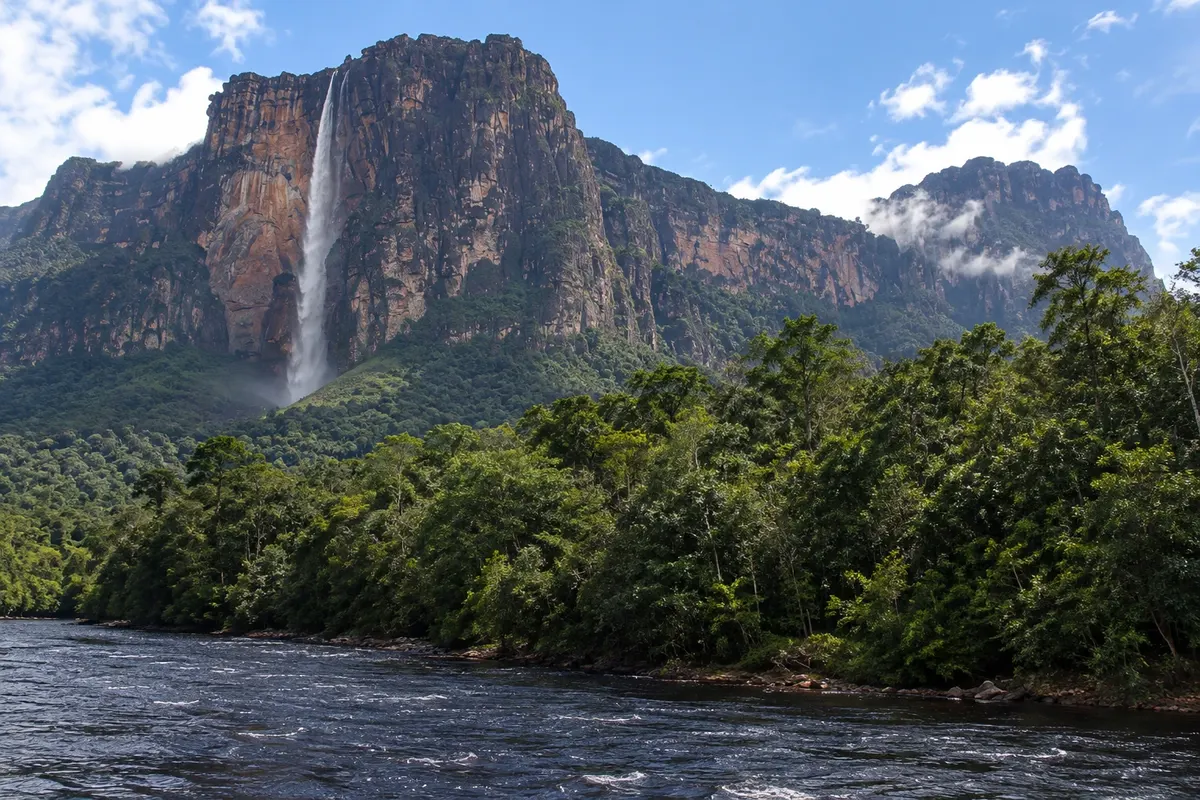
Waterfall · Canaima, Bolívar
Salto Ángel
The highest waterfall in the world, with 979 meters total height and 807 meters of free fall, on the cliff of Auyantepui. It is reached by motor canoe along the Carrao and Churún rivers during the high-water season, or by plane overflight.
Illustrative images. The pictures in this guide are illustrations based on the real place, not photographs, and may differ from it.

Discover
About Salto Ángel
Salto Ángel plunges from the top of Auyantepui, one of the largest tepuis in the region, with more than 700 km² of plateau. It has 979 meters total height, counting the cascades and rapids at the base, and 807 meters of free fall, which makes it the highest waterfall in the world. In the high-water season, the water reaches the bottom like a cloud of vapor; in the dry season, the stream breaks up in the air before touching the ground.
The pemón call the falls Kerepakupai Merú. The name Ángel comes from Jimmie Angel, an American aviator who flew over the falls in 1933. In 1937 he landed on top of the tepui, the plane got stuck, and he, his wife and two companions took 11 days to descend on foot. The main viewpoint is named after Aleksandrs Laime, a Latvian explorer who opened the trail to the base.
In the high-water season, usually from June to November, the visit is made by motor canoe. From Canaima the trip goes up the Carrao River and then the Churún, which runs inside the Cañón del Diablo, between the walls of Auyantepui, in about four to five hours depending on the water level. Overnight is in a camp with hammocks on the island in front of the falls, and from there a trail of about one hour through the forest climbs to Mirador Laime, with the whole fall ahead.
In the dry season, from January to April, the rivers drop and the boat ascent is often not feasible. The visit is then by small plane overflight departing from Canaima that passes in front of the cliff and over the top of the tepui. Clouds frequently cover the falls, and mornings tend to be clearer.
Before you go
Practical information
Cidade Turismo reviews its information regularly, but something may have changed. Check with the place before planning your trip.
How much time to set aside
Two days and one night by river during the high-water season; about one hour for the plane overflight from Canaima.
Best time
From June to November for the boat ascent, when the waterfall has higher volume. At dawn, when the cliff is usually free of clouds. From January to April, the overflight is the most common way to see the falls.
How to get there
From Canaima, by motor canoe along the Carrao and Churún rivers to the camp in front of the falls, and then by a trail of about one hour to Mirador Laime. In the dry season, by small plane overflight from Canaima airstrip. Tours are always guided and are booked through your lodging.
Tip
If you can choose, go in the high-water season and sleep at the camp: seeing the falls at dawn, before the clouds, is worth the trip. Bring a rain poncho, a dry bag, insect repellent and a light warm layer for the night in a hammock. On the boat, sit in the middle to get less wet.
Get your questions answered
Frequently asked questions about Salto Ángel
What is the height of Salto Ángel?
979 meters total height, with 807 meters of free fall. It is the highest waterfall in the world.
When can you go by boat?
During the high-water season, which usually runs from June to November. In the dry season, from January to April, the rivers drop and the most common way to see the falls is by overflight.
How long does the boat trip take?
Four to five hours by motor canoe from Canaima, depending on river level, plus about an hour's hike to Mirador Laime. The trip usually includes an overnight at the camp in front of the falls.
Why is the falls called Ángel?
Because of the American aviator Jimmie Angel, who flew over the falls in 1933 and landed on top of Auyantepui in 1937. For the pemón, the falls are Kerepakupai Merú.
Is the falls always visible?
The cliff is often covered by clouds, especially in the afternoon. Mornings tend to be clearer, which is why spending the night at the camp helps.