

 Brazil
 Argentina
 Bolivia
 Chile
Chile Colombia
 Ecuador
 Guyana
 French Guiana
 Falkland Islands (Malvinas)
 Paraguay
 Peru
Peru Suriname
 Uruguay
 Germany
 Belgium
 Denmark
 Spain
Spain France
 Greece
 the Netherlands
 Ireland
 Italy
Italy Luxembourg
 Norway
 Portugal
 the United Kingdom
 Sweden
 Switzerland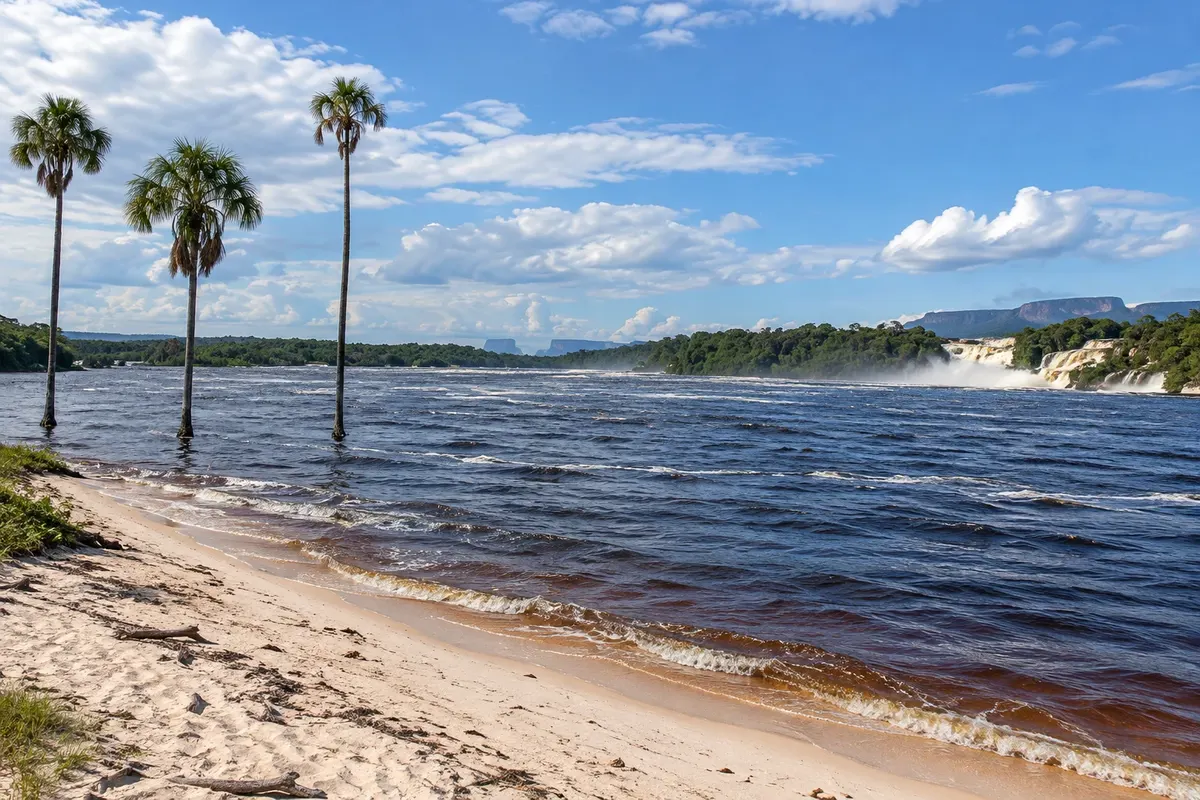
Lagoon · Canaima, Bolívar
Laguna de Canaima
The tea-colored lagoon in front of the village, where the Carrao River falls in a sequence of wide waterfalls, such as the saltos Hacha, Golondrina, Ucaima and Wadaima, with a pink-sanded beach, palm trees and the tepuis in the background.
Illustrative images. The pictures in this guide are illustrations based on the real place, not photographs, and may differ from it.

Discover
About Laguna de Canaima
The Laguna de Canaima is the setting in front of the village and the first thing visitors see when they get off the plane. There the Carrao River, coming from the south, reaches a rock step and falls in a sequence of wide waterfalls, side by side: the saltos Hacha, Golondrina, Ucaima and Wadaima. The water calms in the lagoon and then continues toward the Caroní River.
Color is the hallmark of the place. Tannins from savanna and forest plants tint the water a reddish-brown, like tea, and on the village beach it takes on a pinkish hue over the pale sand. Near the falls the foam is white and the water appears clearer. Some palm trees grow in the lagoon itself, close to the shore.
In the background the tepuis appear, the flat-topped mountains with vertical cliffs of the region: Kurún, Kusari and Kuravaina are among those visible from the beach. At late afternoon, the low light illuminates the rock faces and the waterfalls, and the sky often changes quickly, with clouds rising from the valleys.
Boat trips cross the lagoon and pass close to the waterfalls, always with a pemón pilot, and continue to the island where the trail to Salto El Sapo begins. At the village beach you can swim in the areas indicated by guides, away from the falls' current.
Before you go
Practical information
Cidade Turismo reviews its information regularly, but something may have changed. Check with the place before planning your trip.
How much time to set aside
One hour for the beach and the view; half a day including the boat trip and Salto El Sapo.
Best time
Late afternoon, with low light on the tepuis. From June to November, in the high-water season, the waterfalls are usually more voluminous; from January to April, they are thinner and the lagoon is calmer.
How to get there
The beach is a few minutes' walk from the airstrip and the village lodgings. Boat trips depart from the beach itself, with guides hired at the lodging.
Tip
See the lagoon at two times: early morning, with still water and reflections of the tepuis, and late afternoon, with warm light on the waterfalls. Swim only in the areas indicated, away from the falls.
Get your questions answered
Frequently asked questions about Laguna de Canaima
Which waterfalls form the Laguna de Canaima?
The Carrao River falls in several adjacent drops, such as Hacha, Golondrina, Ucaima and Wadaima, before calming into the lagoon.
Why does the water have a tea-like color?
Because of tannins from savanna and forest plants. On the beach, over the light-colored sand, the water can look pinkish.
Can you swim in the lagoon?
Yes, at the village beach, in areas indicated by the guides. Near the waterfalls the current is strong.
Which mountains appear in the background?
The tepuis — flat-topped mountains with vertical walls. From the beach you can see, among others, Kurún, Kusari and Kuravaina.