

 Brazil
 Argentina
 Bolivia
 Chile
 Colombia
 Ecuador
 Guyana
 French Guiana
 Falkland Islands (Malvinas)
 Paraguay
 Suriname
 Uruguay
 Venezuela
 Germany
 Belgium
 Denmark
 Spain
 France
 Greece
 the Netherlands
 Ireland
 Italy
 Luxembourg
 Norway
 Portugal
 the United Kingdom
 Sweden
 Switzerland
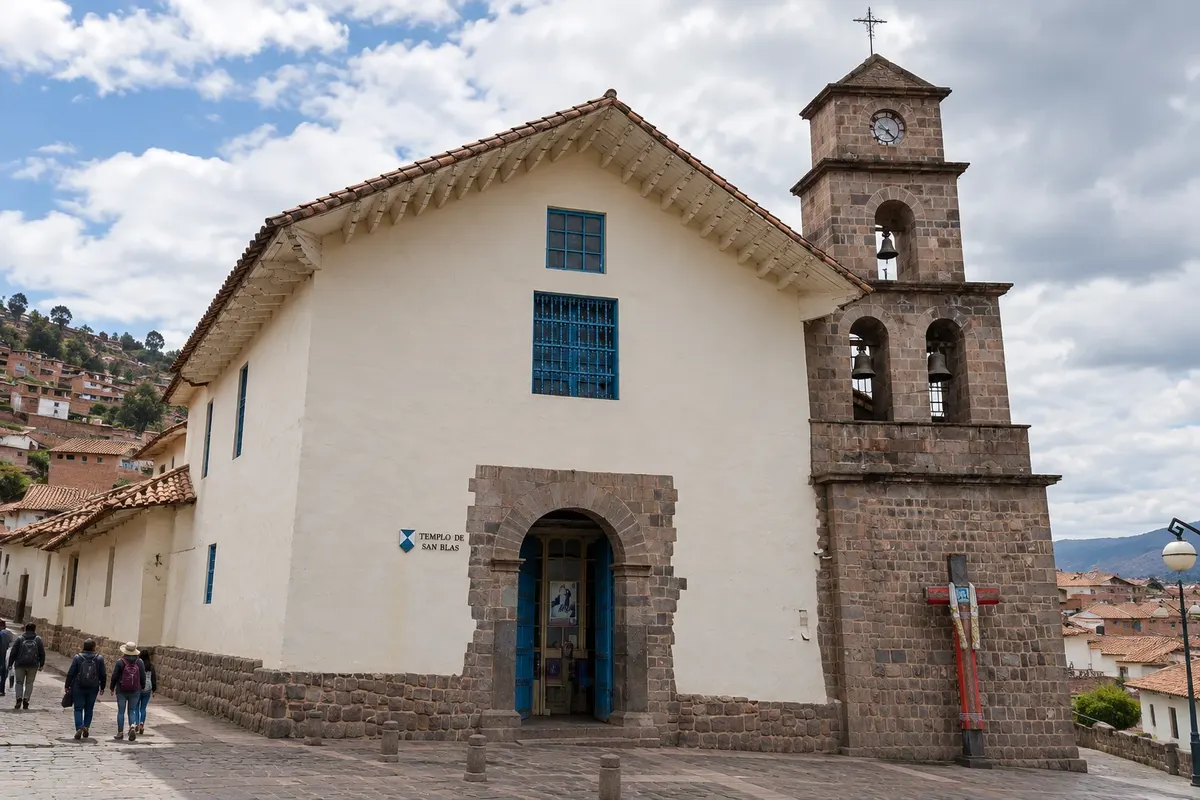
Neighborhood · Cusco, Cusco
Barrio de San Blas
The artisan neighborhood of Cusco, on stone slopes above the Plaza de Armas, with workshops, the church of San Blas and its carved cedar pulpit, and the street Hatun Rumiyoq with the famous 12-angle stone.
Illustrative images. The pictures in this guide are illustrations based on the real place, not photographs, and may differ from it.

Discover
About Barrio de San Blas
San Blas is the neighborhood that climbs the hillside northeast of the Plaza de Armas, with narrow stone streets, stairways and white houses with blue doors and windows. Since colonial times it has been the artisans' quarter, and today it still houses workshops making religious images, ceramics, textiles and paintings. In the Plaza de San Blas at the top there is a fountain, cafés and views over the central rooftops.
The best-known route to the neighborhood is the street Hatun Rumiyoq, which departs from the Plaza de Armas. There is the Inca wall of the palace of Inca Roca, today the Palacio Arzobispal and Museo de Arte Religioso, with the famous 12-angle stone, a block fitted with twelve faces against the neighboring stones. It's common to find residents in traditional dress posing for photos near it.
The church of San Blas, dating from 1563, is one of the oldest in Cusco and looks simple from the outside, but it houses a carved cedar pulpit considered a masterpiece of colonial woodcarving. Attributed to the indigenous artist Juan Tomás Tuyru Túpac, it contains dozens of figures and, according to tradition, a skull at the top. The church is part of Cusco's religious circuit and has a separate entrance.
The streets Tandapata and Carmen Alto above the square are the quietest in the neighborhood, with Inca walls, guesthouses and restaurants. The slopes are steep: at altitude, climb slowly.
Before you go
Practical information
Cidade Turismo reviews its information regularly, but something may have changed. Check with the place before planning your trip.
How much time to set aside
1 to 2 hours for Hatun Rumiyoq, the church and the neighborhood streets.
Best time
Late afternoon for the light over the rooftops seen from the Plaza de San Blas, or in the morning when the workshops open. On Saturdays there is often a craft fair in the square.
How to get there
It's a 5-minute walk from the Plaza de Armas, up Hatun Rumiyoq or the Cuesta de San Blas. The streets are stone and uphill; taxis only reach certain points.
Tip
Walk up Hatun Rumiyoq to see the 12-angle stone and descend by another street, such as the Cuesta de San Blas. Enter the church to see the pulpit up close: photos taken from outside don't show the detail.
Get your questions answered
Frequently asked questions about Barrio de San Blas
Where is the 12-angled stone located?
On Hatun Rumiyoq street, between the Plaza de Armas and San Blas, in the Inca wall of the former palace of Inca Roca, today Palácio Arzobispal.
What to see in the church of San Blas?
The carved cedar pulpit, attributed to Juan Tomás Tuyru Túpac, with dozens of figures. It is one of the most famous examples of colonial woodcarving in Peru.
Is San Blas good to stay in?
Yes, for those who want a quiet neighborhood close to the center. The streets are steep and cobbled, which makes it harder with luggage and during the first days at altitude.