

 Brazil
 Argentina
 Bolivia
 Chile
Chile Colombia
 Ecuador
 Paraguay
 Peru
Peru Uruguay
 Germany
 Belgium
 Spain
Spain Greece
 the Netherlands
 Ireland
 Italy
Italy Luxembourg
 Portugal
 the United Kingdom
 Switzerland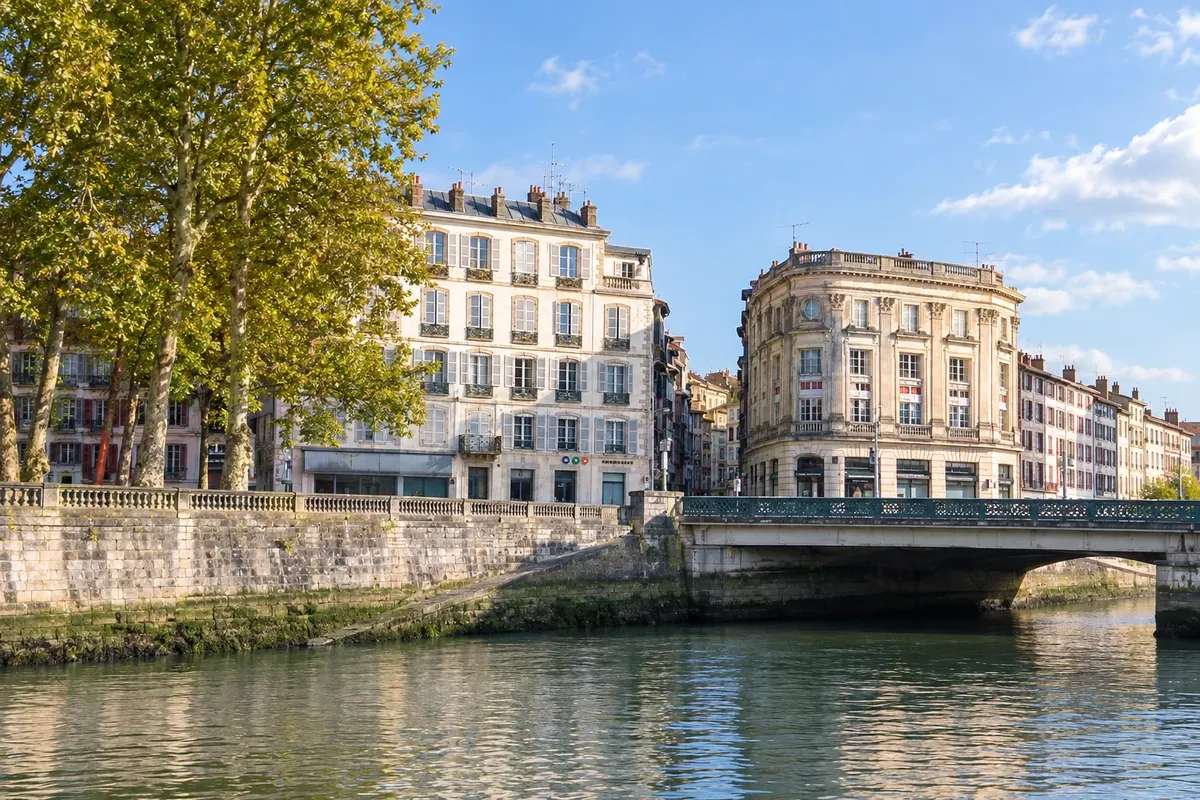
Before you go
Your trip to Bayonne.
Illustrative images. The pictures in this guide are illustrations based on the real place, not photographs, and may differ from it.

Bayonne – Nova Aquitânia Destination French Basque Country about 185 km from Bordéus
How to get there
-
Aéroport de Biarritz-Pays Basque (BIQ) Anglet · 6 km
-
Gare de Bayonne Saint-Esprit · 1 km
Approximate road distances. Check flights and bus schedules before you travel.
Check before buying. The Gare de Bayonne, in the Saint-Esprit district on the other side of the Adour, receives the TGV from Paris-Montparnasse in about four hours, and trains from Bordeaux, Toulouse, Hendaye and Saint-Jean-Pied-de-Port; the center is about a 10-minute walk across the bridge. Biarritz-Pays Basque airport is about 6 km away, with a city bus.
How many days
One day covers the cathedral, the cloister, the two districts and one of the museums. Two days allow a relaxed visit to the Musée Basque and the Musée Bonnat-Helleu and a trip to Espelette or Biarritz. Bayonne is also a good base for exploring the region by train.
When to go
All year round for the city and the museums. From June to September the days are long and the quays fill with tables; the Fêtes de Bayonne at the end of July crowd the city and accommodations, which must be booked well in advance. Rain can come in any season.
The seasons shown are the most usual ones; nature doesn't always follow the calendar.
Do you need a car?
No. The historic center is compact, flat and largely pedestrianised, and buses and trains link Bayonne with Biarritz, Saint-Jean-de-Luz and the airport. A car only helps for inland villages like Espelette and Ainhoa; in the center, use the parking lots at the city entrances.
Suggested itinerary
An order that works
Built with the places on this page. No rush: it's paced so you have time to see them.
One day in Bayonne
-
Morning
Cathedral, cloister and ramparts
Start with the cathedral of Sainte-Marie and the cloister, one of the largest in France. Continue to the botanical garden on a Vauban bastion, and view the Château-Vieux from the outside.
-
Afternoon
Nive quay and Musée Basque
Have lunch near the covered market, on the Nive waterfront. Cross to Petit Bayonne and visit the Musée Basque at the Maison Dagourette, or the Musée Bonnat-Helleu right next door.
-
Late afternoon
Chocolate and streets of Grand Bayonne
Return to Grand Bayonne via the Nive bridges and walk along rue d'Espagne and the shopping streets, with the city's traditional chocolateries.
-
Evening
Petit Bayonne bars
Dine on the quays of Petit Bayonne, where bars serve Basque pintxos and the region's ham.
Check before you go. Opening hours and days change, and places may close for renovations, holidays or events. This itinerary is a suggestion from Cidade Turismo, not a commitment: plan yours by checking directly with each place you intend to visit.
Before you go
Frequently asked questions
How to get from Bayonne station to the center?
The station is in the Saint-Esprit district, on the other side of the Adour. Just cross the bridge: it's about a 10-minute walk to the historic center.
When are the Fêtes de Bayonne?
The festival has been held since 1932, for five days at the end of July, with music, parades and the whole town dressed in white and red. Check the dates for the year and book accommodation well in advance.
Why is Bayonne known for chocolate?
Jewish families from the Iberian Peninsula, who settled in the Saint-Esprit district in the 17th century, brought chocolate-making. Since then the city has traditional chocolateries, and there is a chocolate trail in the centre.
Bayonne or Biarritz: where to stay?
Bayonne is close to the station, has accommodations in the historic center and is good for those travelling by train. Biarritz is better for beach and surfing. The two are about 10 minutes from each other.
Is Bayonne on the Camino de Santiago?
Yes. The cathedral is part of the Routes of Santiago de Compostela in France, a UNESCO World Heritage site since 1998, and many pilgrims pass through Bayonne by train on their way to Saint-Jean-Pied-de-Port, where the French Way begins.