Angra dos Reis
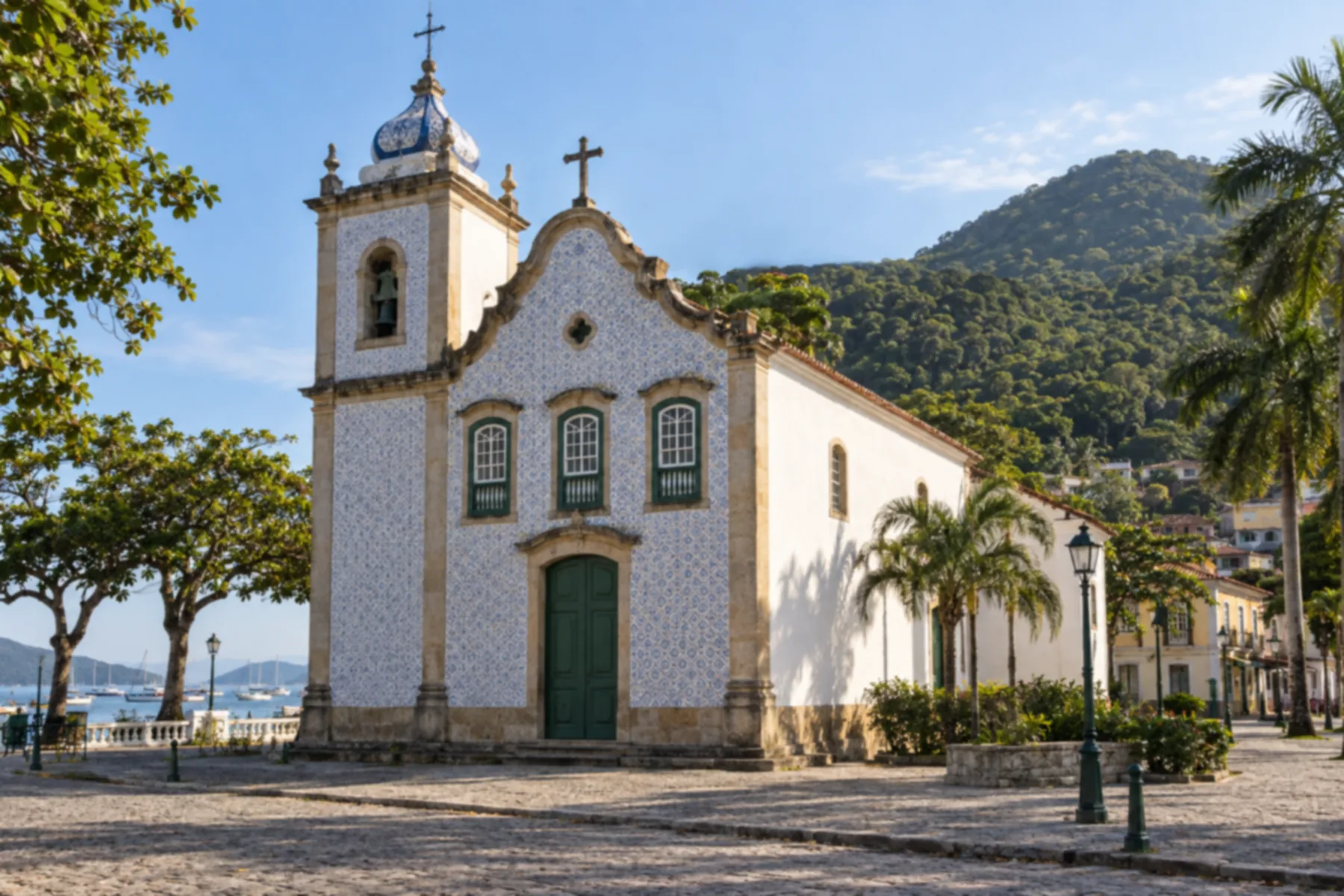
Angra dos Reis se espalha entre o litoral recortado e as ilhas da Costa Verde. Passeios de barco permitem conhecer praias e enseadas, enquanto o centro guarda construções ligadas à história da cidade.
Antarctica
RJ
Serra do Mar, ilhas e a Paraty colonial, entre o Rio e São Paulo.
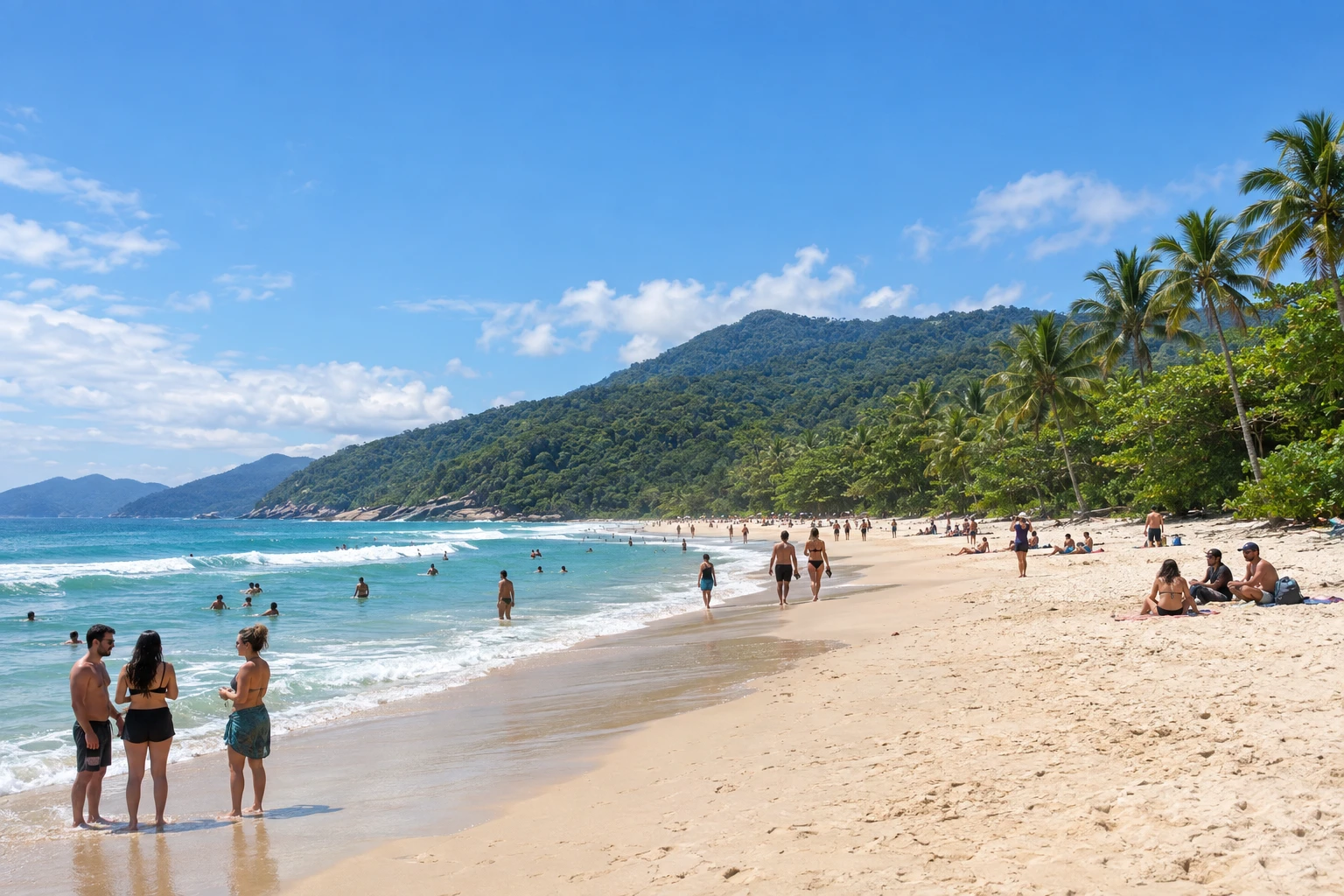
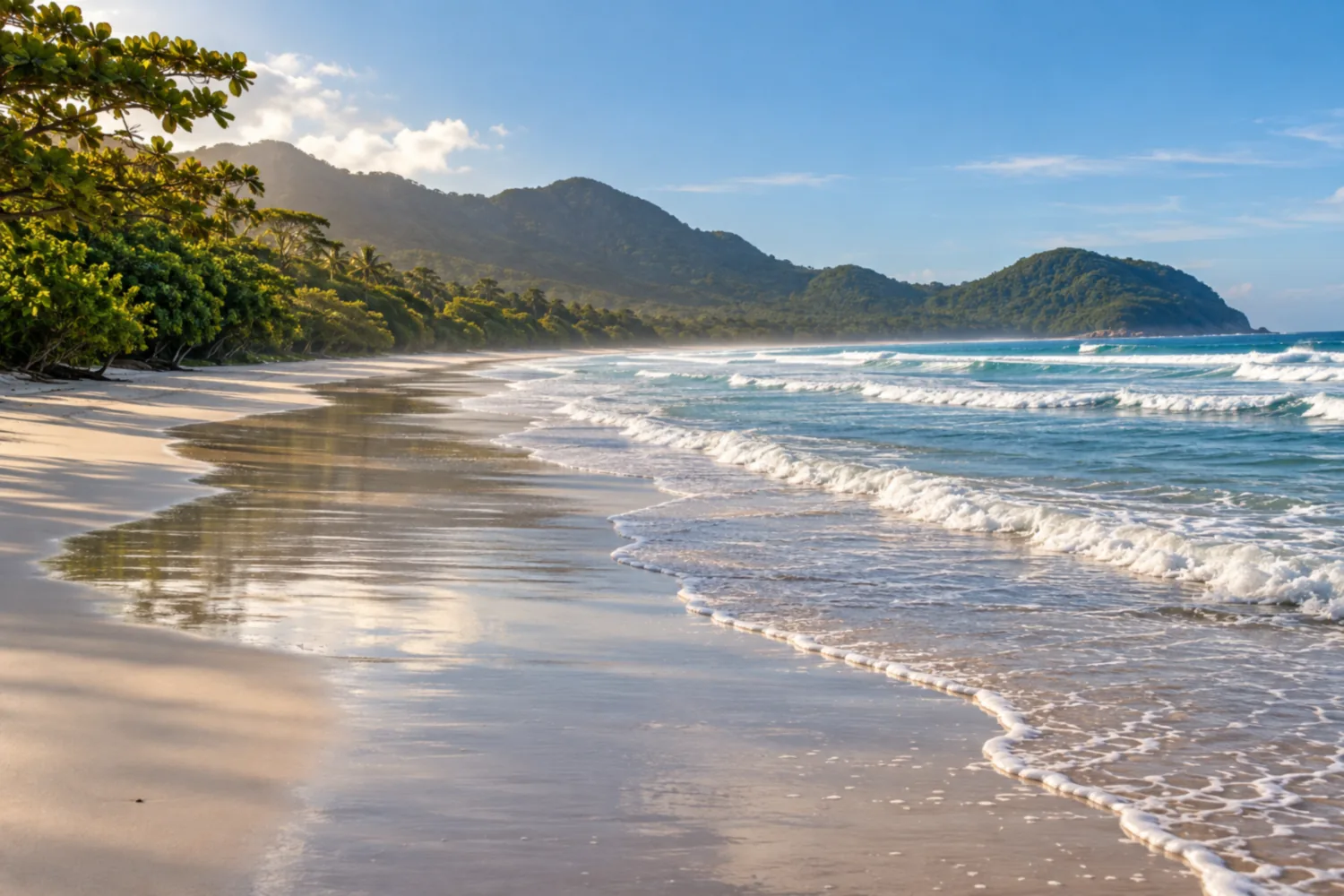
In the photo: Praia de Lopes Mendes, Ilha Grande
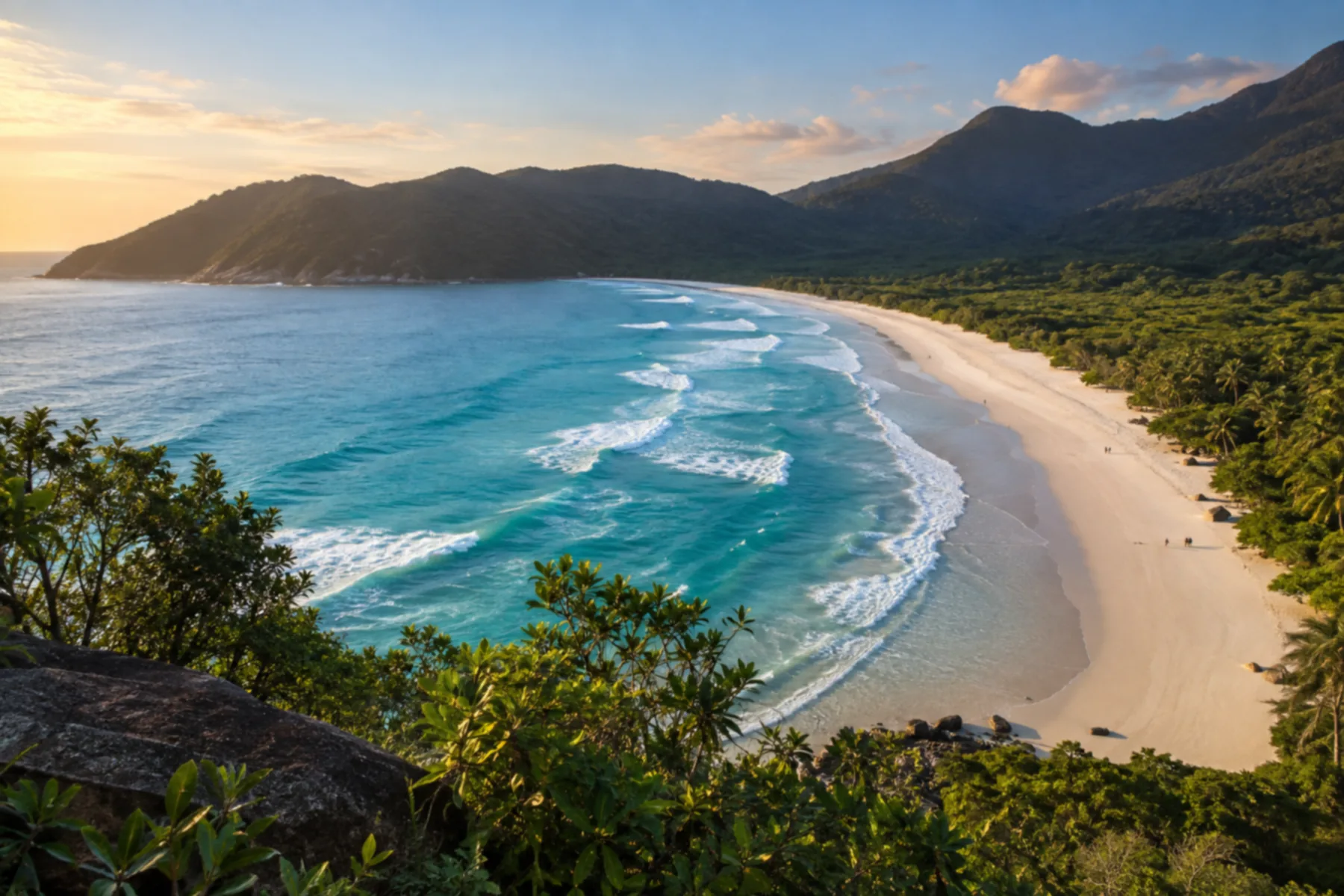
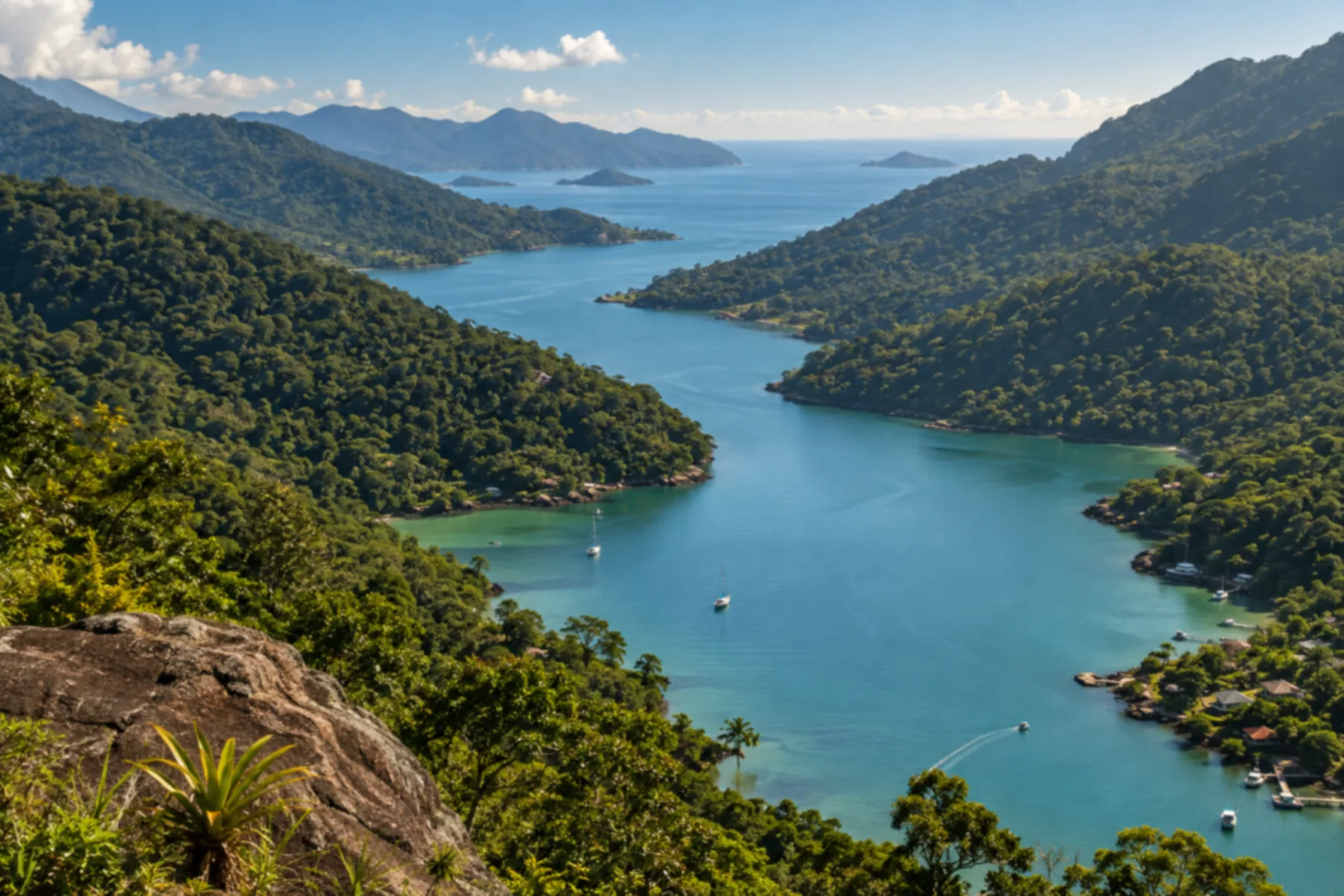
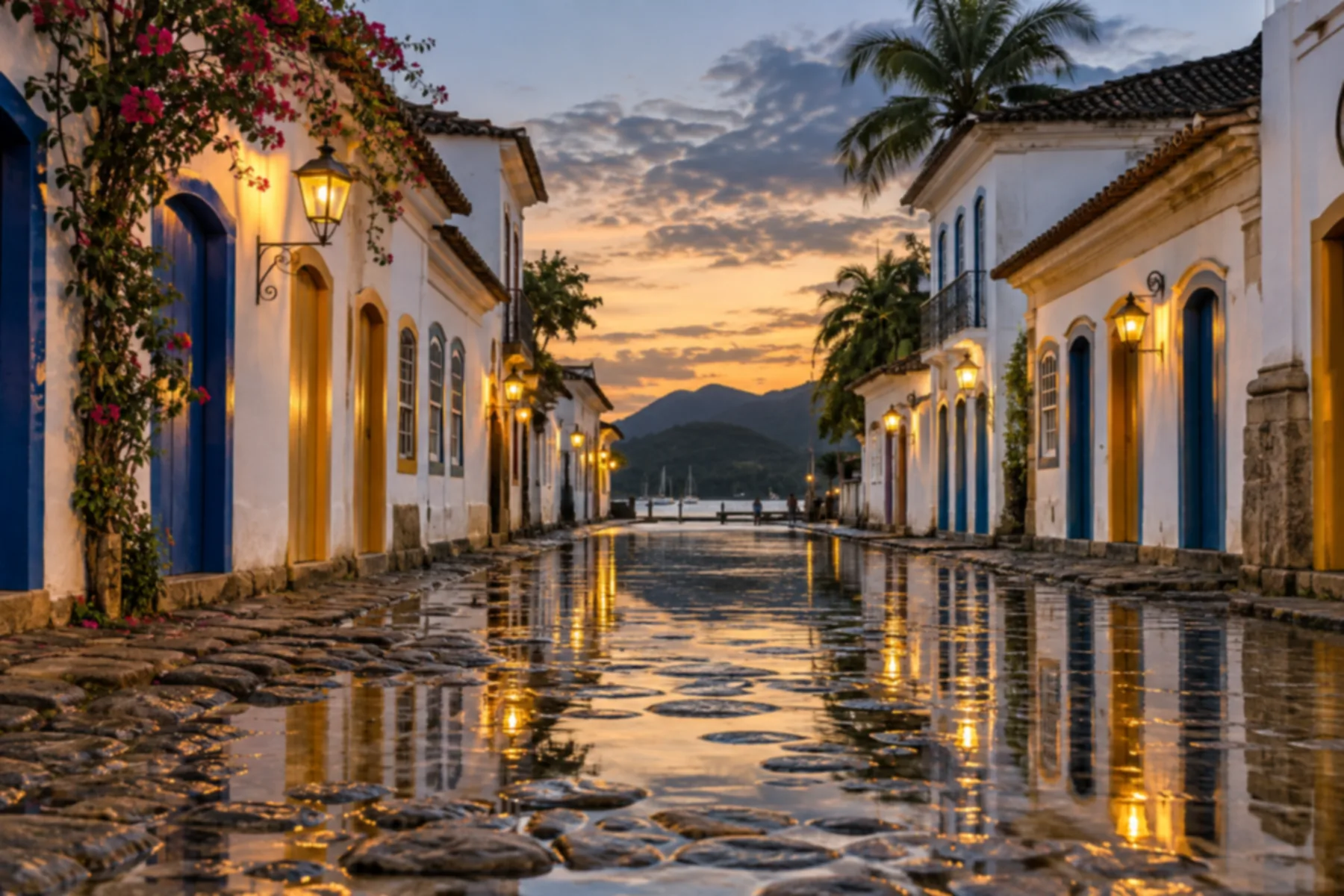
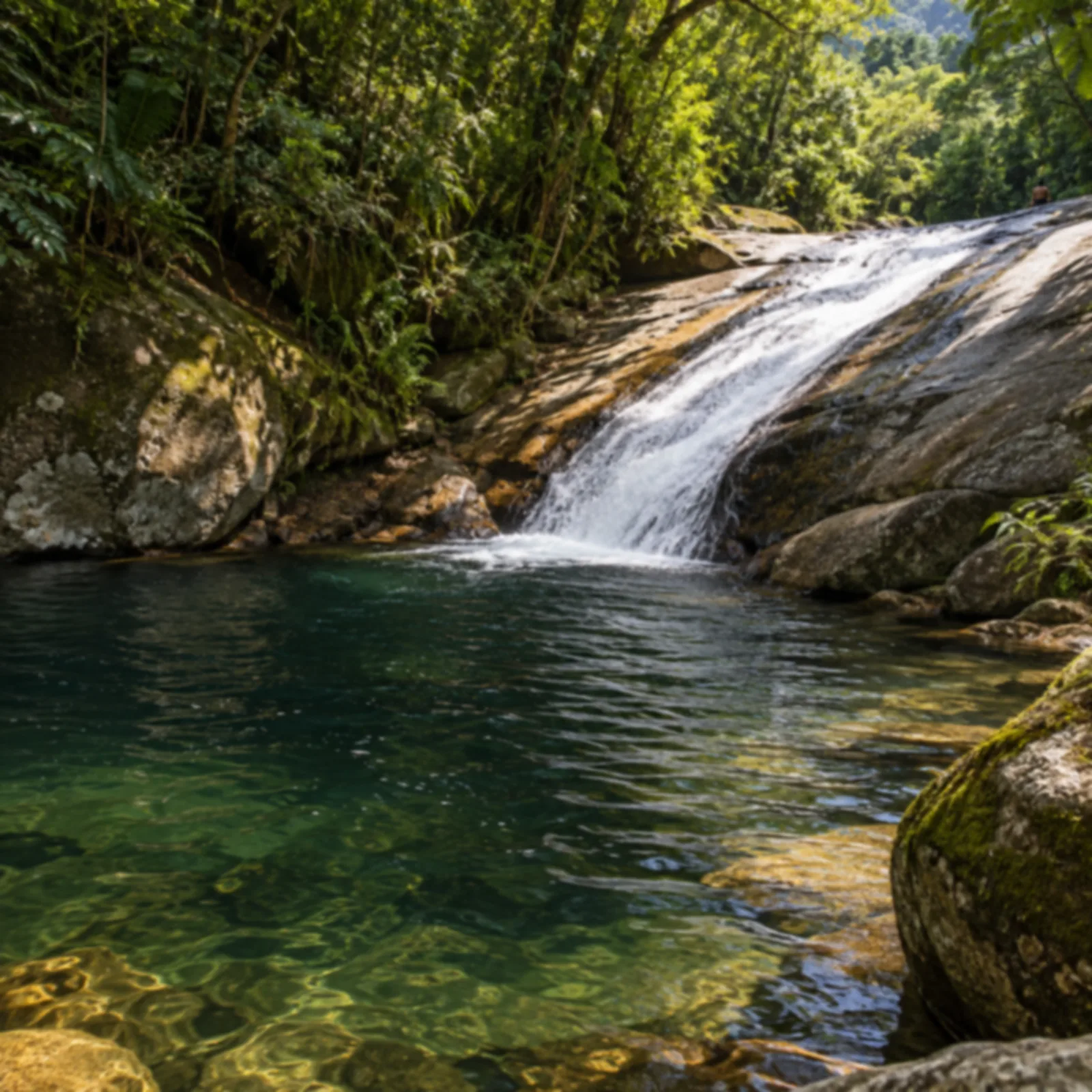
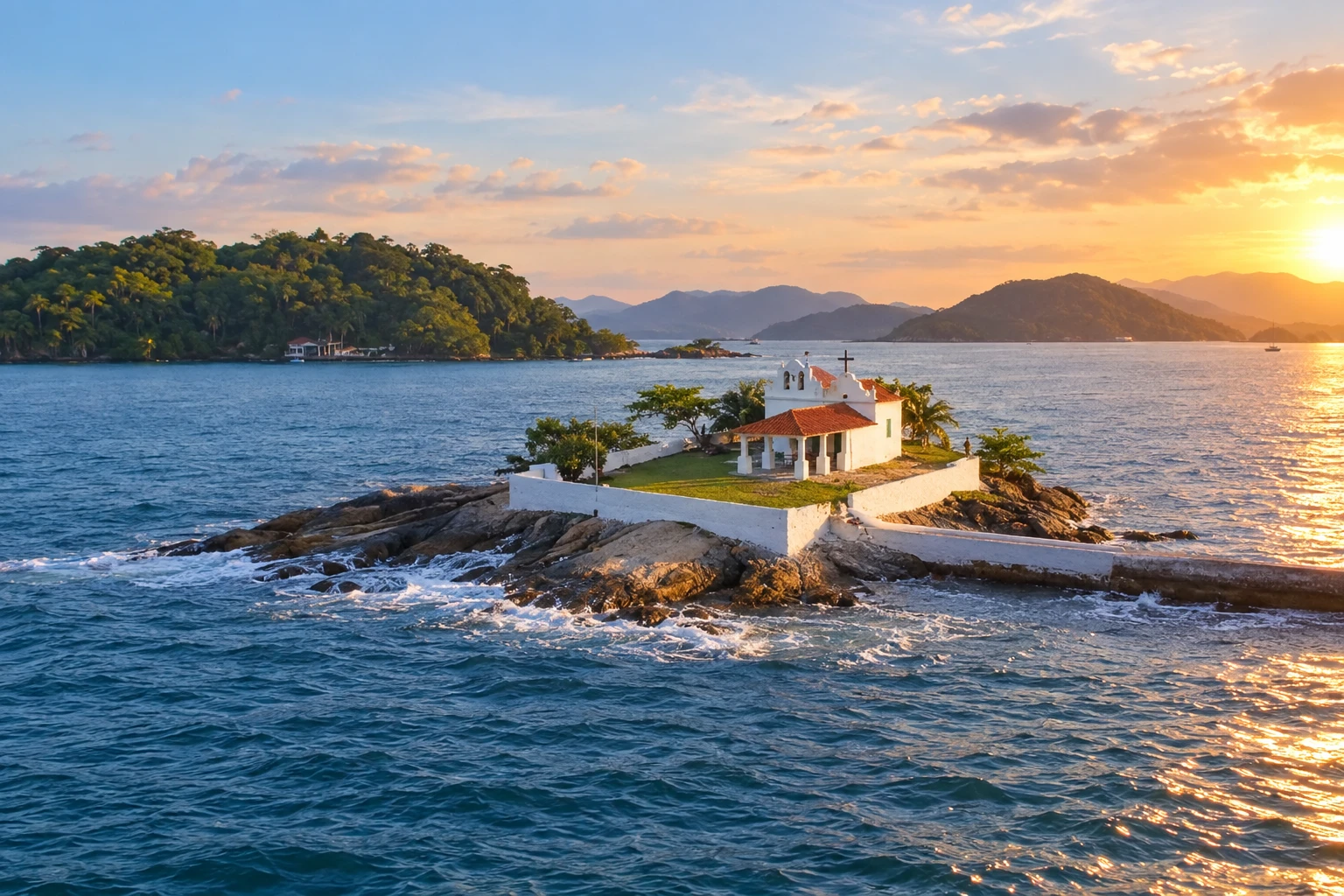
Illustrative images. The pictures in this guide are illustrations based on the real place, not photographs, and may differ from it.
Get to know the place
É o trecho do litoral fluminense onde a Serra do Mar desce até a água e deixa para trás centenas de ilhas, enseadas de água verde-esmeralda e vilas caiçaras que só se alcançam de barco. Você passa a manhã navegando entre piscinas naturais em Angra dos Reis e termina o dia nas pedras irregulares do centro histórico de Paraty, entre casarões brancos e portas coloridas.
Angra dos Reis tem mais de 300 ilhas, e a maior delas, a Ilha Grande, é um mundo à parte: sem carros de passeio, com a Vila do Abraão como porta de entrada, trilhas na mata atlântica e praias como Lopes Mendes e a Lagoa Azul. Paraty junta o casario colonial tombado, os alambiques de cachaça, as cachoeiras da serra e a Vila de Trindade, com piscinas naturais entre as pedras. O Saco do Mamanguá, conhecido como o fiorde tropical, é passeio de barco a partir de Paraty.
No caminho entre o Rio de Janeiro e Angra, Mangaratiba e Itacuruçá abrem o acesso às ilhas da Baía de Sepetiba, e Rio Claro, na serra, guarda as ruínas de São João Marcos. É uma viagem de mar, mata e história, que se faz de barco, a pé e pela Rio-Santos, uma das estradas mais bonitas do país.
This destination brings together 5 cities: Angra dos Reis, Paraty, Mangaratiba, Itaguaí, Rio Claro.
A look at the place
These pictures are illustrations based on the real place, not photographs. They may differ from the place.
Click the picture to enlarge it.
Travelers' photos
One destination, many paths
Start with one city or combine several in your itinerary.
Mapa: @svg-maps/brazil, CC BY 4.0
Aeroporto Internacional do Galeão (GIG), in Rio de Janeiro · 149 km to Angra dos Reis
Aeroporto Santos Dumont (SDU), in Rio de Janeiro
O acesso é pela BR-101 (Rodovia Rio-Santos). Angra dos Reis fica a cerca de 2 horas e meia do Aeroporto do Galeão, no Rio de Janeiro, e Paraty a cerca de 4 horas; de São Paulo, Paraty fica a cerca de 4 horas e meia. Há ônibus do Rio e de São Paulo para as duas cidades. Para a Ilha Grande, barcas e lanchas saem de Angra dos Reis, Conceição de Jacareí e Mangaratiba.
Suggested arrival point: Angra dos Reis

Angra dos Reis se espalha entre o litoral recortado e as ilhas da Costa Verde. Passeios de barco permitem conhecer praias e enseadas, enquanto o centro guarda construções ligadas à história da cidade.

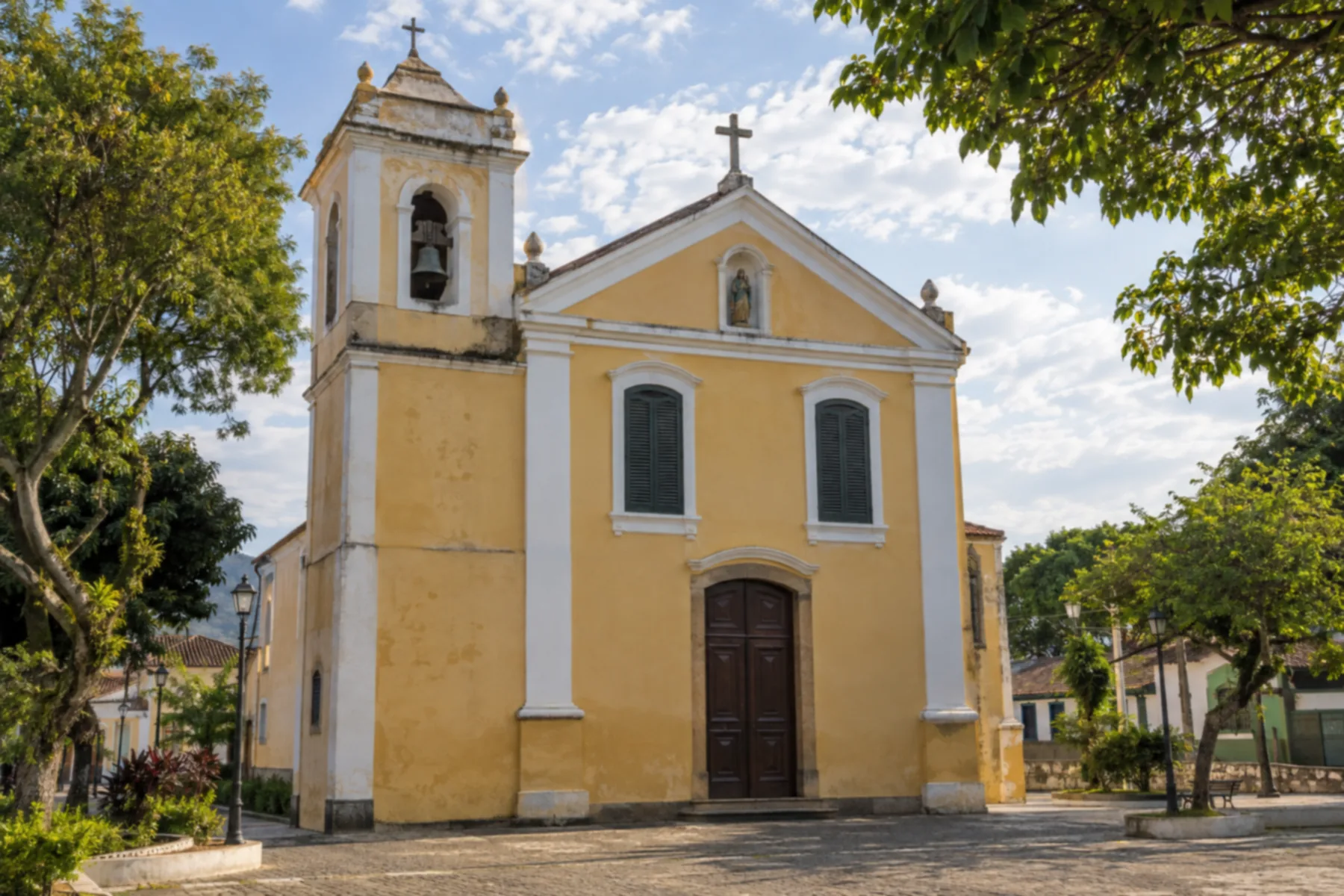
Paraty combina um centro histórico de ruas de pedra com a paisagem entre a Serra da Bocaina e o mar. A viagem pode alternar caminhadas pela cidade com passeios de barco pela baía.

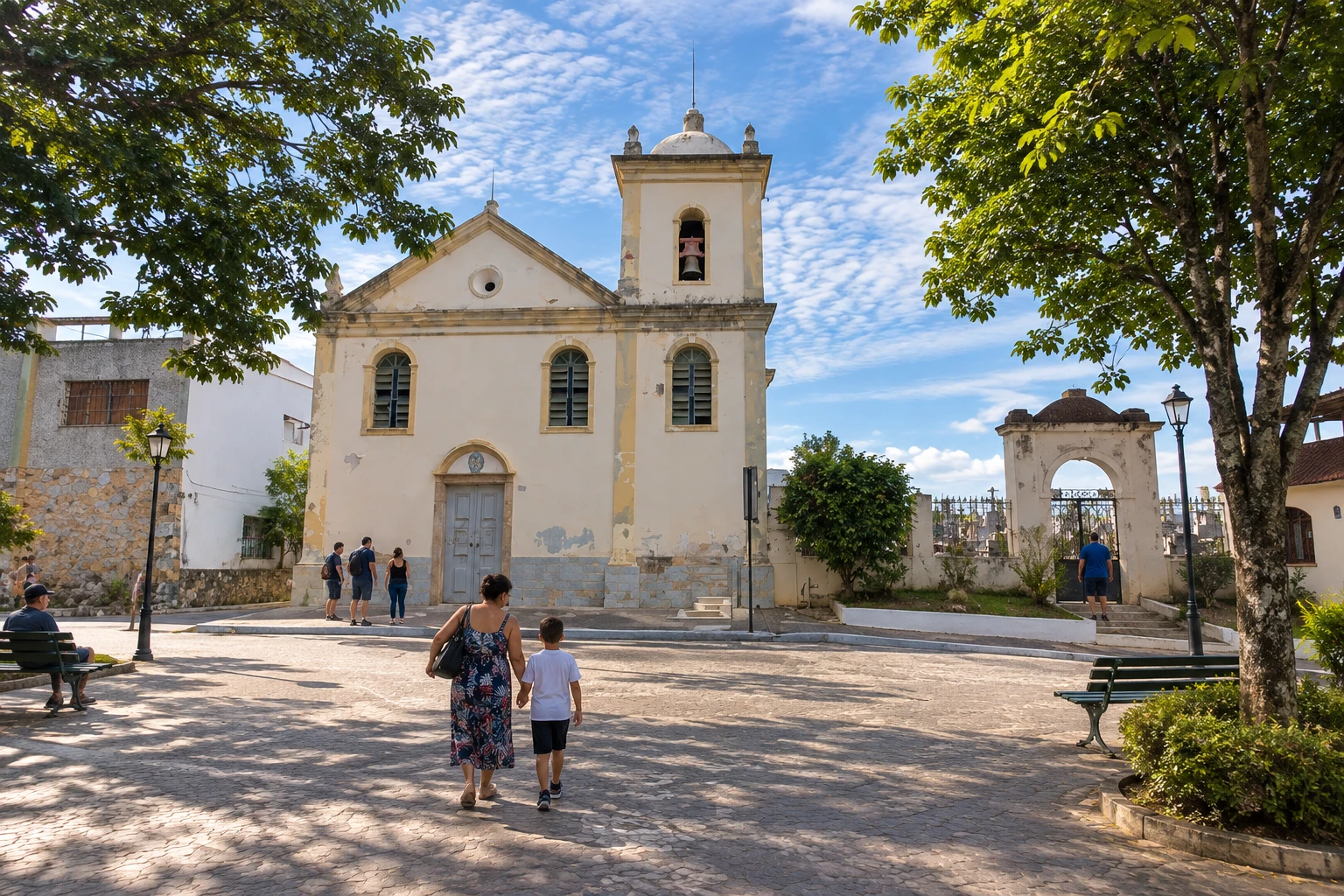
Mangaratiba reúne pequenos núcleos litorâneos entre o mar e as encostas da Serra do Mar. É possível explorar sua história no centro e seguir pelas praias ou embarcar para conhecer as ilhas próximas.

Itaguaí conecta a Baía de Sepetiba às áreas rurais e serranas da Mata Atlântica. O visitante pode conhecer o patrimônio do centro e explorar o litoral ou os caminhos do Vale do Mazomba.

Rio Claro ocupa uma região de serras, rios e paisagens rurais no interior fluminense. Passeios pelo município aproximam o viajante da natureza e da memória da antiga cidade de São João Marcos.
Festivals and events
Dates change every year: check this year's date before you travel.
May/JuneOn the days leading up to Pentecost Sunday, 50 days after Easter; therefore it falls in May or June.
Paraty’s most traditional religious festival, with a novena, processions through the historic center, a solemn Mass and a Sunday Pentecost procession.
July/AugustOnce a year, usually between July and August, for five days.
The literature festival that fills Paraty’s historic center with author talks, debates, and a parallel program spread throughout the town.
AugustIn August, from Thursday to Sunday.
Paraty’s alambique festival, featuring tastings of the region’s cachaças, caiçara food, and music, held in the tents at the Pontal.
The local experience
Erguida entre 1718 e 1729 como parte de um estabelecimento jesuíta, está na origem da antiga vila. O conjunto, em terreno elevado, tem tombamento estadual pelo Inepac que inclui imagens de madeira de São Francisco Xavier e de Nossa Senhora do Pilar.
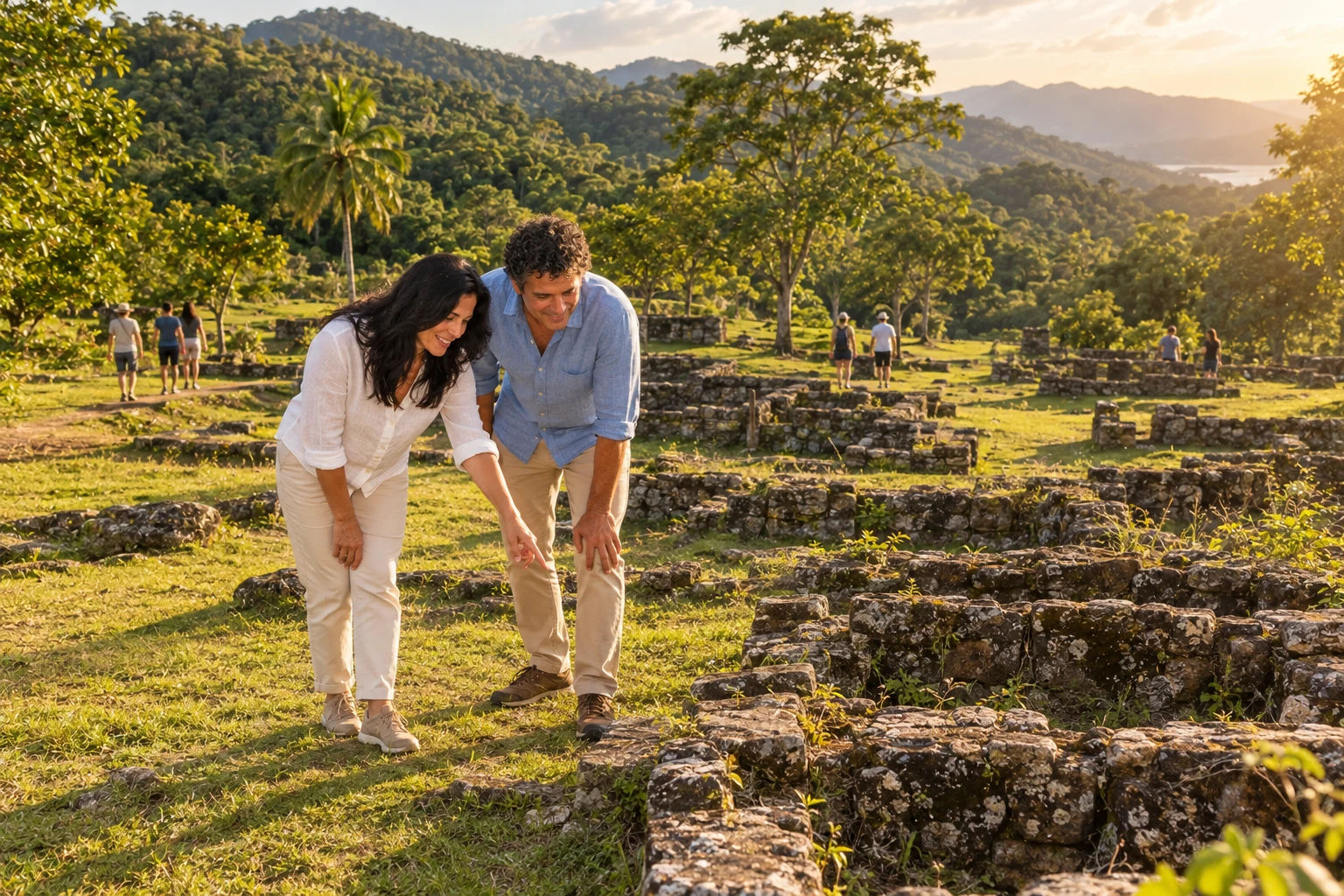
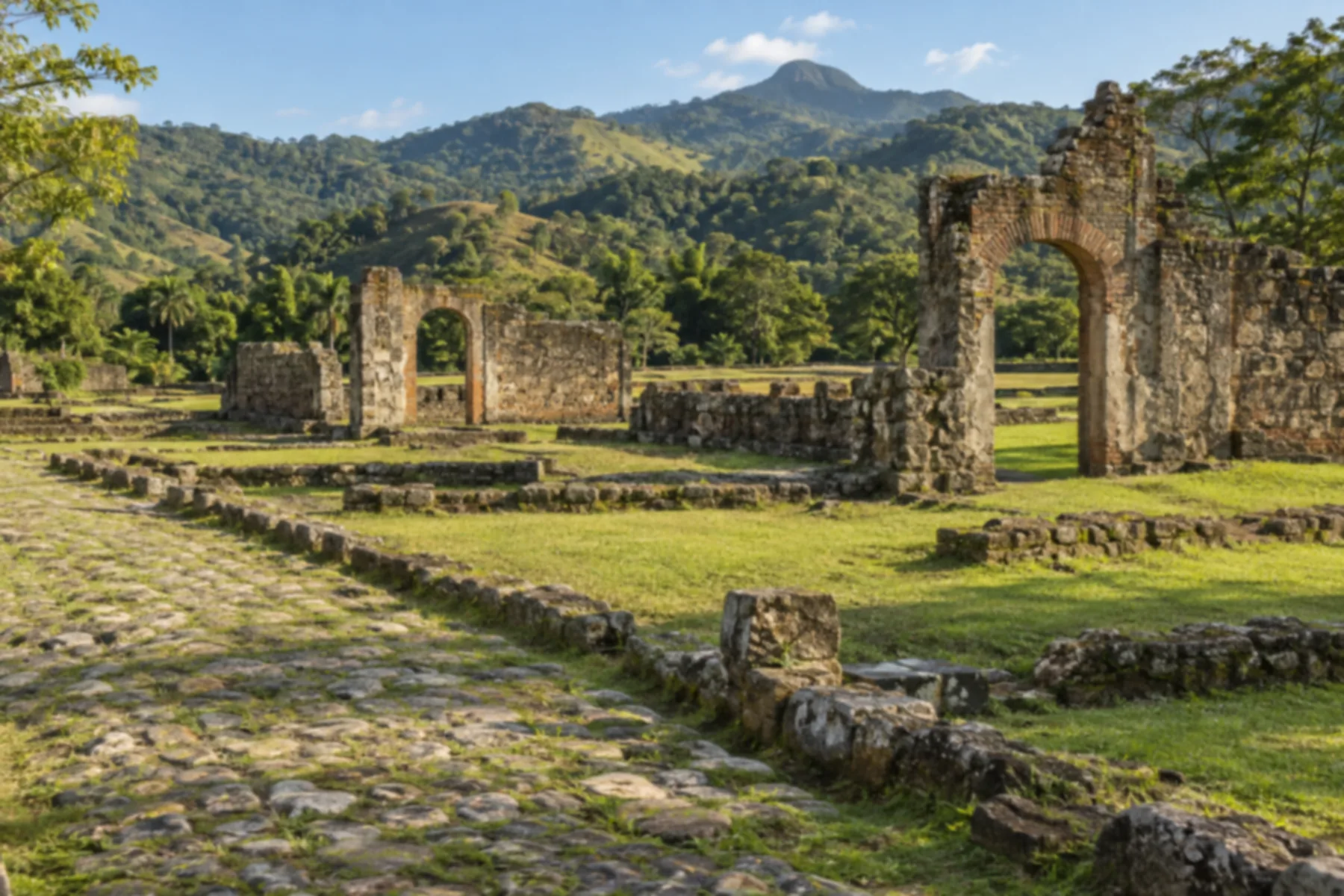
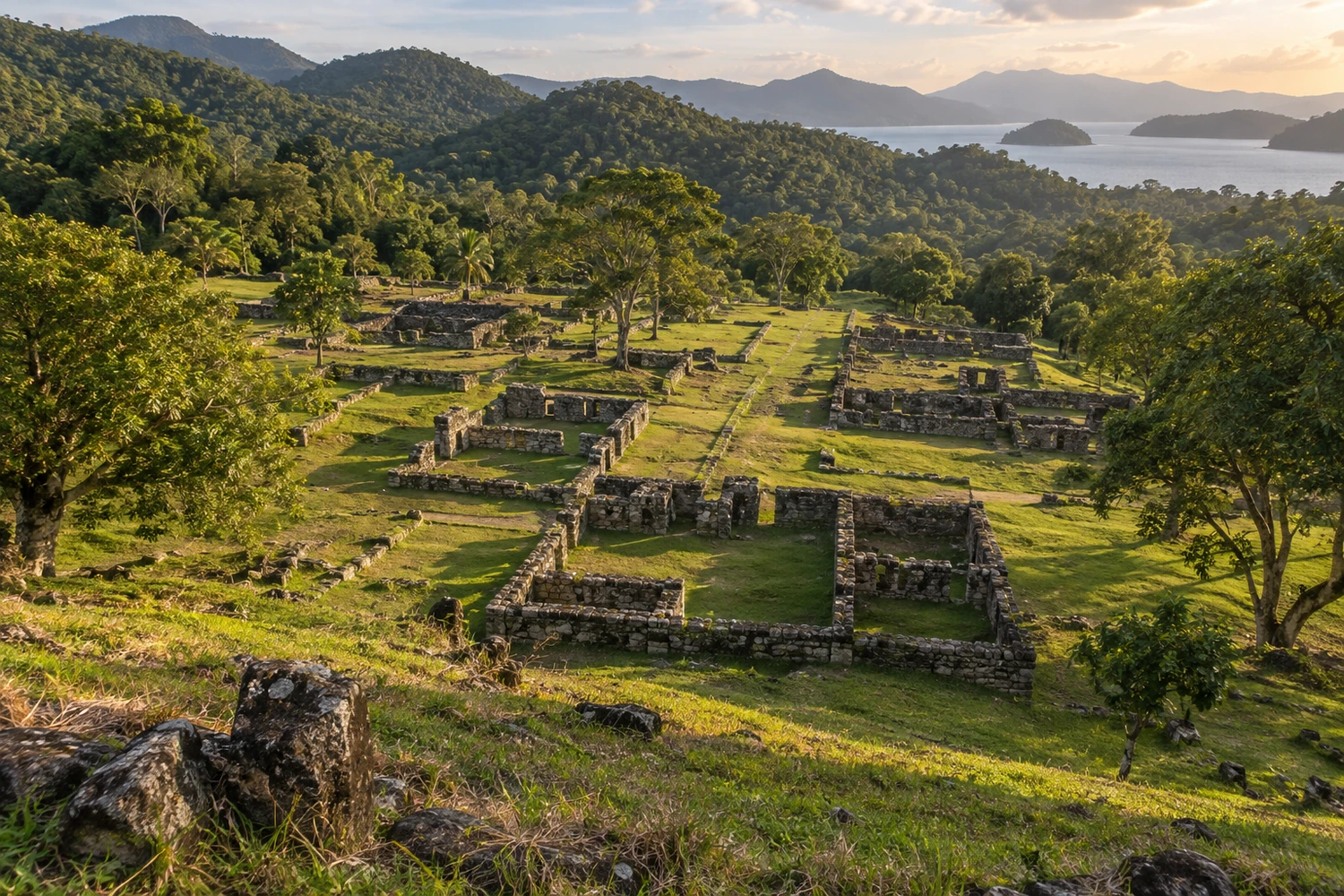
Preserva as ruínas da antiga cidade de São João Marcos, demolida na década de 1940 para a ampliação de uma represa, e é apontado como o primeiro sítio arqueológico urbano do país. Tem trilha do Caminho Imperial e centro de memória.
Faixa de areia branca e firme de quase três quilômetros na Ilha Grande, sem construções e sem quiosques, alcançada por trilha na mata ou por barco até Pouso. É considerada uma das praias mais bonitas do Brasil e tem ondas boas para surfe.
Situada na Baía de Sepetiba, em frente ao distrito de Itacuruçá, é destino dos passeios de escuna e saveiro que partem do cais. Tem várias praias de águas calmas ligadas por trilhas, entre elas a Praia Grande e a Praia Brava.
To choose before you go
Where each tour starts, how long it takes, how it is done, what is included and the price range.
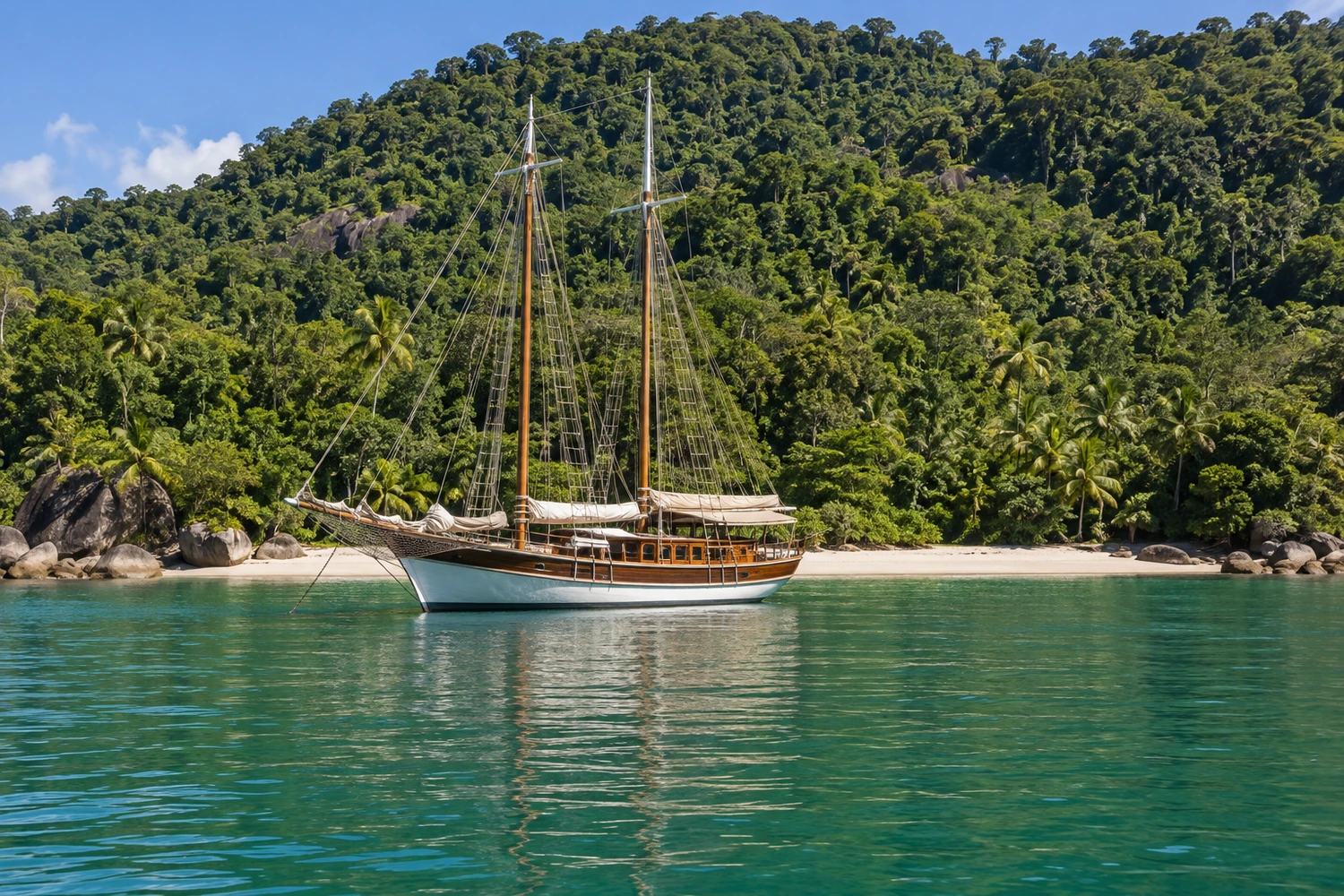
It's the most popular boat trip for first-time visitors to Angra dos Reis. The schooner departs from the downtown pier, near Estação Santa Luzia, and sails among the bay's islands. The typical route starts at Ilha de Cataguases, continues to Lagoa Azul, where the shallow, clear water allows you to float and see fish, and passes by Freguesia de Santana, on Ilha Grande. The last stop is Praia de Japariz, where there's a restaurant for lunch, which is optional. Each stop lasts around 30 minutes, and the lunch stop is longer. The schooners are large, with an onboard bar, music and, on some, a slide. On days with rough seas or heavy rain, the route may change. It's a good option for families and for those who want to visit several islands without paying the price of a speedboat.
Stops: Ilha de Cataguases, Lagoa Azul, Freguesia de Santana, Praia de Japariz, Praia do Araçá.
Includes: It usually includes only the navigation and the use of the schooner. Lunch, drinks and rental of mask and snorkel are paid separately. Small children usually have a reduced fare or travel free; check the agency's current price list. The municipality of Angra dos Reis charges a sustainable tourism fee for visitors; check the current table.
Tip: Arrive at the pier early and bring the voucher and a photo ID. Bring sunscreen, a towel and water, because onboard sales are paid separately. If you are coming from Rio or São Paulo, arrange transfer before arriving so you don't miss the embarkation time.
Best time: April to June and September to November, with clearer water and less crowded islands. In summer there is more activity.
Agencies that run it: Passeio Rio, Angra dos Reis Turismo Ltda., Angra Forte Mar Turismo.
R$49 to R$120 · per person, adultThe speedboat leaves from the center of Angra dos Reis and makes five short stops, of 20 to 30 minutes each, with time for swimming in the sea and snorkeling. The route starts at Ilha de Cataguases, with white sand, and passes Lagoa Azul, where you float among fish. Next are Praia da Grumixama, small and with the feel of an open-sea beach, and Praia do Araçá. The final stop is Praia das Flechas, on Ilha da Gipóia, where lunch is served for about an hour. The speedboats carry groups of 12 to 30 people, depending on the day, and the boat is assigned on the day of the tour. Because it is faster than the schooner, the speedboat covers more spots in the same time, and the group is usually smaller. If the weather is unfavorable, the agency may change the itinerary.
Stops: Ilha de Cataguases, Lagoa Azul, Praia da Grumixama, Praia do Araçá, Praia das Flechas.
Includes: It normally includes the boat tour and the licensed boatman. Lunch at Praia das Flechas, drinks and equipment rental are paid separately. Small children are free or charged a reduced rate depending on the agency; check the current rate table.
Tip: Bring your own snorkel mask if you have one, as well as sunscreen and a dry change of clothes. Book in advance on holidays and in high season. There are also private speedboat options for groups, priced per vessel.
Best time: April to June and September to November, with calmer seas. From December to February there are more people and quick afternoon showers.
R$99 to R$195 · per person, adultIt's the best-selling speedboat tour in Vila do Abraão. The boat follows the north side of Ilha Grande, in sheltered waters with calm sea, making stops of about 50 minutes for swimming and snorkeling. The route brings together Lagoa Verde, Lagoa Azul, Praia do Amor and Praia da Camiranga or Praia da Feiticeira, which is near the start of the trail to the waterfall of the same name. The lunch stop is usually in Maguariquessaba, at a beach restaurant. Boats carry 10 to 24 people, depending on the agency. The tour departs from Vila do Abraão and returns there in the late afternoon. For those staying on the island, it's the most practical way to see the lagoons in a single day. Visitors arriving from the mainland in the morning can also board, if the ferry schedule allows.
Stops: Lagoa Verde, Lagoa Azul, Praia do Amor, Praia da Feiticeira, Praia da Camiranga, Saco do Céu, Maguariquessaba.
Includes: Usually includes the boat, the pilot, and water; rental or use of snorkel equipment varies by agency. Lunch is paid separately. Check each agency's current price table, as the rate changes between high and low season.
Tip: Plan to arrive in Vila do Abraão the day before or early in the morning so you don't miss the departure. Bring cash or a card for lunch, sunscreen and a change of clothes. In rough seas the agency may change the itinerary. To get to the island there are boats and speedboats departing from Angra dos Reis, Conceição de Jacareí and Mangaratiba.
Best time: April to June and September to November. In summer and on holidays the lagoons are fuller.
Agencies that run it: Ilha Tour, Adventure Boat.
R$150 to R$185 · per person, adultThe outing mixes boat and walking. Boats depart from the cais de turismo da Vila do Abraão at various morning times and take 30 to 60 minutes to reach Praia do Pouso, in Enseada de Palmas. From there, trail T11 is about 1 km and takes 20 to 30 minutes over a hill, with a steep climb at the start and sections that become slippery when the ground is wet. On the other side is Lopes Mendes, a beach nearly 3 km long, with light sand and surf, on the island's open coast. The boat does not reach the beach because of the open sea. Those who prefer to walk can go from Abraão along trail T10, about 6 km and 3 hours, moderate level, and return by boat. The speedboat on the Super Sul route is the alternative to reach the sand directly, if the sea allows.
Stops: Praia do Pouso, Trilha T11, Praia de Lopes Mendes, Praia de Santo Antônio.
Includes: The round-trip boat is sold by the village agencies and paid separately. There usually aren't drinks or snacks on board. At Praia do Pouso there's a simple bar; at Lopes Mendes there is no drinking water. Check the agencies' current price list.
Tip: Wear sneakers or closed-toe shoes on the trail, even if arriving by boat. Bring water and a snack. Arrange with the boatman the time of the last boat back and start walking back with plenty of time so you don't miss the vessel.
Best time: Clear-sky days, preferably outside holidays. Arriving early avoids the busiest times.
Agencies that run it: Ilha Tour, Adventure Boat.
It’s the full circuit around Ilha Grande, done in fast boats licensed for open sea, with capacity for 14 to 28 people. The trip explores the south coast, facing the ocean, where the most isolated beaches are located. Stops include Caxadaço, Dois Rios, Parnaioca and Praia do Aventureiro, known for the coconut tree lying on the sand. The route also includes Praia dos Meros, and lunch is usually at Maguariquessaba or Japariz. There are about five stops, and the total duration is around eight hours. Because it sails in open sea, the excursion depends on sea conditions, and the agency may cancel or change the route on days with high waves. It is the longest and most expensive speedboat route departing from Abraão.
Stops: Praia do Caxadaço, Dois Rios, Praia de Parnaioca, Praia do Aventureiro, Praia dos Meros, Maguariquessaba.
Includes: Includes the boat and the captain; lunch and drinks are paid separately. Some agencies require a pre-booking with a deposit. Check the current price list and the cancellation policy before booking.
Tip: If you tend to get seasick, take medication beforehand, because the sea on the south coast is rougher. Bring a light jacket for the wind, sunscreen and cash for lunch. Confirm departure one day in advance, as the trip depends on sea conditions.
Best time: Calm-sea days, more frequent between April and June and between September and November.
Agencies that run it: Adventure Boat.
R$220 to R$230 · per person, adultThe schooner leaves from the pier in Paraty, beside the Centro Histórico, and sails the bay with four stops of 30 to 40 minutes. Routes vary between vessels, but the most common spots are Ilha do Algodão, Saco da Velha, Enseada da Preguiça and Praia da Lula; some boats include Ilha dos Cocos. At each stop you can swim, snorkel or stay on the beach, and a support boat takes passengers to the sand. The schooners have two decks, a bar and restaurant on board, music and, on several, a slide. Meals on board or on the beach are optional. It's the easiest boat trip to do in Paraty, requiring no physical preparation, and pairs well with a free day after visiting the historic center.
Stops: Ilha do Algodão, Saco da Velha, Enseada da Preguiça, Praia da Lula, Ilha dos Cocos.
Includes: In general it includes flotation devices and, on some boats, fruit and coffee. Lunch, drinks and rental of mask and snorkel are paid separately. Small children travel free and those aged 6 to 10 usually have a reduced rate; check the agency's current price list.
Tip: Bringing outside food and drinks is not allowed on most schooners. Bring a photo ID, sunscreen and cash or card for onboard purchases. Book in advance on holidays and during event weeks in the city.
Best time: April to June and September to November, with clearer seas. During Flip week the town gets packed; check the date before booking.
Agencies that run it: Estrela Tours (Escuna Estrela da Manhã).
R$100 to R$150 · per person, adultSaco do Mamanguá is a narrow arm of the sea, about 8 km long, surrounded by hills of the Serra do Mar and with caiçara communities on its shores. It lies within the Reserva Ecológica Estadual da Juatinga. The speedboat leaves from the cais de Paraty and takes about 30 minutes to reach the entrance of the saco. The route usually includes stops for swimming and snorkeling, such as Praia do Engenho, with calm, warm water, and may include Ilha dos Cocos. Some departures allow time for the trail to Pico do Pão de Açúcar, which has a view over the entire cove. There are simple kiosks on some beaches, and lunch is optional. Access is only by boat, canoe or kayak, which keeps visitor numbers low compared with the bay islands.
Stops: Saco do Mamanguá, Praia do Engenho, Ilha dos Cocos, Praia do Cruzeiro, Pico do Pão de Açúcar.
Includes: Usually includes the speedboat, the pilot or guide and, in some cases, a snorkel mask and space for a cooler with ice. Lunch, drinks and the hike to the peak, when offered separately, are paid extra. Check the agency's current rate table.
Tip: Bring insect repellent and sunscreen, because some beaches have few kiosks and little shade. If you have a car you can go to the cais de Paraty-Mirim and hire a local boatman, but the itinerary and price are subject to negotiation. In rough seas the route may change.
Best time: April to June and September to November, with more calm-sea days in the bay.
R$230 to R$260 · per person, adultThe jeep climbs the mountain along the road that follows the old Caminho do Ouro, in the area of the Parque Nacional da Serra da Bocaina, and stops at waterfalls and bathing pools. The full itinerary, 5 to 6 hours, usually includes Cachoeira da Pedra Branca, Poço da Usina, Poço do Tarzan (with a suspension bridge), and Cachoeira do Tobogã, a natural stone slide. There are visits to alambiques such as Paratiana, Pedra Branca or Engenho d'Ouro, with explanations about cachaça production and tastings of cachaças, liqueurs and sweets. Some agencies include a cheese dairy and a cassava flour mill, as well as an optional lunch stop. The short itinerary, about 3 hours, combines two waterfalls and one alambique. The jeep carries groups of up to about 11 people; there is a private-vehicle option.
Stops: Cachoeira da Pedra Branca, Poço da Usina, Poço do Tarzan, Cachoeira do Tobogã, Alambique Engenho d'Ouro, Alambique Paratiana, Estrada Real.
Includes: Usually includes the 4x4 jeep, the local guide, and the tasting at the distillery. The entrance fee to Cachoeira da Pedra Branca and meals are paid separately. Small children do not pay and children aged 6 to 9 have reduced rates at several agencies; check the current price table.
Tip: Bring swimwear, a towel, footwear that can get wet, and insect repellent. At the waterfalls the stone floor is slippery. Bring cash or a card for the Pedra Branca fee and for lunch. Confirm whether the itinerary includes pickup at the guesthouse.
Best time: All year. Between April and September there's less rain; in summer the waterfalls have more water, but rain can alter the itinerary.
Agencies that run it: Pirata Agência de Turismo Ltda. (Piratas Tours).
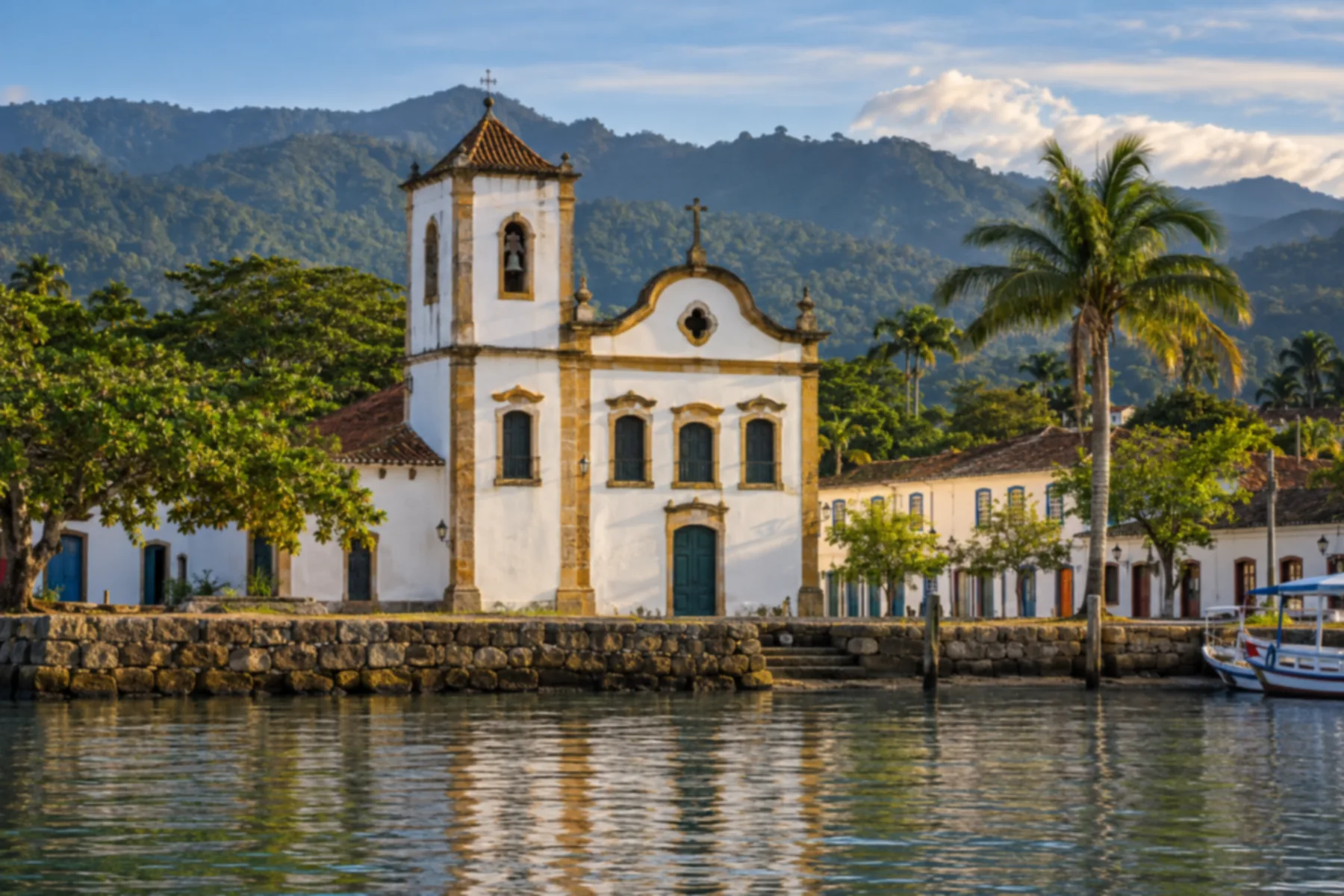
R$110 to R$150 · per person, adult (5 to 6 hour itinerary)It's a guided walk along the cobblestone streets of the colonial ensemble, recognized by UNESCO as a World Heritage Site. The guide tells the story of the port from which gold from Minas Gerais was shipped, explains the architecture of the manor houses and goes by the four colonial churches: Nossa Senhora dos Remédios, Nossa Senhora das Dores, Nossa Senhora do Rosário and Santa Rita. There are stops at the Casa da Cultura and at artists' studios set in old manor houses. The route is flat, but the stone pavement is uneven. There are departures in the morning and late afternoon, and the tour runs even in rain. There are agencies with fixed-price tickets and visit groups without a fixed price, where visitors give a voluntary tip to the guide at the end. It's a good first tour in Paraty, before the boat or jeep tours.
Stops: Centro Histórico de Paraty, Praça da Matriz, Igreja de Nossa Senhora dos Remédios, Igreja de Nossa Senhora das Dores, Igreja de Nossa Senhora do Rosário, Igreja de Santa Rita, Casa da Cultura.
Includes: The fixed-price tour includes the licensed guide. Museum entries, artists' studios and purchases along the way are paid separately. Small children do not pay and those aged 6 to 10 usually pay half price; check the current table.
Tip: Wear sneakers or sturdy sandals because of the uneven paving, and bring water and a hat for morning departures. Combine the visit with the Casa da Cultura and the Forte Defensor Perpétuo, which usually open on specific days and times; check beforehand.
Best time: All year. During the week of Flip the streets get very crowded; check the date before booking.
R$60 to R$150 · per person, adultTrindade is a caiçara village about 25 km from Paraty center, between the Área de Proteção Ambiental do Cairuçu and the Parque Nacional da Serra da Bocaina. The classic program starts at Praia do Meio, which has calm water. From there a trail of about 1.5 km departs, taking less than an hour, passing Praia do Cachadaço to the Piscina Natural, formed between large rocks, with shallow water and many fish for snorkeling. It's also possible to go by water taxi, which leaves from Praia dos Ranchos, Praia de Fora or Praia do Meio. Another trail leaves the end of Praia do Meio, follows the rio dos Codós and goes by pools, the Cachoeira do Escorrega and the Poço Fundo to the Pedra que Engole, a fissure where water flows through. There are regular buses from the rodoviária de Paraty and agency tours with lunch at Praia dos Ranchos.
Stops: Praia do Meio, Praia do Cachadaço, Piscina Natural do Cachadaço, Praia dos Ranchos, Cachoeira da Pedra que Engole, Poço Fundo.
Includes: If you go on your own you only pay for transport, the water taxi if you use it, and purchases at the kiosks. Agency tours include transport and a guide, with lunch paid separately. Check the current table of charges.
Tip: Bring closed-toe shoes and insect repellent for the waterfall trails, as well as water. Before deciding between trail and boat, check the activity at Praia do Meio: the natural pool is more pleasant outside peak hours.
Best time: April to June and September to November. On holidays and in summer the village and the natural pool become very crowded.
The walk begins in Vila do Abraão, at the entrance to Parque Estadual da Ilha Grande, and follows trail T1, the Circuito do Abraão. Along the way are the Poção, the viewpoint at Praia Preta and the ruins of the Lazareto, a former quarantine hospital and prison, which can only be seen from the outside. The trail reaches the Aqueduto, where T2 begins, heading to Cachoeira da Feiticeira. It's about 1h30 from the village, with ascents and descents through forest, roots and rocks. The waterfall has a natural stone slide and a pool for bathing. The trail is signposted and many families do it without a guide. Those who want to shorten the walk can take a water taxi to Praia da Feiticeira and walk about 30 minutes to the waterfall.
Stops: Circuito do Abraão, Aqueduto, Ruínas do Lazareto, Praia Preta, Trilha T2, Cachoeira da Feiticeira, Praia da Feiticeira.
Includes: The trail is done independently, without a guide fee. The water taxi, if used, and the guide, if hired, are paid separately. Check the park for current visitation rules.
Tip: Wear trail footwear, especially when the ground is wet, and bring water, as there are no supply points. Set out early to find shade and return in daylight. Carry your trash out.
Best time: Dry days, between April and September. With rain the trail becomes slippery and the waterfall is stronger.
This is the most demanding trail on Ilha Grande. It starts in Vila do Abraão along the dirt road that goes to Dois Rios, trail T14, and after about 1.5 km reaches the sign for T13, where the steep climb begins to the right. The path is narrow, through dense forest, with roots, rocks and fallen trees, and climbs almost without pause up to the peak, at just under one thousand meters altitude. It's about 12 km round trip, around 6 hours. From the top, a rock with no vegetation, there is a panoramic view of nearly the entire Ilha Grande, of Angra dos Reis and of the Restinga da Marambaia. Some operators make the ascent at dawn to watch the sunrise. It's advisable to hire a local guide, because the trail has forks and the descent is hard on the knees.
Stops: Estrada Abraão–Dois Rios, Trilha T13, Pico do Papagaio.
Includes: The local guide is paid separately and the fee varies between professionals; check the current list of providers. Water and snacks are the visitor's responsibility.
Tip: Bring at least 2 liters of water, because there's only a stream at the start of the trail and none at the top. Wear hiking shoes, sunglasses and sunscreen. Start early and plan the descent to finish while it's still daylight. Camping on the peak is not allowed.
Best time: Dry, clear-sky days between April and September for open views and firm ground.
It's a walk of about 3.6 km along preserved sections of 17th- and 19th-century paving, through which the gold from Minas Gerais was brought down to the port of Paraty. The group leaves the center with a guide, in agency transport, to Vila do Penha, near the Paraty–Cunha road. The trail crosses part of the Parque Nacional da Serra da Bocaina, in Atlantic rainforest. The guide explains the type of paving, what was found in the excavations, the lives of the tropeiros (drovers) and the vegetation. After the descent there is the option to visit Cachoeira do Tobogã and Alambique Engenho d'Ouro. It is an alternative to the jeep for those who prefer to walk and want a history-and-nature outing without large elevation changes. The multi-day crossing, the Trilha do Ouro, is a different route and requires park authorization.
Stops: Caminho do Ouro, Vila do Penha, Parque Nacional da Serra da Bocaina, Cachoeira do Tobogã, Alambique Engenho d'Ouro.
Includes: Usually includes an accredited (licensed) guide and round-trip transport from the agency. The visit to the waterfall and the distillery, when offered, is optional and paid separately. Check the agency's current rates.
Tip: Wear closed shoes with a firm sole, because the stone pavement has uneven sections. Bring water, insect repellent and swimwear if you are going to the waterfall. The tour usually requires a minimum number of participants; book in advance.
Best time: Dry days, between April and September. In the rain the paved path becomes slippery.
The tour combines a speedboat and a hike. The boat departs from Cais de Paraty and takes about 40 minutes to Praia do Cruzeiro, in Saco do Mamanguá, inside the Reserva Ecológica Estadual da Juatinga. From there the ascent begins through the Atlantic forest to Pico do Pão de Açúcar, at about 425 meters altitude. The trail is short, roughly 1.5 km one way, but steep, on uneven ground, and in some sections you need to use your hands. Around 3 hours round trip, including stops. From the top you can see the entire Saco do Mamanguá, about 8 km long and 2 km wide at the entrance. After the descent there's time for a swim on the beach and an optional lunch. Not recommended for people with knee or back problems. Some agencies require a minimum age of 12 with parental authorization and do not run the tour in rainy conditions.
Stops: Saco do Mamanguá, Praia do Cruzeiro, Pico do Pão de Açúcar.
Includes: Usually includes the round-trip speedboat and the guide. Lunch, drinks and personal expenses are paid separately. Check the agency's current price list; the tour usually requires a minimum number of participants.
Tip: Bring at least 1.5 liters of water, a snack, insect repellent, a hat and trail footwear, and swimwear for afterward. There are no restaurants along the way. Arrive at the dock in advance.
Best time: Dry, clear-sky days between April and September to have a clear view from the top.
The Baía de Paraty has calm water, with no waves in the area where you paddle, so it's suitable for people who have never used a kayak. Agencies provide a brief instruction on the beach before departure, which can be from Praia do Pontal or Praia do Jabaquara. Routes vary: island tour of about 2.5 hours, with around 90 minutes of paddling; mangrove tour of about 2 hours; half-day itineraries of 4 hours, with stops for swimming and snorkel; and departures at sunset. Those who paddle further reach small islands, such as Ilha do Malvão, which can only be reached by boat or kayak. There are double and single kayaks. The trip shows the historic town and the mountains from another angle, at a slow pace and without a motor.
Stops: Baía de Paraty, Praia do Pontal, Praia do Jabaquara, Ilha do Malvão, Manguezais de Paraty.
Includes: Usually includes kayak, life jacket, paddle, accredited guide and insurance, with a snack on some itineraries. Check the agency's current rates and the minimum age, which varies. It's recommended to know how to swim.
Tip: Wear swimwear, a T‑shirt and a cap, and bring water, sunscreen and a change of clothes. Ask how many clients there are per guide and what the effective paddling time is before booking. The route varies according to wind and tide.
Best time: Year-round, on days with light wind. Morning and late afternoon have milder sun.
Itacuruçá lies in the Baía de Sepetiba, on the way to Angra dos Reis, and is the departure point for the schooners that cruise among the tropical islands. The schooner leaves the pier in the late morning and makes three to four stops for swimming/snorkeling among Ilha de Jaguanum, Ilha Bonita, Ilha da Vigia, Prainha, Praia da Estopa and Praia do Araçá. The final stop is usually at Jaguanum, at Praia da Pitangueira or Araçá, where there is a pier and a restaurant. A fruit table is served on board, and lunch is optional, with some packages offering a buffet. Navigation is in sheltered waters, not open sea, and you may see dolphins if you're lucky. The schooners have a bar, music/sound system, a slide and toilets. Several agencies sell packages with buses departing from Rio, and others sell only the schooner ride.
Stops: Ilha de Jaguanum, Ilha Bonita, Ilha da Vigia, Prainha, Praia da Estopa, Praia do Araçá, Praia da Pitangueira.
Includes: Generally includes the schooner, a fruit table and stops for swimming/snorkeling. Lunch, drinks and snacks are sold on board and on the island and are paid separately. Packages with transport and lunch have a different price; check the agency's current price table. Children have reduced rates, and very young children usually don't pay.
Tip: Coolers are not allowed on the schooner. Collect your boarding wristbands in advance at the point indicated by the agency. Bring sunscreen, a towel and a change of clothes. The route and schedule may change depending on the weather.
Best time: April to June and September to November. In summer and on holidays the schooners are busier.
The park preserves the ruins of São João Marcos, a colonial town from the coffee cycle that was demolished and partly covered by the Ribeirão das Lages reservoir. Visitors start at the Centro de Memória, where there are panels, archaeological objects, a scale model of the town and a documentary with accounts from former residents. Then they follow the archaeological circuit, with consolidated ruins such as those of the old Igreja Matriz and the sobrado do Capitão-Mor. The visitor trail is about 3 km, with signs about the environment, history and archaeology of the site, and there is a lookout point for birdwatching. The complete visit, at a relaxed pace, takes around 3 hours. Groups usually book a guided visit in advance. Access via the mountain road is by RJ-149 from Rio Claro, and also from Mangaratiba, descending toward the coast. It's a history program for a day when you won't go to the sea.
Stops: Parque Arqueológico e Ambiental de São João Marcos, Centro de Memória, Ruínas da antiga Igreja Matriz, Sobrado do Capitão-Mor, Ponte Bela.
Includes: Check with the park about visitation rules, opening days, and whether there is an entrance fee and parking charge. Guided visits for groups require prior booking. Snacks and lunch are paid separately and it's a good idea to order them in advance when a meal is offered.
Tip: Bring water, a hat and insect repellent, and avoid rainy days because the access may be muddy. Mobile signal often fails at the site; download the map beforehand. You can bring food for a picnic.
Best time: Sunny days, preferably between April and September, when there is less rain.

Prices are estimates, checked in October 2026 with local operators, and may change with the season and the type of tour. Confirm with the operator before booking.
Day by day
Suggestions to plan the trip. Change the order of the days according to the weather and tour availability.
Start in the morning with the guided walking tour of the Centro Histórico: irregular stone streets, white manor houses and colorful doors, within the protected ensemble. The guide explains the town's history and its connection to the Caminho do Ouro. In the afternoon, return to the pier and the waterfront at a relaxed pace. Wear closed, comfortable shoes because of the stones. To enter churches and museums, check the visiting rules and the current fee table.
Boat day. The schooner departs from the downtown pier and tours islands and beaches of the bay, with stops for swimming. Stops change depending on the operator, the day and sea conditions. Bring sunscreen, a towel, a hat and light clothing. When booking, confirm what is included (lunch, snorkel equipment) and what is paid separately.
Vila de Trindade is about 25 km from Paraty's center, at the exit of the BR-101. There are regular buses from the bus station (the trip takes from 1h to 1h30) and organized tours. In the vila, go to the piscina natural do Cachadaço and to the Pedra que Engole, among the coastal rocks. Bring hiking shoes, water and a snack, and plan the return for late afternoon while there is daylight.
Arrive at Vila do Abraão from Angra dos Reis, Conceição de Jacareí or Mangaratiba. The crossing takes from 15 minutes up to about 1h30, depending on the departure point and the type of boat; the Mangaratiba ferry has few departures per day. Check current schedules and fares and bring only what fits in a carry-on or backpack: there are no private cars on the island. Use the afternoon to walk around the vila and along the waterfront.
Tour that combines a boat from Vila do Abraão and a hike to praia de Lopes Mendes. Go in the morning to have time for the beach and the return. Bring water, sunscreen, a snack and closed shoes for the walking section. Confirm with the operator what is included and the return time to Abraão.
Boat tour along the island's channel side, with stops at Lagoa Azul and Lagoa Verde for swimming and snorkeling. Bring a mask if you have one, sunscreen and a towel. The route and the time at each stop vary by operator and day: confirm the boarding point when booking and what is paid separately.
Full day by speedboat, reaching more distant coves: Aventureiro, Parnaioca and Caxadaço. It's a long trip in more open sea; bring sunscreen, a light jacket for the wind and water. Those who prefer to hike can swap the day for the trail to Pico do Papagaio, also on Ilha Grande, early in the morning with a guide, and rest in the vila in the afternoon.
In the morning, do the hike to Cachoeira da Feiticeira and the Circuito do Abraão, starting from the village itself. Bring water, closed shoes and a swimsuit; the dirt trail gets muddy after rain. Book the return crossing for the afternoon, leaving some buffer time between arrival in Abraão and boarding, and check the day's schedules in advance.
Reach Angra dos Reis via the Rio-Santos, by car or by bus. If you arrive early, take the schooner tour, which goes by Lagoa Azul, Cataguases and Japariz, with stops for swimming. It's a relaxed first day to get to know the islands. Bring sunscreen, a towel and lightweight clothing. Confirm with the operator the boarding point and what is included.
Full day by speedboat around Ilha Grande, visiting more distant coves such as Aventureiro, Parnaioca and Caxadaço. The route is long; depart in the morning, bring a light jacket, sunscreen and water. Confirm with the operator the boarding point, the time at each stop and what is paid separately, such as lunch and fees.
Cross from Angra dos Reis to Vila do Abraão early in the morning; the crossing takes between 30 minutes and about 1h30, depending on the boat. From there, take the boat and the trail to praia de Lopes Mendes. Bring closed shoes, water and a snack. Book the return boat to Angra dos Reis with plenty of time and check the day's schedules before leaving.
From Angra dos Reis to Paraty it's about 96 km via the BR-101, roughly 1h30 to 2h by car or bus. Upon arrival, take the guided walking tour of the Centro Histórico, among white manor houses, colorful doors and uneven cobblestones. Wear comfortable closed shoes. Keep the evening free to have dinner in the center.
Schooner tour of the islands and beaches of the Baía de Paraty, departing from the downtown pier, with stops for swimming. The itinerary varies by operator and by day. Bring sunscreen, a towel and a hat, and confirm at booking what is included and what is extra, such as lunch and snorkel equipment.
Speedboat tour through the Saco do Mamanguá, known as a tropical fjord, with calm waters and caiçara communities. Those who want to hike can add the trail to Pico do Pão de Açúcar in Mamanguá itself, with a guide. Bring water, sunscreen and hiking shoes. Confirm the departure point and tour length with the operator.
Last day with a 4x4 jeep tour to the waterfalls and alambiques of Paraty in the mountains. Bring a swimsuit, towel, closed shoes and cash for tastings or purchases, if available. Check the duration with the operator and plan your return for late in the day. If your schedule is tight, swap it for a short visit to the center.
Best time to go
From April to June and from September to November, when the sea is usually clearer, the heat is pleasant and the islands are less crowded. Summer is high season, with more sun and more people, and also quick showers in the late afternoon. During the week of the Paraty Literary Festival (Flip), the town fills up: check the dates before booking.
The seasons shown are the most usual ones; nature doesn't always follow the calendar.
Heat and showers · High season
The hottest and rainiest month of the year in the region. In Angra dos Reis, lows are around 22 °C and highs around 27 °C; Paraty usually gets even more rain. Showers generally come late in the afternoon, and the forest and waterfalls are full. Boat trips are best in the morning and may be rescheduled by the operator if the weather turns. It's high season: book tours and crossings to Ilha Grande in advance.
Frequent rain · Carnival
Hot, very humid and frequently rainy, but with sun much of the time. In Angra dos Reis, lows are around 22 °C and highs around 27 °C. The sea is warm, but visibility at snorkel stops may be reduced. If Carnival falls in this month, the region receives more visitors and crossings to Ilha Grande fill up; book in advance. Bring a light raincoat and protection for your phone on outings.
End of summer · Rain still heavy
Still hot and rainy, with lows near 22 °C and highs near 26 °C in Angra dos Reis. Rains begin to show signs of transition at the end of the month. On trails, the ground gets muddy and waterfalls remain full. Activity usually decreases compared with January and February, except on long holidays and during Holy Week if it falls in March. Check the date before booking.
Rain decreases · Long holidays
Rain eases and days are clearer, with lows around 20 °C and highs around 25 °C in Angra dos Reis. It’s a transitional month: it can still rain, but less often than in summer. Holidays like Tiradentes and, in some years, Holy Week increase visitor numbers in Paraty and Ilha Grande. Outside holiday periods, the islands are quieter than in summer.
More settled weather · Less crowded
The driest period begins. Lows are near 18 °C and highs near 23 °C in Angra dos Reis, with sun and moderate warmth. The trails on Ilha Grande and in Paraty become more pleasant, though still muddy after occasional rain. There is less activity than in summer, which helps if you want more relaxed speedboat or schooner trips. Bring a light jacket for evenings and for the boat.
Dry days · Cooler sea
One of the driest months of the year. In Angra dos Reis, lows are around 17 °C and highs around 22 °C. Mornings are cool and the sea is colder, about 22 °C in Paraty, but you can still swim in sheltered coves. A good time for hikes such as the Caminho do Ouro and Lopes Mendes, and for walking through the Historic Centre. Holidays like Corpus Christi bring more visitors.
Dry winter · Flip and holidays
Dry month, with lows near 16 °C and highs around 22 °C in Angra dos Reis. Skies are usually clear and trails firm. Cooler sea; bring a light jacket for the boat. School holidays and the Festa Literária de Paraty (Flip), which usually takes place in July, fill the town: check the date and book tours and crossings in advance.
Dry month · Less crowded
Among the driest months of the year, with lows near 16 °C and highs around 22 °C in Angra dos Reis. A good time for hikes like Pico do Papagaio on Ilha Grande, and for walks in the Paraty highlands, with firmer ground. The sea is cooler and the late-afternoon breeze calls for a light jacket. Activity is moderate outside holidays and weekends.
Rain returns gradually · Islands less crowded
The transition to spring begins: temperatures rise (lows near 18 °C and highs around 23 °C in Angra dos Reis) and rain returns gradually. There are still many sunny days. The sea is often clear and the islands are less crowded than in summer. Take advantage of speedboat and schooner trips, which have more departures per day than in winter. Check the forecast the day before, as cold fronts can change the weather.
Pleasant warmth · Rain increases
Pleasant warm weather, with lows around 19 °C and highs around 24 °C in Angra dos Reis. Rain increases compared with September, generally in brief showers. The sea still has good visibility on many days and the islands are not yet crowded. Holidays like October 12 can concentrate visitors in Paraty and on crossings to Ilha Grande. Bring a lightweight rain jacket for hikes and boat trips.
More frequent rain · Pre-summer
Warm weather returns and rains become more frequent, with showers in the late afternoon. In Angra dos Reis, lows are around 19 °C and highs around 24 °C. The sea becomes warmer, but snorkel stops can have reduced visibility on rainy days. The month's holidays increase traffic. Prefer boat trips in the morning and have an alternative plan, such as the Centro Histórico de Paraty, for heavy-rain days.
Summer begins · Christmas and New Year's Eve
Start of summer, with lows around 21 °C and highs around 26 °C in Angra dos Reis, and frequent rain, usually in the afternoon. It's the beginning of high season: Christmas and New Year's Eve concentrate visitors in Angra dos Reis, on Ilha Grande and in Paraty. Book tours, crossings and transfers in advance, and prefer morning departures. Bring a lightweight rain jacket and protect your phone on boat trips.
Plan the journey
For Angra dos Reis and Paraty, flights arrive via Rio de Janeiro airports: Galeão (GIG), with domestic and international services, and Santos Dumont (SDU), with domestic flights. From Galeão, Angra dos Reis is about a 2.5‑hour drive and Paraty about 4 hours, roughly 240 km by road. From Santos Dumont, Paraty is about 260 km. Visitors from São Paulo can fly into Guarulhos (GRU), about 250 km from Paraty.
Angra dos Reis has a small airport (Carmelo Jordão), about 5 km from downtown, without regular flights. Paraty has an aerodrome at the city entrance, next to the Rio‑Santos. If any carrier announces a regional small‑plane route, confirm days and times with them before buying.
Itaguaí and Mangaratiba are en route between Rio and Angra, and Rio Claro sits in the highlands, about 130 km from the state capital. In all cases the final leg is by road. Book transfers or a rental car before you arrive.
From Rio de Janeiro, Costa Verde Transportes links Rodoviária Novo Rio with Angra dos Reis, Paraty, Mangaratiba and Itaguaí, with departures throughout the day. The trip to Angra takes about 3 hours, and to Paraty about 4½ hours. The company also departs from Niterói and serves Conceição de Jacareí, from where launches depart for Ilha Grande: ask the driver to drop you off at around km 455 of the Rio-Santos.
From São Paulo, Reunidas Paulista operates the line from Terminal Rodoviário do Tietê to Paraty and Angra dos Reis. According to sales listings, the trip to Paraty takes on average 6 to 7 hours. There are conventional, semi-sleeper and sleeper buses with different fares: check the company’s current fare table.
Another option is a shared van transfer that picks up passengers at Santos Dumont and Galeão airports in Rio and at Guarulhos, and takes them to Paraty and Angra dos Reis. Book in advance and provide your flight number.
On buses, peak times (holidays and summer weekends) sell out: buy your ticket beforehand.
The backbone of the Costa Verde is the BR-101, the Rio-Santos. From Rio de Janeiro, the most used route is Avenida Brasil, which leads onto the BR-101 toward Angra dos Reis and Paraty. Itaguaí and Mangaratiba are located at the beginning of the stretch.
Approximate road distances: Rio de Janeiro to Paraty, 240 km (about 4½ hours); São Paulo to Paraty, 270 km (about 4 hours 40 minutes); Angra dos Reis to Paraty, 100 km (about 1 hour 45 minutes); Ubatuba to Paraty, 73 km. Conceição de Jacareí is about 20 km after Mangaratiba and 30 km before Angra.
To reach Rio Claro from Rio, the trip is around 130 km: follow the Via Dutra (BR-116), take exit 237 and follow signs to the town. From downtown Rio Claro, the RJ-149 descends toward Mangaratiba; the Parque Arqueológico e Ambiental de São João Marcos is at km 20 of that road, roughly 20 km from both Rio Claro and Mangaratiba. You can also reach it via the coast, taking RJ-149 up from Mangaratiba.
Cars are not allowed on Ilha Grande: leave your vehicle on the mainland. On holidays and summer weekends, depart early to avoid queues on the Rio-Santos.
Ilha Grande is only reached by boat; buses or cars take you only to the embarkation pier. There are three departure points on the mainland, all bound for Vila do Abraão.
Mangaratiba: this is the closest point to Rio de Janeiro. The CCR Barcas ferry makes one departure per day in the morning, and the crossing takes about 1h20 to 1h40.
Conceição de Jacareí: located between Mangaratiba and Angra. It’s the point with the most departures throughout the day, by speedboats and schooners, and the crossing takes 15 to 50 minutes depending on the vessel.
Angra dos Reis: boats depart from the Cais de Santa Luzia area. There is a CCR Barcas ferry (afternoon departure, return in the morning) and fast boats with several departures. The route is in sheltered waters, calmer for those who get seasick.
Schedules and fares change. Check the current table from the operators before you go. Travelers to the island must issue the voucher for the Angra dos Reis tourism tax before boarding (see the section on taxes). On holidays, buy your ticket in advance and arrive early at the pier.
The answer depends on your itinerary.
Ilha Grande: there are no private cars. In Vila do Abraão and on the trails, travel is on foot; for distant beaches, tour boats and water taxis depart from the village. A car is not necessary.
Angra dos Reis: islands and coves are visited on boat or schooner trips that depart from the mainland. If you only plan to visit islands, you don’t need a car. For mainland beaches, a car, taxi or local bus will do.
Paraty: the historic centre is protected by Iphan and has cobbled streets. Tour buses do not enter up to the main avenue and park in their own lot; charter buses or vans need prior authorization from the city hall, paid separately. Check with the Tourism Office beforehand. On foot, the centre can be explored at a leisurely pace.
Rio Claro and Parque São João Marcos: located on a road at km 20 of RJ-149; a car is the most practical option.
If you travel between cities on the Rio‑Santos without a car, use intermunicipal buses or transfers. If you plan to combine Paraty, beaches and the highlands, it’s worth renting a car at one of Rio’s airports and returning it at the same location.
There are two ways to organize a trip to the Costa Verde.
Package with transfer: the operator or agency sells transport from Rio de Janeiro, São Paulo or the airports, the boat to Ilha Grande and usually excursions. There are shared van transfers and van+boat combinations, such as Rio de Janeiro to Abraão and Paraty to Abraão. The advantage is having the final leg arranged, with airport pickup and scheduled boarding. Confirm with the operator what is included and whether the Angra dos Reis tourism fee is included in the price or paid separately.
On your own: you choose bus (Costa Verde, Reunidas Paulista), a rental car or a standalone transfer, buy the ferry or launch ticket and book excursions at your destination. This gives more freedom in itinerary and timing, but requires planning connections between bus and boat, especially on holidays and in high season.
In both cases, book in advance, check current boat schedules and issue the Angra dos Reis fee voucher before boarding to the islands.
Angra dos Reis charges the Sustainable Tourism Fee (TTS) for visitors to the city and the municipality’s islands, including Ilha Grande. The fee is issued via voucher through the Viva Angra digital system and is valid for 30 days.
Amount: the fee depends on the type of visit. The standard rate is the same for the mainland and the islands. Those taking a one-day group tour who board in Angra dos Reis receive a lower promotional rate. Those who board in another municipality (Mangaratiba, Conceição de Jacareí, Paraty) pay the standard rate if they can prove at least two nights in a licensed Angra accommodation; without proof, they pay double. Those taking a one-day tour departing from another municipality who prove a reservation at a licensed Angra restaurant pay the standard rate. There may be a system service fee charged separately.
Who is exempt: residents of Angra dos Reis, relatives of residents up to 2nd degree, registered service providers, people over 60, children up to 12 years old and people with disabilities. All must register in advance on the portal and receive the digital card.
How to pay: issue the voucher on the Viva Angra portal or at the kiosks at Cais de Santa Luzia on the mainland and Vila do Abraão on Ilha Grande. Provide length of stay and embarkation point, and pay using the payment code. Check the current table before traveling, as rules may change.
R$28 to R$100 · per person, depending on the type of visit; voucher valid for 30 days · official priceWho takes you
Only agencies with an active registration in Cadastur, the official registry of Brazil's Ministry of Tourism, are listed. The order is not a ranking: compare the tours and book directly with the agency.
Cidade Turismo reviews its information regularly, but something may have changed. Check with the place before planning your trip.
A receptive tourism agency from Rio de Janeiro. Sells an escuna tour package in Angra dos Reis with transport departing from Rio, lunch included and a guide. The boat departs from Cais de Santa Luzia in downtown Angra, with swimming stops at Cataguases, Lagoa Azul and Freguesia de Santana.
Tours: Schooner tour in Angra dos Reis: Lagoa Azul, Cataguases and Japariz.
Cadastur checked in October 2026
Agency with a shop on Avenida Roberto Silveira in downtown Paraty. Sells the escuna tour around Paraty bay, with daily departures and about five hours duration, visiting beaches and islands. Reservations are made via the website, WhatsApp or at the agency.
Tours: Schooner cruise in Baía de Paraty.
Cadastur checked in October 2026
Agency in Paraty’s Historic Center. Sells a 4x4 jeep tour through Parque Nacional da Serra da Bocaina, with waterfalls, the Caminho do Ouro landmark and two alambiques. Meeting point is at the agency in mid-morning, and the guide also drives. The environmental fee is paid separately.
Tours: 4x4 Jeep in Paraty: waterfalls and distilleries.
Cadastur checked in October 2026
Agency on Avenida Júlio Maria in downtown Angra dos Reis, in front of Estação Santa Luzia. Sells the escuna tour around Angra and Ilha Grande, with stops at Lagoa Azul, Praia de Araçá, Ilhas Botinas and Praia das Flechas. Also sells crossings to Ilha Grande and parking. Check-in is done at the agency.
Tours: Schooner tour in Angra dos Reis: Lagoa Azul, Cataguases and Japariz.
Cadastur checked in October 2026
Angra dos Reis agency that sells the escuna tour around Ilha Grande, with stops at Cataguases, Lagoa Azul, Freguesia de Santana and Japariz. Boarding is at Estação Santa Luzia, with a six-hour duration. Lunch is optional and paid separately.
Tours: Schooner tour in Angra dos Reis: Lagoa Azul, Cataguases and Japariz.
Cadastur checked in October 2026
Agency with a shop on Rua Getúlio Vargas in Vila do Abraão, Ilha Grande. Sells the Meia Volta launch tour, including Lagoa Azul, Lagoa Verde, Praia do Amor and Praia da Feiticeira, and the escuna trip to Lopes Mendes. Check-in is at the agency. Also offers transfers from Rio de Janeiro to Abraão.
Tours: Half-tour around Ilha Grande: Lagoa Azul and Lagoa Verde, Praia de Lopes Mendes: boat and trail from Vila do Abraão.
Cadastur checked in October 2026
Agency on Rua Getúlio Vargas in Vila do Abraão, Ilha Grande. Sells shared launches on the Volta à Ilha, Meia Volta and Super Sul routes, the trip to Lopes Mendes, the schooner to Lagoa Azul and private tours. On Saturdays there is a departure from Rio de Janeiro.
Tours: Half-tour around Ilha Grande: Lagoa Azul and Lagoa Verde, Praia de Lopes Mendes: boat and trail from Vila do Abraão, Boat trip around Ilha Grande: Aventureiro, Parnaioca and Caxadaço.
Cadastur checked in October 2026
Your base to explore
Cidade Turismo partners
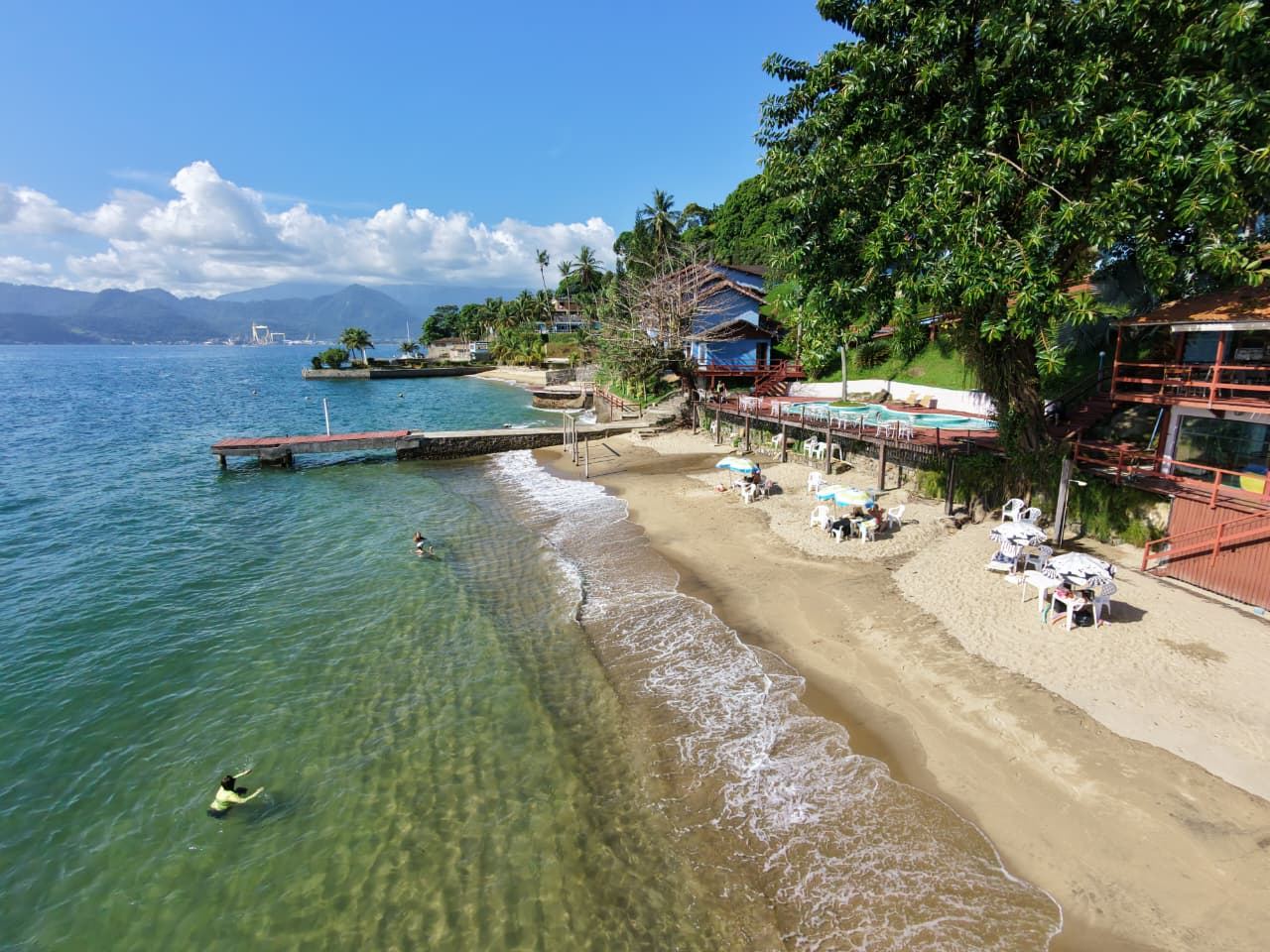
A beachfront pousada in Angra dos Reis (Rio de Janeiro). Seafront pool, beachside restaurant and 4 room categories.
Beachfront Fishing Swimming pool Breakfast On-site restaurant Wi-Fi Air conditioning Parking Pet friendly
Before you go
A little planning leaves more time to enjoy the journey.
From April to June and from September to November, when the sea is usually clearer, the heat is pleasant and the islands are less crowded. Summer is high season, with more sun and more people, and also quick showers in the late afternoon. During the week of the Paraty Literary Festival (Flip), the town fills up: check the dates before booking.
The seasons shown are the most usual ones; nature doesn't always follow the calendar.
Plan 4 to 6 days: 2 or 3 for Angra and Ilha Grande, and 2 or 3 for Paraty, with the historic center, the waterfalls and Trindade. If you only have a weekend, choose one of the two bases and don't try both.
For boat trips around the islands, the base is Angra dos Reis, which has seafront hotels and pousadas on the islands. On Ilha Grande, Vila do Abraão has most of the pousadas and restaurants, and it's where the boats and trails start. In Paraty, it's best to stay in or near the historic center, so you can do everything on foot; Trindade has simple pousadas if you want to be close to the beaches.
Take your trash with you, follow the signs and support local businesses. In natural areas, follow the visiting guidelines.
Beyond the guide
Your questions
Para ir de uma cidade a outra, o carro dá liberdade, e a Rio-Santos é bem sinalizada. Mas os melhores passeios são de barco, a Ilha Grande não tem carros e o centro histórico de Paraty é fechado para veículos. Quem vai de ônibus consegue fazer tudo com barcos, vans e passeios contratados.
Não há ponte: a travessia é de barca ou lancha. Os barcos saem principalmente de Angra dos Reis, de Conceição de Jacareí e de Mangaratiba, e chegam à Vila do Abraão. A lancha leva cerca de 30 a 50 minutos, dependendo do ponto de saída; a barca é mais lenta. Na ilha, tudo se faz a pé ou de barco.
Depende do que você procura. Angra é para quem quer passar os dias no barco, entre ilhas e piscinas naturais, e para quem vai à Ilha Grande. Paraty é para quem quer centro histórico, gastronomia, cachaça, cachoeiras e praias como as de Trindade. Com 5 dias ou mais, dá para combinar as duas.
Sim. O calçamento do centro histórico é de pedras grandes e irregulares, chamado pé-de-moleque, e o centro é fechado para carros. Use tênis ou sandália baixa, e cuidado com malas de rodinha. Em algumas marés altas, a água do mar entra em ruas do centro, o que faz parte do projeto original da cidade.
Na alta temporada e nos feriados, é recomendável. Fora deles, dá para contratar no próprio cais de Angra, de Paraty ou da Vila do Abraão, na véspera. Os roteiros mudam conforme o tempo e o mar, e os mais procurados passam pela Lagoa Azul, pelas praias da Ilha Grande e pelas ilhas da baía.
Sim. Angra dos Reis cobra a Taxa de Turismo Sustentável de quem visita o continente e as ilhas, incluindo a Ilha Grande. O valor atual é único por pessoa, vale para o continente e para as ilhas e tem validade de 30 dias. Quem faz day use (sem pernoite) saindo de Angra dos Reis tem um valor promocional menor. A taxa é emitida online, no sistema Viva Angra, da prefeitura. O voucher pede dados pessoais e o tempo de permanência. A lei prevê isenções para alguns grupos. Confira a tabela atual e quem tem direito antes de pagar, e emita o voucher antes de embarcar.
O caminho mais usado combina barco e trilha. Saem barcos diários da Vila do Abraão até a Praia do Pouso, em cerca de 25 a 50 minutos, conforme a embarcação. De lá, a trilha T11 tem 1 km e leva de 20 a 30 minutos até Lopes Mendes. O passeio completo dura de 5 a 6 horas, e a volta à trilha também leva de 20 a 30 minutos. Antes de descer do barco, confirme os horários de retorno para o Abraão e respeite o último barco. Quem prefere caminhar faz as trilhas T10 e T11 a partir do Abraão: são 5,6 km e cerca de 3 horas, em nível intermediário, com subidas e descidas. Use tênis ou calçado fechado, porque há trechos escorregadios. A lancha do roteiro Super Sul passa por Lopes Mendes, mas só ancora com mar muito calmo.
Depende do horário. Segundo o Inea, órgão que administra o Parque Estadual da Ilha Grande, a subida à noite ou de madrugada, para ver o nascer do sol, só é permitida com guia ou condutor credenciado pelo parque. Nos demais horários, a contratação não é obrigatória. A regulamentação também exige o Termo de Responsabilidade e Reconhecimento de Risco e limita o acesso a 90 pessoas por dia. A trilha T13 sai do Abraão, tem cerca de 5,5 km e leva por volta de 6 horas, entre subida e descida. O cume fica a 982 m de altitude. O nível é difícil: a subida é constante, em mata fechada e com poucas placas. Operadoras locais indicam que crianças pequenas não devem fazer o trajeto, e o passeio pode ser adiado se o tempo mudar. Confirme as regras vigentes com a administração do parque.
Dá, mas o dia é corrido. O embarque mais prático para quem sai do Rio é Conceição de Jacareí, a cerca de 2 horas de carro ou transfer (uns 130 km). De lá, as lanchas rápidas fazem a travessia até a Vila do Abraão em 15 a 25 minutos, com saídas frequentes durante o dia. Somando estrada e barco, são de 5 a 6 horas em trânsito. O último barco de volta sai no fim da tarde, e os horários variam conforme a embarcação, então confirme antes. Para encaixar um passeio, como Lopes Mendes ou a Lagoa Azul, uma opção é contratar um pacote com transfer e barco incluídos. Quem faz day use saindo de Angra dos Reis tem valor promocional na taxa de turismo.
Operadoras e guias locais indicam de 3 a 4 dias. Esse prazo dá para encaixar os passeios principais: a Volta à Ilha de lancha, a Praia de Lopes Mendes (de 5 a 6 horas entre barco e trilha), a trilha até Dois Rios e uma trilha mais curta a partir do Abraão, como a da Cachoeira da Feiticeira. Com apenas um dia, escolha um único passeio e programe a volta com folga para o último barco ao continente. Os veículos não circulam na ilha, então os deslocamentos são a pé ou de barco. Isso toma tempo, principalmente nas trilhas. Se pretende fazer o Pico do Papagaio, reserve uma manhã inteira. Em caso de chuva ou mar agitado, os passeios de barco podem ser remarcados, e um dia extra ajuda.
De ônibus de linha regular. A Colitur opera a linha Paraty–Trindade, com partidas da rodoviária de Paraty ao longo do dia, em intervalos de cerca de uma hora, e a viagem leva cerca de 30 a 40 minutos. A vila fica a cerca de 25 a 30 km do centro de Paraty, e a entrada da estrada está na Rio-Santos. A passagem é paga no embarque, e os horários mudam nas primeiras horas da manhã e à noite, então confira a tabela atual com a empresa. Outra opção é um passeio de agência, em van ou micro-ônibus, com guia e cerca de 6 horas de duração. Esses passeios costumam incluir a trilha até a piscina natural do Cachadaço. Leve calçado para trilha, protetor solar e dinheiro para as barracas da vila.
Pode, mas com regras. Paraty é cidade tombada pelo Iphan, e a Secretaria Municipal de Turismo regula a entrada e a circulação de ônibus de turismo, double deck, micro-ônibus e vans. É preciso solicitar uma senha de acesso, e o pedido deve ser feito por um prestador turístico legalizado em Paraty. A viagem também precisa ter reserva de serviços turísticos locais, e o veículo só embarca e desembarca em locais autorizados e usa o estacionamento indicado. A Vila de Trindade tem regra própria. Ônibus convencionais, micro-ônibus e double deck não entram na vila. Vans só entram se o grupo tiver hospedagem dentro dela. Quem fica em Paraty vai a Trindade de transporte local ou de ônibus de linha. Organize o grupo com antecedência e confira a norma atual com a prefeitura.
Depende da trilha. A T11, entre a Praia do Pouso e Lopes Mendes, é curta, tem 1 km e leva de 20 a 30 minutos, em nível leve. É a opção mais usada por famílias, e a travessia de barco até a Praia do Pouso fica a cargo da operadora. Já a T10 somada à T11, saindo do Abraão, tem 5,6 km e cerca de 3 horas, com subidas e descidas. Costuma ser classificada como intermediária. O Pico do Papagaio é difícil, com subida constante, e operadoras locais não indicam o percurso para crianças pequenas. Em qualquer caminho, leve água, protetor solar e calçado fechado, porque há trechos escorregadios. Pergunte à operadora a idade mínima aceita e as regras de segurança a bordo antes de contratar o passeio de barco.
Brazilian routes
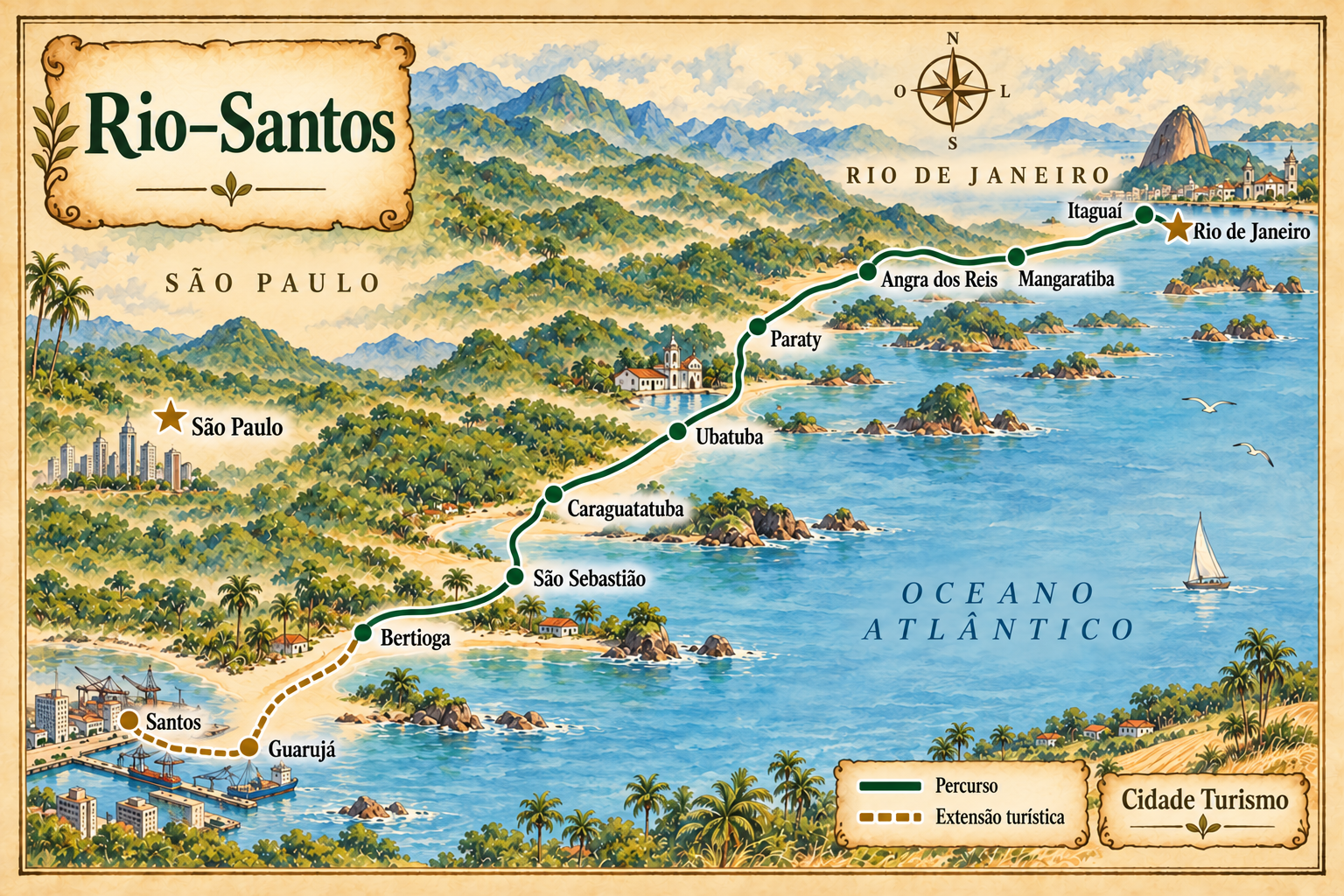
From the Costa Verde to the São Paulo coast, with beaches, heritage and an extension via Guarujá to Santos.
Brazilian routes
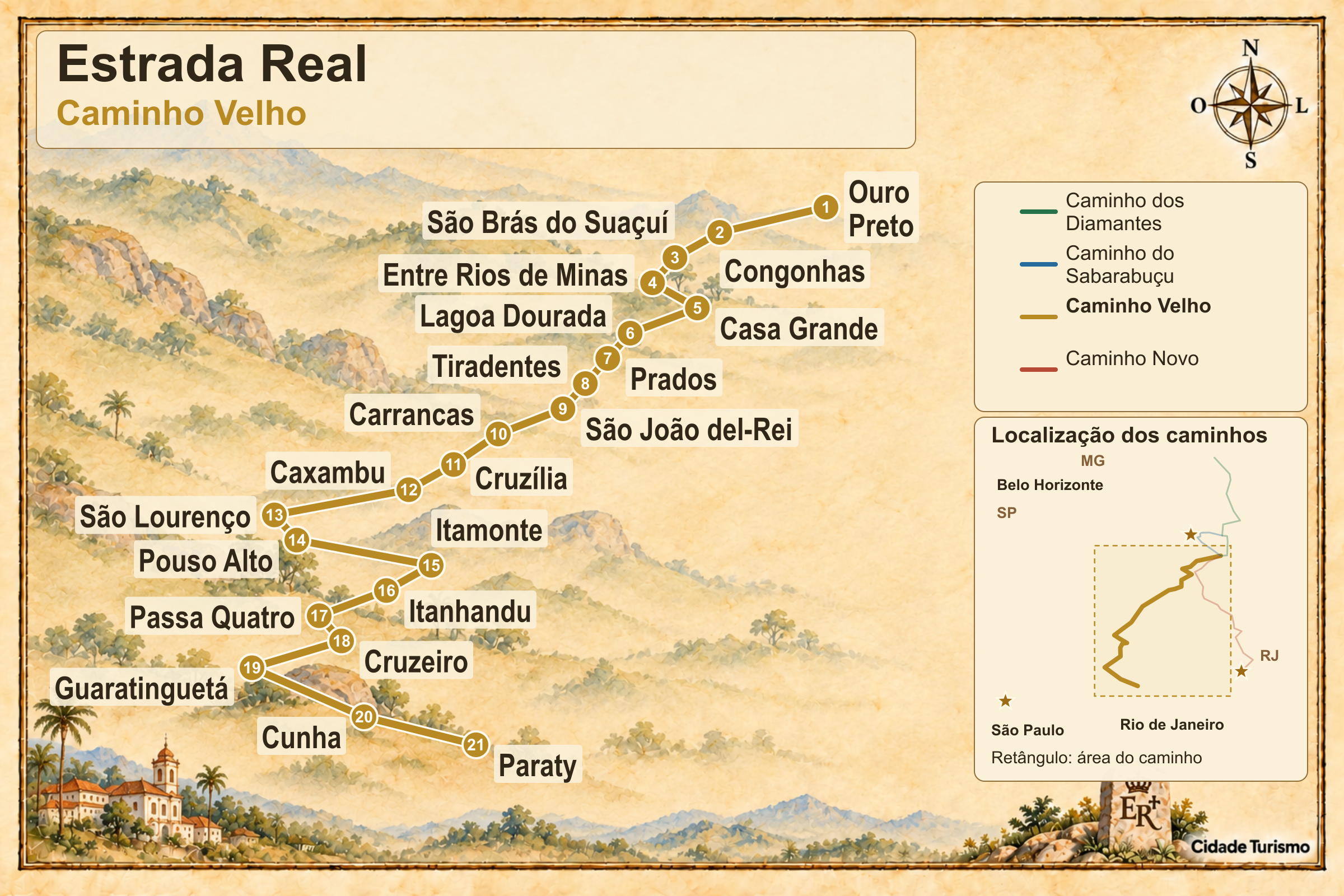
From Ouro Preto to Paraty, the oldest route of the Estrada Real passes through historic towns, mineral-water spa towns, and the Mantiqueira mountain range.
Brazilian routes
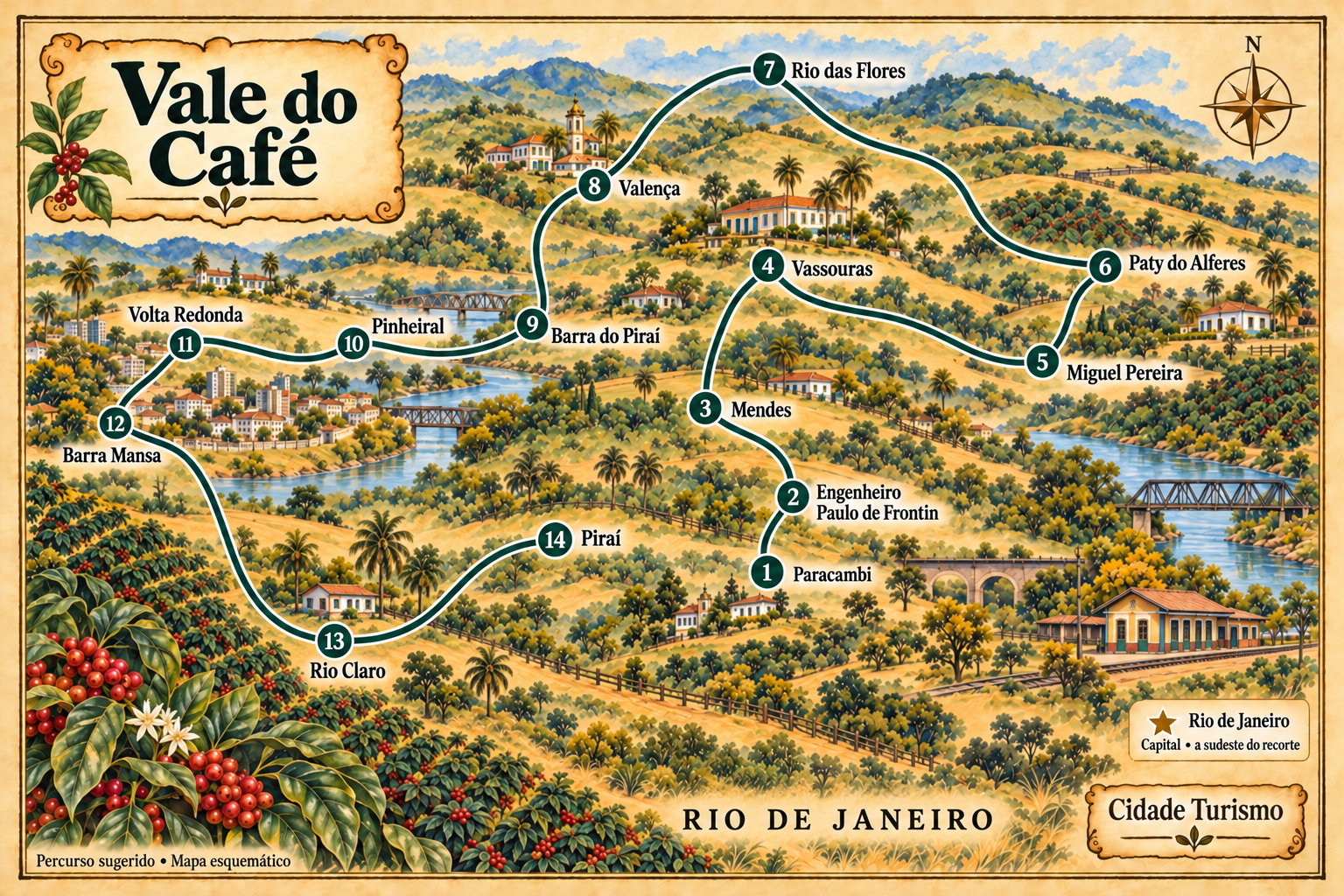
A route through 14 municipalities in the state of Rio de Janeiro, among historic farms, museums, memories of the railways and the heritage of the towns of the Médio Paraíba.