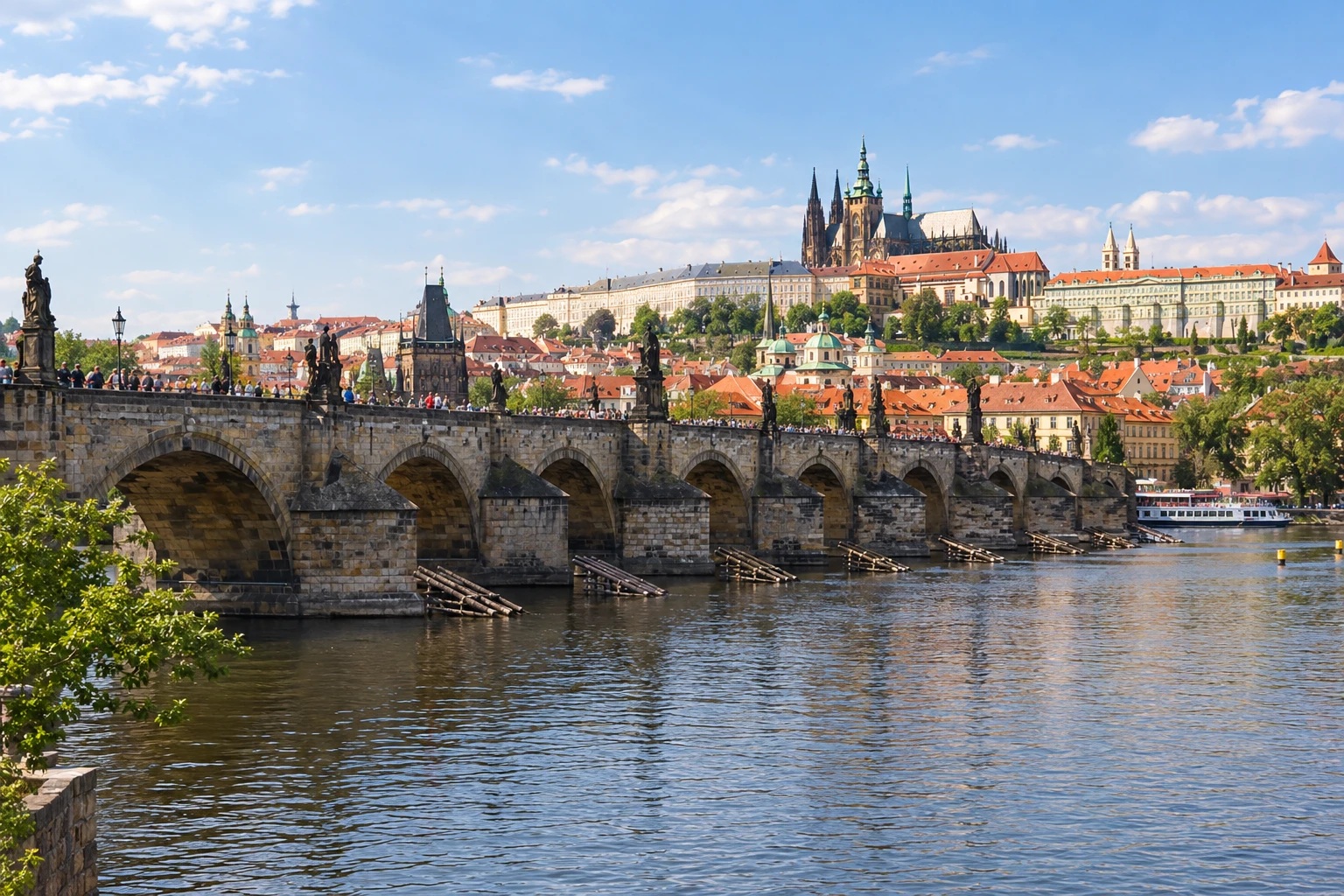
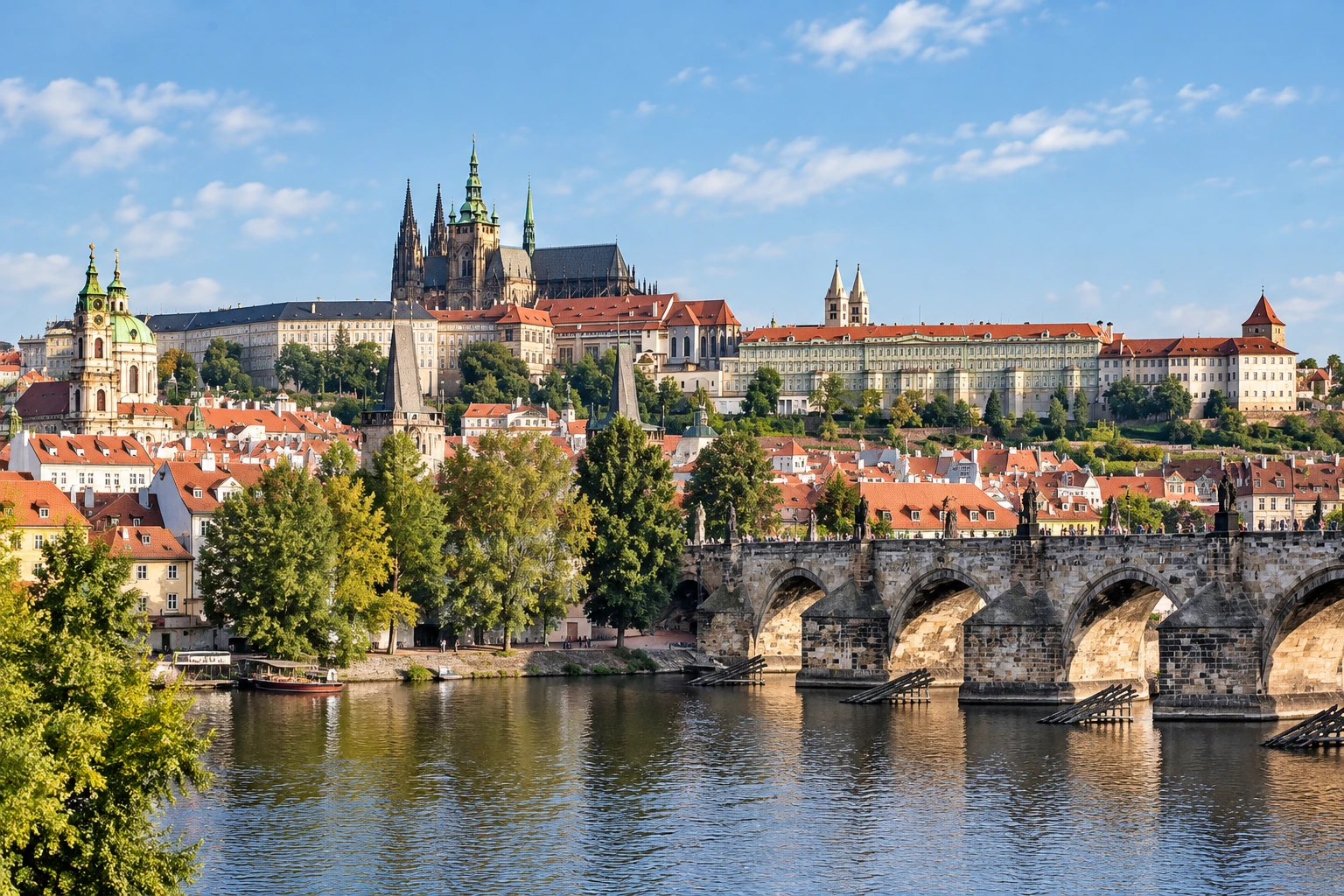
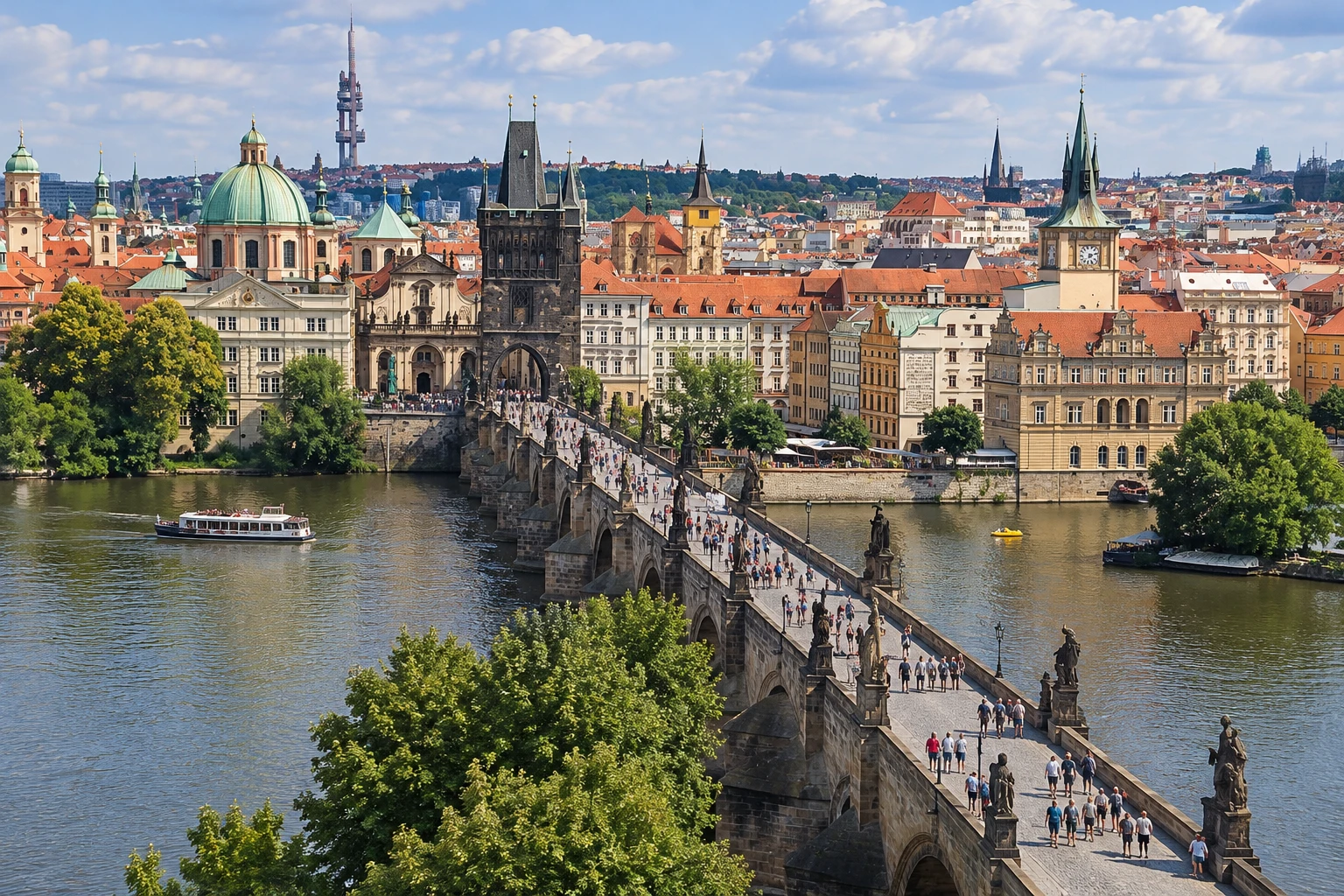
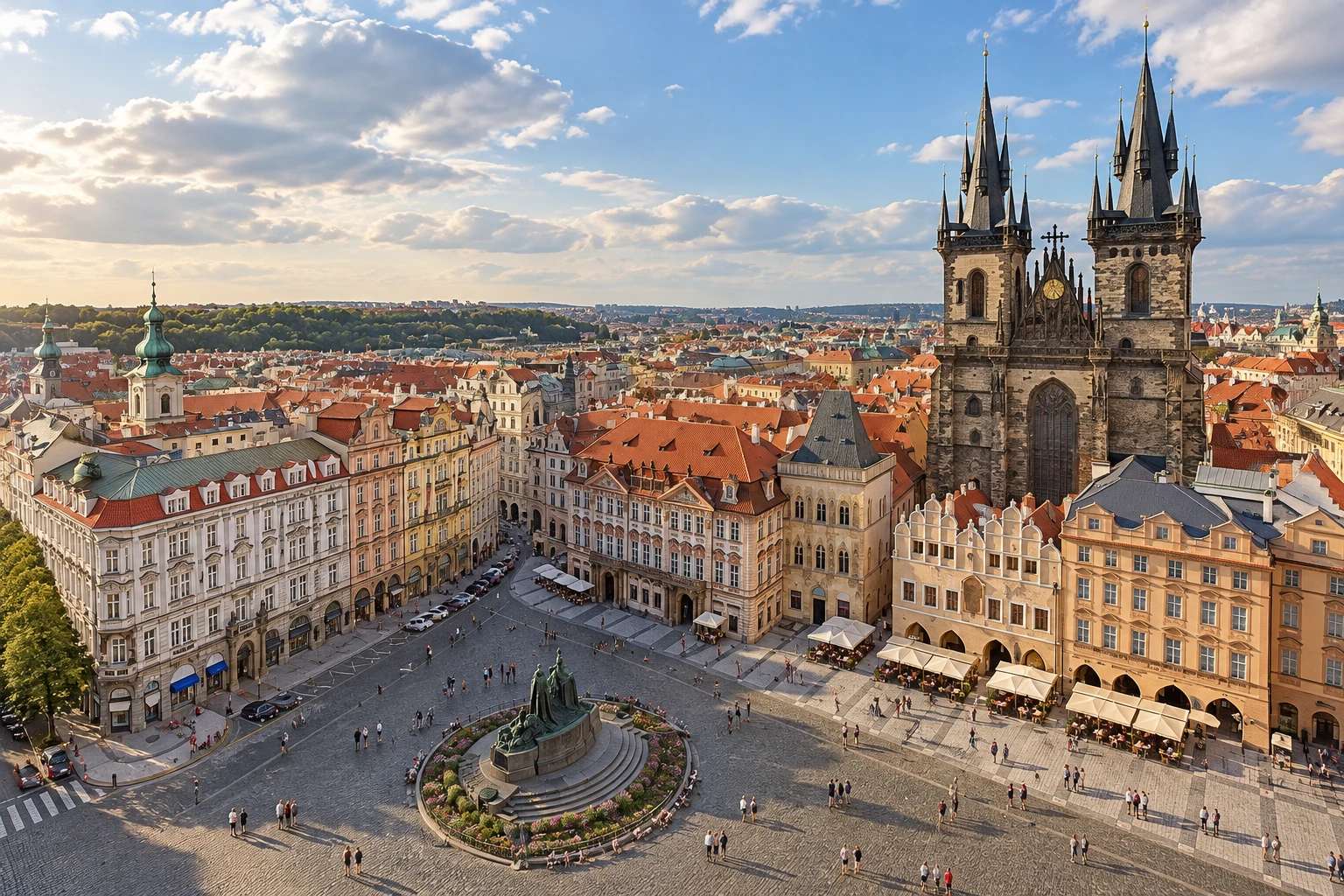
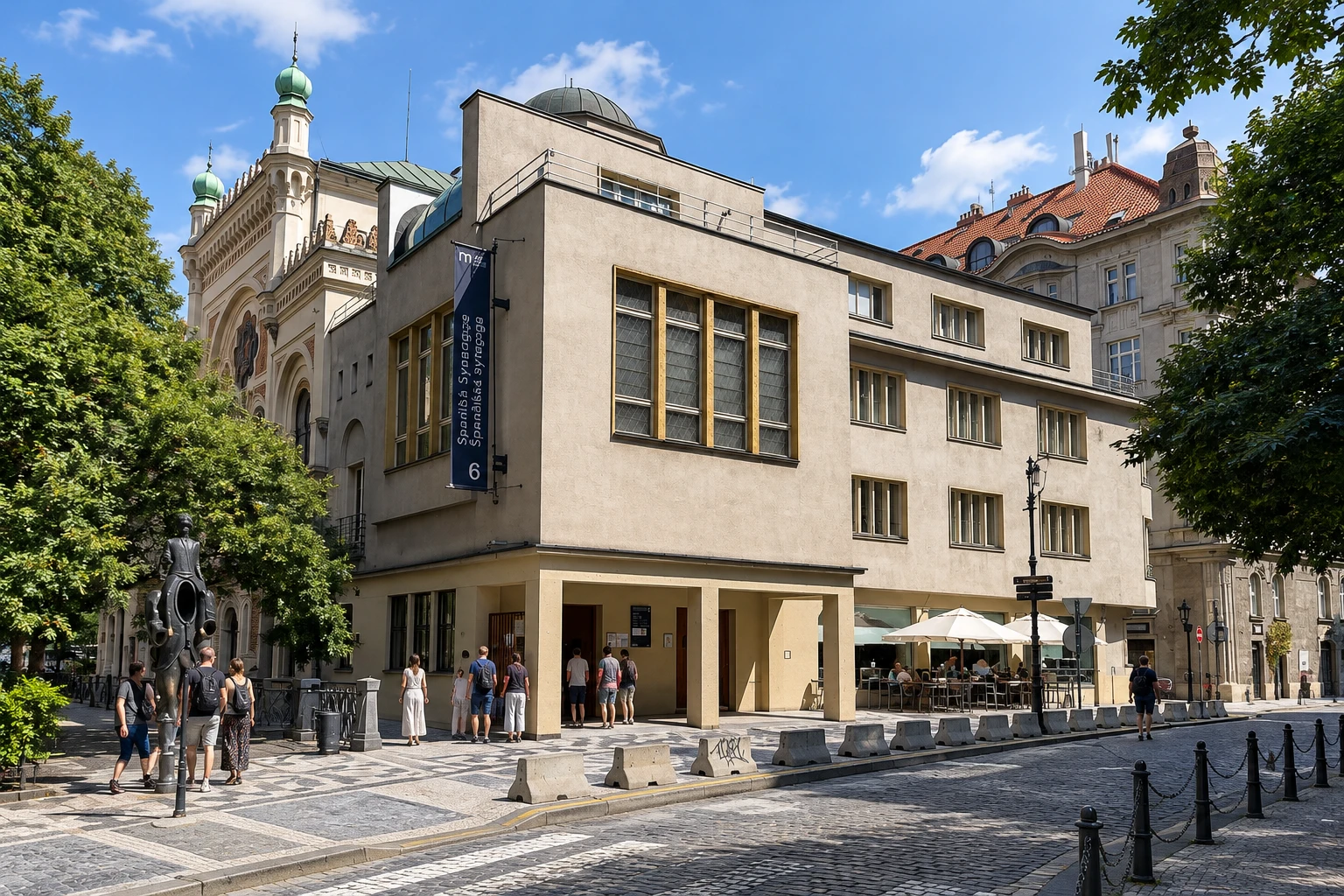
Illustrative images. The pictures in this guide are illustrations based on the real place, not photographs, and may differ from it.
The city
What to expect from Prague.
Prague is spread across both banks of the Vltava. Prague Castle, Charles Bridge and the Old Town Square form the initial axis. Josefov concentrates the Jewish Museum; the National Museum, Vyšehrad and Petřín help vary routes and alternate indoor spaces, gardens and viewpoints.
Prague Castle sits on an elevation on the west bank of the Vltava. The complex brings together courtyards, palaces and churches from different periods, with St. Vitus Cathedral as a landmark in the skyline. The visit requires choosing which interiors of the circuit to see, in addition to walking the external areas.
Charles Bridge spans the Vltava between the Old Town and Malá Strana. The stone arches, the end towers and the row of sculptures form a pedestrian passage along Prague’s historic axis. The castle rises above the roofs on the west bank.
Old Town Square is the core of Staré Město. the former town hall, the astronomical clock and the towers of the Church of Our Lady before Týn help orient a walk. The streets radiating from the square lead toward the Vltava and other parts of the historic centre.
The Jewish Museum in Prague lays out its visit across buildings in Josefov. Synagogues, exhibitions and the old cemetery present the history and culture of Jewish communities of Bohemia and Moravia. The circuit occupies streets near the Old Town rather than a single museum building.
Approximate distances. Check flights and bus, train or boat schedules before you travel.
Connections with Brazil are usually via a stopover in another city. Confirm before buying. Václav Havel airport is to the west. Combine bus or trolleybus with the metro to reach the center. Praha hlavní nádraží is the main rail reference.
How many days
Three to four days in the city, with a full day for the castle and another for Josefov.
When to go
May and September usually have mild temperatures. December to February requires warm clothing and short outdoor routes; July and August have longer daylight hours. The seasons are reversed compared with Brazil.
The seasons shown are the most usual ones; nature doesn't always follow the calendar.
Do you need a car?
Skip the car in central Prague. Metro, tram and walking connect the historic neighborhoods.
Suggested itinerary
An order that works
Built with the places on this page. No rush: it's paced so you have time to see them.
One day in Prague
manhã
Castle and Malá Strana
Start with the Prague Castle circuit and descend the Malá Strana slope.
tarde
Bridge and Old Town
Cross Charles Bridge and continue to the Old Town Square, observing the surrounding facades.
fim de tarde
Banks of the Vltava
Return to the bank to observe the bridge's arches and the castle's position above the rooftops.
noite
Dinner in the center
Choose your lodging area for dinner and leave museums for another day.
Check before you go. Opening hours and days change, and places may close for renovations, holidays or events. This itinerary is a suggestion from Cidade Turismo, not a commitment: plan yours by checking directly with each place you intend to visit.
Before you go
Frequently asked questions
How to get out from Prague airport?
Surface transport links the terminals to metro lines. Check the proper connection to the neighborhood where you'll stay.
Where to start a walk in Prague?
The top of the castle allows you to plan a downhill route through Malá Strana to Charles Bridge.
Does Prague require many car trips?
Tourist routes are handled by public transport and on foot; the old areas have narrow streets and pedestrian zones.
What to do in Prague on a rainy day?
The National Museum lets you spend a few hours on exhibitions and the architecture of the historic building.


 Brazil
 Antarctica
 Argentina
 Bolivia
 Chile
 Colombia
 Ecuador
 Falkland Islands (Malvinas)
 French Guiana
 Guyana
 Paraguay
 Peru
 Suriname
 Uruguay
 Venezuela
 Austria
 Belgium
 Croatia
 Denmark
 Finland
 France
 Germany
 Greece
 Hungary
 Iceland
 Ireland
 Italy
 Luxembourg
 Norway
 Poland
 Portugal
 Slovakia
 Slovenia
 Spain
 Sweden
 Switzerland
 the Netherlands
 the United Kingdom
 Turkey
 Bermuda
 Canada
 Greenland
 Mexico
 Saint Pierre and Miquelon
 the United States
 the Dominican Republic
 Japan
 Egypt
 South Africa
 Australia
 Fiji
 New Zealand
 Papua New Guinea