

 Brazil
 Antarctica
 Argentina
 Bolivia
 Chile
 Colombia
 Ecuador
 Falkland Islands (Malvinas)
 French Guiana
 Guyana
 Paraguay
 Peru
 Suriname
 Uruguay
 Venezuela
 Albania
 Austria
 Belgium
 Croatia
 Denmark
 Finland
 France
 Germany
 Greece
 Hungary
 Iceland
 Ireland
 Italy
 Luxembourg
 Norway
 Poland
 Portugal
 Slovakia
 Slovenia
 Spain
 Sweden
 Switzerland
 the Czech Republic
 the Netherlands
 Turkey
 Bermuda
 Canada
 Greenland
 Mexico
 Saint Pierre and Miquelon
 the United States
 the Dominican Republic
 Japan
 Egypt
 South Africa
 Australia
 Fiji
 New Zealand
 Papua New Guinea
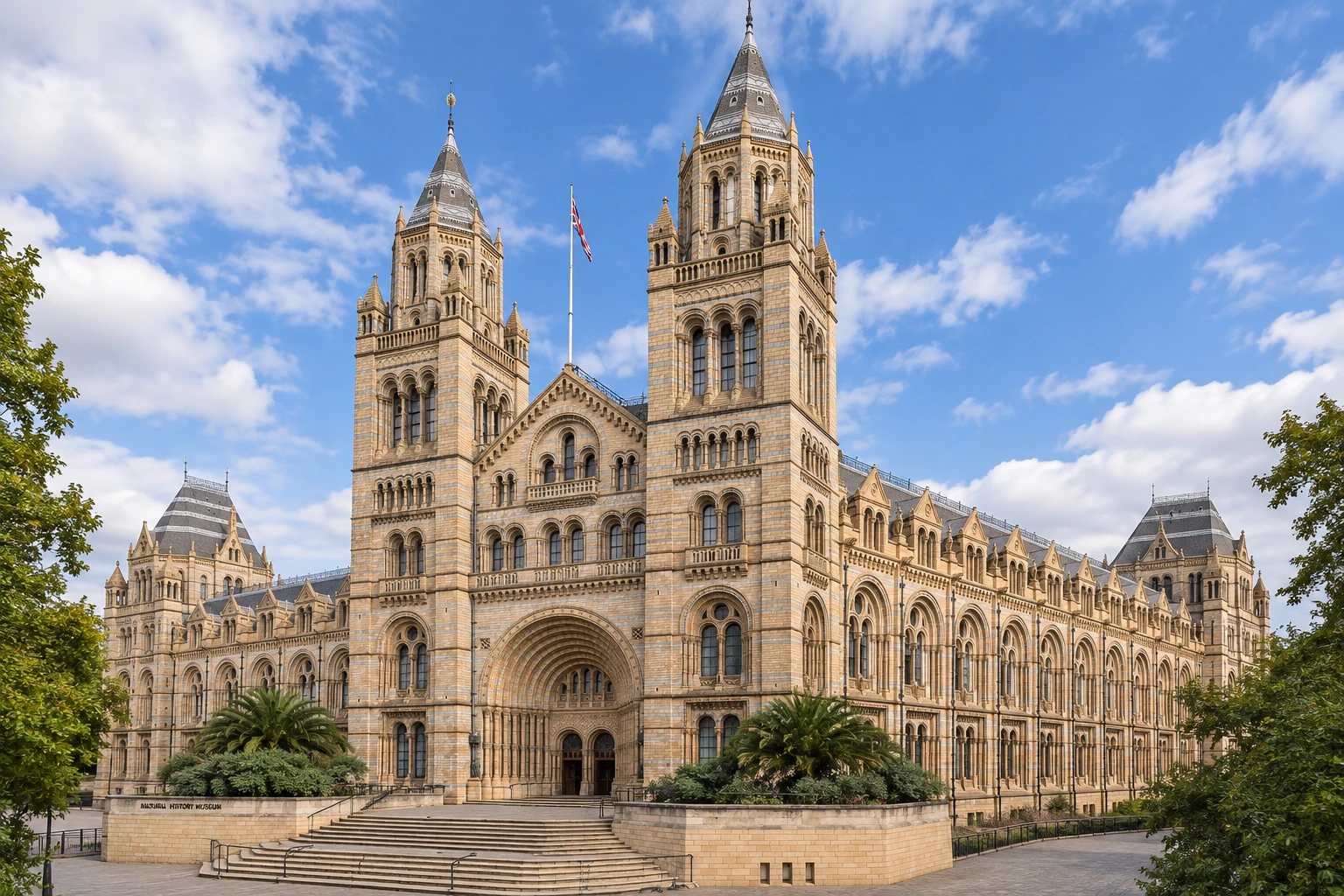
Museum · London, the United Kingdom
Natural History Museum
The museum of natural history in South Kensington, in a terracotta Victorian building, with the blue whale skeleton in the Hintze Hall, the dinosaurs and the mineral collection. Entry to the permanent displays is usually free; check beforehand.
Illustrative images. The pictures in this guide are illustrations based on the real place, not photographs, and may differ from it.

Discover
About Natural History Museum
The Museu de História Natural de Londres occupies a terracotta building decorated with animals and plants, designed by Alfred Waterhouse and opened in 1881 in South Kensington. The collection began with Hans Sloane's holdings, the same that gave rise to the British Museum, and today includes about 80 million specimens, most kept for research.
At the entrance, the Hintze Hall, with arches and a painted ceiling, displays the suspended skeleton of a 25-metre female blue whale nicknamed Hope. The galleries are divided into colour-coded zones. The blue zone brings together the dinosaurs, with an animatronic tyrannosaurus and the skeleton of a stegosaurus, and the mammals hall, with a life-size blue whale model. The red zone covers the Earth, with an escalator that passes through a globe and an earthquake simulator.
The green zone houses birds, insects and the minerals gallery, with gemstones and meteorites, and the orange zone contains the Darwin Centre, where you can see scientists at work and alcohol-preserved collections. The renovated garden has a path that tells the story of the evolution of life on Earth.
Admission to the permanent collection is usually free, but the museum may require a timed reservation during school holidays; temporary exhibitions, such as wildlife photography, charge for entry. In winter, the side courtyard usually has an ice-skating rink.
Before you go
Practical information
Cidade Turismo reviews its information regularly, but something may have changed. Check with the place before planning your trip.
How much time to set aside
About 2 to 3 hours. With children, allow half a day.
Best time
Right at opening, on a weekday outside English school holidays. On rainy Saturday and Sunday mornings the entry queue can exceed half an hour. The dinosaurs gallery is the first to get crowded.
How to get there
South Kensington station (Piccadilly, District and Circle lines), via the pedestrian tunnel that leads straight to the side entrance on Exhibition Road, a 5-minute walk. It is next to the Science Museum and the Victoria and Albert Museum, and a 10-minute walk from Hyde Park.
Tip
Enter via the Exhibition Road entrance, which usually has a shorter queue than Cromwell Road, and start with the dinosaurs. Combine it the same day with the Victoria and Albert Museum across the street, or with the neighbouring Science Museum.
Official website
Your questions
Frequently asked questions about Natural History Museum
Does the Museu de História Natural charge admission?
Admission to the permanent collection is usually free. Temporary exhibitions require tickets, and there may be timed reservations at busy periods; confirm beforehand.
What to see with kids?
The dinosaur gallery with the animatronic Tyrannosaurus, the Hintze Hall blue whale, the mammals gallery and the earthquake simulator in the red zone.
Which entrance has the shortest queue?
It's usually the Exhibition Road entrance, next to the tunnel exit of South Kensington station.
Is the Science Museum nearby?
Yes, it's the neighboring building on Exhibition Road, and the Victoria and Albert Museum is across the street.