

 Brazil
 Antarctica
 Argentina
 Bolivia
 Chile
 Colombia
 Ecuador
 Falkland Islands (Malvinas)
 French Guiana
 Guyana
 Paraguay
 Peru
 Suriname
 Uruguay
 Venezuela
 Austria
 Belgium
 Croatia
 Denmark
 Finland
 France
 Germany
 Greece
 Hungary
 Iceland
 Ireland
 Italy
 Luxembourg
 Norway
 Poland
 Portugal
 Slovakia
 Slovenia
 Spain
 Sweden
 Switzerland
 the Czech Republic
 the Netherlands
 Turkey
 Bermuda
 Canada
 Greenland
 Mexico
 Saint Pierre and Miquelon
 the United States
 the Dominican Republic
 Japan
 Egypt
 South Africa
 Australia
 Fiji
 New Zealand
 Papua New Guinea
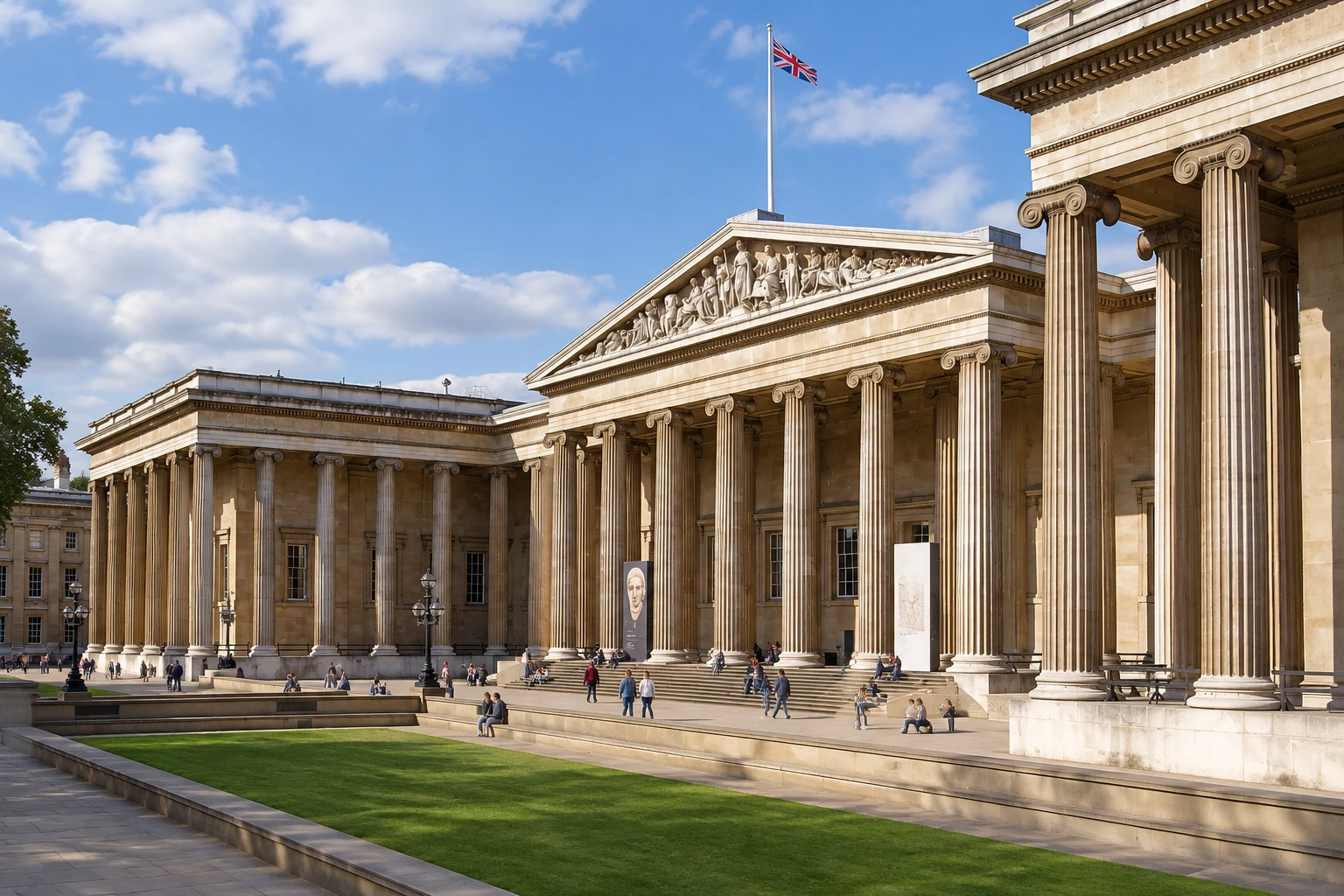
Museum · London, the United Kingdom
British Museum
The museum of human history and culture founded in 1753, with the Rosetta Stone, the Parthenon marbles, Egyptian mummies and the Great Court covered with glass. Admission to the permanent collection is usually free; check before you go.
Illustrative images. The pictures in this guide are illustrations based on the real place, not photographs, and may differ from it.

Discover
About British Museum
The British Museum was founded in 1753 from the collection of physician Hans Sloane and opened to the public in 1759, becoming the first national museum open to all. The Greek‑columned building in Bloomsbury dates from the 19th century, and its centre is the Queen Elizabeth II Great Court, covered in 2000 by a glass and steel roof around the old circular reading room.
The collection spans roughly two million years of history and contains objects from every continent. The most sought‑after items are the Rosetta Stone, which enabled the deciphering of Egyptian hieroglyphs; the Parthenon sculptures from Athens, known as the Elgin Marbles; the mummies and sarcophagi in the Egyptian rooms on the upper floor; the Assyrian reliefs from Nineveh; the Anglo‑Saxon treasure of Sutton Hoo; and the Lewis chessmen.
Admission to the permanent collection is usually free, but the museum may require a timed reservation during busy periods; temporary exhibitions charge an entry fee. With more than 90 rooms, you cannot see everything at once: pick three or four areas and follow the map.
The museum has left‑luggage facilities, cafés and a large shop in the Great Court. On some weeknights it stays open later with fewer visitors; check opening times on the official website.
Before you go
Practical information
Cidade Turismo reviews its information regularly, but something may have changed. Check with the place before planning your trip.
How much time to set aside
2 to 4 hours for the highlights. Archaeology enthusiasts can easily spend a whole day.
Best time
At opening time on weekdays, go straight to the Rosetta Stone, which gets crowded by late morning. On extended-hours evenings the museum is usually quieter. Avoid rainy weekends, when everyone heads to museums.
How to get there
Tottenham Court Road station (Central, Northern and Elizabeth lines), Holborn and Russell Square, all 5–10 minutes on foot. It's in Bloomsbury, a 15-minute walk from Covent Garden and 20 minutes from King's Cross.
Tip
Pick up the map at the entrance and plan your route: the Rosetta Stone and the Egyptian sculpture on the ground floor, the Parthenon marbles in room 18, the mummies upstairs. The side entrance on Montague Place usually has a shorter queue than Great Russell Street.
Official website
Your questions
Frequently asked questions about British Museum
Does the British Museum charge admission?
Admission to the permanent collection is usually free. Temporary exhibitions require a ticket, and the museum may require timed reservations at busy times; confirm beforehand.
What not to miss at the British Museum?
The Rosetta Stone, the Parthenon sculptures, the Egyptian mummies, the Assyrian reliefs, the Sutton Hoo treasure and the Lewis chessmen.
How long does the visit take?
Two to four hours for the highlights. There are over 90 rooms, so it's worth choosing areas beforehand.
Can you take photos?
Generally yes, without flash, in the permanent collection. Some temporary exhibitions prohibit photography.