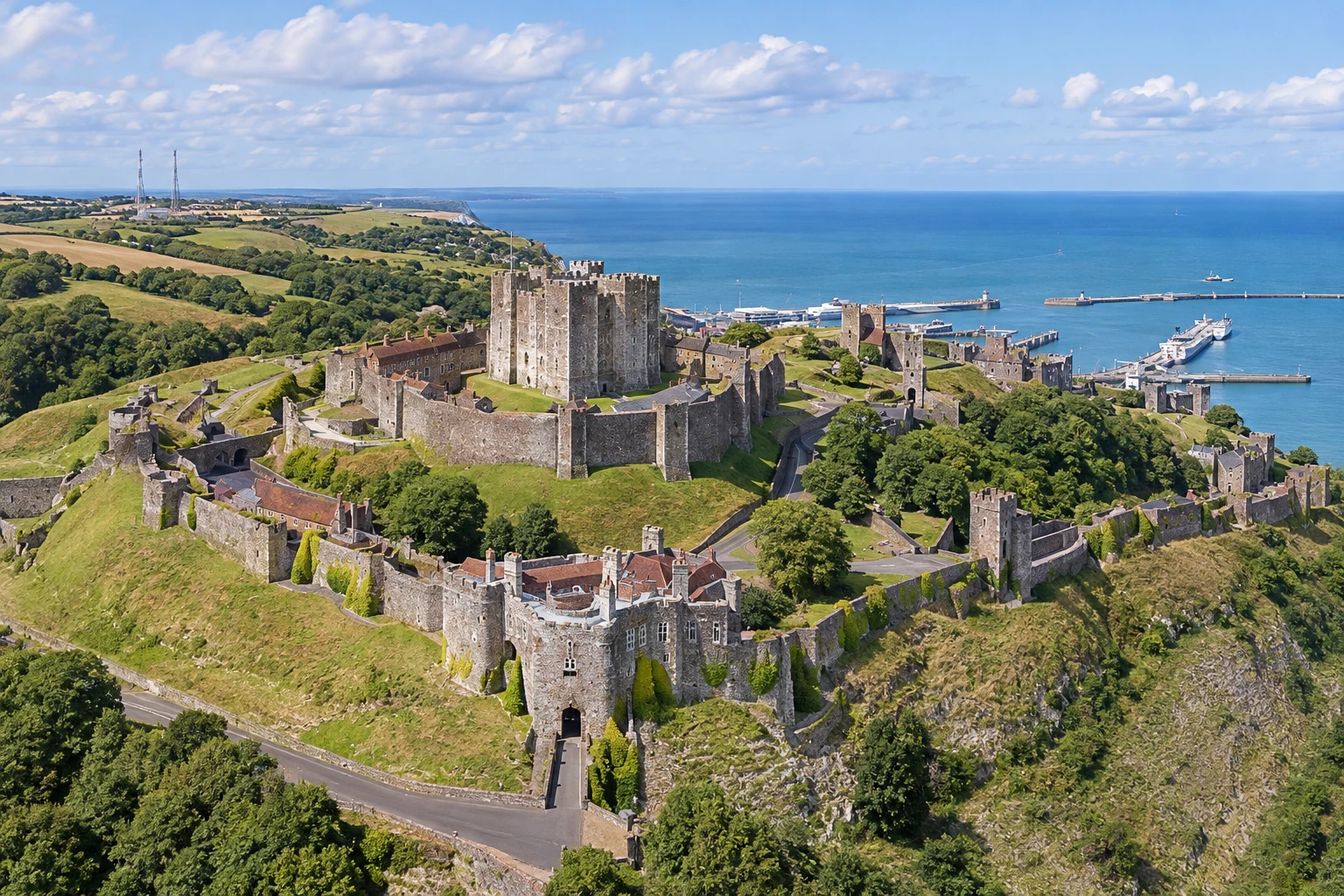
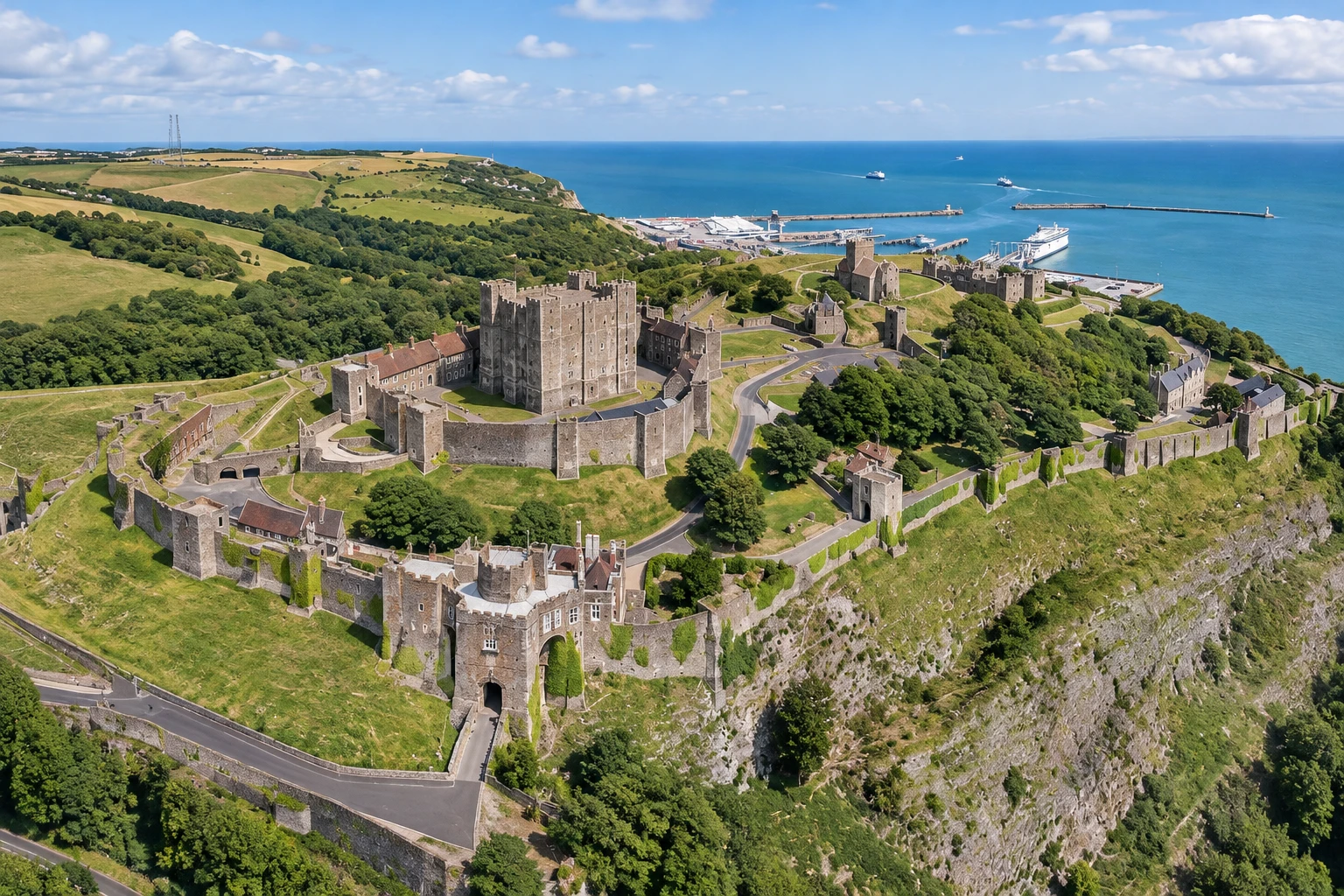
Illustrative images. The pictures in this guide are illustrations based on the real place, not photographs, and may differ from it.
The city
What to expect from Dover.
Dover is the English port closest to France, in Kent, between the Falésias Brancas, with ferries crossing the English Channel to Calais. On the hilltop stands the Castelo de Dover, with the Grande Torre from the 12th century, the Roman lighthouse and the Second World War tunnels, and to the east the National Trust trail runs along the cliff tops to the South Foreland lighthouse.
The fortress atop Dover's cliffs, with the Grande Torre of Henrique II from the 12th century, a Roman lighthouse, a Saxon church and the secret tunnels from which the evacuation of Dunquerque was commanded in 1940. From English Heritage.
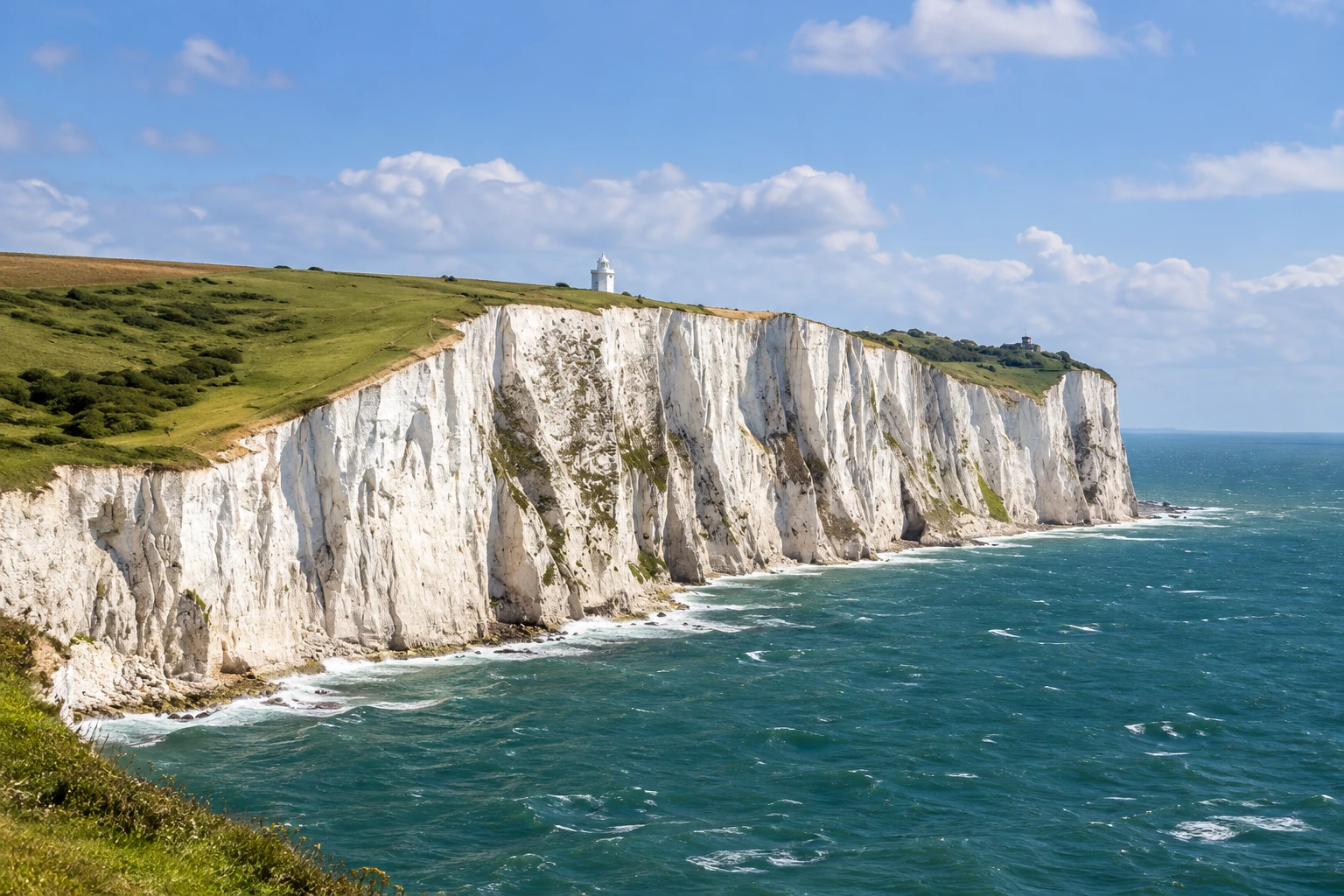
The white limestone cliffs above the English Channel, rising to about 110 metres, traversed by a National Trust trail to the South Foreland lighthouse, with views to France on clear days.
Dover – the United KingdomDestination Canterbury and Kentabout 125 km from London
How to get there
London Gatwick Airport (LGW)Crawley · 130 km
Dover Priory railway station1 km
Port of Dover2 km
Approximate distances. Check flights and bus, train or boat schedules before you travel.
Connections with Brazil are usually with a stopover in another city. Check before you buy. From London, the high-speed train departs St Pancras and arrives at Dover Priory in about 1h05. From Canterbury, the train takes about 25 minutes. Ferries from Calais arrive at Dover port, and the Eurotunnel departs from Folkestone, about 12 km away.
How many days
A full day: the castle and the tunnels in the morning and the cliff walk in the afternoon. Visitors arriving from Canterbury or London can do everything in a day and return at night.
When to go
From spring to autumn, with long days and a better chance of clear skies to see France. In summer there is more activity at the port and the castle. In winter it is very windy on top of the cliffs and the castle is open only part of the week.
The seasons shown are the most usual ones; nature doesn't always follow the calendar.
Do you need a car?
Not necessary: trains arrive from London and Canterbury, and there are local buses and taxis to the castle and the cliffs. A car helps if you want to continue along the Kent coast to Deal and Folkestone. Drive on the left.
Suggested itinerary
An order that works
Built with the places on this page. No rush: it's paced so you have time to see them.
One day in Dover
manhã
Castelo de Dover
Arrive when the castle opens, book the time for the war tunnels and see the Grande Torre.
tarde
Falésias Brancas
Have lunch at the National Trust visitor centre and walk along the cliff tops to the South Foreland lighthouse.
fim de tarde
Orla
Go down to the waterfront and Dover beach to see the cliffs from below in the late afternoon light.
noite
Jantar no porto
Dine in the town centre or on the waterfront, or take the train to Canterbury or London.
Check before you go. Opening hours and days change, and places may close for renovations, holidays or events. This itinerary is a suggestion from Cidade Turismo, not a commitment: plan yours by checking directly with each place you intend to visit.
Before you go
Frequently asked questions
Is Dover worth a full day?
Yes, for the castle and the cliffs. Together they fill the day.
How to get from Dover town centre to the castle?
On foot, about 20 to 30 minutes with a steep climb, or by local bus and taxi.
Can you go from Dover to France?
Yes, ferries depart Dover port for Calais, a crossing of about 1h30. The Eurotunnel for cars departs from Folkestone. Check documentation rules beforehand.
Is Dover the same town as the Falésias Brancas?
Yes, the cliffs sit on both sides of the port, and the most visited stretch begins about 3 km from the town centre.