Illustrative images. The pictures in this guide are illustrations based on the real place, not photographs, and may differ from it.

Get it on Google Play

Interactive maps

Antipode: the other side of the Earth

Choose a city, tap the map, or use your location and see what lies exactly on the opposite side of the Earth. In orange, the continents that fall on the other side are shown.

Share: WhatsApp

Loading the map…

Tap anywhere on the map to see its antipode

Country outlines and cities: Natural Earth (public domain). Your location, when you ask for it, stays in your browser and is not sent to the site.

How to use the map

Type the name of a city in the field above the map, tap any point, or use the location button. Point A is the chosen place and point B is the antipode, on the other side of the Earth.

The orange patches show the continents mapped to the opposite side of the globe. Where an orange patch falls on land, both sides of the world have land; where it falls on sea, the antipode is in the ocean.

Your location is used only when you press the button and is kept in your browser; it is not sent to the site.

What is the antipode

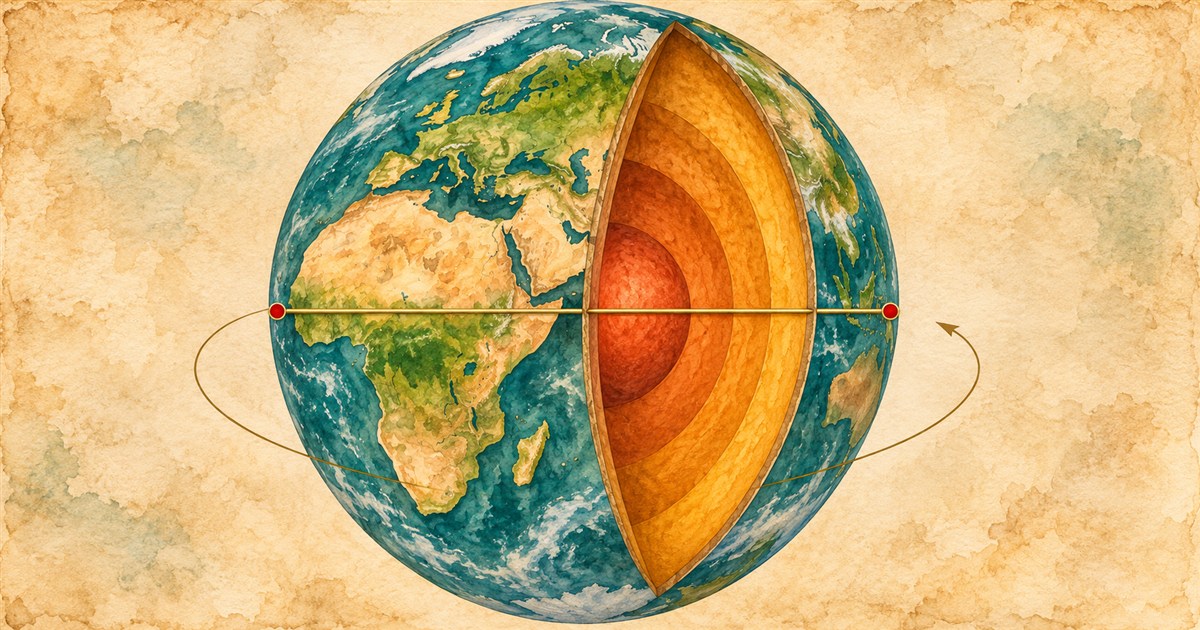
The antipode of a place is the point on the Earth’s surface directly opposite it. A straight line from the place through the center of the planet would emerge on the other side at the antipode.

To find the antipode, reverse the latitude hemisphere and add 180 degrees to the longitude. The antipode of a point at 23 degrees south latitude and 46 degrees west longitude is at 23 degrees north latitude and 134 degrees east longitude.

Between a place and its antipode are about 20,000 kilometers — half the way around the Earth — no matter which direction you travel.

Why almost every antipode is in the sea

About 70% of the Earth’s surface is covered by water, and the continents are concentrated in the Northern Hemisphere. That is why most land places have their antipode in the ocean.

Only a small portion of the planet’s land has land on the opposite side as well. The best-known examples are Spain, with antipodes in New Zealand, and parts of Argentina and Chile, with antipodes in China and Mongolia.

The antipode of Brazil falls almost entirely in the Pacific Ocean, between East Asia and Oceania, near Taiwan, the Philippines and the southern islands of Japan.

Antipodes that surprise

Madrid, Spain, has its antipode near Weber, a small town on New Zealand’s North Island. That is why Spain and New Zealand are the most often cited example of countries on opposite sides of the Earth.

Hong Kong is almost exactly on the other side of the world from La Quiaca, in northern Argentina on the border with Bolivia. Much of Argentina and Chile have antipodes in China and Mongolia.

In Brazil, almost all antipodes are in the Pacific Ocean. The exception is the far north: parts of Roraima and Amazonas have antipodes on Indonesian islands such as Borneo and Sulawesi.

Traveling to the antipode

The antipode is the farthest place possible from home: about 20,000 kilometers, half the way around the Earth. For that reason, any return route from there is practically the same distance.

For people living in Brazil, the lands closest to your antipode are in East Asia, such as Japan, Taiwan, the Philippines, and Indonesia. The trip usually takes more than 24 hours, with one or two connections.

At the antipode, the seasons are reversed and the time difference is close to 12 hours: when it is noon here, it is near midnight there.

Frequently asked questions

What is the antipode of a place?

It is the point exactly opposite it on the Earth’s surface. A line passing through the center of the planet would connect the two points.

What is the antipode of Brazil?

Most of Brazil has its antipode in the Pacific Ocean, between East Asia and Oceania. The antipode of São Paulo, for example, is in the sea southeast of Okinawa, Japan.

How do you calculate the antipode?

Reverse the latitude hemisphere (north becomes south and south becomes north) and add or subtract 180 degrees from the longitude, to keep it within 180 degrees west and 180 degrees east.

What is the distance between a place and its antipode?

About 20,000 kilometers in any direction — half the Earth’s circumference. It is the greatest possible distance between two points on the planet.

Why are most antipodes in the ocean?

Because roughly 70% of the Earth is covered by water and the continents are mostly in the Northern Hemisphere. Few land places have land directly on the opposite side.

Is the time at the antipode the opposite of mine?

Almost. The difference is close to 12 hours, so when it is daytime in one place it is usually nighttime at the antipode. Official time zones and daylight saving time can alter that difference slightly.