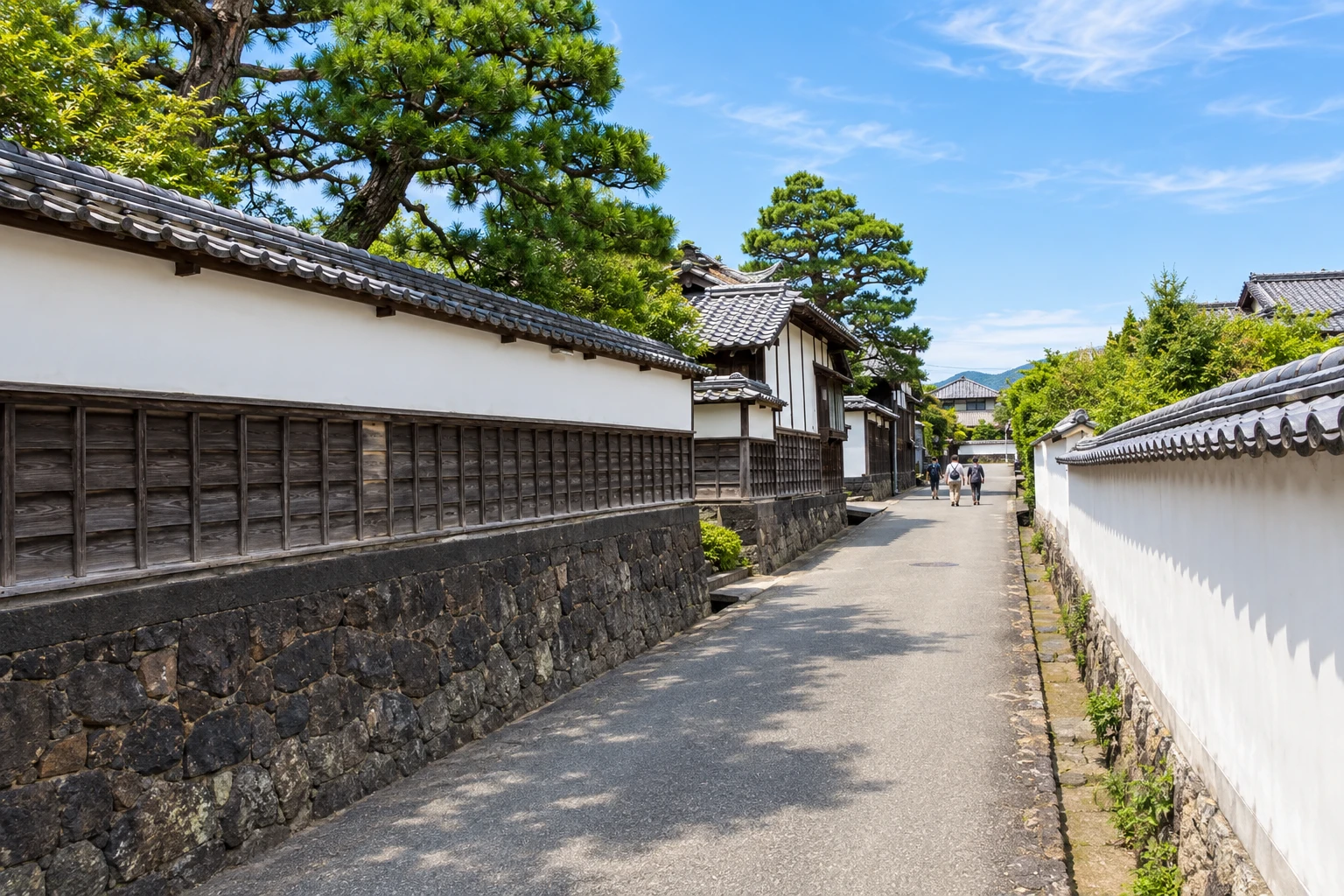
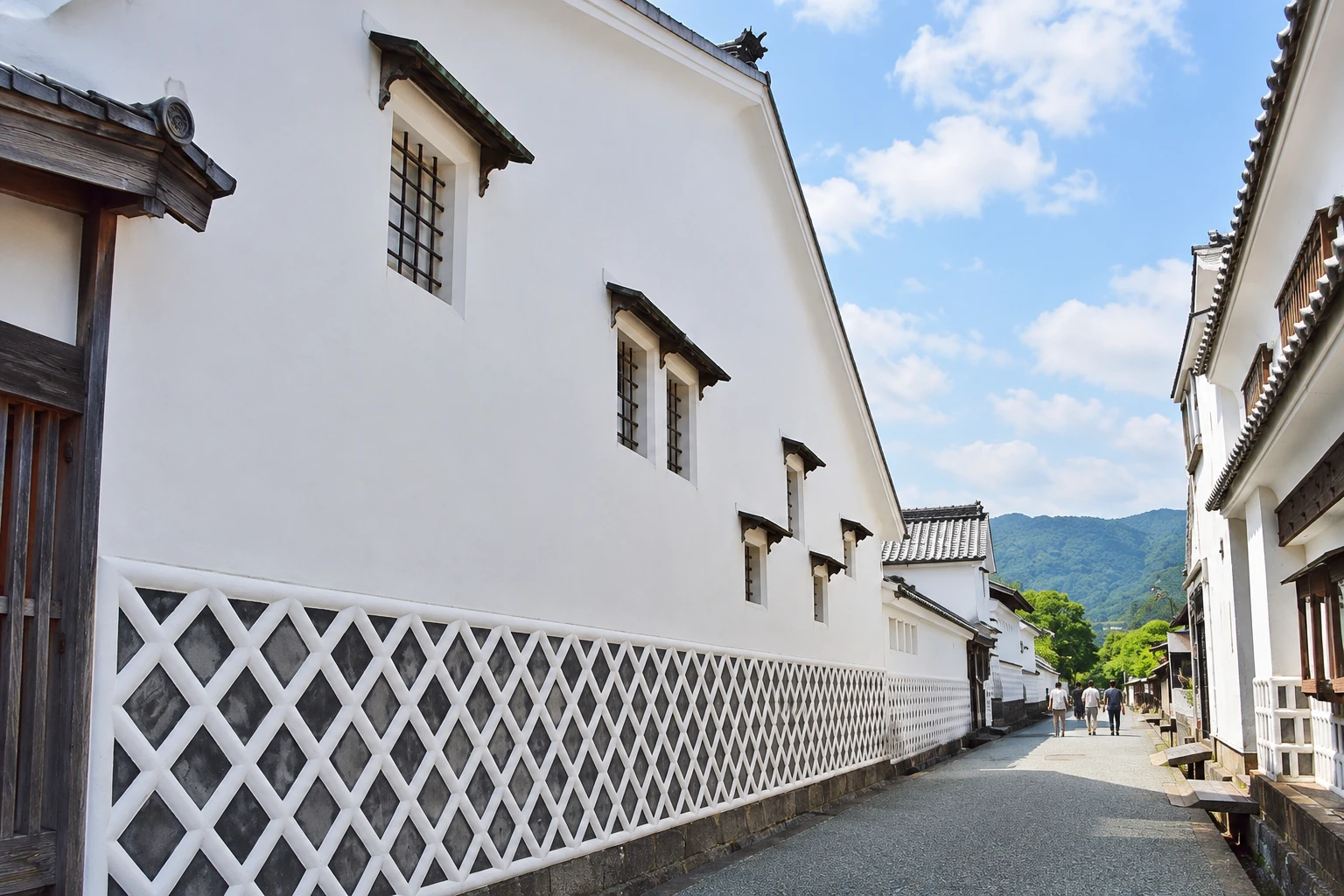
In the photo: Street of white walls in Hagi’s historic district.
Illustrative images. The pictures in this guide are illustrations based on the real place, not photographs, and may differ from it.
The city
What to expect from Hagi.
Hagi is the former castle town of the Mori on the Sea of Japan coast in Yamaguchi. It features streets with white walls and samurai and merchant houses, the castle ruins in Shizuki Park, Yoshida Shoin’s Shokasonjuku and other UNESCO Meiji sites, as well as Hagi-yaki pottery kilns. Bicycles are the common way to get around.
Hagi’s old quarter, with white plaster and earthen walls, samurai and merchant houses, wooden gates and orange trees, preserved in its 17th-century layout and part of the UNESCO Meiji sites.
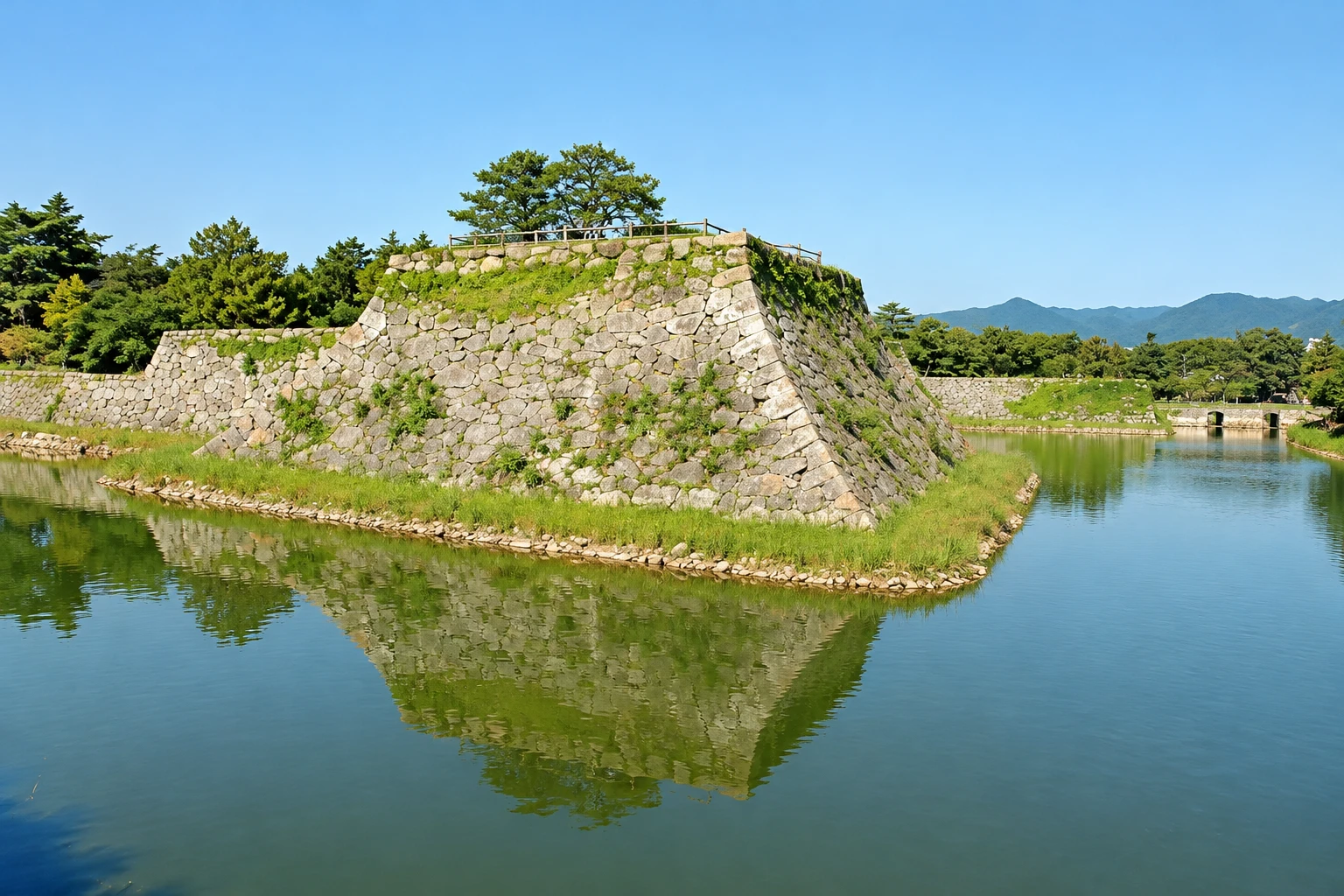
Stone walls, moat and the base of the Mori castle tower, in Shizuki Park at the foot of Mount Shizuki and on the Sea of Japan, with a tea house and cherry trees.
Approximate distances. Check flights and bus, train or boat schedules before you travel.
The express bus from Shin-Yamaguchi on the shinkansen line reaches Hagi in about 1 hour; there are also buses from Yamaguchi Ube Airport and to Akiyoshido. Higashi-Hagi station on the San'in line has few trains. Hagi-Iwami Airport is about 60 km away.
How many days
A full day by bicycle covers the castle town, the castle ruins and Shokasonjuku. With two days, add the reverberatory furnace, the shipyard, pottery workshops and volcanic Kasa Island.
When to go
Natsumikan orange trees bloom in May and perfume the streets. The cherry trees in Shizuki Park usually flower in early April. Autumn is mild. In winter cold winds come from the Sea of Japan; summer is hot and humid.
The seasons shown are the most usual ones; nature doesn't always follow the calendar.
Do you need a car?
No. The town is flat and compact, excellent for cycling; bikes can be rented near stations and hotels. Two circular buses, running in opposite directions, serve the main sights.
Suggested itinerary
An order that works
Built with the places on this page. No rush: it's paced so you have time to see them.
One day in Hagi
manhã
Castle town
Rent a bicycle and ride the white-walled streets of the Horiuchi district and the merchants’ alleys, visiting the houses of Kido Takayoshi and Takasugi Shinsaku.
tarde
Castle ruins
Cycle to Shizuki Park, with the castle’s walls and moat, the Hananoe teahouse and a view of the Sea of Japan.
fim de tarde
Shokasonjuku
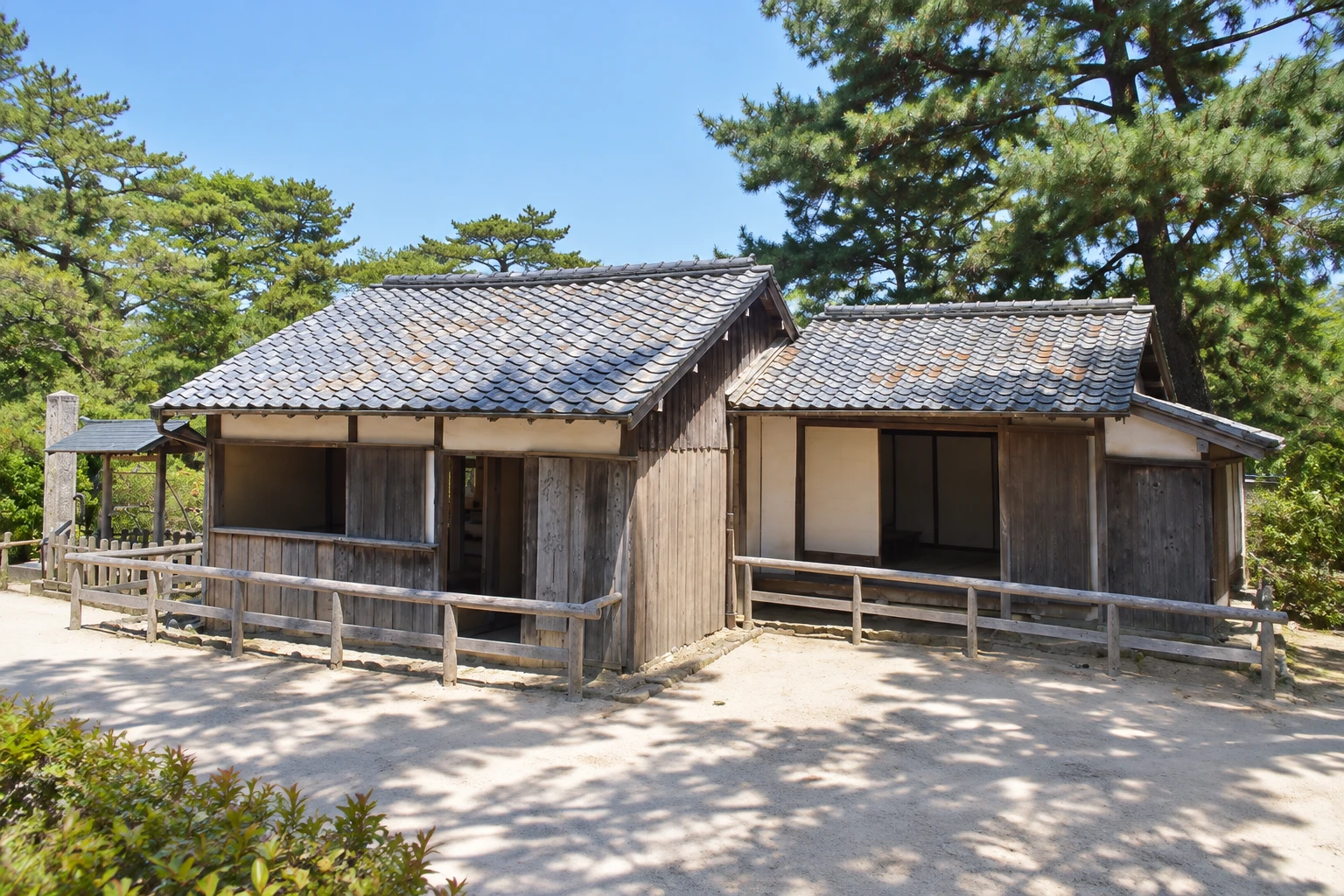
Cross the river to the Shoin shrine and see Yoshida Shoin’s small wooden school; continue on to the reverberatory furnace.
noite
Dinner and pottery
Dine on Sea of Japan fish such as Hagi cod and squid, served on Hagi-yaki dishes.
Check before you go. Opening hours and days change, and places may close for renovations, holidays or events. This itinerary is a suggestion from Cidade Turismo, not a commitment: plan yours by checking directly with each place you intend to visit.
Before you go
Frequently asked questions
How do I get around Hagi?
By bicycle, rented near stations and hotels, or using the two circular buses that run the route in opposite directions. The town is flat.
Which UNESCO sites are in Hagi?
The reverberatory furnace, the Ebisugahana shipyard, the old Ohitayama iron foundry, the castle town and the Shokasonjuku school, which form Hagi’s portion of the Meiji UNESCO sites.
Where can I buy Hagi pottery?
In the shops and galleries of the castle-town and in the potters’ kilns, some near Shizuki Park and others in the Matsumoto area near Shokasonjuku.
What are Hagi natsumikan?
A bitter summer orange planted in samurai gardens after the Meiji Restoration to generate income. The trees appear above the walls, and the fruit is made into sweets and juices.


 Brazil
 Antarctica
 Argentina
 Bolivia
 Chile
 Colombia
 Ecuador
 Falkland Islands (Malvinas)
 French Guiana
 Guyana
 Paraguay
 Peru
 Suriname
 Uruguay
 Venezuela
 Austria
 Belgium
 Croatia
 Denmark
 Finland
 France
 Germany
 Greece
 Hungary
 Iceland
 Ireland
 Italy
 Luxembourg
 Norway
 Poland
 Portugal
 Slovakia
 Slovenia
 Spain
 Sweden
 Switzerland
 the Czech Republic
 the Netherlands
 the United Kingdom
 Turkey
 Bermuda
 Canada
 Greenland
 Mexico
 Saint Pierre and Miquelon
 the United States
 the Dominican Republic
 Egypt
 South Africa
 Australia
 Fiji
 New Zealand
 Papua New Guinea