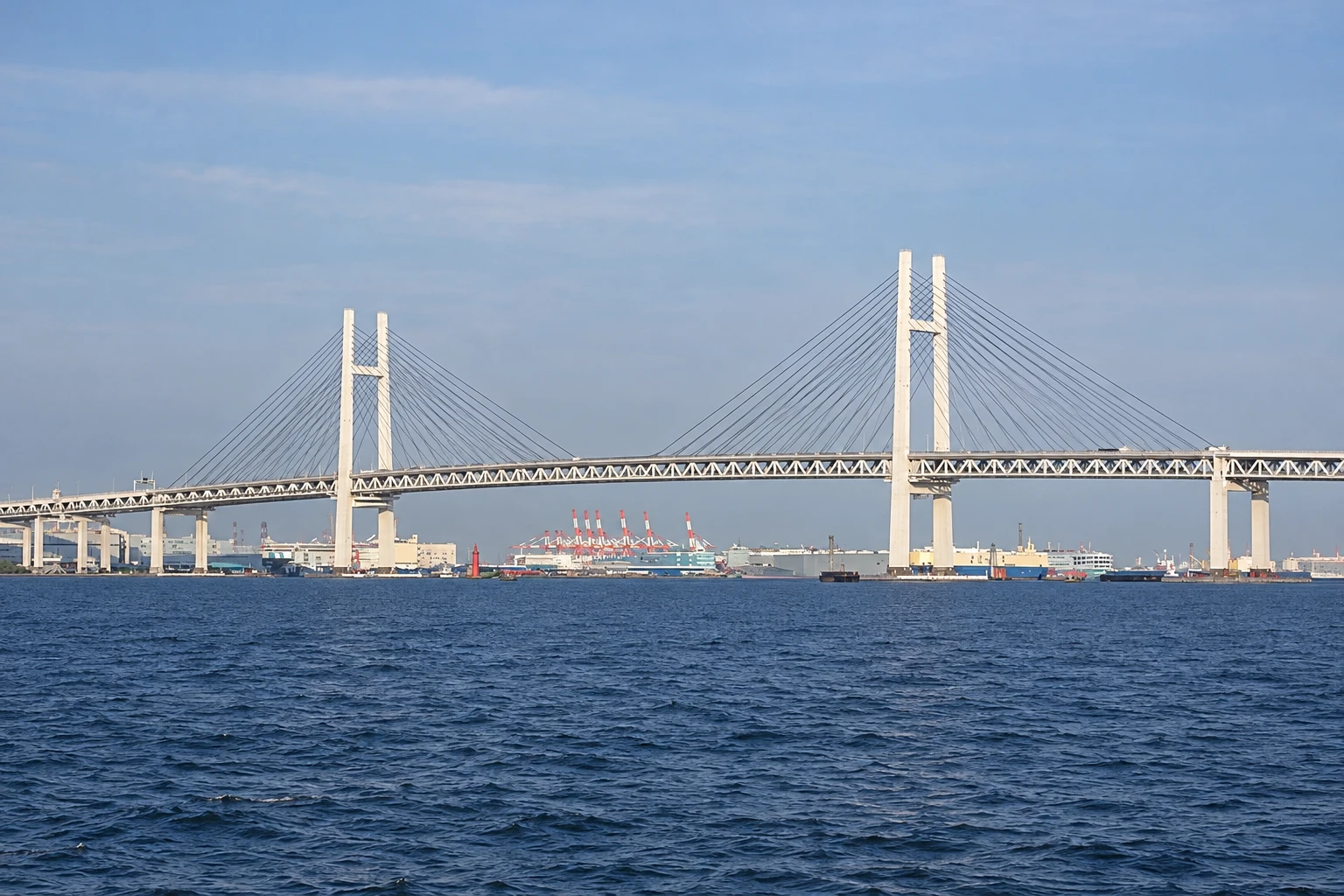
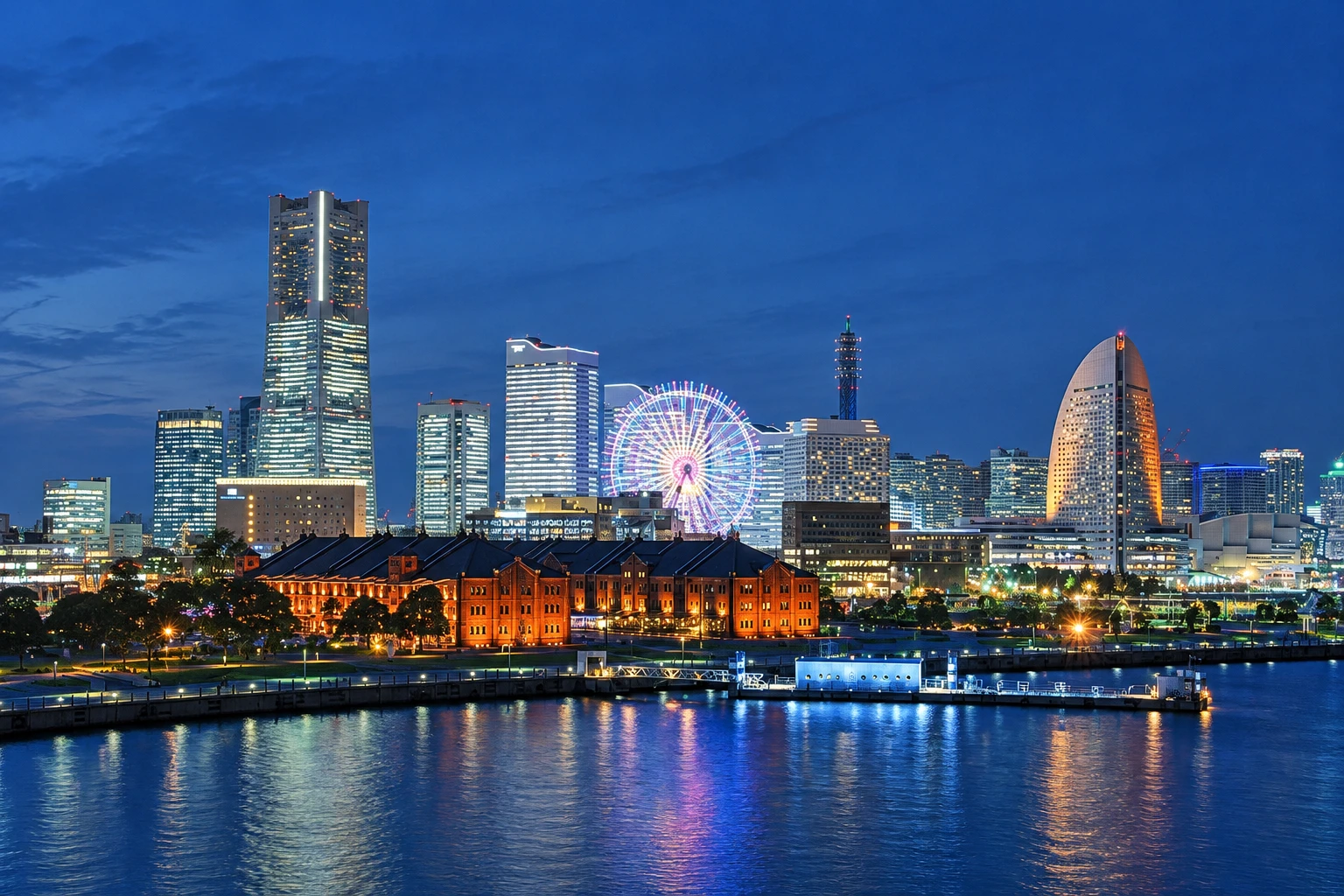
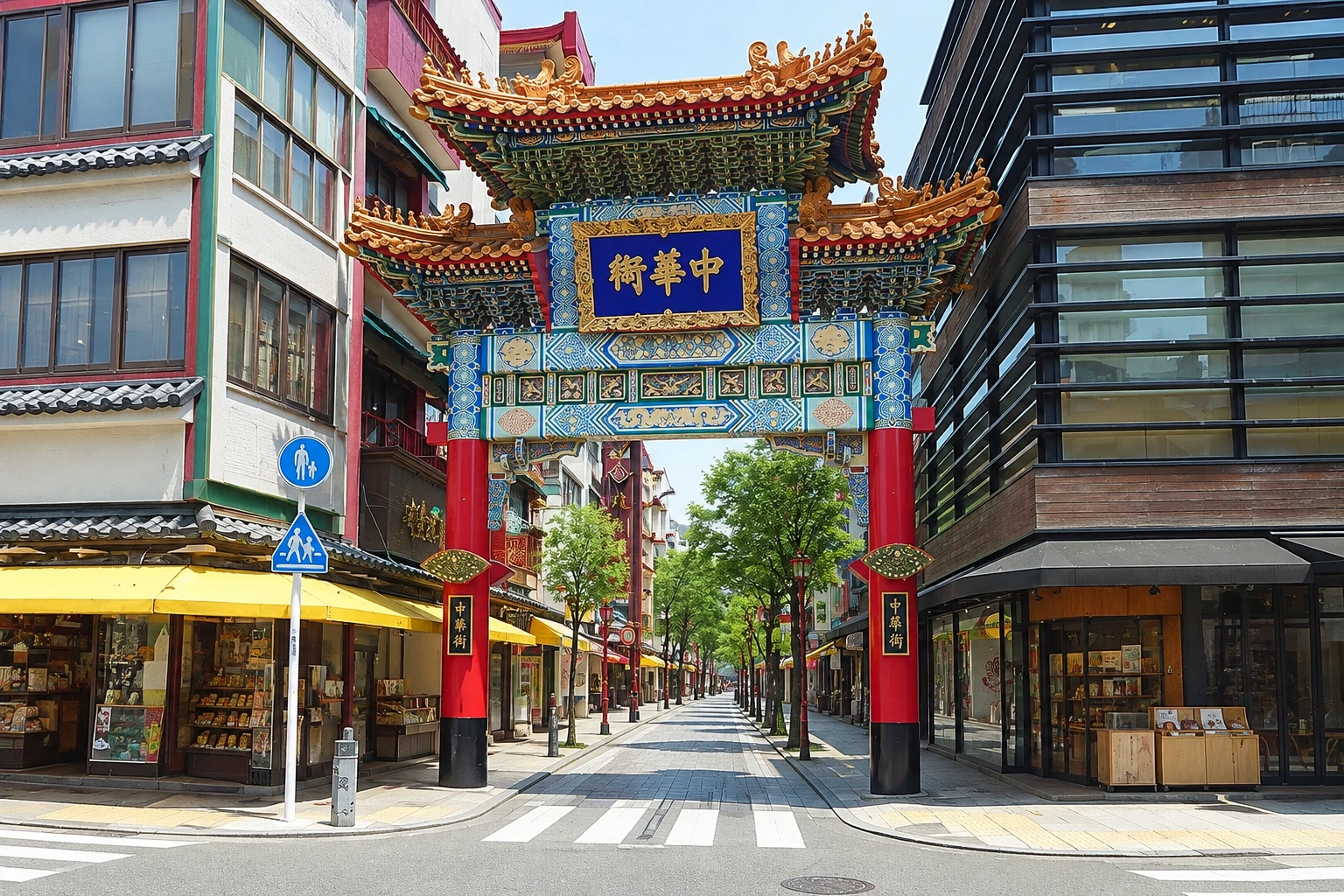
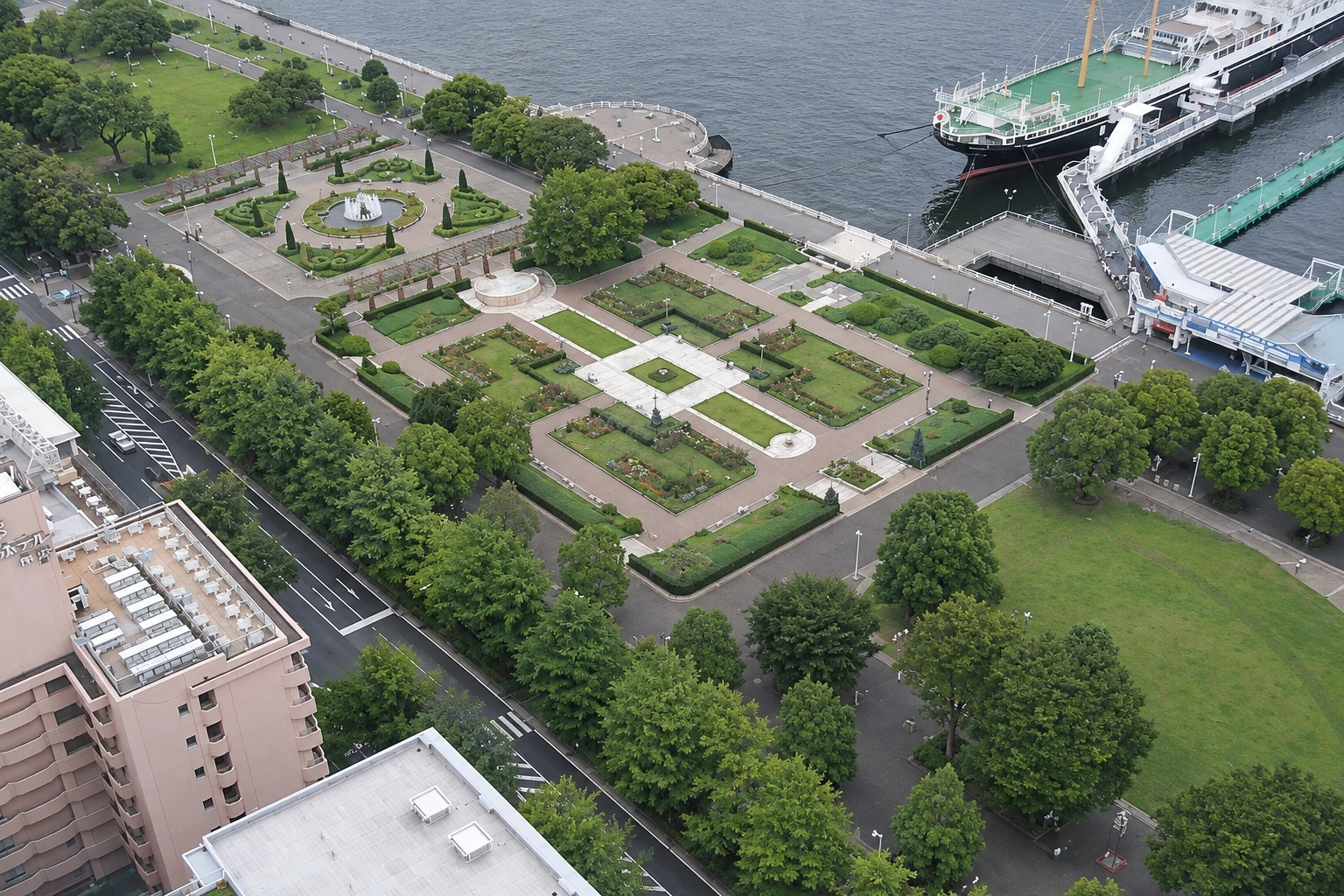
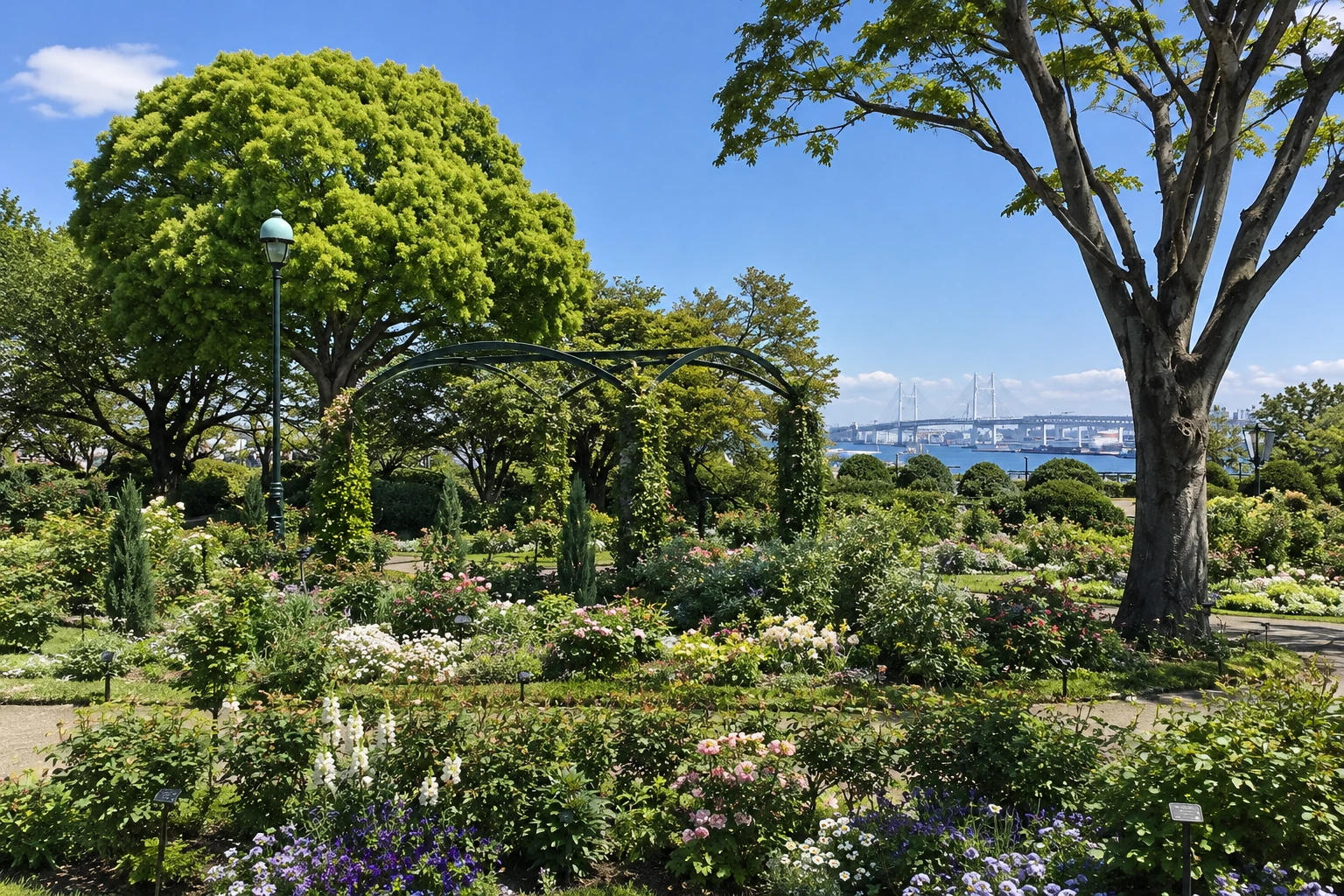
Illustrative images. The pictures in this guide are illustrations based on the real place, not photographs, and may differ from it.
The city
What to expect from Yokohama.
Yokohama, the capital of Kanagawa and Japan’s second-most populous city, grew after its port opened to foreign trade in 1859. The waterfront includes Minato Mirai, with the Landmark Tower and the red-brick warehouses, and Yamashita Park, with the ship Hikawa Maru. Chinatown is just a few steps away, and the Yamate hill preserves Western-style houses. The Sankei-en garden, to the south, has historic buildings.
Yokohama’s modern waterfront, with the Landmark Tower and its observatory, the Ferris wheel, the sailing ship Nippon Maru, the red-brick warehouses and the promenade over old port tracks.
The waterfront park in Yokohama built on the rubble from the 1923 earthquake, featuring the Hikawa Maru ship, rose gardens and a view of Osanbashi Pier.
The hill where foreigners lived after the port opened, with Western-style houses open to visitors, the foreigners’ cemetery and the Minato no Mieru Oka Park viewpoint.
Aeroporto Internacional de Tóquio (Haneda) (HND)Ota · 20 km
Estação de Yokohama2 km
Approximate distances. Check flights and bus, train or boat schedules before you travel.
From Tokyo and Shinagawa stations, the JR Tokaido and Yokosuka lines reach Yokohama Station in about 25 to 30 minutes; from Shibuya, the Tokyu Toyoko goes directly to Minato Mirai and Chinatown. From Haneda Airport, trains and buses take about 30 minutes.
How many days
One day is enough for Minato Mirai, Yamashita Park, Chinatown and Yamate. With an extra half day, include Sankei-en and the museums. It can be a day trip from Tokyo or a stop on the way to Kamakura.
When to go
May and October, when parks have roses and the days are mild. Summer has festivals and fireworks over the harbor; December has markets and the Yamate houses decorated for Christmas. Cherry trees bloom in late March and early April.
The seasons shown are the most usual ones; nature doesn't always follow the calendar.
Do you need a car?
No. The Minatomirai Line, JR, the subway, buses and boats connect the waterfront, Chinatown and Yamate, and much of the area is walkable.
Suggested itinerary
An order that works
Built with the places on this page. No rush: it's paced so you have time to see them.
One day in Yokohama
manhã
Sankei-en
Start early at Sankei-en garden; take a bus from Sakuragicho Station.
tarde
Yamate and Yamashita Park
Visit the Western-style houses and the Yamate lookout, then walk down to Yamashita Park and the Hikawa Maru.
noite
Chinatown and Minato Mirai
Have dinner in Chinatown and finish on the Minato Mirai waterfront, with the lit-up buildings and Ferris wheel.
Check before you go. Opening hours and days change, and places may close for renovations, holidays or events. This itinerary is a suggestion from Cidade Turismo, not a commitment: plan yours by checking directly with each place you intend to visit.
Before you go
Frequently asked questions
What to do in Yokohama in one day?
Visit Minato Mirai and the Landmark Tower, Yamashita Park, Yamate hill and have dinner in Chinatown.
Which train line is most useful in Yokohama?
The Minatomirai Line, which links Yokohama Station with Minato Mirai, Chinatown and Motomachi, and continues to Shibuya via the Tokyu Toyoko.
Can you do a day trip from Tokyo to Yokohama?
Yes. Yokohama Station is about 25 to 30 minutes by train from Tokyo and Shinagawa stations.
Are there boat rides in Yokohama?
Yes. Sightseeing boats and water buses operate on the bay, departing from Yamashita Park and Minato Mirai.
Which museum to visit in Yokohama?
The Yokohama Port Museum, next to the sailing ship Nippon Maru, the ship-museum Hikawa Maru and, for food, the Shin-Yokohama Ramen Museum.


 Brazil
 Antarctica
 Argentina
 Bolivia
 Chile
 Colombia
 Ecuador
 Falkland Islands (Malvinas)
 French Guiana
 Guyana
 Paraguay
 Peru
 Suriname
 Uruguay
 Venezuela
 Austria
 Belgium
 Croatia
 Denmark
 Finland
 France
 Germany
 Greece
 Hungary
 Iceland
 Ireland
 Italy
 Luxembourg
 Norway
 Poland
 Portugal
 Slovakia
 Slovenia
 Spain
 Sweden
 Switzerland
 the Czech Republic
 the Netherlands
 the United Kingdom
 Turkey
 Bermuda
 Canada
 Greenland
 Mexico
 Saint Pierre and Miquelon
 the United States
 the Dominican Republic
 Egypt
 South Africa
 Australia
 Fiji
 New Zealand
 Papua New Guinea