Trieste · Italy · Square
Piazza Unità d'Italia
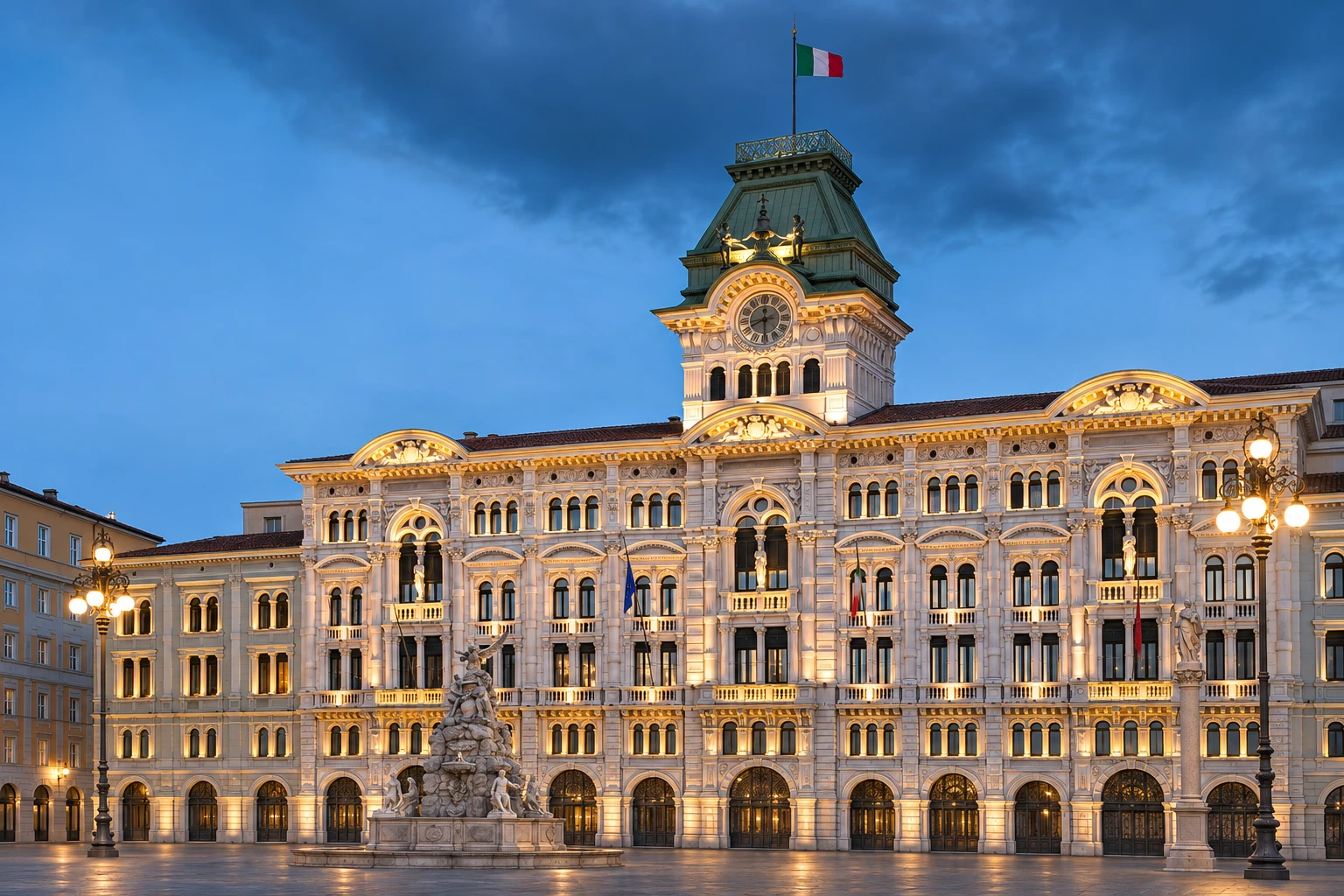
Square facing the gulf of Trieste, surrounded by palaces and the town hall with its clock tower. The Fontana dei Quattro Continenti sits in front of the municipal building.

 Search
 Brazil
 Antarctica
 Argentina
 Bolivia
 Chile
 Colombia
 Ecuador
 Falkland Islands (Malvinas)
 French Guiana
 Guyana
 Paraguay
 Peru
 Suriname
 Uruguay
 Venezuela
 Austria
 Belgium
 Croatia
 Denmark
 Finland
 France
 Germany
 Greece
 Hungary
 Iceland
 IrelandItaly
 Luxembourg
 Norway
 Poland
 Portugal
 Slovakia
 Slovenia
 Spain
 Sweden
 Switzerland
 the Czech Republic
 the Netherlands
 the United Kingdom
 Turkey
 Bermuda
 Canada
 Greenland
 Mexico
 Saint Pierre and Miquelon
 the United States
 the Dominican Republic
 JapanTurkey
 Egypt
 South Africa
 Australia
 Fiji
 New Zealand
 Papua New Guinea
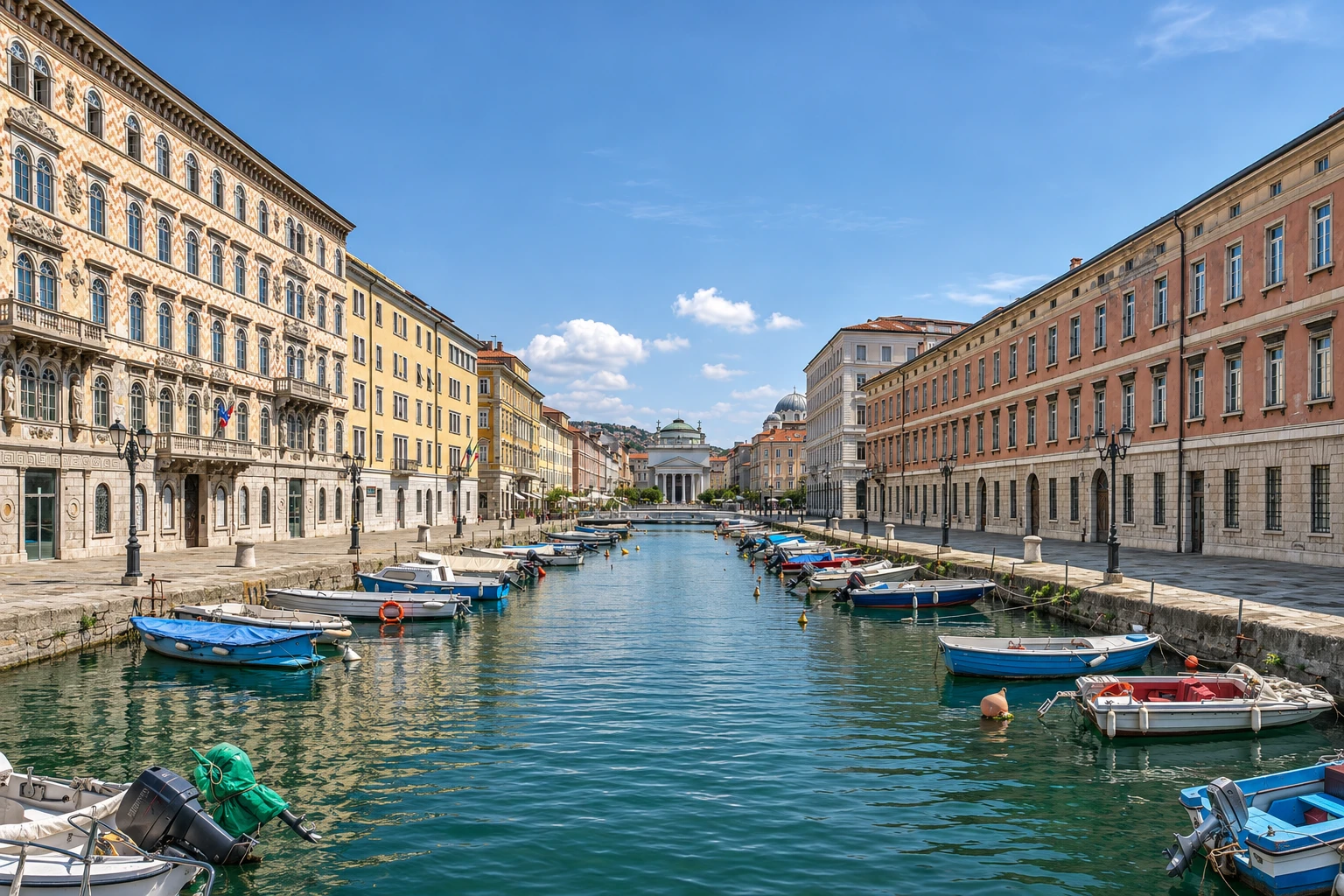
In the photo: Trieste’s Grand Canal, in the Borgo Teresiano.
Illustrative images. The pictures in this guide are illustrations based on the real place, not photographs, and may differ from it.

The city
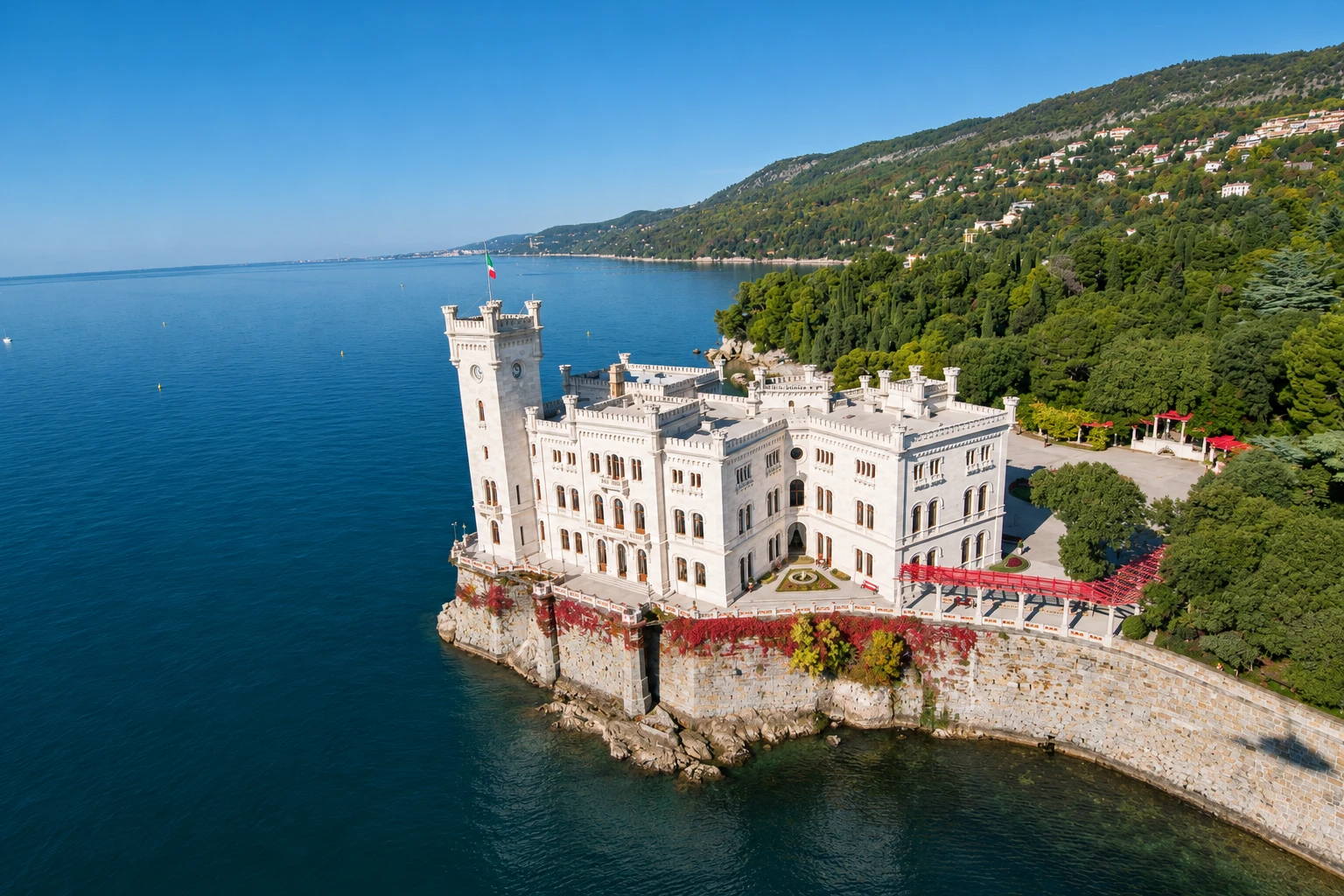
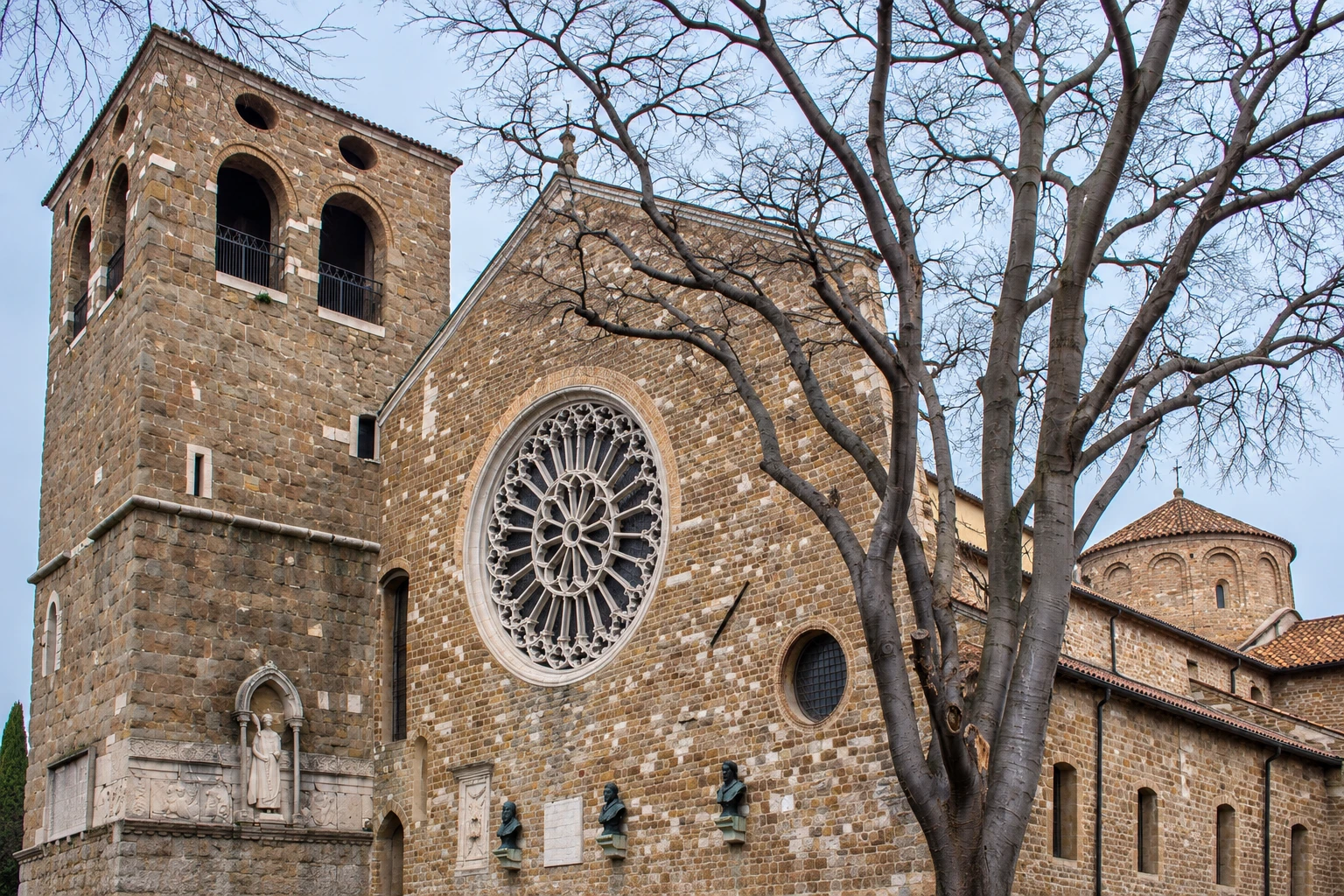
Trieste sits between the Adriatic and the Karst plateau. Piazza Unità d’Italia opens the port center onto the gulf, facing the Molo Audace. At the top of the old town, the Cathedral of San Giusto houses medieval mosaics. On the Grignano coast, Miramare Castle occupies a promontory surrounded by gardens.
Trieste is the capital of Friuli Venezia Giulia and the last major Italian port before the Slovenian border. The city occupies a narrow strip between the gulf and the edge of the Karst, the limestone plateau that separates it from the interior. Latin, Slavic and Germanic cultures meet here, and you can see all three on the street: a domed Serbian Orthodox church beside a canal, one of Europe’s largest synagogues, Viennese-style coffeehouses and, on the plateau, Slovenian customs such as the osmize farmhouse taverns.
The city unfolds in three layers. The oldest is at the top of San Giusto Hill: the remains of Roman Tergeste’s forum and basilica, a cathedral formed by joining two medieval churches, and the Habsburg castle. On the way down are the Arco di Riccardo, a Roman gate, and the Roman theater, which held up to 3,500 people. At the foot of the hill begins the city of the free port. Piazza Unità d’Italia opens onto the sea, framed by the town hall and the palaces of government, insurance and shipping. Molo Audace reaches 246 m into the gulf. The Grand Canal cuts through Borgo Teresiano, a grid of streets laid out in the 18th century over former salt pans.
Beyond downtown, you can explore the coast and plateau without leaving the municipality. To the northwest, locals swim along the Barcola waterfront, which leads to Miramare Castle. Archduke Maximilian of Habsburg had this white residence built on the Grignano headland, surrounded by a 22-hectare park. Up on the plateau, Opicina is the gateway to the Karst. The level, 5 km Strada Napoleonica starts there, overlooking the gulf and passing near the Monte Grisa sanctuary. At the other end of town, the Risiera di San Sabba is a national monument and World War II memorial.
Trieste is also a city of coffee and writers. Coffee beans helped drive its economic growth. Historic cafés such as Caffè degli Specchi on the square and Antico Caffè San Marco were gathering places for Italo Svevo, Umberto Saba and James Joyce, who lived here for almost eleven years. Ordering coffee has its own vocabulary: a “nero” is an espresso and a “capo” is an espresso topped with milk foam.
The climate is typical of the Adriatic coast. July and August have average highs of 29 °C, and swimming is part of everyday life at Barcola and the public baths near downtown. Fall is the wettest season, especially from September through November. October brings the Barcolana regatta, filling the gulf with sails. Winter is cool, with average highs of 9 to 10 °C. The bora can blow at any time of year. This east-northeast wind sweeps down from the plateau in strong gusts, clearing the sky or, in its “dark” form, bringing rain.
Downtown is walkable, with city buses to Miramare, Barcola and Opicina. Two days cover the main square, San Giusto Hill and Miramare. With three, explore the Karst and take your time in the museums and cafés.
29 places to stay in Trieste.
30 places to eat in Trieste.
Hotéis e restaurantes da cidade no mapa.
The local experience
Square facing the gulf of Trieste, surrounded by palaces and the town hall with its clock tower. The Fontana dei Quattro Continenti sits in front of the municipal building.
19th-century residence built for Maximilian and Charlotte of Habsburg on a promontory of the gulf. The visit includes rooms with historic furniture and the Grignano park.
Cathedral on the top of the San Giusto hill, formed by the joining of two medieval churches. It has a stone façade with a rose window and preserves mosaics in the apses.
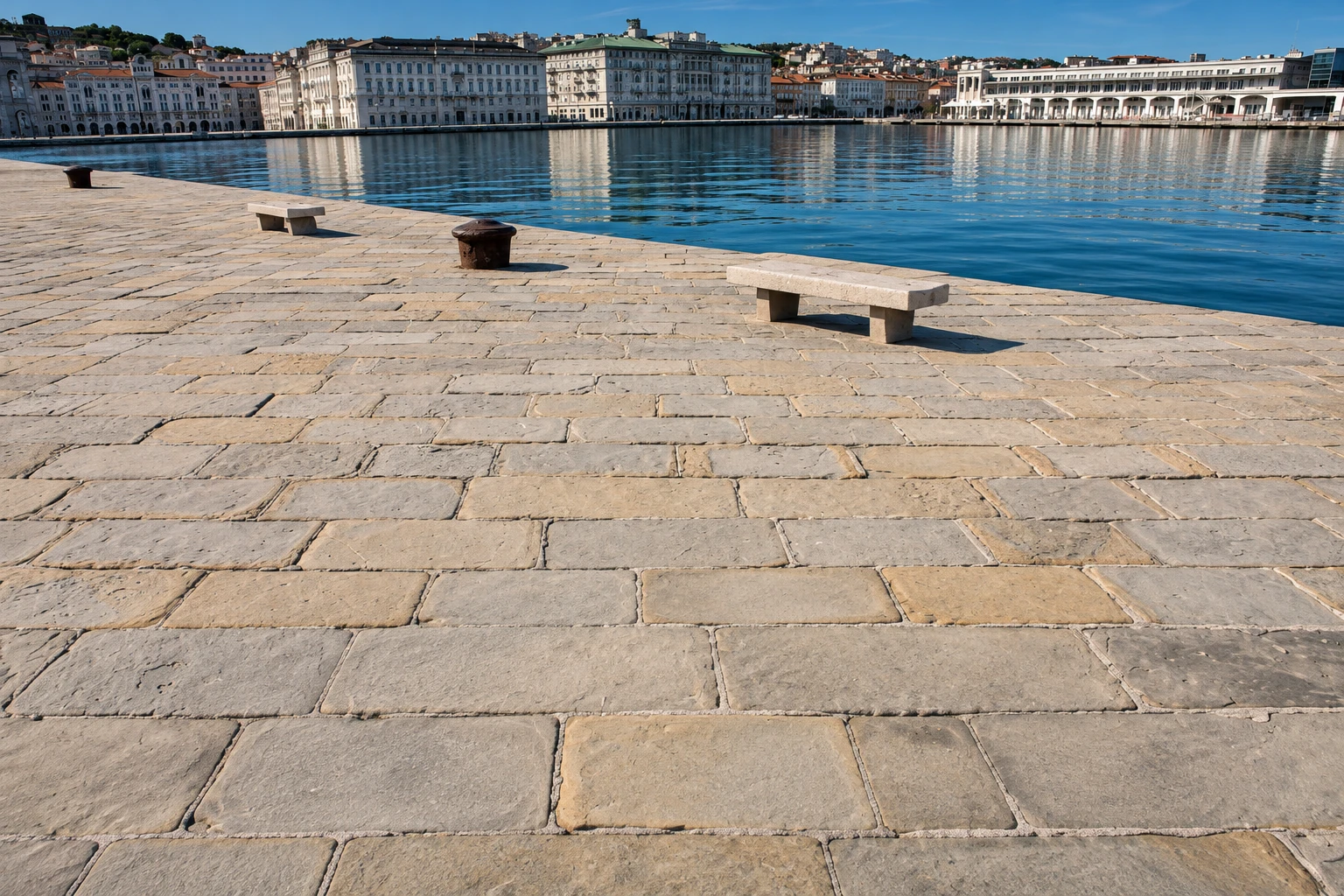
Public stone pier that juts into the gulf near Trieste’s centre. From the tip, the view returns to the seafront and the façades of Piazza Unità d’Italia.
To choose before you go
Where each tour starts, how long it takes, how it is done, what is included and the price range.
Piazza Unità d’Italia, still called Piazza Grande by locals, is Trieste’s gathering place. Palaces frame three sides and the fourth opens onto the gulf. It’s considered Europe’s largest square opening directly onto the sea. The buildings reflect the wealth of the empire’s old port: the Art Nouveau Government Palace, the palaces of Assicurazioni Generali and Lloyd Triestino and, at the back, the Town Hall. This last building to go up has a clock tower where two mechanical figures, Mikez and Jakez, strike the hours. The Fountain of the Four Continents stands in front. A line of blue lights in the paving marks the former shoreline. This was the mandracchio, the city’s small inner harbor, later filled in. Cross the waterfront avenue to Molo Audace. The pier was built between 1743 and 1751 over the hull of the San Carlo, a ship that sank in the harbor, and gradually extended to its present 246 m. It received its current name in 1922 to commemorate the destroyer Audace, the first Italian navy ship to dock in Trieste, on November 3, 1918. A compass rose marks the end of the pier. From there, look back at the facades around the square and along the Rive seafront avenue. Locals come here to watch the sunset. When the bora blows hard, the pier is exposed to the gusts. On those days, view it from the waterfront.
Stops: Piazza Unità d'Italia, Fontana dei Quattro Continenti, Palazzo del Municipio, Molo Audace, Rive.
Includes: The square and quay are public spaces with free admission.
Tip: Return to the square at night to see the facades lit up. The tourist information office stands at the corner of the square on Via dell’Orologio.
Best time: Year-round. In fall the late-afternoon light often turns the facades along the Rive red.
Borgo Teresiano grew up with the free port in the 18th century on land once occupied by salt pans. Its streets form a grid from the railway station to Corso Italia. The Grand Canal cuts into the middle of the district. Matteo Pirona began work on it in 1754 so boats could unload goods directly outside the warehouses. Other canals were considered, but only this one was built. Its far end was filled in in 1934 to create Piazza Sant’Antonio. The banks are lined with the palaces of merchants who shaped Trieste. Palazzo Carciotti stands at the corner of the Rive. Palazzo Gopcevich, with its two-tone geometric facade, houses the Carlo Schmidl Theater Museum. Midway along the canal, Ponte Rosso is the sole survivor of three old swing bridges. A statue of James Joyce by Trieste sculptor Nino Spagnoli was placed here on the centenary of the writer’s arrival. The language school where he taught stood on Piazza Ponterosso. Locals nicknamed a newer pedestrian crossing, Passaggio Joyce, the Ponte Curto. At the head of the canal, two churches reflect the trading city’s religious diversity. Sant’Antonio Taumaturgo, known as Sant’Antonio Nuovo, is Trieste’s largest church. Designed by Pietro Nobile and built between 1825 and 1849, it has a Neoclassical portico with six Ionic columns. Beside it, the white stone Serbian Orthodox Church of San Spiridione has a Greek-cross plan, one large dome and four smaller ones. It opened for worship in 1868 and holds Russian icons covered with gold and silver. A few blocks away, the synagogue built between 1908 and 1912 by Ruggero Berlam and his son Arduino is among the largest in Europe.
Stops: Canal Grande di Trieste, Ponte Rosso, Piazza Ponterosso, Chiesa di San Spiridione, Chiesa di Sant'Antonio Nuovo, Palazzo Gopcevich, Sinagoga di Trieste.
Includes: The streets, canal, and churches are free to explore. The synagogue offers paid guided visits on scheduled dates and at set times. Check current prices.
Tip: The synagogue closes to visitors on Jewish and public holidays. Churches may close during services. Check before visiting.
Best time: Year-round. In December the Christmas market stalls fill Piazza Sant'Antonio, Piazza Ponterosso, and surrounding streets.
Trieste began on San Giusto Hill, probably as a prehistoric fortified settlement and later as the walled center of Roman Tergeste. Begin climbing at the Roman Theater at the foot of the hill. Built almost entirely of masonry in the first and second centuries, it held up to 3,500 spectators. For centuries it lay beneath neighborhood houses until it was uncovered in 1938. Higher up on Piazza del Barbacan, the Arco di Riccardo is a gate through the old Roman walls, probably from the first century. Beside the cathedral at the top are the remains of the forum, a three-aisled civic basilica and the monumental entrance to the sacred precinct, the propylaea. They were excavated between 1929 and 1934. In the 14th century, two neighboring churches, the Assunta and the chapel of St. Justus, were joined to form San Giusto Cathedral. The aisles separating them were demolished to create a central nave. The resulting interior has five aisles and two apses with Byzantine-inspired mosaics, one of the enthroned Virgin, the other of Christ between St. Justus and St. Servulus. The facade has a Gothic rose window. The low, solid bell tower incorporates remains of the Roman propylaea. The Treasury Chapel holds the halberd of St. Sergius, now the city’s emblem. Construction of San Giusto Castle began in 1468, when Emperor Frederick III ordered a fortified house for his captain. The three bastions were only completed in 1636. Walk the walls for views of the city and gulf, then visit the museum’s arms collection, St. George’s Chapel and the Lapidario Tergestino in the Lalio Bastion, with 130 inscriptions and sculptures from the Roman city. At the entrance stand the originals of Mikez and Jakez, the mechanical figures from the Town Hall clock.
Stops: Teatro Romano di Trieste, Arco di Riccardo, Cattedrale di San Giusto, Castello di San Giusto, Lapidario Tergestino, Roman forum on San Giusto Hill.
Includes: The cathedral, forum, arch and Roman theater are free to see. The castle charges separate admission, covering the walls, museum, Lapidario and exhibitions in the Bastione Fiorito. Admission is free on the first Sunday of the month. Check current rates.
Tip: The castle closes one day a week. Check before climbing. To avoid the uphill walk, take a city bus up and walk down past the Arco di Riccardo and Roman Theater. Visit the cathedral outside services.
Best time: Year-round. In summer, the castle courtyard hosts concerts during the Trieste Estate festival.
Miramare Castle occupies the tip of the Grignano headland less than 10 km northwest of downtown. Built in the mid-19th century, it was the home Archduke Ferdinand Maximilian of Habsburg planned to share with his wife, Charlotte of Belgium. He is said to have chosen the spot, then bare rock, after taking shelter from a storm in Grignano’s small harbor. The eclectic white Istrian stone castle is visible from afar on the coastal road into town. Inside are original furnishings and objects in Maximilian and Charlotte’s ground-floor apartments, the guest rooms and the throne room with its wooden ceiling. Part of the building tells its 20th-century story, when Duke Amedeo d’Aosta lived here and installed a telephone, heating and an elevator. The 22-hectare park contains species selected by the archduke during his travels as an admiral in the Austrian navy. You’ll find the Castelletto, the smaller house where the couple lived during construction, along with greenhouses, a formal garden with a café and the Scuderie. These former stables host exhibitions and BioMa, the immersive museum of the Miramare Marine Protected Area. A red granite sphinx from the third century BC stands on the harbor quay, the only surviving piece from the archduke’s Egyptian collection. Without a car, take city bus 6 or 36 from near Trieste Centrale toward Miramare-Grignano. From Bivio di Miramare, it’s about 750 m to the park entrance. Some regional trains stop at Miramare station, built to serve the castle and just 150 m from the Via Beirut park entrance. A scheduled boat connects downtown with Barcola, Grignano and Sistiana from spring to early fall.
Stops: Miramare Castle, Parco di Miramare, Castelletto, Scuderie del Castello, Porticciolo di Grignano, Area Marina Protetta di Miramare.
Includes: The park is free. The castle charges admission, and the Castelletto and historic kitchens require reservations. Check current prices.
Tip: Parking beside the park is limited. Take a bus, train or boat if possible. Buy castle tickets ahead for weekends and holidays, when lines can form. The park closes earlier in fall and winter. Check hours before going.
Best time: Year-round. From April to September the park stays open longer and the river shuttle usually runs.
Barcola is the neighborhood you pass on the coastal road into Trieste, a strip of seafront sheltered from the bora. The Romans had villas here, and the elegant houses you still see along Viale Miramare began appearing in the mid-19th century. Today the waterfront is the city’s beach. Residents spread out towels and unfold chairs on the broad promenade a few steps from the water. Each stretch has its own name. Coming from Miramare, you pass Marinella, California, Molo G, the Topolini and the Pineta pine grove. The Topolini are ten semicircular terraces built in the 1930s, with changing rooms, restrooms and showers underneath. At the city end, the first terraces have two little pebble beaches popular with families. Farther along, you enter the sea by ladder or dive in. There are lifeguards and accessible ramps. The season generally runs from April through October. In winter, come for a walk and the sunset. Above the neighborhood on Gretta Hill, the Faro della Vittoria serves as both lighthouse and monument. Designed by Arduino Berlam and first lit in 1927, it was built on the base of a former Austrian fort. It’s about 70 m tall and stands 60 m above sea level. Clad in Karst and Istrian stone, it honors sailors who died in World War I. Giovanni Mayer’s copper Winged Victory crowns the dome, and an anchor traditionally linked to the destroyer Audace stands at its base. Visitors can climb to the first terrace for a view across the entire gulf. Barcola gave its name to the Barcolana, the regatta held on the second Sunday in October.
Stops: Barcola, Topolini, Pineta di Barcola, Faro della Vittoria, Viale Miramare.
Includes: The waterfront, the Topolini bathing platforms, and the lighthouse are all free to visit.
Tip: The lighthouse opens only part of the year, generally from April to early November, mainly Friday through Sunday. It closes in bad weather and admits only a few people at a time. Check ahead.
Best time: The waterfront season usually runs from April to October, but the walk is worthwhile year-round. The lighthouse opens from April to early November.
Opicina is Trieste’s neighborhood on the Karst plateau, at an elevation of about 330 m. Getting there is part of the outing. The Opicina tram, city line 2, has run since 1902 and covers just over 5 km between downtown and the plateau. On an 800 m stretch with a gradient of up to 26%, a funicular system pushes the cars uphill and holds them on the descent, an arrangement described as unique in Europe. The cars are protected historic vehicles. The line has had extended closures, when city buses 2 and 4 provide the connection. Get off at Obelisco beside the obelisk dedicated to Emperor Francis I of Austria. Here begins the Strada Napoleonica, also called the Vicentina, a nearly level 5 km path along the edge of the plateau to the village of Prosecco. Legend credits Napoleon’s troops with opening it. The other name more likely comes from Vicentini, the engineer who designed the route. There’s a broad gravel road and narrower woodland trails, with sunny stretches sheltered from the bora. Views extend across the city, harbor and gulf. Near the end, the path passes between rock faces used for climbing practice. Above the trail stands the Marian sanctuary of Monte Grisa, nicknamed “formaggino,” or little cheese, for its triangular shape. Antonio Guacci designed it from a sketch by Archbishop Antonio Santin, who made a vow in 1945 for the city’s deliverance. It was built between 1963 and 1965. You can walk there from Obelisco or from the Prosecco end of the trail. In the Karst villages, look for osmize, farmhouses that open for a few days to sell their own wine and cured meats.
Stops: Tram di Opicina, Obelisco di Opicina, Strada Napoleonica, Santuario di Monte Grisa, Prosecco, Villa Opicina.
Includes: The path and sanctuary are free. A standard city transit ticket, purchased separately, covers the tram. Check current fares.
Tip: Confirm the tram is running that day. It is not wheelchair accessible. You can walk halfway and return to the Obelisco. If continuing to Prosecco, check return bus times in advance.
Best time: Spring and fall for mild temperatures and clear skies. On the second Sunday of October, the path is one of the places to watch the Barcolana regatta.
Coffee helped drive Trieste’s economy and became part of everyday life. Its coffeehouses are salons where people read the paper, study or talk for hours. Eight establishments make up the city’s historic café list: Caffè degli Specchi, Tommaseo, Antico Caffè San Marco, Torinese, Urbanis, Stella Polare and the pastry shops Pirona and La Bomboniera. Caffè degli Specchi opened in 1839 on the ground floor of Palazzo Stratti. It’s the only survivor of four cafés that once stood on Piazza Unità d’Italia. Its name recalls the custom of engraving major local events on mirrors and glass panels. Antico Caffè San Marco, dating to 1914, preserves its Viennese Secession decor, including red Verona marble tables, brass chandeliers and coffee leaves painted on the ceiling. Forcibly closed in 1915, it reopened after World War II and now combines a café, restaurant and bookstore. Stella Polare stands beside the Grand Canal. Italo Svevo, Umberto Saba and James Joyce sat at these tables. The Irish writer lived in Trieste between 1904 and 1920, taught English, befriended Svevo and wrote much of his work here, including the opening chapters of Ulysses. His statue stands on Ponte Rosso. LETS, the city’s literature museum on Piazza Hortis, houses the Joyce Museum. Trieste celebrates Bloomsday every June 16. When ordering, try the local vocabulary. A “nero” is an espresso in a cup. A “capo” is an espresso with a little milk foam. “In b” means served in a glass, as in “capo in b.” A “goccia” has just a drop of foam. Ask for “caffelatte” to get what the rest of Italy calls a cappuccino.
Stops: Caffè degli Specchi, Antico Caffè San Marco, Caffè Tommaseo, Caffè Stella Polare, LETS – Museo della Letteratura, Statue of James Joyce on Ponte Rosso.
Includes: The walk and literature museum are free. Café orders and guided visits cost extra.
Tip: Choose one café and take your time. Antico Caffè San Marco has a bookstore in the main room and hosts talks and concerts.
Best time: Year-round. A good choice in the rain or when the bora wind blows.
Two museums trace the origins of Trieste’s wealth and the legacy it left. Museo Revoltella is the city’s modern art gallery. It opened in 1872 through a bequest from Baron Pasquale Revoltella, who left the city his palace, art collection and income for future acquisitions. The collection grew quickly, adding 19th-century Italian paintings from Hayez to De Nittis, works purchased at the Venice Biennales and, during the 20th century, pieces by Casorati, Sironi, Carrà, Morandi, De Chirico, Fontana and Burri. The visit spans the baron’s palace and neighboring Palazzo Brunner, remodeled to a design by architect Carlo Scarpa to house the modern art gallery. The Maritime Museum tells Trieste’s seafaring story in Magazzino 26, a warehouse in the old harbor, Porto Vecchio. A large scale model introduces the 19th-century city and port. The exhibition then explores the maritime economy, ship design, travel and emigration. You’ll see instruments from the Academy of Commerce and Navigation, founded by Empress Maria Theresa in 1754, models of merchant sailing vessels and exploration ships, and exhibits on Josef Ressel, who tested the screw propeller on steamships in Trieste, and Guglielmo Marconi. An entire section is devoted to Lloyd, the local shipping company, with posters, models and shipboard furnishings. If you have time, the city’s other municipal museums include collections of natural history and Asian art.
Stops: Museo Revoltella, Palazzo Brunner, Museo del Mare, Magazzino 26, Porto Vecchio.
Includes: Museo Revoltella charges admission. Museo del Mare is free. Check current prices.
Tip: Municipal museums close on different weekdays. Check ahead. They usually offer free admission on the first Sunday of the month.
Best time: Year-round. A good option on rainy fall days.
The Risiera di San Sabba is a national monument outside downtown. Built in the late 19th century as a rice mill, the complex was used as a police detention camp under German occupation from late 1943 to April 1945. Hostages, resistance members and political prisoners from Italy, Slovenia and Croatia were killed here. Thousands of people deported on political and racial grounds were sent on to other camps, and property confiscated in the region was stored here. It was the only camp with a crematorium in what is now Italian territory. The Risiera was declared a national monument in 1965. Trieste architect Romano Boico transformed it into a memorial, which took its present form in 1975. The visit passes through the Sala delle Croci, where prisoners awaited deportation, the cells where resistance members were held, the museum room renovated in 2016 and the Sala delle Commemorazioni, which houses Marcello Mascherini’s sculpture group I Martiri. Visitors are asked to observe silence and turn phones off or set them to silent. Animals are not admitted. Photography is allowed.
Stops: Risiera di San Sabba, Sala delle Croci, Sala delle Commemorazioni.
Includes: Admission is free. An audio guide and guided visits are available. Check details.
Tip: Allow time to read the museum panels before walking through the cells. Groups must book a time slot from March through May. The floor is uneven in some rooms.
Best time: Year-round.
Day by day
Suggestions to plan the trip. Change the order of the days according to the weather and tour availability.
Start early on Piazza Unità d’Italia while the square is still quiet. See the Town Hall, the Fountain of the Four Continents and the blue lights in the paving that mark the old harbor. Cross the avenue and walk to the tip of Molo Audace. Follow the waterfront to the mouth of the Grand Canal and enter Borgo Teresiano. Cross Ponte Rosso, with its statue of James Joyce, and continue to the head of the canal for Sant’Antonio Nuovo and the Serbian Orthodox Church of San Spiridione. Take a break in a historic café and try ordering a “nero” or a “capo in b.” Have lunch downtown. Local cooking brings the sea and Central Europe together. Try jota, a bean, potato and sauerkraut soup, or sardoni impanai, anchovy-like fish served breaded and fried. In the afternoon, climb San Giusto Hill. Pass the Roman theater and Arco di Riccardo, enter the cathedral for the apse mosaics and explore the castle ramparts and Lapidario Tergestino. Walk down in time for sunset at Molo Audace. End the evening with a walk across the illuminated square.
Spend the morning on Piazza Unità d’Italia, Molo Audace and in Borgo Teresiano, with the Grand Canal, the two churches at its head and the synagogue if a guided visit runs that day. After lunch, climb San Giusto Hill via the Roman theater and Arco di Riccardo. Visit the cathedral and the castle, including its ramparts and Lapidario Tergestino. In the late afternoon, settle into a historic café. Antico Caffè San Marco, with a bookstore in the middle of the room, is a little farther from the square and worth the walk.
Take bus 6 or 36 from near Trieste Centrale or a regional train that stops at Miramare. Arrive early, before the lines form. Visit Maximilian and Charlotte’s rooms and the throne room, then explore the park, with the Castelletto, greenhouses, small harbor and sphinx, and former stables. On the return trip, get off at Barcola. In summer, swim at the Topolini or the Pineta. At other times of year, walk along the waterfront. If the Faro della Vittoria is open, climb to the first terrace for a view of the gulf. End the day downtown.
Start at Piazza Unità d’Italia and Molo Audace in the morning, then explore Borgo Teresiano and the Grand Canal. In the afternoon, climb San Giusto Hill for the Roman theater, Arco di Riccardo, cathedral, forum and castle. Return to the illuminated square at night.
Spend the morning at Miramare Castle and park, allowing time for the Castelletto and BioMa, the marine protected area’s museum in the former stables. In the afternoon, visit the Barcola waterfront, swim in summer and stop at the Faro della Vittoria if it’s open. From spring to early fall, you can go or return on the scheduled boat connecting downtown with Barcola and Grignano.
In the morning, head up to Opicina by tram if it’s running, or by city bus, and get off at Obelisco. Walk the Strada Napoleonica overlooking the gulf and, if you like, climb to the Monte Grisa sanctuary. On the way back, look for an open osmiza in one of the Karst villages to try Terrano or Vitovska wine with cured meats and cheese. In the afternoon, follow your interests: Museo Revoltella for modern art and the baron’s salons, the Maritime Museum in Porto Vecchio or the Risiera di San Sabba World War II memorial. The rose garden in San Giovanni Park, with thousands of rose varieties, is another option. For a trip out of the city, visit the Grotta Gigante in neighboring Sgonico or take the boat across the gulf to Muggia.
Best time to go
The seasons shown are the most usual ones; nature doesn't always follow the calendar.
Winter · Museums and cafés · Bora wind
Winter brings average highs of 9 °C and lows near 4 °C, with about 50 mm of rain. Snow is rare, but the bora can bring strong gusts. It’s a month for museums, historic cafés and quiet streets without lines. The Faro della Vittoria closes and Miramare Park shuts earlier. Check ahead.
Winter · Longer days · Historic cafés
Winter brings average highs near 10 °C and lows of 4 °C, with about 65 mm of rain. Days start to lengthen, and sunny afternoons draw locals back to the Barcola waterfront and Molo Audace. It’s still a good time for the castle, cathedral and museums. Bring a warm layer for the wind.
Early spring · Walks on the Karst plateau
Early spring brings average highs of 13 to 14 °C, lows of 7 °C and about 57 mm of rain. The weather still varies, but you can walk the Strada Napoleonica and explore Miramare Park, which starts staying open later.
Spring · Faro della Vittoria reopens · Scheduled boats resume late in the month
Spring brings average highs near 18 °C and lows of 11 °C, with around 70 mm of rain falling in showers. The Faro della Vittoria usually reopens on weekends, and scheduled boats to Barcola, Grignano and Sistiana return late in the month. The first swimmers appear along the waterfront on sunny days. Check dates before you go.
Spring · Walks on the Karst plateau · Public bathing establishments open in the second half of the month
Spring is in full swing, with average highs of 22 °C, lows of 15 °C and around 80 mm of rain. It’s a comfortable month to walk the Strada Napoleonica and Miramare Park. The swimming season at the city’s public bathing establishments begins in the second half of the month.
Early summer · Bloomsday on June 16 · Sea swimming
Early summer brings average highs of 26 to 27 °C, lows of 19 °C and around 75 mm of rain, generally in brief storms. These are the longest days of the year, and the Barcola waterfront fills up. The city celebrates James Joyce on Bloomsday, June 16. Fast boats to the Istrian coast usually begin running late in the month.
Summer · Concerts at San Giusto Castle · Boats to Istria
High summer brings average highs of 29 °C, lows of 21 °C and around 55 mm of rain, making this the driest month of the warm season. Swim at Barcola or at the baths near downtown, catch a summer concert at San Giusto Castle or take scheduled boats in all directions. Visit the hill and Miramare early, before the heat.
Summer · Sea swimming · Scheduled boats
Summer brings average highs of 29 °C and lows of 21 °C, with about 75 mm of rain concentrated in storms. The waterfront stays busy, and weekend lines can form at Miramare. Buy tickets ahead. Seasonal boats continue to run.
Late summer · Swimming through the end of the month · Wetter weather begins
Late summer brings average highs of 24 °C and lows of 17 °C. Rainfall increases to about 108 mm, but the public swimming season continues to the end of the month and scheduled boats still run. It’s a good time to combine the city, Miramare and a walk on the Karst plateau.
Fall · Barcolana on the second Sunday · Last scheduled boats
Fall brings average highs of 19 °C and lows of 13 °C, with about 113 mm of rain. On the second Sunday, the Barcolana regatta gathers thousands of sailboats in the gulf, with days of celebrations on the Rive before the start. The city fills up, so book ahead. Seasonal boat services end early in the month.
Fall · St. Justus’s Day on November 3 · San Nicolò fair late in the month
Late fall brings the wettest month, with about 118 mm of rain. Highs average 14 °C and lows 9 °C. November 3 is the feast of St. Justus, Trieste’s patron saint. The Faro della Vittoria closes after the first few days of the month. The San Nicolò fair begins on Viale XX Settembre in late November. It’s a good time for museums and cafés.
Winter · Christmas market in Borgo Teresiano · San Nicolò fair through the 6th
Early winter brings average highs of 10 °C, lows of 5 °C and around 83 mm of rain. Christmas market stalls fill Piazza Sant’Antonio, Piazza Ponterosso and Piazza della Borsa through Epiphany, and the San Nicolò fair continues through December 6. Days are short and the bora can blow hard.
Plan the journey
Trieste Airport is in Ronchi dei Legionari, 33 km from the city, with flights from other cities in Italy and Europe. The terminal has its own stop, Trieste Airport, on the train line to Trieste Centrale. Bus 51 serves Piazza della Libertà beside the station, with frequent departures throughout the day. Taxis wait outside arrivals.
Venice Marco Polo Airport, 120 km away, and Treviso Airport, 145 km away, have more flight options. Buses and vans link them to Venezia Mestre station for trains to Trieste. Ljubljana Airport in Slovenia is 114 km away.
Travelers from Brazil connect in a European city, then continue by plane to Trieste or Venice, or by train. Check routes and schedules before booking.
Trains arrive at Trieste Centrale on Piazza della Libertà, a level walk from Borgo Teresiano and Piazza Unità d’Italia. Two lines connect Trieste with the rest of Italy. One runs through Monfalcone and Cervignano to Venice, with onward connections across the country. The other goes through Gorizia to Udine. High-speed trains also serve the line.
International trains run to Ljubljana in Slovenia, and a daily service to Vienna runs via Villach, Klagenfurt and Graz in just under seven hours.
Regional trains on the Venice and Udine routes also serve Trieste Airport, and some stop at Miramare. Check schedules before traveling.
Several operators run buses from Trieste’s Autostazione bus station to Slovenia, Croatia, Austria, Germany and Serbia, as well as to Trieste and Venice airports.
Within the region, suburban services run to Monfalcone, Gorizia, Udine and the airport. The regional operator’s journey planner lists routes and times. Check before setting out.
From the rest of Italy, arrive via the A4 highway from Turin, Milan and Venice. From Austria, take the A23 through Tarvisio, Udine and Palmanova, then join the A4. The coast road is the scenic alternative. Leave the highway at Sistiana and follow regional road 14 along the sea, past Miramare and down Viale Miramare to the station area.
From Slovenia, cross at Škofije–Rabuiese on the Muggia side or Sežana–Fernetti on the Opicina side.
Downtown has paid street parking and garages including Silos beside the station, Foro Ulpiano and Park San Giusto on Via del Teatro Romano. Driving here means constant hills. Leave the car in a garage and explore downtown on foot.
You can also arrive by sea. A scheduled boat runs year-round between Trieste and Muggia from Molo Bersaglieri.
Seasonal boats, generally from late April through early October, link downtown with Barcola, Grignano (Miramare) and Sistiana, and with Grado and Lignano. A summer service also runs to Monfalcone, stopping in Sistiana and Duino. Bikes are welcome while space is available.
In high summer, fast boats leave Molo IV for Piran in Slovenia and Poreč, Rovinj and Mali Lošinj in Croatia. Dates and operating days change each year, so check before planning.
Explore downtown on foot. From the station, you can walk to Piazza Unità d’Italia and the foot of San Giusto Hill. The only steep part is the climb to the cathedral and castle, and a city bus goes to the top.
City buses cover the whole city and its plateau neighborhoods. Routes 6 and 36 serve Barcola and Miramare, 42 and 44 pass the Faro della Vittoria, 2 and 4 climb to Opicina, and 8 and 10 serve the Risiera di San Sabba. City tickets are also valid on the Opicina tram, line 2, when it’s running. On the tram you can buy a ticket on board with a contactless card.
The city has shared bikes you can unlock through an app at docking stations, and taxis can be called by phone. The digital FVGcard, valid for 48 hours or one week, includes guided visits and admission to attractions such as Museo Revoltella and the Grotta Gigante.
Tourist information offices are on the corner of Piazza Unità d’Italia, at San Giusto Castle and at Miramare.
Your questions
Trieste Centrale. The waterfront and Piazza Unità d’Italia are within walking distance of the station.
Use the urban bus along the coast or take a regional train that stops at Miramare. The station is within walking distance of the park entrance on Via Beirut.
In one day, focus on the square, the quay and San Giusto. A second day gives time for Miramare.
There is parking around the central station and garages along the waterfront. Check access signs in the center before driving to the squares.
It’s an east-northeast wind that sweeps down from the Karst plateau over the gulf in sometimes powerful gusts. Locals call it a clear bora when the skies are blue and a dark bora when it brings clouds, rain or snow. It can blow at any time of year but tends to be more noticeable in the colder months. On windy days, avoid the tip of Molo Audace, head indoors to museums and cafés, and check whether the Faro della Vittoria lighthouse and scheduled boats are operating.
The city has its own coffee vocabulary. Ask for a “nero” for an espresso in a cup or a “capo” for an espresso with a little milk foam. Add “in b” for a glass, as in “capo in b.” A “deca” is decaf, a “goccia” is an espresso with just a drop of foam, and a “caffelatte” is what the rest of Italy calls a cappuccino.
It’s a Karst farmhouse that opens its cellar for a few days to sell its own products, including Terrano, Vitovska and Malvasia wines, eggs, cured meats and cheeses. The tradition dates to 1784, when a Habsburg law allowed sales for periods of eight days. The name comes from “osem,” Slovenian for eight. About 50 farms in the province open in rotation throughout the year, marked by a branch hanging beside the road. Check which are open before heading up to the plateau.
The airport is in Ronchi dei Legionari, 33 km away. The terminal has a train stop called Trieste Airport, with regional trains to Trieste Centrale. Bus 51 covers the same route and stops at Piazza della Libertà beside the station. Taxis wait outside arrivals. Check schedules before traveling.
Take the Opicina tram, urban line 2, from Piazza Dalmazia next to Piazza Oberdan. A funicular helps it climb the steepest section on the way to the plateau. Get off at Obelisco, where the walk begins. The line has had extended closures, so check that it’s running. City buses 2 and 4 also reach Obelisco. There’s parking there and in Prosecco at the other end of the path.
Yes, right in the city. In Barcola, residents swim from the promenade and the Topolini, free terraces with showers, changing rooms and steps down to the sea. Close to downtown are traditional bathing establishments such as Ausonia and La Lanterna, known as El Pedocin. At this public bathing facility, a wall still separates the men’s area from the area for women and children. The public bathing season runs from mid-May through late September.
The regatta has taken place on the second Sunday of October every year since 1969. In the days before the race, the Rive waterfront fills with festivities, moored boats and events. In 2018, 2,689 boats earned it a world record as the largest regatta. Traditional viewing spots include the Strada Napoleonica, the Faro della Vittoria lighthouse, which opens that morning, the Santa Croce lookout and the Rive, where the winner finishes. Book accommodations well in advance.
No. The park is free year-round. It opens in the morning, with seasonal closing times that are earlier in fall and winter. Only the castle interior charges admission. The Castelletto and historic kitchens require reservations. Check current prices and hours before you go.
Yes, as far as the first terrace in the monumental section. Admission is free. The lighthouse opens seasonally, usually from April to early November, mainly Friday through Sunday, and closes in poor weather. Only a few people enter at a time, and visits are short. Buses 42 and 44 leave from Piazza Oberdan. Check opening days before visiting.
Yes. The Slovenian border runs right beside the city. Buses leave the bus station for Slovenia and Croatia, and trains run to Ljubljana. In high summer, fast boats connect Trieste with Piran in Slovenia and Poreč, Rovinj and Mali Lošinj in Croatia. Bring your travel document. Entry requirements depend on nationality and can change, so check before traveling.
The food draws on the Adriatic and Central Europe. Try jota, a soup of beans, potatoes and sauerkraut, sardoni impanai, anchovy-like fish breaded and fried, capuzi garbi, fermented cabbage served with pork, or a spinach roll cooked in a cloth. Sweets include presnitz, a Christmas nut-filled puff pastry, Easter pinza, strucolo de pomi (apple strudel) and rigojanci. On the Karst plateau, try Terrano, Vitovska and Malvasia wines.
The Irish writer lived in Trieste between 1904 and 1920. His statue stands on Ponte Rosso over the Grand Canal, near the former language school where he taught. The Joyce Museum, inside the literature museum on Piazza Hortis, documents his apartments, his friendship with Italo Svevo and the books he wrote here. In Cavana, a neighborhood he frequented, red lights installed by artists commemorate him. The city celebrates Bloomsday on June 16.
It’s on the Karst plateau in the neighboring municipality of Sgonico. This show cave is known for its enormous main chamber. Visits are guided and require a reservation and a separate admission ticket. Check tour times and transportation before you go.
There are several places to spend time indoors. Museo Revoltella combines the rooms of a 19th-century palace with a modern art gallery, the Museo del Mare in the Porto Vecchio tells the port’s story, and you can tour the interior of Miramare Castle. Historic cafés such as San Marco and Caffè degli Specchi are made for long afternoons. The natural history museum is an option for children.
Cross-border routes
From Ljubljana to Trieste along the Karst railway, with stops at Postojna, Divača and Sežana and arrival by the Adriatic.