Szentendre · Hungary · Historic center
Szentendre Main Square
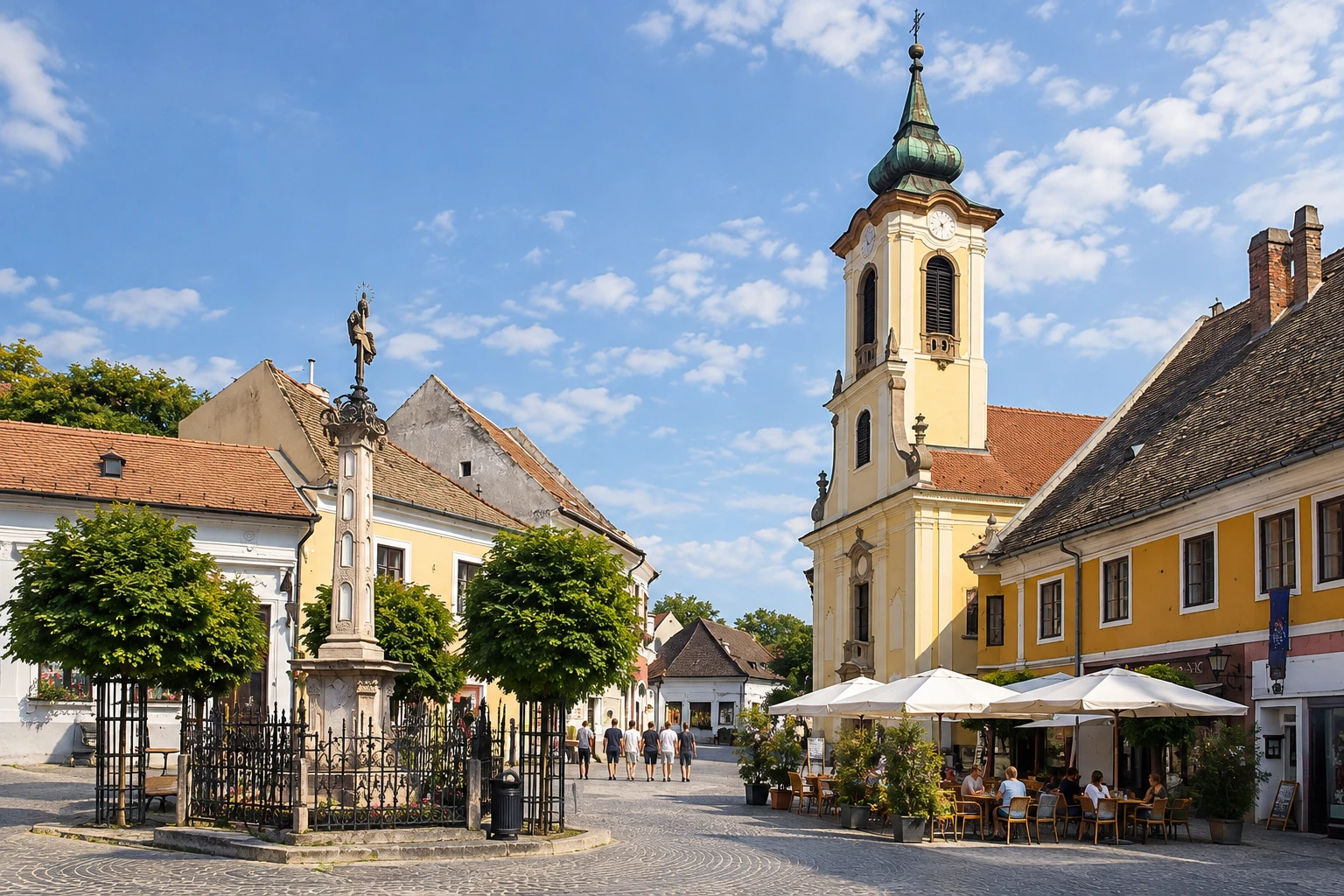
Szentendre’s main square brings together colorful façades, cobbled streets and a walking connection to the Danube’s bank.

 Search
 Brazil
 Antarctica
 Argentina
 Bolivia
 Chile
 Colombia
 Ecuador
 Falkland Islands (Malvinas)
 French Guiana
 Guyana
 Paraguay
 Peru
 Suriname
 Uruguay
 Venezuela
 Austria
 Belgium
 Croatia
 Denmark
 Finland
 France
 Germany
 GreeceHungary
 Iceland
 Ireland
 Italy
 Luxembourg
 Norway
 Poland
 Portugal
 Slovakia
 Slovenia
 Spain
 Sweden
 Switzerland
 the Czech Republic
 the Netherlands
 the United Kingdom
 Turkey
 Bermuda
 Canada
 Greenland
 Mexico
 Saint Pierre and Miquelon
 the United States
 the Dominican Republic
 JapanTurkey
 Egypt
 South Africa
 Australia
 Fiji
 New Zealand
 Papua New Guinea
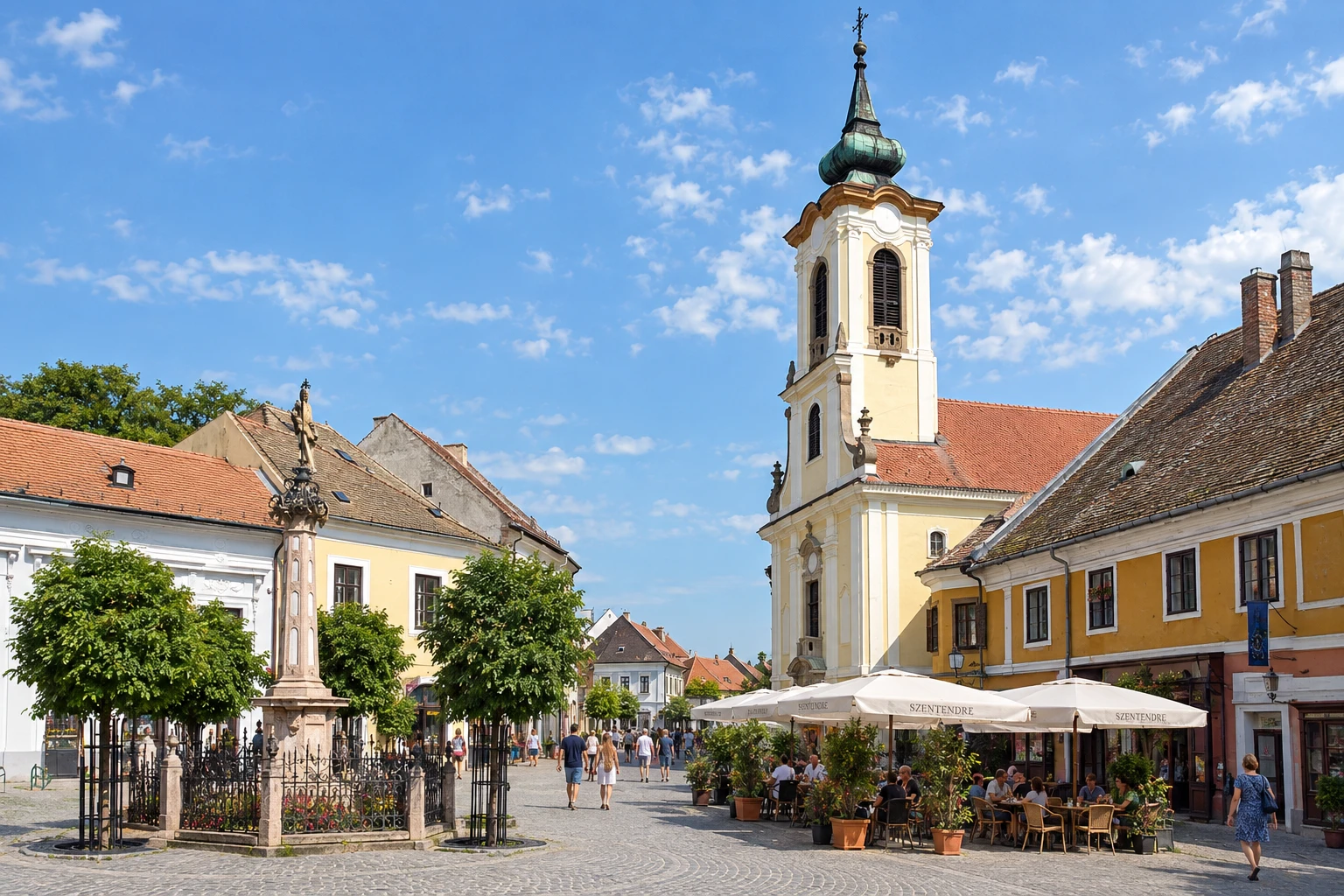
In the photo: Fő tér
Illustrative images. The pictures in this guide are illustrations based on the real place, not photographs, and may differ from it.

The city
Szentendre has cobbled streets and colorful façades around the Fő tér, near the Danube. The town center is explored on foot. Outside it, the Skanzen displays rural buildings and ways of life from several Hungarian regions; visiting the museum requires a separate transfer.
Szentendre is a small town on the Danube north of Budapest, at the entrance to the Danube Bend. The suburban train from the capital ends here, making it a natural first stop for visitors to the region. A few minutes on foot will take you through a center of narrow cobbled streets, stepped alleys, low houses tucked side by side, and Baroque church towers.
The town owes much of its appearance to the late 17th century. In 1690, after the Ottomans left, Serbs, Dalmatians, and Greeks arrived under the leadership of Patriarch Arsenije III. They made their living from wine, crafts, and trade. Their first churches were wooden, followed by the stone churches that still stand today, almost all of them Orthodox. The triangular main square, Fő tér, marks the meeting of the old roads from Buda, Visegrád, and the Pilis Hills. The Merchants' Cross stands at its center.
The town's history goes back further than its Baroque street plan. The Romans maintained the fort of Ulcisia Castra here as part of their defensive line along the Danube, and the name Szentendre appears in writing in 1009. In the 19th century, floods, fires, and the phylloxera outbreak that destroyed the vineyards brought growth to a halt. Little industry followed, and the town center survived much as it was.
It was this townscape that drew painters here. An artists' colony was founded in 1926, and Szentendre has been known as a town of artists ever since. There are museums devoted to ceramicist Margit Kovács and the painters Czóbel and Ferenczy, galleries in old houses, and a contemporary art space in a 19th-century sawmill. Smaller museums explore marzipan, miniatures viewed through a microscope, and Hungarian wine.
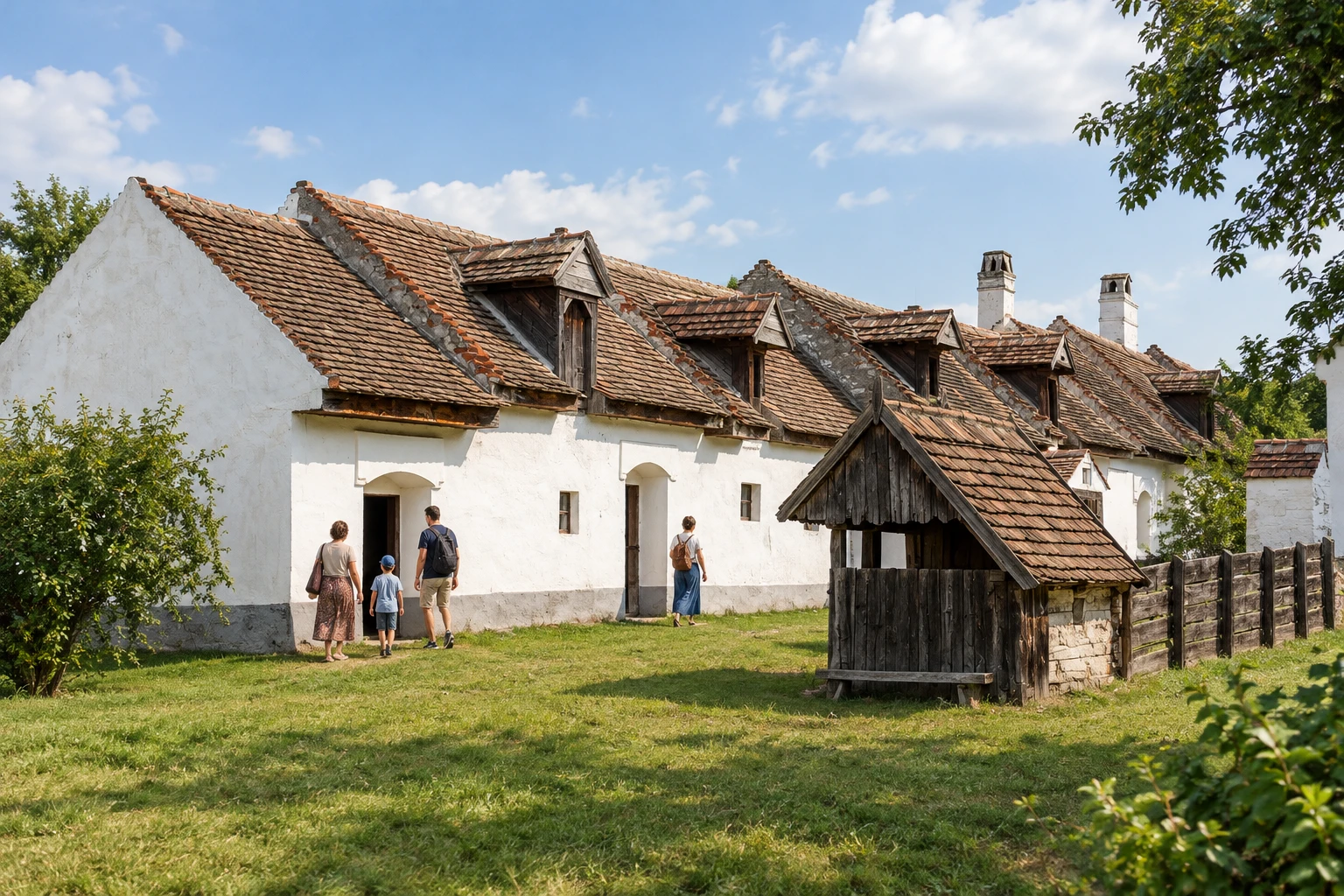
Outside the center is the Skanzen, the open-air ethnographic museum. Houses, mills, and workshops from around the country occupy nearly 80 hectares, which you can also explore aboard a train from the 1930s. Allow half a day to a full day and arrange transportation from the center. The museum opens seasonally from March to November.
The climate is much like Budapest's. From December through February, highs hover around 5°C and lows around 0°C. Days are short, the Skanzen closes, and some churches close to visitors. April through June and September and October are the best times for walking, with highs between 17°C and 27°C. July and August are hot, with rain showers, boats arriving from Budapest, summer festivals, and busier streets.
With a few hours, visit Fő tér, climb Church Hill, see the Serbian cathedral, and walk along the river. With a full day, add the Skanzen or two art museums. Visegrád and Esztergom, the other Danube Bend towns, are farther upstream and have their own guide pages.
19 places to stay in Szentendre.
17 places to eat in Szentendre.
Hotéis e restaurantes da cidade no mapa.
The local experience
Szentendre’s main square brings together colorful façades, cobbled streets and a walking connection to the Danube’s bank.
Houses, workshops and rural buildings from different Hungarian regions, arranged in an open‑air museum outside Szentendre’s center.
To choose before you go
Where each tour starts, how long it takes, how it is done, what is included and the price range.
Fő tér has been the center of Szentendre since the Middle Ages. The roads from Buda, Visegrád, and the Pilis Hills met here, giving the square its triangular shape. In the middle, surrounded by a wrought-iron fence, stands the Merchants' Cross. The Serbian merchants' association put it up in 1763 in thanks after a plague epidemic spared the town. It is Szentendre's best-known symbol. Each house on the square has its own story. No. 18, built as an inn around 1770, is one of the town's best-preserved Rococo buildings. The Szentendre Gallery hosts temporary exhibitions one floor above street level in the former Trading House, and the basement holds a local history exhibition. Beside the square is Blagovestenska, the Church of the Annunciation, known locally as the Greek church. Designed by András Mayerhoffer and built in 1752, it replaced a wooden church. Its Baroque facade has a single tower, a carved stone portal, and oak doors. Above the side entrance is a fresco of St. Constantine and St. Helena. The Rococo iconostasis inside dates to the early 19th century. The cobbled streets branching off the square make a pleasant walk. Narrow alleys and steps climb toward Church Hill past old gateways and a mix of one- and two-story houses. The shopping streets are lined with craft shops, ceramics stores, and galleries, and the Duna korzó promenade along the Danube is only a few steps away. The town holds a farmers market on Wednesday and Saturday mornings.
Stops: Fő tér, Merchants’ Cross, Blagovestenska Church (Church of the Annunciation), Szentendre Gallery (Trading House), Duna korzó.
Includes: Self-guided outing. Blagovestenska Church and the exhibitions charge separate admission when open.
Tip: Blagovestenska Church usually opens to visitors from April to September. On fine weekends the center fills at midday. Early mornings and late afternoons are quieter.
Best time: April to October. In December, the town center hosts an Advent market.
The Serbs, Dalmatians, and Greeks who arrived in Szentendre in 1690 formed parishes according to where they came from. Each group built its own church, first in wood and then in stone. Several still stand in the center with their sanctuaries facing east in the Orthodox tradition. The most important is Belgrade Cathedral, also known as Saborna, a bishop's seat since it was built. Families who had left Belgrade and its surroundings built the cathedral. Work began in 1762, and the church was consecrated to the Virgin Mary in 1764. Local metalworker Márton Ginesser made the wrought-iron garden gates in 1771 and 1772. Inside, a large iconostasis fills the entire archway, with icons painted by Vasa Ostojić. The same garden holds the bishop's palace and the Serbian Ecclesiastical Art Collection. It brings together icons, precious metalwork, and liturgical objects from the 16th through the 19th century, drawn from the treasury of the Serbian Orthodox Diocese of Buda and Serbian churches throughout Hungary. You can trace the transition from late Byzantine art to 18th-century icons influenced by Western Baroque art. The collection also includes 16th-century Ottoman documents and early printed books in Slavonic. Near Bükkös Creek stands Požarevačka Church, built in 1759–1763 by refugees from the Serbian town of Požarevac and dedicated to St. Michael the Archangel. Its Byzantine iconostasis dates to 1742 and is older than the building. The church does not open for regular visits. In the northern part of the center, once home to tanners and winegrowers, Preobraženska Church, dedicated to the Transfiguration, opens to the public once a year for the Serbian feast on August 19. In the morning, the image of the Black Madonna is carried into the courtyard. Tambura music and dancing follow in the afternoon.
Stops: Belgrade Cathedral (Saborna), Serbian Ecclesiastical Art Collection, Požarevačka Church, Preobraženska Church.
Includes: Self-guided outing. The cathedral and the ecclesiastical art collection charge separate admission. Check current prices.
Tip: The cathedral usually closes to visitors in winter, and the other churches can be seen only from outside for much of the year. The tourist office offers themed walks that enter some churches. Check ahead.
Best time: April to October. The Serbian festival at Preobraženska Church is on August 19.
From Fő tér, stepped alleys lead up to Church Hill in just a few minutes. It's the high point of the old town, with views over its rooftops and towers. At the top stands the Catholic parish church, Szentendre's oldest monument. Its history goes back to the 13th century. Records say it was destroyed in 1294 and rebuilt in the Gothic style a few years later. It again fell into near ruin during the Ottoman period. In the early 18th century, the Zichy family helped rebuild it for the town's Dalmatian Catholics, giving it the Baroque form you see today. Look for two details in particular. On the corner of a buttress is a sundial carved from a single stone in the 14th century, a rare survivor from Hungary's astronomical history. Inside the sanctuary, members of the Szentendre artists' colony painted frescoes between 1933 and 1938, setting biblical scenes against landscapes from their own town. The Czóbel Museum is on the same hill. Béla Czóbel, often called the most French of Hungarian painters, divided his life between Paris and Szentendre. He was an honorary citizen of the town and the first artist in Hungary to have a museum dedicated to him during his lifetime. The exhibition traces his career in chronological order.
Stops: Church Hill (Templomdomb), Catholic parish church, Czóbel Museum.
Includes: The climb and the square are free. Czóbel Museum charges separate admission. Check current prices.
Tip: The church opens year-round, except for sightseeing during Mass. The stone steps become slippery in rain.
Best time: Year-round. Late afternoon light falls on the rooftops in the center.
Szentendre's reputation as a town of artists began when painters discovered the small houses and colors of its historic center. The artists' colony was founded in 1926 and also welcomed painters from Nagybánya, the colony that ended up outside Hungary when the borders changed after World War I. From the 1960s onward, about a dozen small museums opened in Szentendre, each devoted to an artist with ties to the town. The most visited is the Margit Kovács Ceramic Museum, which opened in 1973. It holds more than 300 pieces donated by the artist, most of them human figures or compositions featuring people. Kovács lived from 1902 to 1977 and is credited with revitalizing Hungarian ceramics. One room recreates her home, complete with her potter's wheel. The last room has touchable copies of her best-known works designed for visitors who are blind or have low vision. The Ferenczy Museum takes its name from the painter Károly Ferenczy and occupies the 18th-century Pajor Mansion on Kossuth Lajos Street. It began as a local history collection and now serves as the hub of a group of town museums. Its holdings include paintings, prints, sculptures, and medals from Szentendre, with galleries for temporary shows featuring artists from town and farther afield. MűvészetMalom, or ArtMill, occupies a former 19th-century sawmill. Painters Dezső Korniss and Pál Deim came up with the idea of turning it into an arts center, and it opened to the public in 1999. Its galleries, each with a different shape and layout, host temporary contemporary art exhibitions. Between museums, you'll find private galleries and ceramics, batik, and design studios in houses around the center.
Stops: Margit Kovács Ceramic Museum, Ferenczy Museum, MűvészetMalom (ArtMill), Szentendre Gallery.
Includes: Museums charge separate admission. Check current prices.
Tip: Museums have different opening days, and temporary exhibitions change throughout the year. Check what's on before visiting. This outing works particularly well on a rainy or cold day.
Best time: Year-round.
The Skanzen lies outside the center on nearly 80 hectares in Duna-Ipoly National Park. Founded in 1967, this open-air museum explores Hungary's rural architecture and everyday life. Houses, mills, workshops, and barns were dismantled in villages and towns across the Hungarian-speaking world and reassembled here with the furnishings and tools of each period. The buildings are grouped by region, each cluster laid out like a settlement. You'll find a market town from the Great Plain, the Little Plain, Southern and Western Transdanubia, the Bakony and Balaton Uplands, the Upper Tisza, a market town from the Uplands, a northern Hungarian village, and Transylvania. Among them are a watermill, a village laundry, a school, an old general store, and a bee farm. Living history programs at several locations demonstrate period crafts and cooking. The grounds cover quite a distance, so the Skanzen has its own train. The museum describes the 2.2-km line as Europe's longest standard-gauge museum railway. A railcar built in the 1930s runs the route, with a driver and conductor in period uniforms. There are six stops, including the entrance station, and you can hop on and off at any of them. All are accessible to wheelchairs and strollers. The museum opens for the season in March. From spring through fall it generally opens Tuesday through Sunday, and the season ends in mid-November with the St. Martin's festival celebrating new wine and goose. It closes in winter except for separately announced events.
Stops: Skanzen (Szabadtéri Néprajzi Múzeum), Skanzen train, Market town on the Great Plain, Western Transdanubia, Balaton Highlands, Upper Tisza, Transylvania, Northern Hungarian village.
Includes: Admission costs extra, and the museum train has its own ticket. Check current prices.
Tip: The local bus leaves from the platform beside the HÉV terminus only a few times daily. Check the return before boarding. Use the museum train to reach the farthest area and walk back. Bring water and comfortable shoes for the extensive grounds.
Best time: April to October. The museum closes for winter from mid-November to March.
Alongside its art museums, Szentendre has several small and unusual collections that make good stops along a walk, especially with children or on a rainy day. The Marzipan Museum is on the main shopping street. It's small enough to see in a few minutes. Bears, storybook characters, kings, queens, artists, and even musical instruments are all modeled in marzipan, a paste made from almonds and sugar. The Micro Art Museum showcases the work of Mykola Syadrysty, who worked with surgical precision on grains of rice, half a poppy seed, the head of a pin, or the eye of a needle. Each of the 15 pieces sits under a glass cover and can only be seen through a microscope. Look for a tiny book and a gold flea wearing horseshoes. The artist has three permanent museums worldwide, and this is one of them. The National Wine Museum opened in 1993 in a network of old cellars covering nearly 650 square meters, where the temperature varies little throughout the year. The museum explores Hungarian wine culture and has a tasting corridor and a shop. Wine has deep roots here. It sustained the Serbian settlers' prosperity until phylloxera destroyed the vineyards in 1880. The Urban Public Transport Museum traces the history of transit in Budapest and other cities through documents, old tickets, and dozens of restored trams, buses, and other vehicles. You can step aboard some of them.
Stops: Szabó-Szamos Marzipan Museum, Micro Art Museum, National Wine Museum, Urban Public Transport Museum.
Includes: Each museum charges its own admission. Check current prices. Wine tasting costs extra.
Tip: Check each museum's opening days and season, especially the transportation museum's. If you'll be driving afterward, visit the cellar and skip the tasting.
Best time: Year-round for the downtown museums.
Day by day
Suggestions to plan the trip. Change the order of the days according to the weather and tour availability.
Arrive early by suburban train and walk about 1 km from the station to the center. Start at Fő tér with the Merchants' Cross and Blagovestenska Church, then climb the steps to Church Hill for the rooftop views and the parish church's medieval sundial. Head down to Belgrade Cathedral and visit the Serbian Ecclesiastical Art Collection in the same garden. Have lunch in the center. In the afternoon, choose one longer outing. In season, if the weather is clear, take the local bus to the Skanzen and use its train to see two or three groups of buildings. Check bus times for the ride back to the center. If it's raining or you're visiting in winter, try the Margit Kovács Ceramic Museum and the Ferenczy Museum, then round out the day at the Marzipan Museum or the Micro Art Museum. Before leaving, stroll along the Duna korzó beside the Danube.
Spend the morning in the center. Start at Fő tér and Blagovestenska Church, then take the alleys up Church Hill to the medieval parish church and the Czóbel Museum. Continue to Belgrade Cathedral and its collection of Orthodox art. After lunch, visit the Margit Kovács Ceramic Museum and, depending on what's showing, either the Ferenczy Museum or MűvészetMalom. Save the late afternoon for galleries, craft shops, and the riverfront promenade. In the evening, once the day-trippers have gone, the center grows quiet. It's a good time to see the empty square and linger over dinner.
During the March-to-November season, spend the day at the Skanzen. Take the first morning bus from the terminal beside the HÉV station or go by taxi. Start at the Great Plain market town near the entrance, ride the train to the farthest stop, and work your way back on foot through the Transylvania, Upper Tisza, and Balaton Uplands sections. Stop at the watermill and catch the living history demonstrations along the way. In winter, when the museum closes, spend the morning at the small museums in the center, including the National Wine Museum, then continue to Visegrád in the afternoon or return to Budapest. If you're traveling farther along the Danube Bend, regional buses serve the town. Visegrád and Esztergom have their own guide pages.
Best time to go
The seasons shown are the most usual ones; nature doesn't always follow the calendar.
Skanzen closes for winter.
This is the coldest month, with highs near 5°C and lows around -1°C according to records from Budapest, the nearest weather station. Days are short, and snow is possible. The town center is quiet. The art museums and smaller collections make good stops, and some churches close to visitors.
Skanzen closes for winter.
It stays cold, with highs near 7 °C, lows around 0 °C and little rain or snow. The days begin to lengthen. It’s a good month for museums without lines and quiet streets downtown. Bring a heavy coat for the windy riverbank.
The Skanzen’s early season starts in March.
Spring begins, with highs around 12 °C and lows near 4 °C. The Skanzen reopens with a reduced program at first. Check the dates. You still need a coat in the mornings, and downtown streets remain quiet.
Main season at the Skanzen. Blagovestenska Church usually opens to visitors in April.
Highs near 19 °C and lows around 9 °C, with little rain. The main season begins at the Skanzen, which usually has special Easter events. This is one of the best months to visit both downtown and the open-air museum in a day.
Days range from mild to warm, with highs around 23°C and lows near 13°C. This is one of the rainiest months, usually with showers in the late afternoon. Flowers fill the center, and café terraces open. Long weekends bring crowds from Budapest.
The sightseeing boat from Budapest starts running in late June.
Summer brings highs near 27 °C, lows around 16 °C and the longest days of the year. Some afternoons bring thunderstorms. Start early at the Skanzen to beat the heat. The boat from Budapest becomes an option for either leg of the trip.
Sightseeing boats from Budapest are running.
A hot month with highs around 29 °C, lows near 18 °C and brief showers. Downtown fills up at midday. Visit churches and museums during the strongest sunshine and save the riverbank and Church Hill for late afternoon.
August 19: Serbian feast at Preobraženska Church. Late August: Szentendre Éjjel-Nappal Nyitva festival.
The heat continues, with highs near 29°C. During the Serbian feast, Preobraženska Church opens to visitors for its only day of the year. At the end of the month, the Szentendre Éjjel-Nappal Nyitva festival (Szentendre Open Day and Night) fills the streets, courtyards, and galleries with concerts, exhibitions, and extended opening hours. The boat from Budapest usually runs through the end of August.
Last month to visit Blagovestenska Church this season.
The heat eases, with highs around 23 °C, lows near 13 °C and less rain than in summer. This is one of the best months for walks downtown and a day at the Skanzen, with fewer visitors than in July and August.
Fall hours at Skanzen.
Fall brings highs near 17°C and lows around 9°C. The surrounding hills turn color and the days shorten quickly. Skanzen switches to fall hours, so check ahead. Bring a warm layer for late afternoon.
St. Martin's feast at Skanzen marks the end of its season in mid-November.
The colder weather settles in, with highs around 11°C, lows near 4°C, and frequent overcast skies. The Skanzen ends its season with the St. Martin's festival celebrating new wine and goose, then closes from mid-month. In the center, daily life returns to its local rhythm.
Advent market downtown. Skanzen closes for winter.
It's cold, with highs near 5°C, lows around 0°C, and the shortest days of the year. The Advent market brings craftspeople into the streets of the center, and the art museums stay open. The Serbian cathedral usually closes to visitors in winter, so check before you go.
Plan the journey
The easiest way to reach Szentendre is on the H5 line of Budapest's HÉV suburban rail network. It leaves from Batthyány Square in Buda, where you can connect from metro line M2, and terminates in Szentendre. The trip takes about 40 minutes, with trains throughout the day.
Szentendre station is the end of the line, about a 1-km walk from the old town. The local and regional bus terminal and a taxi stand are beside the station.
The last stretch of track is outside Budapest's city limits. Check the capital's transit app or ask at the ticket window which ticket covers the whole journey, especially if you're using a city transit pass.
Regional buses to Szentendre leave Budapest from the Újpest-Városkapu terminal on metro line M3 in Pest. The trip takes 30 to 35 minutes and ends at the terminal beside Szentendre's HÉV station.
Regional buses also link Szentendre to other towns on the Danube Bend, including Visegrád. They're a convenient way to continue your trip without returning to the capital. Check departure times in advance.
From Budapest, take Route 11 along the west bank of the Danube. The drive takes 40 minutes to an hour, depending on traffic. The same road continues to Visegrád and Esztergom. For the Skanzen, follow the signs from Route 11 once you're in Szentendre.
The narrow streets of the old town are difficult to navigate by car. The municipality runs paid parking in town, so most visitors park and continue on foot. The Skanzen has its own parking lot.
In summer, a sightseeing boat links Budapest and Szentendre. It leaves the landing at Vigadó Square in Pest in the morning, travels upstream along the branch of the Danube that passes through Szentendre, and returns in the afternoon, giving you a few hours ashore. The main season runs from late June through late August, when some boats continue to Visegrád.
The boat takes longer than the train, and the scenery is part of the appeal. A popular option is to go by boat and return by HÉV train, or the other way around. Check the season's timetable and operating days before planning your trip.
A local ferry also links Szentendre with Szigetmonostor on the island across from town.
Szentendre has no airport. The nearest is Budapest Ferenc Liszt International Airport (BUD), on the far side of the capital. From the airport, bus 100E takes about 40 minutes to reach central Budapest. From there, take metro line M2 to Batthyány Square for the suburban train to Szentendre.
If you're flying from Brazil, the journey to Budapest usually involves a connection in another European city. Check the route before booking.
Explore the old town on foot. From Fő tér, Church Hill, the Serbian cathedral, and the river are all just a few minutes away, over uneven stone paving and some stairs.
You'll need transportation to reach the Skanzen outside the center. A local bus leaves from the terminal beside the HÉV station a few times a day, with longer gaps on weekends. Buy your ticket from a machine or the ticket window at the terminal. A taxi stand at the same location gives you more flexibility for the trip in either direction.
Your questions
The suburban HÉV train terminates in Szentendre and allows you to continue on foot to the center.
The distance requires planning; a local bus or taxi leaves more time for the open‑air collection.
It is the name of the main square, surrounded by colorful façades and cobbled streets.
With the museum and transfers, it is better to choose one town or limit the itinerary to external pass‑bys.
The H5 HÉV suburban train takes about 40 minutes from Batthyány Square in Buda to the end of the line in Szentendre. Regional buses from Újpest-Városkapu take 30 to 35 minutes. Driving on Route 11 takes 40 minutes to an hour, depending on traffic.
Yes, if you want to see the old town without the day-trippers who arrive in midmorning and return to Budapest in the afternoon, or if you plan to spend a full day at the Skanzen. Szentendre also makes a first base for continuing to Visegrád and Esztergom without returning to the capital. For the town center alone, a day trip from Budapest is enough.
April through June and September and October offer mild temperatures and an open Skanzen. July and August are hot and busy, with the boat from Budapest and festivals in August. December through February is cold. The open-air museum closes and some churches stop receiving visitors, but the center is quiet and December brings an Advent market.
No. The museum opens seasonally in March. Its main season runs from spring through fall, usually Tuesday through Sunday, and ends in mid-November with the St. Martin’s Day festival. It closes in winter except for separately announced events. Dates change each year, so check ahead.
Allow four to six hours to explore several sections at leisure. The grounds cover almost 80 hectares, and buildings are grouped by region some distance apart. The museum train has six stops and helps you get around. In two or three hours, you can see two sections near the entrance and take a train ride.
In 1690, after the Ottomans left, Serbs, Dalmatians and Greeks settled here under Patriarch Arsenije III. Each group, from a different place, established its own parish and church, first in wood and then in stone in the 18th century. Belgrade Cathedral and the Blagovestenska, Požarevačka and Preobraženska churches date to this period. Most Serbs eventually left town, but the churches remain.
Some of them. Belgrade Cathedral charges admission and opens for much of the year, closing in winter. Blagovestenska Church on Fő tér usually opens April through September. The Catholic church on Church Hill opens year-round outside Mass times. Požarevačka can be visited only on themed walks, and Preobraženska opens once a year on August 19. Check before visiting.
Spend the day in the museums. The Margit Kovács Ceramic Museum is the most visited. Ferenczy Museum, Czóbel Museum and MűvészetMalom exhibit artists connected to the town. The Serbian Ecclesiastical Art Collection holds icons from the 16th through 19th centuries. Smaller options include the Marzipan Museum, the Micro Art Museum and the National Wine Museum in old wine cellars. Save the mostly outdoor Skanzen for a dry day.
Yes. The Skanzen has a 1930s train, houses you can enter and living history programs. Downtown, the Marzipan Museum has figures made of candy, and the Micro Art Museum has works viewed through microscopes. Both make short visits that often hold children’s attention. At the Urban Public Transport Museum you can step aboard some old trams. Cobblestones and stairs can make strollers tricky in places.
Yes, in summer. A sightseeing boat leaves the pier at Vigadó Square in Pest in the morning and returns in the afternoon, leaving you a few hours to explore Szentendre. Service is concentrated between late June and late August. Many visitors take the boat one way and return by suburban train. Check the year’s schedule before planning.
The HÉV station at the end of line H5 and the bus terminal are side by side, about a 1 km walk from the old town. The local bus to the Skanzen outside downtown leaves from the same terminal, where there’s also a taxi stand.
Yes. For about 400 years beginning in the first century, the Romans maintained Ulcisia Castra here, a fort on the Danube frontier of Pannonia. A lapidarium between downtown and Route 11 displays carved stones from that period. For more extensive ruins, visit the Aquincum archaeological park in Budapest on the same suburban rail line.
Take a regional bus from the terminal beside the HÉV station. Route 11 follows the Danube, and in summer boats also travel upriver to Visegrád. The suburban railway ends in Szentendre. Both towns have their own guide pages with detailed directions.
Routes in Hungary
From Budapest to Visegrád by boat, along the branch of the Danube that runs past Szentendre and the wooded shores of Szentendre Island.