Sopron · Hungary · Tower
Firewatch Tower
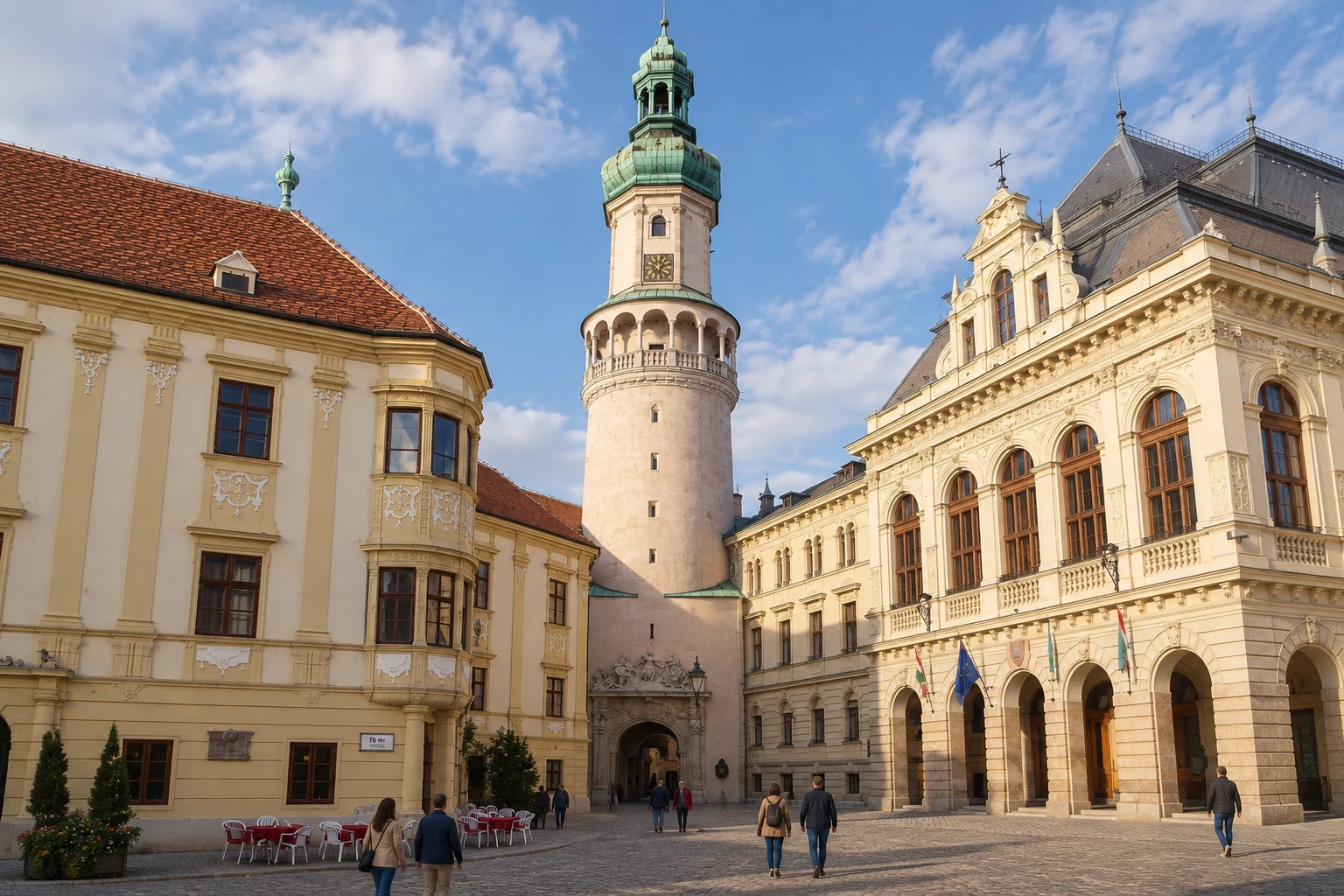
Watchtower next to Sopron’s main square, with a viewpoint over the historic center.

 Search
 Brazil
 Antarctica
 Argentina
 Bolivia
 Chile
 Colombia
 Ecuador
 Falkland Islands (Malvinas)
 French Guiana
 Guyana
 Paraguay
 Peru
 Suriname
 Uruguay
 Venezuela
 Austria
 Belgium
 Croatia
 Denmark
 Finland
 France
 Germany
 GreeceHungary
 Iceland
 Ireland
 Italy
 Luxembourg
 Norway
 Poland
 Portugal
 Slovakia
 Slovenia
 Spain
 Sweden
 Switzerland
 the Czech Republic
 the Netherlands
 the United Kingdom
 Turkey
 Bermuda
 Canada
 Greenland
 Mexico
 Saint Pierre and Miquelon
 the United States
 the Dominican Republic
 JapanTurkey
 Egypt
 South Africa
 Australia
 Fiji
 New Zealand
 Papua New Guinea
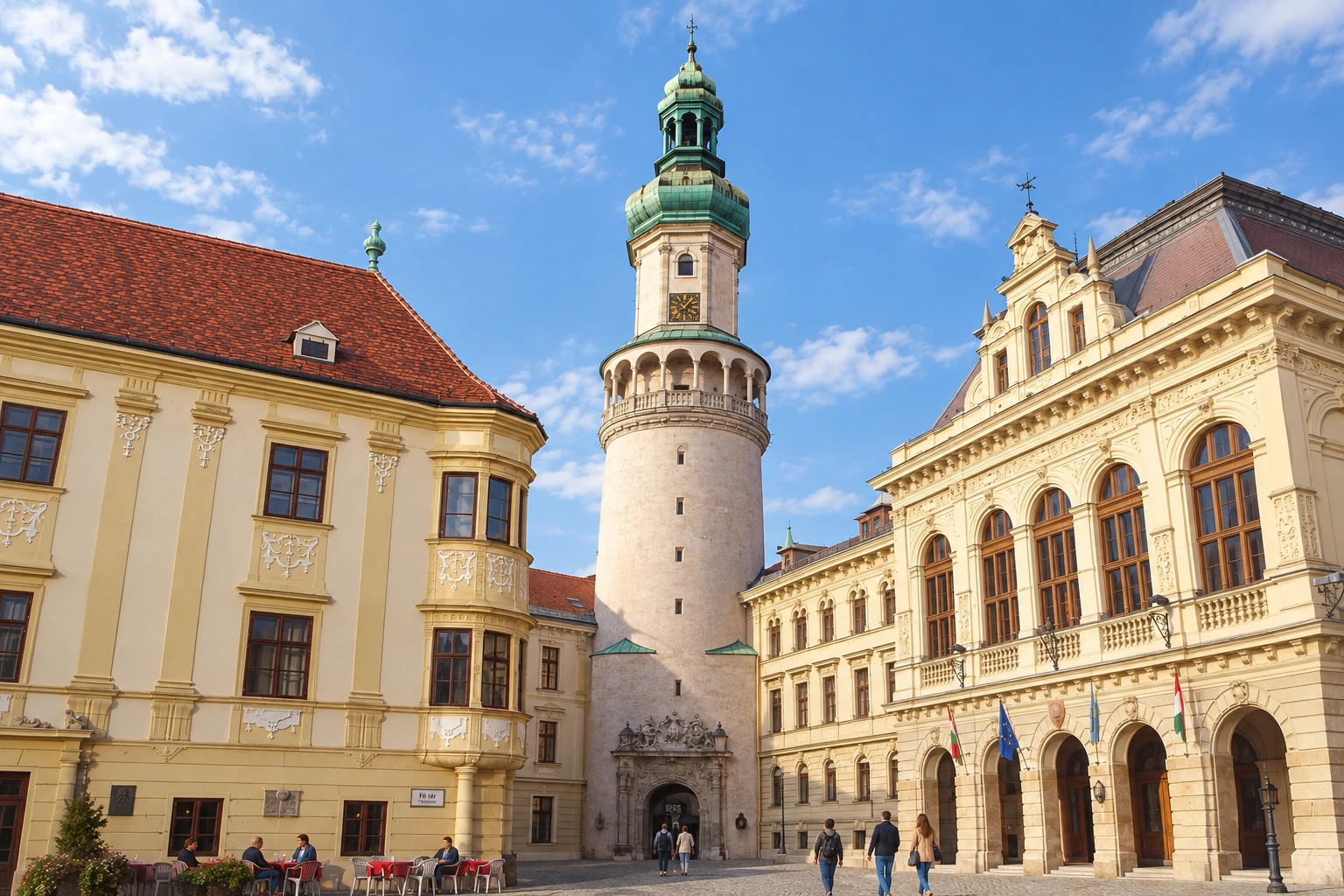
In the photo: Tűztorony
Illustrative images. The pictures in this guide are illustrations based on the real place, not photographs, and may differ from it.

The city
Sopron brings together historic streets around the Tűztorony (Torre do Fogo) and Casa Storno. The town is a base for the Fertőrákos quarry and the wetland landscape of Fertő-Hanság National Park. The urban center and excursions into the surroundings require separate days.
Sopron lies in far western Hungary at the foot of the Alps, on a finger of land surrounded by Austria, about 60 kilometers from Vienna and 220 kilometers from Budapest. This medium-sized city has just over 60,000 residents and preserves more monuments than any other city in Hungary outside the capital. The old center fits inside the outline of a wall dating back to Roman times, when the town was called Scarbantia, and you can explore it all on foot.
Start on Fő tér, the main square, with the Fire Tower (Tűztorony), Storno House, the Holy Trinity Column and the Benedictine church known as the Goat Church. Narrow streets lead into the medieval center, including Templom utca, Új utca and Szent György utca, with museums, churches and the medieval synagogue. Around it, Várkerület follows the curve of the old moat, lined with shops and cafés.
Sopron calls itself the “most loyal city.” In a December 1921 plebiscite the city and eight neighboring villages voted to remain in Hungary. The Gate of Loyalty at the tower’s base commemorates the vote. More recent history is remembered nearby at the site of the Pan-European Picnic of August 19, 1989, when hundreds of East Germans crossed the border into Austria.
Beyond the center the city changes character. Near the former Vienna Gate is the quarter of the poncichter, German-speaking winegrowers who planted beans between their vines and kept wine in cellars under their houses. The region’s grape is the red kékfrankos. To the southwest rise the Lővérek, slopes dotted with summer homes, chestnut trees and lookout towers leading into the Sopron hill forests. Sopronbánfalva, with its Pauline-Carmelite monastery, former mining village Brennbergbánya and Balf, a medicinal spa facing Lake Fertő, are former villages now within the municipality.
The climate is cooler and wetter than in most of Hungary. In July, the warmest month, highs are around 25–26°C. In January, the coldest, nights usually fall below freezing. Rain is spread throughout the year, and locals joke that in Sopron it is either raining, windy or the bells are ringing. April through June and September and October are usually mild for walking. In winter, museums and cellars fill the short days.
Fertőrákos quarry is 10 kilometers away in the neighboring village. Esterházy Palace in Fertőd and Széchenyi Palace in Nagycenk are outings for another day by bus or car.
30 places to stay in Sopron.
30 places to eat in Sopron.
1 lugar no mapa: onde ficar e onde comer, por bairro.
The local experience
Watchtower next to Sopron’s main square, with a viewpoint over the historic center.
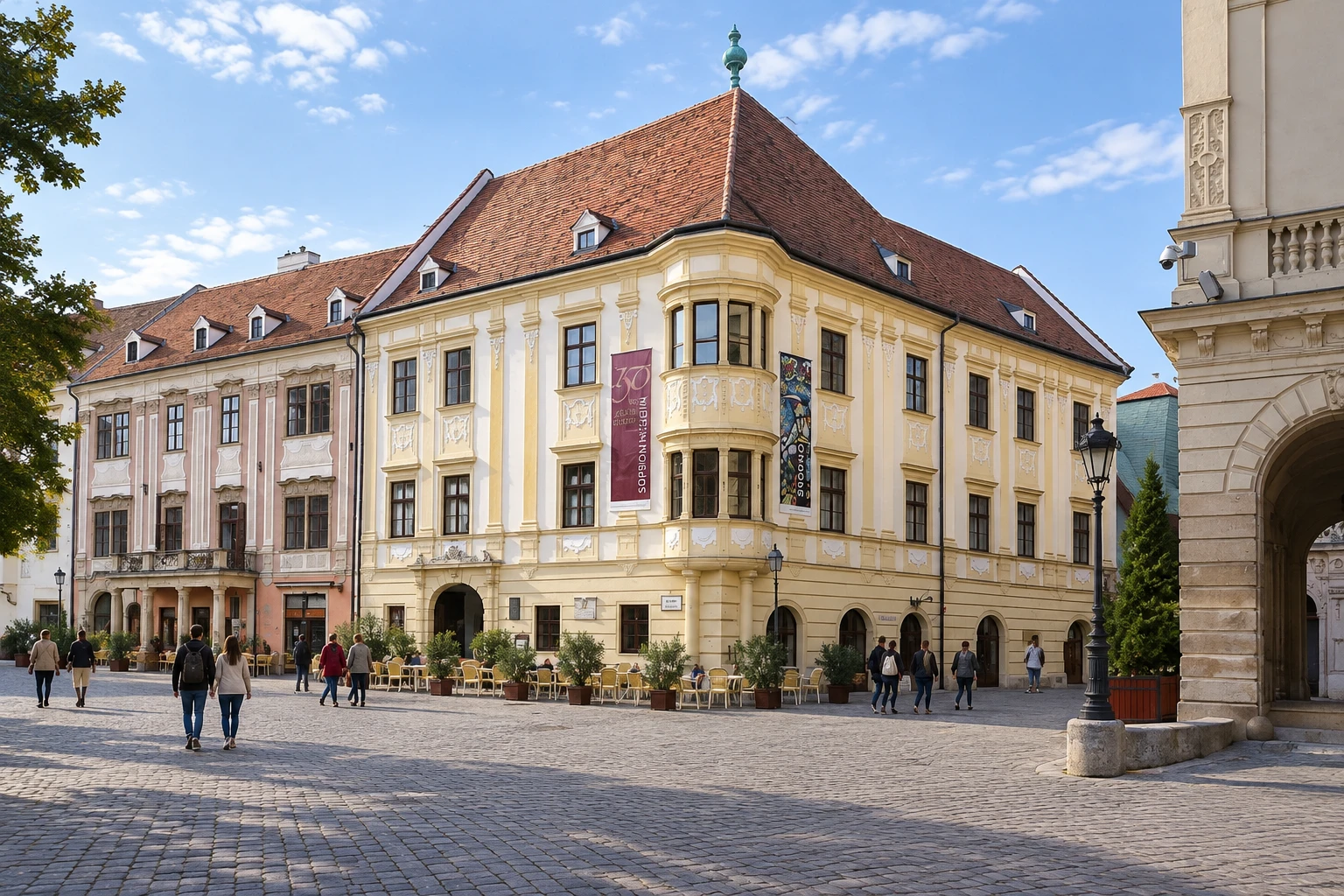
Historic house with a baroque facade on the main square, associated with the collector family Storno and Sopron’s museum complex.
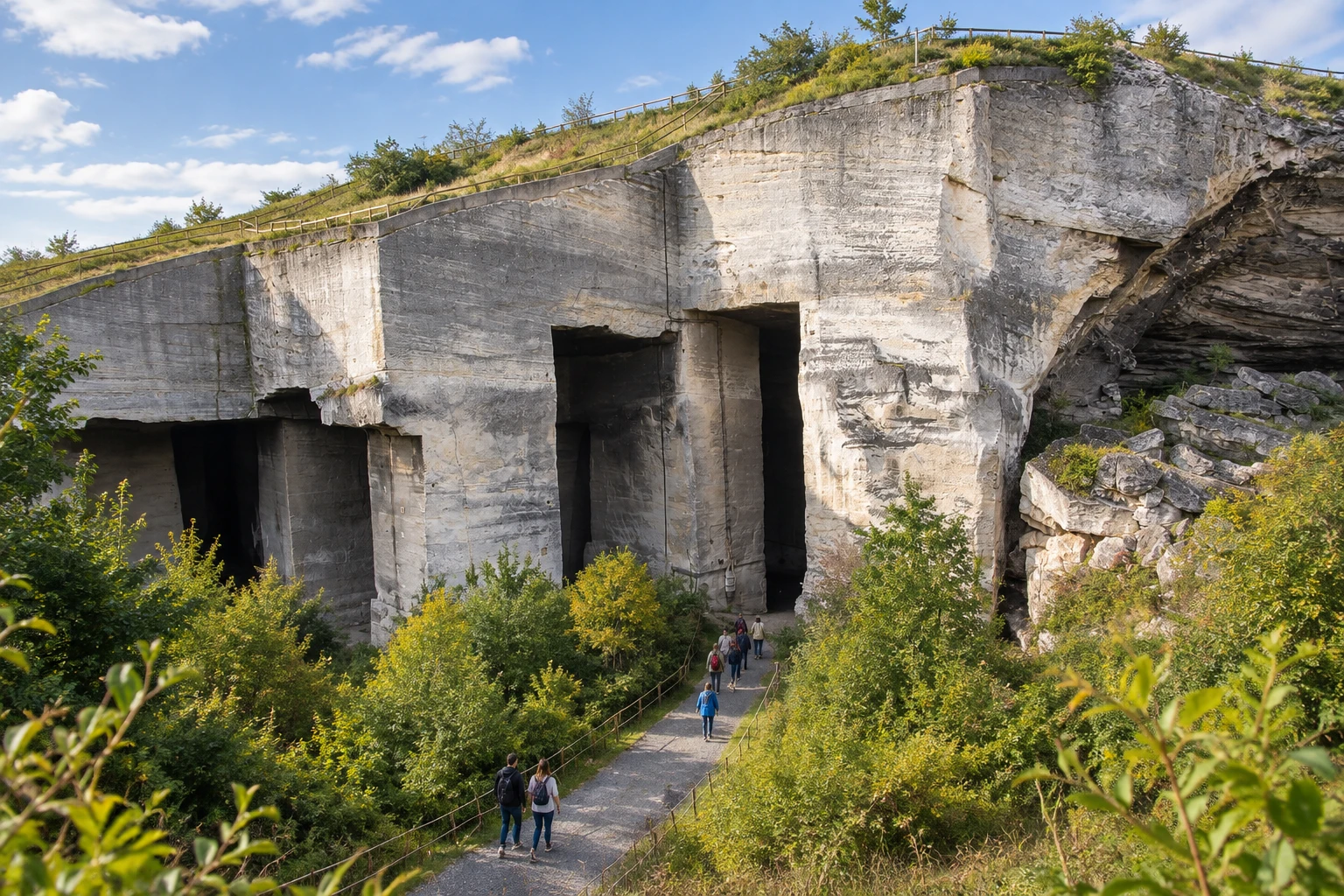
Former limestone quarry with large stone pillars, a themed route and a theatre space.
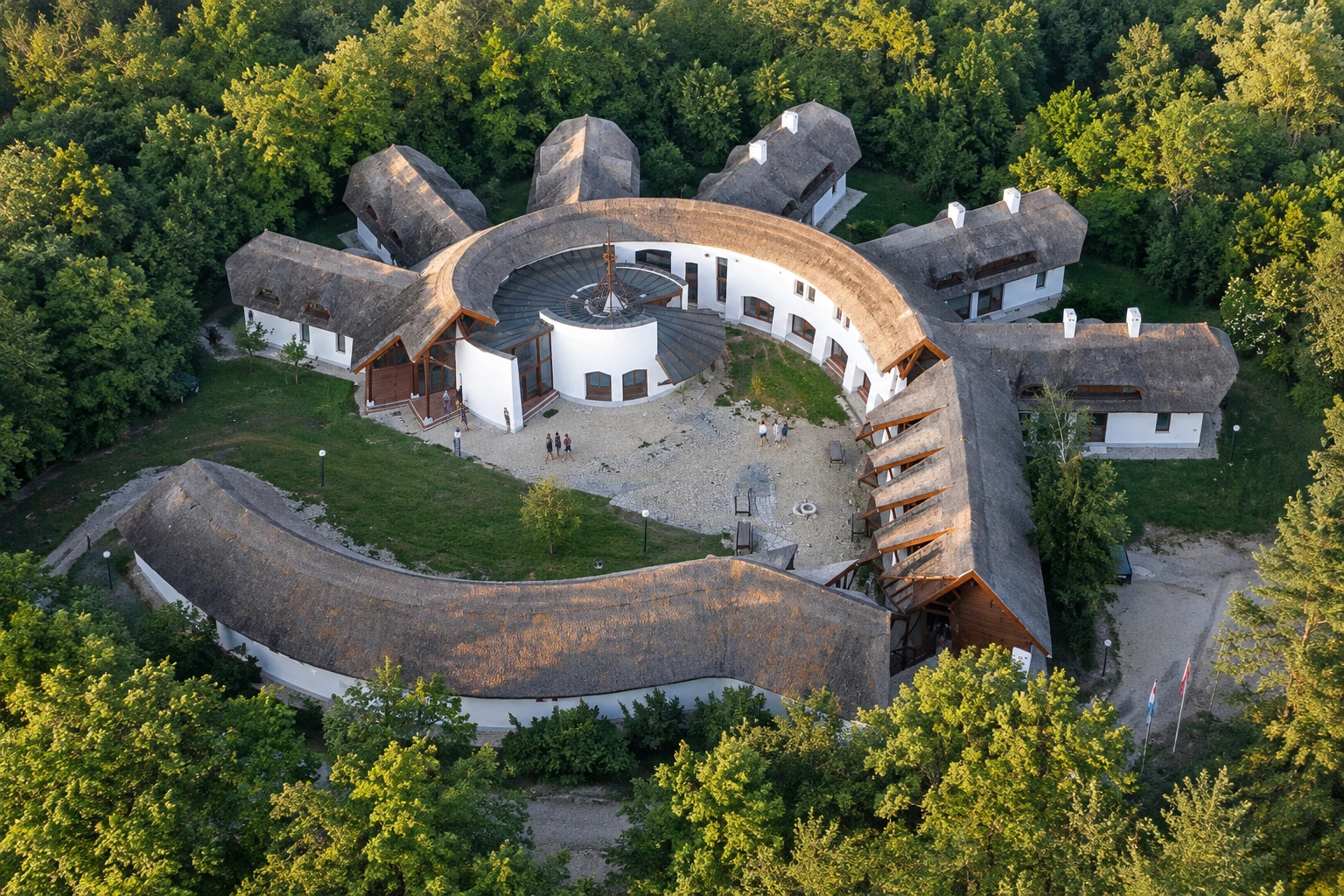
Reedbed landscape, wetlands and fields around Lake Fertő, with observation programs and authorized paths.
To choose before you go
Where each tour starts, how long it takes, how it is done, what is included and the price range.
Fő tér brings Sopron’s best-known sights together within a few steps. The Fire Tower (Tűztorony) is the city’s symbol. Its base is Roman, cylindrical shaft medieval, circular balcony Renaissance and onion dome Baroque, reaching 58 meters with a double-headed eagle on top. The balcony and dome were rebuilt after the fire of 1676. Nearly 200 spiral steps lead to the balcony for views over the rooftops and Lővérek slopes. On clear days the Alpine peaks of Rax and Schneeberg appear. The tower guards watched for fires, announced approaching troops and carts carrying outside wine, and played music at city celebrations. At the base is the Gate of Loyalty, built in 1928 with a sculptural group by Zsigmond Kisfaludi Strobl. It recalls the December 14, 1921 plebiscite in which Sopron and eight villages voted to remain in Hungary. Opposite stands the Baroque Storno House, which took its present shape in the 18th century. King Matthias stayed here during the siege of Vienna, and Franz Liszt was also a guest. Its name comes from the Storno family of restorers and collectors. Storno House, the General’s House, Fabricius House and the tower form the Museum Quarter, the Sopron Museum complex on the square, with exhibitions spanning prehistory to the present. In the middle of the square stands the Holy Trinity Column of 1701, erected in fulfillment of a vow after plague epidemics. It is the oldest of its kind in Hungary. By the exit to Templom utca stands the Gothic Benedictine church, begun by Franciscans in the 1260s. Its nickname, the Goat Church, comes from the Geissel family, who paid for the tower and whose coat of arms appears on it. Between the 16th and 17th centuries it hosted five sessions of the Hungarian parliament and three coronations.
Stops: Tűztorony (Fire Tower), Gate of Loyalty, Storno-ház, Museum Quarter (Múzeumnegyed), Holy Trinity Column, Benedictine Church (Goat Church).
Includes: Self-guided outing. The tower and Museum Quarter exhibitions have separate admission charges, with combined tickets available. Check current prices at the square's ticket office.
Tip: Climb the tower first. From the balcony you can make out the oval shape of the center and locate the Lővérek. The Benedictine church’s chapter house is closed to visitors, and the pharmacy house museum on the same square closes for part of the year. Check what is open on your travel day.
Best time: Year-round. On clear days the view from the tower stretches to the Alps. When it rains, explore the exhibitions.
Three nearly parallel streets lead from Fő tér through the heart of the old center. Walk them as a loop without retracing your steps. Near the start of Templom utca, the Central Mining Museum occupies the Esterházy Palace, a house of medieval origin with a Renaissance courtyard and Baroque facade. It explores Hungary’s mining history with recreated galleries and a children’s play mine with helmets, a slide and a mine cart. The Forestry Museum is next door. Farther on, the Lutheran church of 1784 is Sopron’s largest and Hungary’s third-largest Lutheran church, seating 3,000. It was built without a tower and set back from the street as Protestant churches were then required to be. Its 50.5-meter tower dates to 1867. The congregation, organized in 1565, is Hungary’s oldest. Új utca was the Jewish street in the Middle Ages. The Old Synagogue, built around 1300, sits back from the street and preserves a men’s hall, women’s prayer room and ritual bath. Among Europe’s medieval synagogues this arrangement survives only here, in Prague and in Kraków. Forgotten after the community’s expulsion in 1526, it was rediscovered in 1967. At the corner of Új utca and Szent György utca, below the house containing the tourist office, Forum Scarbantiae displays part of the Roman city’s forum, four and a half meters below today’s streets. On Szent György utca, St. George’s Church from the 1390s hides among the houses. At number 12, Eggenberg House is home to Macskakő, a children’s museum. Orsolya tér, documented in 1428 as the salt market, completes the circuit.
Stops: Central Mining Museum, Forestry Museum, Lutheran Church, Old Synagogue (Ó-zsinagóga), Forum Scarbantiae, St. George’s Church, Macskakő Gyermekmúzeum, Orsolya tér.
Includes: Self-guided visit. Museums charge separate admission. A combined family ticket is sold at the Museum Quarter ticket office. Check current prices.
Tip: Downtown museums usually close on Mondays, and the Old Synagogue closes for part of the year. Check ahead. The Lutheran church hosts choral and classical concerts.
Best time: Year-round. A good outing on rainy or cold days.
Sopron’s wall has followed the same outline for around 1,600 years. Its shape and semicircular bastions date to the Roman city and formed the basis of the 11th-century fortifications and the triple medieval walls built between the late 13th and mid-14th centuries. The Great Bastion, St. George’s, survives from the 17th century. The wall is incorporated into the houses, so the walk runs along its foot. The Várfalsétány promenade follows the former moat, with panels explaining each phase. Outside runs Várkerület, the curving avenue laid out when the moat was filled. The inner row has mansions and narrow houses on former moat plots. The outer row is older, with many houses of medieval origin. The section between Ikvahíd utca and Ógabona tér is Kisvárkerület. Here are Rejpál House and Festőköz, the alley where indigo dyers carried cloth to the dyehouse attic. It crosses the Ikva stream to Rózsa utca. Nearby, Zsolnay majolica covers the Lion Pharmacy facade. Ógabona tér appears in documents from 1400 as a grain market. Continue around the curve to Petőfi tér, laid out over a former lake, with the Art Nouveau Petőfi Theatre and a musical fountain. Adjacent Széchenyi tér is named for Count István Széchenyi, Sopron’s first honorary citizen. It has his statue and the Dominican church, built from 1719 to 1725, the city’s only twin-towered church.
Stops: Várfalsétány (city wall walk), Várkerület, Festőköz, Ógabona tér, Petőfi Square and Petőfi Theater, Széchenyi tér, Dominican Church.
Includes: Self-guided outdoor outing.
Tip: Várkerület is lined with shops and cafés. Save the walk for late afternoon and finish on the benches in Széchenyi tér. In December the Advent market fills the avenue.
Best time: April through October for the outdoor terraces. Come during Advent for the market and lights.
Across the Ikva stream begins the poncichter quarter, around Balfi, Gazda, Szentlélek and Szent Mihály streets. The name comes from the German Bohnenzüchter, or bean grower, because Sopron winegrowers planted beans between the vines. Their cellars are in town under the houses, away from the vineyards, a practice that earned the area its nickname as an eccentric wine region. The main grape is red kékfrankos, covering about 1,000 hectares, two-thirds of the region. The growers’ taverns, or Buschenschank, signal that they are open with a pine branch hung at the door, sometimes with a straw wreath or ribbon indicating what they serve. On Balfi utca, the Zettl-Langer collection occupies the home of a family of liqueur and vinegar makers. It is filled with antiques collected by Gusztáv Zettl in the 19th century and has been a museum since 1955, with tours led by descendants. Historic cellars on the same street host tastings by appointment. At the top of the hill is Szent Mihály-templom, St. Michael’s, Sopron’s oldest parish church. Mentioned in 1278 and completed in 1484, its size has earned it a reputation as the country’s most important Gothic building after Matthias Church in Buda. The tower is 48 meters high and the sacristy’s glazed ceramic floor is unique in Hungary. The medieval Chapel of St. James stands in the surrounding old cemetery. Szentlélek-templom in the same quarter is Gothic outside and Baroque inside. A ten-minute walk from the historic center, Bécsi-domb preserves a second-century Roman amphitheater. Its arena measured 63 by 42 meters. The hill was also one of the settings of the 1625 coronation.
Stops: Balfi utca, Zettl-Langer Collection, Szent Mihály-templom, St. James’ Chapel, Szentlélek-templom, Bécsi-domb and the Roman amphitheater.
Includes: Self-guided outing. Tastings, cellar visits, and the Zettl-Langer collection charge separately. Check current prices with each venue.
Tip: The Zettl-Langer collection opens a few mornings a week and otherwise by arrangement. Wine cellars require appointments. Take time to taste the local wine with Poncichter food, in which beans are a staple.
Best time: April to October. An early October wine-region event commemorates the Poncichter growers. November brings St. Martin's goose and new wine dinners.
South of the old center, the 19th-century town opens into long squares and parks. Deák tér is described as Central Europe’s second-longest square. It was laid out in the 1870s when the Rák stream was covered and still flows beneath it. Covering around 2.7 hectares, it has shaded benches, fountains, a playground, statues and a small weather station from 1911. At one end is Lenck-villa, built in 1892 for a family of wine merchants by the Sopron-born Viennese architect Otto Hofer. The city’s first permanent museum opened here in 1913. Its exhibition explores the daily lives of wealthy merchant families, the region’s ethnography and Sopron’s trades. The Reformed church, consecrated in 1929, stands on the same square. Erzsébet-kert is one of Hungary’s oldest public parks. The city bought the land in 1763 and named the garden for Queen Elisabeth in 1899. Part of the French layout became an English garden in 1847, and the 1889 bandstand has been rebuilt. Labels identify tulip trees, walnuts, beeches, ginkgos and the country’s tallest giant sequoia. Nine panels tell the park’s history. Plant lovers can continue to the University of Sopron botanical garden, covering 17.2 hectares and protected since 1978.
Stops: Deák tér, Lenck-villa, Reformed Church, Erzsébet-kert, University of Sopron Botanical Garden.
Includes: Self-guided outing. Lenck Villa charges separate admission. Check current prices.
Tip: Lenck Villa usually closes on Mondays. If you're traveling with children, Deák tér has a playground.
Best time: April to October, when the trees are in leaf. Come in October for fall colors.
The Lővérek are the slopes southwest of downtown where the city meets the forests of the Sopron hills. In the late 19th century, at the initiative of Endre Muck, known as the father of Sopron’s forests, plots for summer houses were laid out among orchards and chestnut trees. Follow Villa sor in the lower Lővérek past one- and two-story Alpine villas with wooden verandas to the Chapel of St. John of Nepomuk. The closest lookout to downtown stands on Sörházdomb, the hill dividing lower and upper Lővérek. A wooden tower overlooks the city and Lake Fertő. Károly-kilátó, on a 398-meter hill, is the forest’s most visited spot and Sopron’s second symbol after the Fire Tower. Printer Károly Romwalter paid for the first wooden tower in 1876. The stone replacement of 1936 stands nearly 21 meters high, with a two-level terrace facing the city, lake and peaks of Rax and Schneeberg. Nearby are a visitor center with a forest exhibition, a hunting museum and a children’s story trail. Váris sétaút, a 3,300-meter family loop, has forest information panels and stylized Fire Tower markers. Taródi-vár, also called Owl Castle, was one man’s work. István Taródi bought the land in 1951 and began the 4,000-square-meter stone castle in 1959, working on it until his death in 2010. A drawbridge crosses a three-meter moat. Inside are a well, knights’ hall, cellar and spiral staircases.
Stops: Villa sor, Sörházdombi-kilátó, Károly-kilátó, Váris sétaút, Taródi-vár.
Includes: Self-guided outing. Károly Tower and Taródi Castle charge separate admission. Check current prices.
Tip: Bring walking shoes and water. Károly Tower and the castle have different seasonal opening days and hours. Check before climbing.
Best time: April to October. On clear winter days the views extend farther, but trails may be muddy or icy.
Sopronbánfalva was a separate village until 1950 and is now a neighborhood adjoining the city. A staircase built in 1718 and decorated around 1750 with seven pairs of saints’ statues climbs to the Pauline-Carmelite monastery and Church of the Queen of Heaven. It began with a chapel in 1441 tended by a Pauline hermit. The church and monastery date to about 1482. The Ottomans burned the complex, which was rebuilt in the first half of the 17th century with an enclosed Baroque cloister. After the Pauline order was dissolved in 1786, the building served as miners’ lodging and a military hospital, then as a Carmelite convent from 1892 to 1950. The church preserves an early copy of the Black Madonna of Częstochowa. In paintings made in 1950, the archangel Michael defeats a demon with Stalin’s features. The Heroes’ Cemetery is a few minutes’ walk away. The 12th-century Church of St. Mary Magdalene is one of the oldest Catholic monuments in and around Sopron. Farther on is Brennbergbánya, site of Hungary’s first coal mine. The Church of St. Barbara, patron saint of miners, took its present form in 1930. Wooden arches give the interior the appearance of a mine gallery. It is known throughout Hungary as the church-bar because the former miners’ café has operated in its basement since the early 1960s. Next door is a mining-themed playground. On 522-meter Mount Muck, the Erdő Háza forest visitor center has an interactive exhibition, freshwater aquariums and a wildlife park viewed from a wooden walkway, with fallow deer, red deer, mouflon and wild boar.
Stops: Pauline-Carmelite Monastery of Sopronbánfalva, Mennyek Királynője-templom, Heroes’ Cemetery, Church of St. Mary Magdalene, Szent Borbála Church in Brennbergbánya, Erdő Háza (House of the Forest).
Includes: Self-guided outing. Erdő Háza charges separate admission. Check current prices. Access to the monastery interior depends on its program. Check ahead.
Tip: Check seasonal opening hours at Erdő Háza before visiting. From the Sopronbánfalva staircase, walk to the scouts' chapel on Nándor Hill for views over the neighborhood and monastery.
Best time: April to October.
Fertőrákos is a neighboring village on Lake Fertő, 10 kilometers from Sopron. Its quarry is counted among Sopron’s attractions and makes a short outing from the city. The quarry consists of high halls hewn from limestone, supported by great pillars, over nearly two thousand years. Extraction began under the Romans and ended in 1948. The Lajta limestone, easy to carve and resistant to frost, went into facades in Sopron and Vienna. Teams of buffalo pulled four-ton blocks to the imperial capital on a monthlong journey. The visitor route has two parts. The first explores how the rock formed on the bottom of a shallow Miocene sea. A 22-meter time tunnel leads to life-size reconstructions of a whale, shark and dolphin from the era suspended overhead. The second part shows quarrying and stonemasons’ work. Outside, the Sziklai Benge trail passes lookouts over the lake and introduces the area’s protected plants and wildlife. One hall is the Barlangszínház, the quarry theater, which hosts performances and concerts. On show nights buses leave from Sopron’s bus station. The trip takes about 22 minutes. On the road from Fertőrákos to Mörbisch at the border, the Roman sanctuary of Mithras, discovered in 1866, opens from spring to fall. The Pan-European Picnic memorial stands by the border at Sopronpuszta, 5 kilometers from Sopronkőhida. On August 19, 1989, hundreds of East Germans crossed here into Austria. The park has a sculpture by Miklós Melocco and a visitor center. It was Hungary’s first site to receive the European Heritage Label.
Stops: Fertőrákosi Kőfejtő és Barlangszínház, Sziklai Benge Trail, Sanctuary of Mithras, Pan-European Picnic Memorial.
Includes: Self-guided outing. The quarry charges admission, and theater performances require a separate ticket. Check current prices.
Tip: Bring a warm layer even in summer, as it's cooler inside the rock. The memorial park opens year-round, but the visitor center closes in winter. Check return bus times before leaving Sopron.
Best time: April to October. Most performances at the quarry theater take place in the warmer months.
Balf is a former wine village in the World Heritage landscape of Fertő and has belonged to Sopron since the 1980s. The Romans knew its medicinal water and used it for bathing and drinking. From the 16th century it gained a reputation for healing. Under the Austro-Hungarian monarchy, Balf ranked among the empire’s most popular spas alongside Karlsbad and Franzensbad. Three things made it famous: sulfurous spring water, carbonated lithium-bearing “Balf water,” also called wine water, and the medicinal mud of Lake Fertő. A stream crosses the spa’s twenty-acre English park, with broad paths, colorful benches and sculptures. It contains the Baroque spa chapel of 1773, dedicated to St. Joseph, with frescoes and an altarpiece by István Dorffmaister. The park surrounds a medical rehabilitation institute. On the way out toward Fertőrákos, an ornamental fountain made by the Zsolnay porcelain works lets you taste the water and fill a bottle for the road. On a hill stands the small Church of St. Wolfgang, with a Romanesque-Gothic chancel. The village’s Hungarian name comes from the German Wolfs, linked to devotion to the saint. Balf and Fertőrákos can be combined on one drive.
Stops: Balf Spring, English-style park and spa chapel, Church of St. Wolfgang (Szent Farkas).
Includes: Self-guided outdoor outing.
Tip: The institute offers medical treatment. For a leisure visit, explore the park, chapel, and spring.
Best time: April to October.
Day by day
Suggestions to plan the trip. Change the order of the days according to the weather and tour availability.
Begin on Fő tér and climb the Fire Tower as soon as it opens. The balcony overlooks the oval old center and, on clear days, the Alps. Descend through the Gate of Loyalty, visit Storno House or another Museum Quarter exhibition and enter the Benedictine Goat Church. Follow Templom utca to the Lutheran church and return via Új utca, home to the medieval synagogue, and Szent György utca. Have lunch downtown. In the afternoon, circle the walls along Várfalsétány and Várkerület, including Festőköz alley and Széchenyi tér. Cross the Ikva to the poncichter quarter and climb to St. Michael’s Church. End at a grower’s tavern with a glass of kékfrankos and a bean dish or at a Várkerület café. Check the last departure if returning by train.
Devote the morning to Fő tér, visiting the Fire Tower, Storno House, Holy Trinity Column and Goat Church. Explore Templom utca for the Central Mining Museum and Lutheran church, then Új utca and Szent György utca for Forum Scarbantiae, the Roman forum section preserved below ground. In the afternoon, circle the wall along Várfalsétány and Várkerület to Széchenyi tér. If time remains, visit Deák tér and Lenck-villa. Have dinner in the poncichter quarter across the Ikva.
Head to the Lővérek in the morning. Walk along Villa sor, climb to the Sörházdomb lookout and continue to Károly Tower and the forest visitor center. With children, the 3,300-meter Váris sétaút is an alternative. After lunch, visit Taródi Castle and continue to Sopronbánfalva. Climb the staircase of saints to the Pauline-Carmelite monastery and the Church of the Queen of Heaven. Return to Fő tér for the late afternoon. Check opening days for Károly Tower and the castle, which change by season.
Begin at the Fire Tower and Storno House, then explore the Museum Quarter exhibitions. Visit the Goat Church and follow Templom utca, Új utca and Szent György utca, stopping at the Central Mining Museum or Forum Scarbantiae. In the afternoon, circle the walls along Várfalsétány and Várkerület, finishing on Széchenyi tér outside the Dominican church.
Cross the Ikva in the morning for Balfi utca, the Zettl-Langer collection if open, St. Michael’s Church and the Roman amphitheater on Bécsi-domb. A prearranged wine cellar visit fits before lunch. In the afternoon, head into the Lővérek for Károly Tower and Taródi Castle. Return via Deák tér and Erzsébet-kert.
Take a regional bus or drive 10 kilometers to Fertőrákos. Visit the quarry with its limestone halls and exhibition on the Miocene sea, then follow the Sziklai Benge trail overlooking Lake Fertő. From spring to fall, the sanctuary of Mithras is a stop on the road to the border. If driving, include the Pan-European Picnic memorial or return via Balf for the spa park, baths chapel and fountain. With a fourth day, visit Esterházy Palace in Fertőd or Széchenyi Palace in Nagycenk.
Best time to go
The seasons shown are the most usual ones; nature doesn't always follow the calendar.
New Year’s concerts · Downtown museums
The coldest month has nights around -3°C and highs between 2°C and 4°C. Days are short and snow is possible in town and on Lővérek trails. This is a time for museums, churches and wine cellars. Some places close for winter, including the sanctuary of Mithras and some Sopron Museum exhibitions. Check ahead.
Low season
It stays cold, with frost at night. The town is quiet, and you can take your time downtown. Károly Tower and Taródi Castle operate on winter schedules. Bring a coat, warm hat and shoes that can handle wet ground.
Season reopens in the Lővérek
Temperatures gradually rise, though mornings remain cold and windy. Taródi Castle resumes daily opening on March 1. Trails can be muddy. It’s a good month for the city center and the first forest walks of the season.
Easter in the wine cellars when it falls this month · Tavaszi Napok
Spring brings mild days and passing showers. The parks and Lővérek come into leaf, and protected orchids bloom in Szárhalom forest. Regional wineries organize Easter events, and the city’s Spring Days bring music, theater and dance. Check dates for the year.
Spring · Exhibitions reopen
One of the most pleasant months for walking, with mild temperatures, green landscapes and long days. The sanctuary of Mithras in Fertőrákos and the exhibitions that close in winter are usually open. Bring a light raincoat.
Soproni Ünnepi Hetek (Festive Weeks): check the dates for your year
Early summer brings warm days without excessive heat and thunderstorms on some afternoons. Sopron Festive Weeks, a festival more than half a century old, fills downtown squares and courtyards for almost a month with theater, church concerts, a fair and folk events. Dates change each year. Check the program before traveling.
SopronFest early in the month
The warmest month brings highs around 25–26°C and nights of 16–17°C. Days above 30°C are infrequent. Summer is sunny, with showers and thunderstorms. SopronFest takes place early in the month and Fertőrákos quarry theater usually stages performances. Book accommodations ahead.
August 19: anniversary of the Pan-European Picnic
It stays warm, with cool nights. On the 19th, the memorial at Sopronpuszta commemorates the opening of the border in 1989. The Lővérek trails offer respite during the hottest hours.
Grape harvest
The heat eases and the days remain good for walking. It’s harvest time in the vineyards around the city and Lake Fertő, with dates varying each year as the grapes ripen. A good time to combine downtown, the wine cellars and the quarry.
“Hey, Poncichter!” early in the month
Fall brings cold mornings and colorful woodland. Early in the month a wine-region event commemorates the historic poncichter growers. Many attractions close or shorten their opening week from November, making October the last chance to catch everything open. Taródi Castle opens daily through the end of the month.
St. Martin’s Day: goose and new wine · Start of Advent
Expect cold weather and short days. Around St. Martin’s Day, regional restaurants and cellars serve goose dinners with new wine. Late in the month the lights come on and the Advent market opens on Várkerület and Fő tér. Some Sopron Museum exhibitions stay closed until spring.
Advent · Loyalty Day on December 14
Cold weather brings frost and possible snow. The Advent market runs through the fourth Sunday of Advent, with a tree, Nativity scene and candle wreath on Fő tér and a little train through the illuminated center. The 14th commemorates the 1921 plebiscite that kept Sopron in Hungary.
Plan the journey
Sopron has no airport with scheduled flights. The nearest is Vienna (VIE) in Austria, around 65 kilometers away. Bratislava in Slovakia is about 100 kilometers away and Budapest more than 200.
From Vienna, continue by rail with a change in the city, or drive on Austria’s A2 and A3 highways. From Budapest, continue by train.
From another continent, the journey generally involves a connection in a European capital. Confirm routes with the airline before purchasing and leave time between the flight and train.
The train is the most convenient option. Regional railway GYSEV connects Sopron to the Hungarian and Austrian networks.
Regional trains from Vienna run throughout the day and take just over an hour. From Győr, the main line reaches Sopron in about an hour and a half. Budapest has direct trains and connections via Győr. The fastest take around two and a half hours. From Szombathely to the south, allow about 50 minutes.
Sopron station stands south of the historic center. Walk, take a city bus or use a taxi to reach Fő tér.
Schedules and tickets can change. Check GYSEV, MÁV or the Austrian railway before traveling.
The bus station is on Lackner Kristóf utca at the northwestern edge of the center, a few minutes’ walk from Várkerület. Regional services leave for Győr, Kőszeg and Szombathely, and buses serve Lake Fertő communities such as Fertőrákos.
For Budapest, the train is faster and simpler than the bus.
The MÁV system lists times, tickets and fares for regional and city services. Departures are fewer on weekends and holidays. Check your return before setting out.
The M85 expressway links Sopron with the Hungarian highway network toward Győr and Budapest, with three city exits: Sopron East, Balf and Fertőrákos. Road 85 follows the same route through local towns, and Route 84 leads south toward Lake Balaton. Budapest is about 220 kilometers away.
From Vienna, around 60 kilometers away, take the A2 to Traiskirchen, the A3 to Eisenstadt and the road to the Klingenbach crossing at the entrance to Sopron. Other crossings include Kópháza–Deutschkreutz and Fertőd–Pamhagen. Several smaller ones allow vehicles only up to 3.5 tons, and some, such as Fertőrákos–Mörbisch, are pedestrian- and cycle-only.
Hungarian and Austrian highways use toll vignettes. Check the rules of each country before traveling.
Explore the old center on foot. Zoned street parking is paid during the day Monday through Saturday, with garages on Petőfi tér and Árpád utca. Check current rates.
The historic center, Várkerület, the poncichter quarter, Deák tér and Erzsébet-kert are all walkable.
City buses serve neighborhoods including the Lővérek, Sopronbánfalva and Brennbergbánya. Check routes. Károly Tower has parking. From there, a 3-kilometer road and several trails lead to Erdő Háza.
Fertőrákos lies 10 kilometers away. The bus from the station to the quarry takes about 22 minutes. The Pan-European Picnic memorial at the border is best reached by car or bicycle.
Fertőd with Esterházy Palace and Nagycenk with Széchenyi Palace are separate communities reachable by bus or car. Fertő-Hanság National Park has several sectors scattered around the lake. Choose your access point and confirm the program before leaving.
Some crossings into Austria, including Fertőrákos–Mörbisch, are for pedestrians and cyclists only.
Your questions
The town is in Hungary, near the Austrian border.
Both are located at the main square and can be combined on foot.
Yes. The quarry is in Fertőrákos, reached by a road excursion.
The park is divided into sectors; confirm a route or program before setting out.
One day covers Fő tér, the medieval streets and a walk around the walls. With two days, add the Lővérek, Károly Tower and Sopronbánfalva. Three days give you time for the Fertőrákos quarry and Balf. Allow another day for the palaces at Fertőd and Nagycenk.
Yes. Vienna is about 60 km away, and regional trains run throughout the day. The trip takes just over an hour. You can walk to the historic center from the station. Sopron is in Hungary, so bring your travel document and check the last train back.
Take a direct train or change trains in Győr. The fastest services take about two and a half hours. By car, it’s about 220 km, approaching Sopron on the M85. Check schedules before traveling.
In the referendum of December 14, 1921, the city and eight neighboring villages voted to remain in Hungary rather than join Austria. The Latin title Civitas Fidelissima became part of the coat of arms. The Gate of Loyalty at the base of the Fire Tower commemorates the vote, and December 14 is Loyalty Day.
A spiral staircase of almost 200 steps leads to the circular balcony. The tower measures 58 meters to the top of the dome. From the balcony you can see the historic center, the Lővérek and, on clear days, the Alpine peaks of the Rax and Schneeberg.
Try kékfrankos, a red wine known as Blaufränkisch in Austria. The grape accounts for about 1,000 hectares, two-thirds of the wine region, and Sopron calls itself the capital of kékfrankos. You’ll also find zweigelt, pinot noir, merlot and whites such as zöldveltelini and chardonnay. The wine cellars are beneath houses in the city itself.
They were Sopron’s German-speaking winegrowers. The name comes from Bohnenzüchter, meaning bean grower, because they planted beans between the grapevines and used them in many dishes. Their neighborhood lies across the Ikva stream around Balfi, Gazda, Szentlélek and Szent Mihály streets.
It’s a tavern run by a winegrower. When it’s open, a pine branch hangs over the door, sometimes with a straw wreath or ribbon indicating what’s served inside.
Beans are a staple of Poncichter cooking, and babsterc is the best-known local bean dish. In November, restaurants serve goose with new wine for St. Martin’s Day. Finish with a visit to one of the pastry shops downtown.
They’re the hillsides southwest of downtown between the city and the forests of the Sopron Hills. The neighborhood has late-19th-century summer houses, orchards, chestnut trees, trails and lookout towers. You’ll find Károly Tower, Sörházdomb and Taródi Castle here.
Near the Austrian border at Sopronpuszta, 5 km from Sopronkőhida, north of Sopron. On August 19, 1989, hundreds of East Germans crossed the border gate during a gathering organized in the spirit of friendship. The site is now a memorial park with a sculpture and visitor center.
Yes. Downtown has the Macskakő children’s museum and a play mine at the Central Mining Museum. In the Lővérek, Károly Tower has a story trail and a forest discovery park, and you can see deer, mouflon and wild boar at Erdő Háza. Taródi Castle and the Fertőrákos quarry are also popular with children.
April through June and September and October usually bring mild weather and a full range of open attractions. July and August are the warmest months and festival season. November through March is cold and some sights close, but from late November to the fourth Sunday of Advent, a market and lights fill downtown.
The Hungarian forint (HUF). Hungary is in the European Union and uses its own currency. Keep some forints handy for markets, winegrowers’ taverns, buses and parking meters.