Győr · Hungary · Cathedral
Győr Cathedral
Cathedral on Káptalandomb hill, with Romanesque, Gothic and Baroque layers and a tradition of pilgrimage.

 Search
 Brazil
 Antarctica
 Argentina
 Bolivia
 Chile
 Colombia
 Ecuador
 Falkland Islands (Malvinas)
 French Guiana
 Guyana
 Paraguay
 Peru
 Suriname
 Uruguay
 Venezuela
 Austria
 Belgium
 Croatia
 Denmark
 Finland
 France
 Germany
 GreeceHungary
 Iceland
 Ireland
 Italy
 Luxembourg
 Norway
 Poland
 Portugal
 Slovakia
 Slovenia
 Spain
 Sweden
 Switzerland
 the Czech Republic
 the Netherlands
 the United Kingdom
 Turkey
 Bermuda
 Canada
 Greenland
 Mexico
 Saint Pierre and Miquelon
 the United States
 the Dominican Republic
 JapanTurkey
 Egypt
 South Africa
 Australia
 Fiji
 New Zealand
 Papua New Guinea
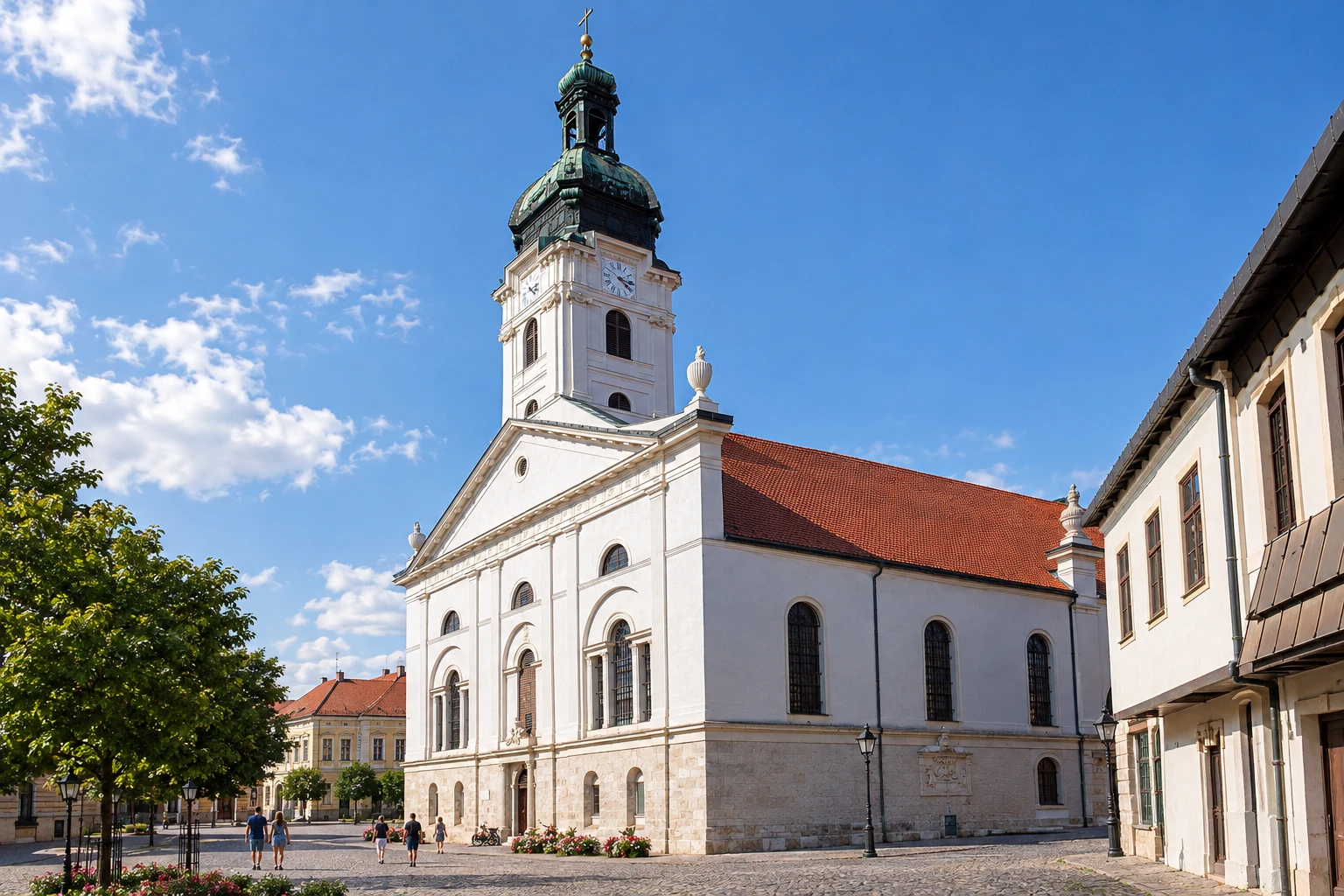
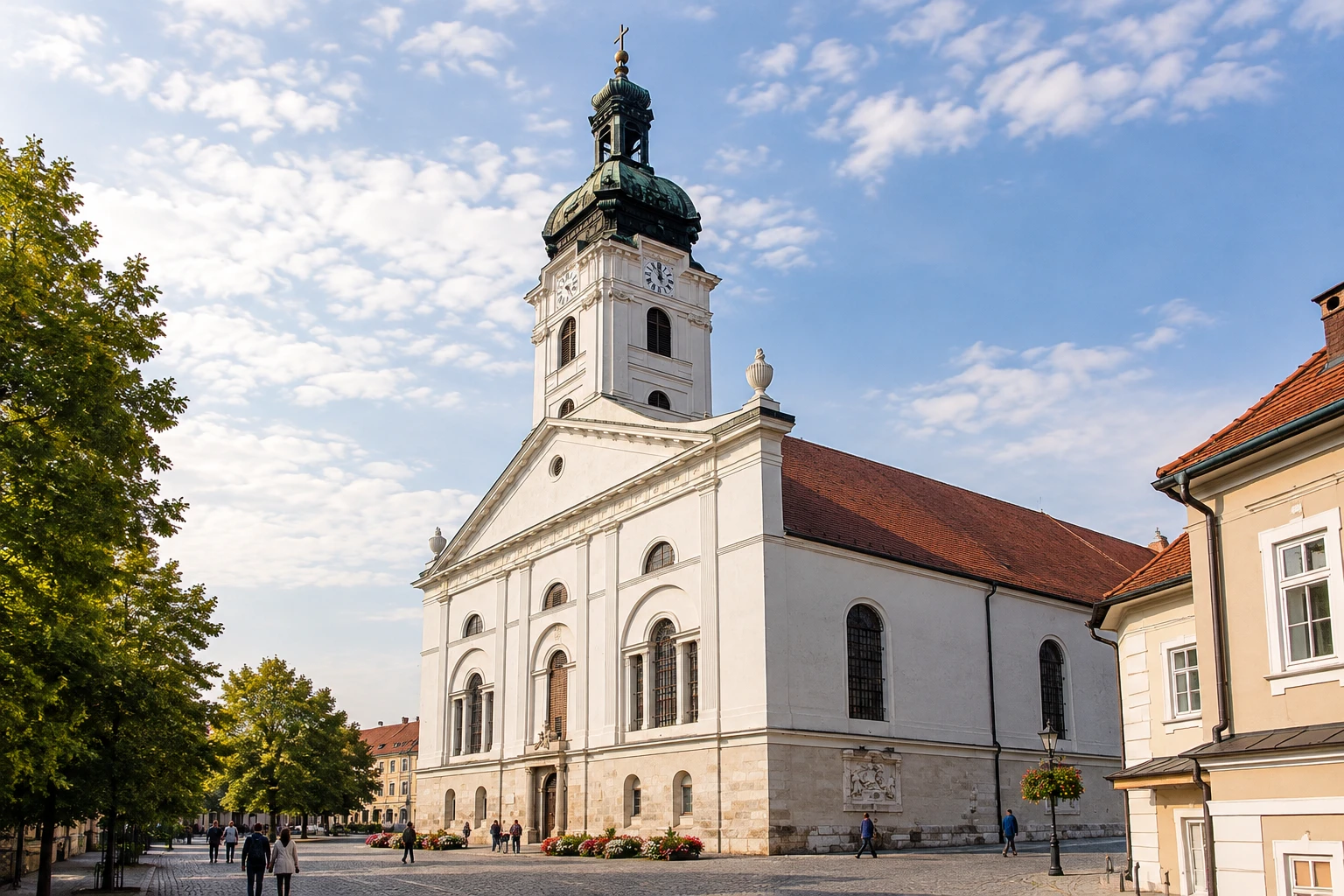
In the photo: Nagyboldogasszony-székesegyház
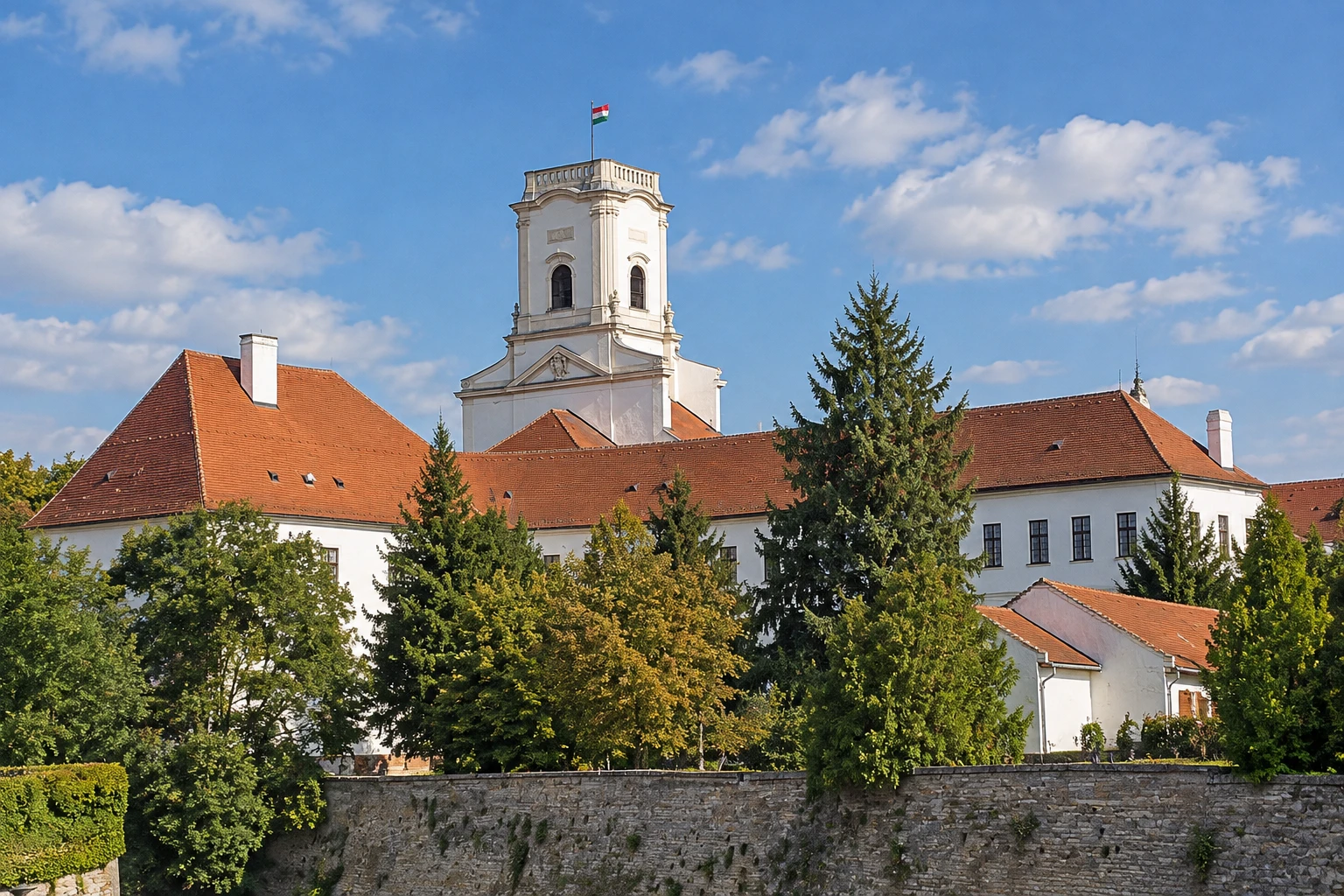
Illustrative images. The pictures in this guide are illustrations based on the real place, not photographs, and may differ from it.

The city
Győr is the seat of Győr-Moson-Sopron and a river junction in western Hungary. On the Káptalandomb hill, the cathedral and the bishop’s castle structure the visit. The old centre allows complementing interiors with walks and views by the water.
Győr stands in northwestern Hungary, about 120 kilometers from Budapest and roughly halfway to Vienna on the rail line and highway linking the two capitals. It is the seat of Győr-Moson-Sopron County and Hungary’s sixth-largest city, with nearly 130,000 residents. Hungarians call it the city of rivers. Here the Rába and Rábca meet the Mosoni-Duna, a branch of the Danube, and water wraps around the old center to the north and west.
The oldest part is Káptalandomb, Chapter Hill, on the point between the rivers. The Roman camp of Arrabona stood here, and King Stephen I established the bishopric on the site in the 11th century. At the top are the Cathedral of the Assumption, home to the reliquary of St. Ladislaus and the painting of the Weeping Madonna, and Püspökvár, the bishops’ residence, with a lookout tower.
In the 16th century Győr became the main fortress on the road to Vienna. The Ottomans took it in 1594 and lost it four years later. The legend of the iron rooster that would crow only when the city was retaken dates from that time, and the rooster remains a local symbol. Two bastions survive, one with a collection of carved stones below ground. After the war came Baroque Győr, with Széchenyi tér, the Benedictine Church of St. Ignatius and the Marian Column, Bécsi kapu tér with its Carmelite church, and streets of houses with enclosed corner balconies, a feature repeated throughout downtown.
The compact center is easy to explore on foot. The rail and bus stations lie to the south beside the tall-towered Városháza, or City Hall. From here Baross Gábor út leads to the old squares. West across the Rába, Újváros has the synagogue and churches of several denominations. The thermal baths and water park occupy the point between the rivers. The Audi factory and zoo are outside the center on the industrial side of town.
The climate is continental. From June through August highs range from 26°C to 28°C, with showers. It is the season for street festivals such as the children’s Győrkőcfesztivál and the Baroque Wedding. April, May, September and October are mild and good for walking. December through February is cold, with highs between 3°C and 6°C and lows below freezing. Széchenyi tér hosts the Advent market.
One day covers the hill, squares and riverbanks. With two or three days, add museums, thermal baths, the zoo and a trip to Pannonhalma, about 20 kilometers away, where the Benedictine abbey is a World Heritage Site.
30 places to stay in Győr.
30 places to eat in Győr.
The city's hotels and restaurants on the map.
The local experience
Cathedral on Káptalandomb hill, with Romanesque, Gothic and Baroque layers and a tradition of pilgrimage.
Episcopal residence on Győr hill, with a viewing tower and organised heritage routes.
To choose before you go
Where each tour starts, how long it takes, how it is done, what is included and the price range.
Káptalandomb is Győr’s oldest quarter and a designated National Memorial. The cathedral, bishops’ residence and chapter houses stand within a few meters of each other on the site of the medieval fortress. The cathedral, the Nagyboldogasszony-székesegyház, began as an 11th-century Romanesque church, became Gothic and was rebuilt in the Baroque style in the 17th century after serving as a warehouse and stable during the Ottoman wars. The neoclassical facade dates to 1823. Inside are ceiling frescoes by Austrian painter Franz Anton Maulbertsch and his students. The Gothic Héderváry Chapel of 1404 is the oldest well-preserved section. It holds the red marble sarcophagus of Bishop Vilmos Apor, who died in 1945 protecting women sheltering in the palace basement. The reliquary of St. Ladislaus, a medieval metalwork bust more than 600 years old containing a fragment of the king’s skull, is regarded as Hungary’s third national relic. On the altar of the north aisle is the painting of the Weeping Madonna, brought from Ireland in the 17th century by Bishop Walter Lynch. Tradition holds that the image wept tears of blood on March 17, 1697. Opposite is Püspökvár, the residence of Győr’s bishops for nearly a thousand years. The square tower rises almost 40 meters, with 206 steps to a lookout over the Baroque center, Radó Island and the meeting of the rivers. In the same complex, an exhibition commemorates Bishop Apor in the place where he sheltered refugees. At the Káptalanház, an exhibition tells the stories of the reliquary and painting. The Püspöki udvarbíróház, of late Gothic origin, displays the work of sculptor Miklós Borsos.
Stops: Nagyboldogasszony-székesegyház, Héderváry Chapel, Bishop’s Castle and lookout tower, Apor Vilmos püspök tere, Káptalanház, Püspöki udvarbíróház.
Includes: Cathedral admission follows the service schedule. The St. Ladislaus visitor center charges for the tower, exhibitions, and treasury. Check current prices. The bishop's palace and garden open only on announced dates with a guide.
Tip: Conservation work may move the reliquary from the chapel to the visitor center. Ask at the ticket desk. Climb the tower in clear weather. There is no elevator. On June 27, St. Ladislaus’s Day, the hill hosts a procession and festivities.
Best time: Year-round. The St. Ladislaus Days take place in late June.
Széchenyi tér has always been the heart of Győr. A square for markets, assemblies and trials, it took its present shape after the great fire of 1566 and was named for István Széchenyi in 1860. The twin towers of the Church of St. Ignatius of Loyola dominate the square. Built by the Jesuits and completed in 1641, it is the oldest Baroque church in present-day Hungary, modeled on the Gesù in Rome. Paul Troger painted the ceiling frescoes and high altarpiece. When the order was dissolved, the church, monastery and college passed to the Benedictines, who still run the school. In the attics of the church and monastery, a guided visit to the exhibition marking the college’s 400 years takes you above the vaults. The Marian Column in front dates to 1686, commissioned by Bishop Leopold Kollonich to commemorate the recapture of Buda. Look around at the facades. Vastuskós-ház has a two-story cylindrical corner balcony and a wooden stump covered in nails, traditionally driven in by apprentices as they left the city. Apátúr-ház was the Baroque mansion of the abbots of Pannonhalma. Esterházy-palota, on the Király utca corner, houses the city museum. The enclosed corner balcony is a signature of Győr’s Baroque architecture and appears on dozens of houses. Toward the hill, the Jedlik-csobogó fountain has a turquoise glass siphon honoring Ányos Jedlik, the Benedictine monk of Győr credited with inventing the soda siphon. Continue to Gutenberg tér, the city’s smallest square, with the Frigyláda-szobor, the Baroque Ark of the Covenant monument of 1731, and the white-walled, green-shuttered Kreszta-ház.
Stops: Széchenyi tér, Marian Column, Benedictine Church of St. Ignatius of Loyola, Vastuskós-ház, Apátúr-ház, Esterházy-palota, Jedlik-csobogó, Gutenberg Square and the Ark of the Covenant monument, Kreszta-ház.
Includes: The walk is free. The Benedictine attic exhibition and historic house museums charge admission and have set visiting periods. Check ahead.
Tip: Shops and cafés occupy the ground floors of the old houses. Look up for balconies and wrought-iron signs such as the Golden Ship. The square is quietest early in the morning. Its Advent market runs from late November until shortly before Christmas.
Best time: Year-round. The Advent market fills the square in December.
This riverside walk is recommended by the local tourist office. From Dunakapu tér, follow the foot of the walls around Káptalandomb to Bécsi kapu tér, then cross the bridge onto Radó Island. Dunakapu tér opens onto the Mosoni-Duna and takes its name from the former Danube Gate. A fountain supports a copy of the Vaskakas, the iron rooster. Legend says the Ottomans placed it above the gate after taking the city in 1594 and declared they would stay until it crowed. Four years later the fortress was retaken. The path follows the water beside the walls of Kastély-bástya. At the end stands Sforza-félbástya, the other surviving bastion of the fortress built by Italian engineers from 1537 and dismantled after the Napoleonic siege of 1809. Its casemates house Várkazamata–Kőtár, a collection of stonework with Roman tombstones, carved stones and remains of the old Fehérvár Gate. Nearly all the houses on Bécsi kapu tér, Vienna Gate Square, are listed buildings in Baroque, Louis XVI or neoclassical styles. The Carmelite church, completed in 1725, has an oval plan and detached tower. The confessional passage leads to the Loreto Chapel with an image of the Black Madonna. An open chapel alongside holds the Hab Mária, a Baroque sculpture that residents credited with ending a flood of the Rába. The square also has a statue of playwright Károly Kisfaludy and a weather tower with a clock and meteorological instruments. The double Rába bridge crosses tree-covered Radó-sziget, created as an outwork of the fortress in the 17th century and turned into a public promenade in the 19th. At the northern tip, a small footbridge passes the spot where the Rába flows into the Mosoni-Duna.
Stops: Dunakapu Square and the Iron Rooster Fountain, Path along the base of the wall, Várkazamata–Kőtár, Bécsi kapu tér, Carmelite Church, Statue of Károly Kisfaludy, Rába-kettőshíd, Radó-sziget.
Includes: The walk is free. The lapidarium in the casemates charges admission. Check opening days.
Tip: Walk in late afternoon when the hill and Carmelite church catch the light. In summer, ask the tourist office about boat trips on the rivers downtown.
Best time: April to October, when the island’s trees are in leaf.
The Rómer Flóris Museum of Art and History, Győr’s city museum, occupies several historic houses downtown, all a few minutes apart. They make a good outing in cold or rainy weather. Its headquarters are in Esterházy-palota, a mansion formed by joining five houses during the 18th and 19th centuries. It has a portal flanked by herms and an enclosed corner balcony. Inside are the larger temporary exhibitions and the Radnai collection, one of the leading private collections of Hungarian art. The ground floor has a café and shop. Medieval Kreszta-ház, opposite the Ark of the Covenant monument, houses a permanent exhibition of Győr-born ceramicist Margit Kovács, with folk-inspired figures and biblical scenes. The artist helped install it in 1974. The only comparable group of her works is in Szentendre. Vastuskós-ház on Széchenyi tér holds the Imre Patkó collection of 20th-century Hungarian and European art alongside objects from Africa, Asia and Oceania. On the hill, the Püspöki udvarbíróház presents works by sculptor and medalist Miklós Borsos. Two other sites are a little off the main route. Magyar Ispita, a former almshouse founded in the 17th century by Bishop György Széchényi, has courtyards with Tuscan arcades and its own church and now hosts exhibitions. Fruhmann-ház was the home and workshop of a master tile stove maker. It traces the craft’s history, with the most striking examples displayed in a pavilion.
Stops: Esterházy-palota, Kreszta-ház (Kovács Margit), Vastuskós-ház (Imre Patkó Collection), Püspöki udvarbíróház (Borsos Miklós), Magyar Ispita, Fruhmann-ház.
Includes: Each house charges admission. Check current prices and whether a combined ticket is available. The museum usually opens Tuesday through Sunday and closes Mondays.
Tip: Some galleries close temporarily for exhibition changes or maintenance. Check the museum website for the day's openings. Guided visits run on scheduled dates, usually in Hungarian.
Best time: Year-round. In June, the museums stay open late for the Night of Museums.
West of the center across the Rába, Újváros has places of worship of five faiths within a few blocks. Several stand on Kossuth Lajos utca, lined with 18th- and 19th-century houses. The Neolog synagogue, built between 1868 and 1870, became one of Győr’s landmark buildings and a model for synagogues in other cities. Almost the entire local Jewish community was murdered during World War II. Today the city university manages the building, whose acoustics make it a concert venue. Nearby, the Reformed church of 1906 seats 776 and shows late Historicist features. The Evangélikus Öregtemplom, the Lutheran Old Church, was built after Joseph II’s Edict of Toleration and consecrated in 1785. Its interior galleries illustrate early Protestant churchbuilding in Hungary after the edict. Farther on, merchants founded what is now the Greek Catholic church in 1727 as a Serbian Orthodox church. Its iconostasis and Louis XVI-style seating survive, and old gravestones stand in the walled garden. In May the Five Churches Festival (Öt Templom Fesztivál) opens these places for several days of music and events organized by the communities. The neighborhood has its own Advent concert program.
Stops: Győr Synagogue, Reformed Church, Evangélikus Öregtemplom, Greek Catholic church, Kossuth Lajos utca.
Includes: The walk is free. The places of worship open for services, concerts, and events. Access to the synagogue interior depends on its program.
Tip: Combine this with Radó Island. The double Rába bridge links downtown to the island and the island to Újváros. To see inside the synagogue, check the city's concert calendar.
Best time: May for the Five Churches Festival, or December for Advent at the Five Churches.
Győr also has hot springs. On the peninsula between the Mosoni-Duna and the Rába, a short walk from the old center, the complex known as RQ, short for Rába Quelle, combines thermal baths, leisure pools, a swimming pool and saunas across 4.5 hectares. There are 21 indoor and outdoor pools. The thermal area is for soaking in warm water, a Hungarian custom in every season. The leisure section has interconnected pools on three levels, jets and sprays for small children and a jungle-themed children’s slide area. The most striking feature is the 32-meter slide tower shaped like a soda siphon in tribute to Ányos Jedlik, the Győr monk and physicist associated with the invention. A panoramic elevator rises to four slides starting at different heights. The tower lights up at night. The complex also has a Japanese-inspired sauna area on two floors with guided sessions, and a medical center offering rheumatology and physical therapy.
Stops: RQ Vízi Élménypark, Thermal pools, Siphon-shaped waterslide tower, Sauna World.
Includes: The thermal baths, water park, and saunas require different tickets. Check current prices and sauna rules.
Tip: Bring flip-flops and a towel. Pools close for maintenance on certain dates, and hours change over the year-end holidays. Check the day's notice. Weekends and school vacations are busiest.
Best time: Year-round. The outdoor areas are best from June to August.
Two family outings are located outside the old center. Győr Zoo, the Xantus János Állatkert, has more than 900 animals representing nearly 150 species and opens every day of the year. Activities include public feedings, elephant training, penguin walks and keeper presentations. An indoor playhouse with animals to touch, a games area and a bouncy play area is handy in cold weather. The zoo takes its name from 19th-century Hungarian naturalist János Xantus. Mobilis is an interactive science center that turns physics and technology into play, with laboratory demonstrations, robot games, virtual reality, a Formula 1 driving simulator and a puzzle room. Visit both in one day with a lunch break between them, or fit them separately into a two- or three-day itinerary.
Stops: Xantus János Állatkert, Mobilis Interaktív Élményközpont.
Includes: Each site charges admission. Check current prices. Some zoo activities take place at set times during the day.
Tip: Check whether Mobilis accepts individual visitors on your date. On weekdays it may receive only booked groups. At the zoo, read the activity board at the entrance and plan around the day's events.
Best time: Year-round. Spring and fall offer more comfortable temperatures for walking around the zoo.
Industry has long sustained Győr. Two visits show the range of that history, from the assembly line to traditional handcraft. For more than three decades the city has been home to Audi’s Hungarian plant, one of the world’s largest engine factories. Guided tours take in the vehicle plant’s press shop, body shop and assembly areas. You can follow engine production and see a bare body become a road-ready car. The traditional craft is kékfestő, resist printing and indigo dyeing that leaves white patterns on a blue background. UNESCO lists the technique as intangible cultural heritage. In Győr, descendants of Péter Éhling have kept it alive for around five generations. Pieces are sold at the downtown Győri Kékfestő Műhely shop. At the family workshop on Festő utca, you can learn about the process and try printing. If you prefer a walk, iron and bronze signs on downtown streets recall other trades, including the Golden Ship, the Indigo Dyer’s Girl, the Golden Lion and the Fishermen.
Stops: Audi factory in Győr, Győri Kékfestő Műhely.
Includes: Both visits charge admission and require reservations. Check prices, tour languages, and the factory's minimum age.
Tip: Book the factory visit ahead and check ID requirements and photography rules. At the kékfestő workshop, small irregularities in the hand-printed pieces are characteristic of the process.
Best time: Year-round on weekdays.
Day by day
Suggestions to plan the trip. Change the order of the days according to the weather and tour availability.
From the station, pass the Városháza, City Hall with its 59-meter tower, and follow Baross Gábor út to Széchenyi tér. See the Church of St. Ignatius, the Marian Column and the corner balconies of Vastuskós-ház and Esterházy-palota. Continue past the Jedlik fountain and Gutenberg tér with the Ark of the Covenant monument, then climb Káptalandomb. Visit the cathedral, Héderváry Chapel and the Weeping Madonna, then climb the 206 steps of the Püspökvár tower. After lunch, descend to Dunakapu tér for the iron rooster and follow the foot of the walls to Bécsi kapu tér and the Carmelite church. Cross the bridge to Radó Island and continue to the confluence of the Rába and Mosoni-Duna. If time allows, see Margit Kovács’s ceramics in Kreszta-ház. Finish with a fröccs, wine mixed with soda water, on a downtown terrace.
Spend the morning on the squares and the hill, taking in Széchenyi tér, the Church of St. Ignatius, Gutenberg tér, the cathedral and the Püspökvár tower. If a tour is running, include the exhibition in the Benedictine attic. In the afternoon, follow the riverside circuit through Dunakapu tér, the path below the walls, the casemate stone collection, Bécsi kapu tér, the Carmelite church and Radó Island. Have dinner downtown.
Start at Esterházy-palota and the city museum houses, with Margit Kovács at Kreszta-ház and the Imre Patkó collection at Vastuskós-ház. Cross Radó Island to Újváros to see the synagogue and churches on Kossuth Lajos utca. Reserve the afternoon for the RQ thermal baths and water park on the point between the rivers. With children, swap the morning museums for Xantus János Zoo.
Explore Széchenyi tér, the Baroque streets, Gutenberg tér and Káptalandomb in the morning, including the cathedral and Püspökvár tower. In the afternoon, visit Dunakapu tér, the walls, Bécsi kapu tér, the Carmelite church and Radó Island. End the day by passing illuminated City Hall near the station.
Spend the morning at the Rómer Flóris Museum houses and in Újváros with its synagogue and places of worship of five faiths. In the afternoon, try the thermal baths and pools at RQ. If you booked ahead, fit in the Audi factory tour or kékfestő workshop here and leave the baths for the evening.
The UNESCO-listed Benedictine abbey of Pannonhalma, around 20 kilometers from Győr, has its own guide covering the basilica, cloister and library. Take a bus or train, allowing for the final uphill stretch, and book the visit ahead. On your return, taste wines from the Pannonhalma wine region. If you prefer to stay in town, spend the day at Xantus János Zoo and the Mobilis science center, or take another leisurely riverside walk along the Mosoni-Duna.
Best time to go
The seasons shown are the most usual ones; nature doesn't always follow the calendar.
Winter · Theater, ballet and concert season
The coldest month brings lows near -3°C, highs near 3°C, little precipitation, occasional snow and short days. The city is quiet after the holidays. Visit the cathedral, museums and thermal baths and catch the season’s performances by the Győr Ballet, the philharmonic or the Győr National Theatre. Dress warmly for wind along the riverbanks.
Winter · Farewell to Winter Ball
It stays cold, with lows near -2°C and highs near 6°C. This is the driest month. Days begin to lengthen and the squares suit short walks in the sun. Indoor options include the city museum houses, the Benedictine exhibition and thermal bathing. It is a good month if you want the city quiet.
Győr Spring Festival · Easter market
Early spring brings lows around 2°C, highs near 12°C and still little rain. From midmonth, the Győr Spring Festival offers about three weeks of concerts, theater and dance. A market fills downtown around Easter. Trees on Radó Island begin to bud. Bring a coat for cold mornings.
Spring Festival (through Easter) · St. George’s Days
Days are mild, with lows near 6 °C, highs near 18 °C and little rain. It’s a lovely time to walk downtown and along the riverbanks, with the city in bloom and little heat. Café terraces return to the squares.
Five Churches Festival in Újváros · May Day celebrations
Spring is in full swing, with lows near 10°C, highs near 22°C and more frequent showers. In Újváros, the Five Churches Festival opens the synagogue and churches for several days of music. May 1 brings a popular celebration. It is a good month to combine the city with Pannonhalma.
Hungarian Dance Festival · Night of Museums · St. Ladislaus Days (June 27)
Early summer brings lows near 14°C, highs near 26°C and showers, generally in the afternoon. The Hungarian Dance Festival brings companies and performances to town. Late in the month, St. Ladislaus Days include a procession with the reliquary on Káptalandomb.
Győrkőcfesztivál children’s festival · Fröccs Days
The warmest month has lows near 16°C, highs near 28°C and passing summer storms. On the first weekend, Győrkőcfesztivál fills downtown with children’s activities. There are nighttime river cruises and summer street events. Walk early and spend the afternoon in the water.
Baroque Wedding · St. Stephen’s Days · Győr Wine Days
Summer heat brings lows near 15°C and highs near 28°C. Early in the month the Baroque Wedding (Barokk Esküvő) brings period festivities to the streets, with events on Káptalandomb too. The August 20 national holiday brings St. Stephen’s Days, followed by Győr Wine Days late in the month.
Ars Sacra Festival · Heritage Days · Fish Days · Győr race
Late summer is mild, with lows near 11°C and highs near 22°C. The calendar stays busy with the sacred art festival, Cultural Heritage Days opening normally closed buildings, Fish Days and the city road race. It is an excellent month for walking and for a Pannonhalma trip during the grape harvest.
Autumn Festival of Museums
Fall brings lows near 7°C, highs near 16°C, cool mornings and yellow leaves on Radó Island and along the riverbanks. The Autumn Festival of Museums brings guided tours and special events to the city museum houses. Days grow shorter, so walk around midday and leave museums and baths for late afternoon.
Advent begins in Győr late in the month · St. Martin’s goose feasts in the surrounding area
Cold, damp days bring lows near 3°C, highs near 10°C and limited daylight. It is a month for theater, concerts and museums. Neighboring villages celebrate St. Martin with goose and new wine. On the last Friday of the month, lights come on at City Hall and Széchenyi tér as Győr’s Advent begins.
Advent in Győr: market on Széchenyi tér · Five Churches Advent
Winter brings lows near -1°C and highs near 4°C. In the run-up to Christmas, Széchenyi tér hosts the Advent craft market, concerts, a little train for children and Sunday candle lighting. Baross Gábor út has food stalls and Dunakapu tér hosts ice shows. Bring warm clothing for evenings outdoors.
Plan the journey
Győr has no scheduled passenger flights. Győr-Pér Airport about 15 kilometers away serves private aviation. The city lies between three international airports.
The closest is Bratislava (BTS) in Slovakia, about 90 kilometers away. Vienna (VIE) in Austria, about 117 kilometers away, has the widest choice of flights in the region. Budapest (BUD), Hungary’s main airport, is around 159 kilometers away on the far side of the capital.
From Vienna or Budapest, continue by train with a change in the city, by bus or by car on the M1. Driving from either airport takes less than two hours. Public transportation from Bratislava is less direct and usually requires a change.
Austria, Slovakia and Hungary belong to the Schengen Area. There are generally no fixed border controls between them, but carry your travel document.
From another continent, the journey usually involves a connection in a European city. Confirm the connection before buying.
The train is the most convenient way to arrive. Győr is a main stop on the Budapest–Vienna line, served by international express trains and Hungarian InterCity trains. The fastest services from Budapest take just over an hour and those from Vienna about an hour and a half. This makes Győr a good day stop between the capitals.
Other routes from Győr include the line to Sopron operated by the Győr–Sopron–Ebenfurt railway and regional lines south, including the route via Pannonhalma toward Veszprém. From Bratislava, at least one train change is necessary.
The station is at the southern edge of downtown opposite City Hall. Széchenyi tér is around 1 kilometer away on foot along Baross Gábor út. The station offers luggage storage, useful for a stop of only a few hours.
Buy ahead on weekends and festival dates, and check the last train if returning on the same day.
The bus station lies just south of the railway station across the tracks. Long-distance buses arrive from Budapest’s Népliget terminal, and international routes serve Vienna and Bratislava, including connections with Vienna Airport. Trains are usually faster for travel between the capitals, while buses offer direct airport links and reach towns without rail service.
Regional buses also leave here for Pannonhalma and county villages. Routes to Lake Balaton pass through Zirc in the Bakony hills.
City buses are rarely needed in the old center but are useful for the zoo, science center and outlying neighborhoods.
Services are reduced on weekends and holidays. Check the national transportation planner before setting out.
The M1 highway from Budapest to Vienna runs beside Győr, about 120 kilometers from the Hungarian capital. Arriving from the south, for example from Lake Balaton, take roads 82 and 81. The M85 expressway serves Sopron and the Austrian border. Pannonhalma is around 20 kilometers away via Route 82 and a signposted turnoff.
Hungarian highways require an electronic vignette bought before entering. Austria and Slovakia have their own systems. Check each country’s rules if crossing borders.
Much of the old center is pedestrian-only. Park on the edge of downtown and explore on foot. A car is mainly useful for the zoo, the Audi factory and outings around the county.
Pannonhalma, the other town in this destination, lies around 20 kilometers south. Regional buses leave from the bus station, and regional trains use the Veszprém line. The abbey is on a hill above the village. Check your bus stop and allow for the final climb, which is longer if you arrive by train. Some abbey tours require reservations.
The Győr tourist office also suggests nearby Nyúl, with rows of excavated wine cellars and a lookout, the Romanesque Church of St. James in Lébény, and Mosonmagyaróvár with its castle. A car makes these trips easier.
Sopron, at the western end of the county, has direct trains. Vienna, Bratislava and Budapest are within day-trip distance by rail or bus.
Your questions
The centre and the religious hill justify a full day before departing for the abbey.
The cathedral and the bishop’s castle are in the Káptalandomb area and can be combined on foot.
The tower requires stairs; check the effort before choosing to climb.
Győr is the seat of Győr-Moson-Sopron.
Walk from City Hall to Széchenyi tér to see St. Ignatius’ Church and the Baroque houses. Head up Káptalandomb for the cathedral and the tower of the Bishop’s Castle, then walk down to the rivers via Dunakapu tér, Bécsi kapu tér and Radó Island. Everything is a few minutes apart on foot, leaving time for a museum or a coffee on the square.
One day covers the old town, hill and rivers. Two days give you time for the city museum’s historic houses, the Újváros district and the thermal baths. With three days, spend one in Pannonhalma, about 20 km away, or take the children to the zoo and science center.
April, May, September and October offer comfortable walking weather, with highs between 16 and 22 °C. June through August is hot, with highs near 28 °C and street festivals such as Győrkőcfesztivál and the Baroque Wedding. December is cold and the days are short, but it’s worth visiting for the Advent market on Széchenyi tér.
Yes. Győr is on the railway between the two capitals, just over an hour from Budapest on the fastest trains and about an hour and a half from Vienna. The station is on the edge of downtown, and luggage storage makes it easy to stop for a few hours en route. Check the last train back.
Pannonhalma is about 20 km south. Regional buses leave from the bus station beside the train station, and regional trains run on the Veszprém line. The abbey stands on a hill above the village, so allow time for the final climb. Check return schedules, as services are less frequent on weekends. By car, follow Route 82 to the signposted turnoff.
Four waterways meet in or near town: the Rába, Rábca, Marcal and Mosoni-Duna, a branch of the Danube. The old town occupies the point between the Rába and Mosoni-Duna. Walks along the banks, across the bridges and around Radó Island are part of a visit.
It’s a bust made by medieval goldsmiths more than 600 years ago, containing a fragment of King Ladislaus I’s skull. It’s considered Hungary’s third national relic after the Holy Crown and the Holy Right Hand. It belongs to the Héderváry Chapel of Győr Cathedral. A votive procession honors it each June 27, continuing a tradition begun after the 1763 earthquake.
Legend says that when the Ottomans took the city in 1594, they placed an iron rooster on the Danube Gate and declared they would stay until it crowed. The fortress was retaken four years later. The Vaskakas became a symbol of Győr. One copy tops the fountain on Dunakapu tér, and another stands on the cross outside City Hall.
The Városháza, built between 1896 and 1898, has a 59-meter tower with views as far as Pannonhalma on a clear day. Visits to the ceremonial hall and tower must be arranged in advance through the city tourist office. For an easier lookout to visit, try the Bishop’s Castle tower on Káptalandomb.
Yes. The RQ complex on the peninsula between the Mosoni-Duna and Rába, near downtown, combines thermal baths, a water park, a swimming pool and saunas, with 21 indoor and outdoor pools. It operates year-round. Check prices and maintenance notices before visiting.
The Xantus János Zoo opens every day of the year, with animal activities and an indoor playhouse. RQ water park has children’s areas. The Mobilis science center offers hands-on experiments. Check when it’s open to individual visitors. On the first weekend in July, Győrkőcfesztivál fills downtown with children’s events.
Advent in Győr runs from late November until just before Christmas. Széchenyi tér hosts a craft market, concerts, a children’s train and the lighting of a candle each Sunday. Food and drink stalls line Baross Gábor út, while Dunakapu tér hosts ice shows. The program changes each year. Check the city calendar.
Fröccs is wine mixed with sparkling water, a popular Hungarian summer drink. The city credits its invention to Ányos Jedlik, a Benedictine monk, teacher and physicist from Győr. A fountain with a glass soda siphon downtown also commemorates him. You can order fröccs made with wines from nearby Pannonhalma.
It’s on the southern edge of downtown, opposite City Hall. From there, Széchenyi tér is about a 1 km level walk along Baross Gábor út. Káptalandomb and the rivers are just a few minutes farther. The bus station is immediately south of the train station.