Miskolc · Hungary · Lake
Lake Hámori
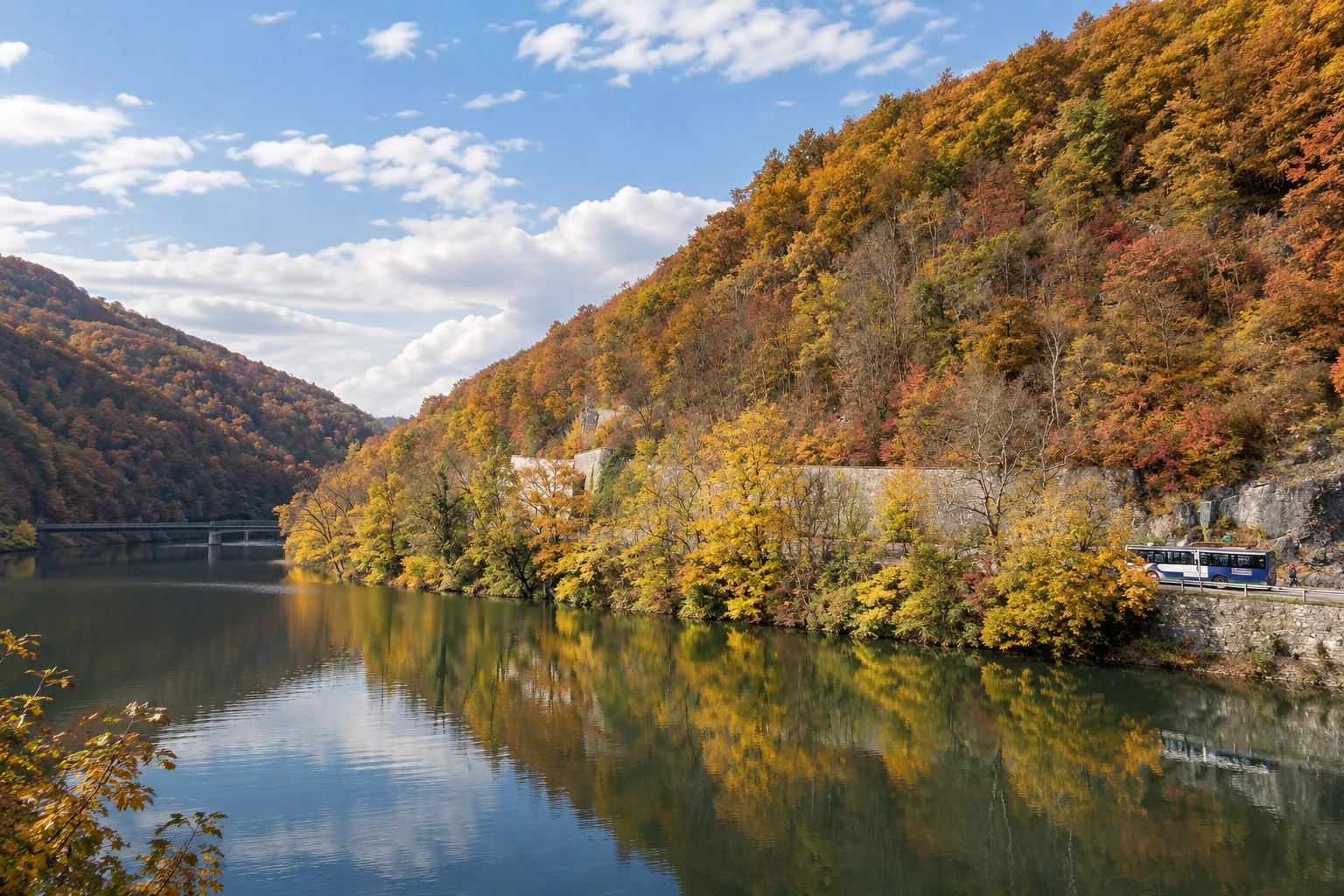
A dammed lake in Lillafüred, part of Miskolc, surrounded by the wooded slopes of the Bükk mountains.

 Search
 Brazil
 Antarctica
 Argentina
 Bolivia
 Chile
 Colombia
 Ecuador
 Falkland Islands (Malvinas)
 French Guiana
 Guyana
 Paraguay
 Peru
 Suriname
 Uruguay
 Venezuela
 Austria
 Belgium
 Croatia
 Denmark
 Finland
 France
 Germany
 GreeceHungary
 Iceland
 Ireland
 Italy
 Luxembourg
 Norway
 Poland
 Portugal
 Slovakia
 Slovenia
 Spain
 Sweden
 Switzerland
 the Czech Republic
 the Netherlands
 the United Kingdom
 Turkey
 Bermuda
 Canada
 Greenland
 Mexico
 Saint Pierre and Miquelon
 the United States
 the Dominican Republic
 JapanTurkey
 Egypt
 South Africa
 Australia
 Fiji
 New Zealand
 Papua New Guinea
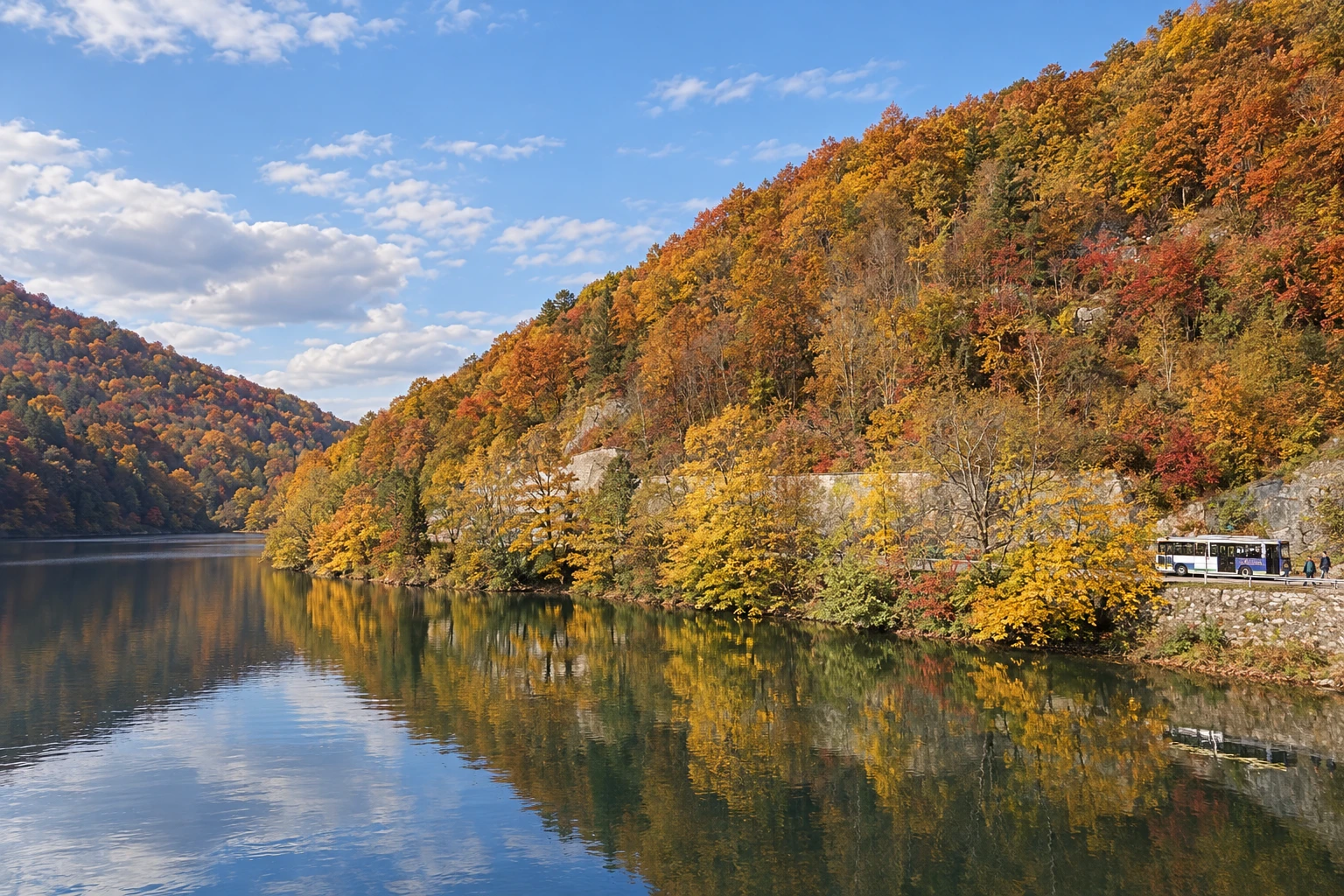
In the photo: Hámori-tó
Illustrative images. The pictures in this guide are illustrations based on the real place, not photographs, and may differ from it.

The city
Miskolc is the seat of Borsod-Abaúj-Zemplén and a base for the Bükk valleys. Lake Hámori is in Lillafüred, part of the city. In another direction, Miskolctapolca offers cave bathing. The geological visit to the Baradla in Aggtelek requires its own regional outing.
Miskolc is the largest city in northeastern Hungary, about 180 km from Budapest, where the Bükk Mountains meet the Great Plain. A market town by the 14th century, it prospered through fairs, wine and the Greek and Jewish merchants who settled here in the 18th and 19th centuries. In the 20th century it became a city of iron and machinery. Today visitors come for a different side of Miskolc. Few cities this size have a thermal cave bath, a mountain valley with a lake and waterfall, and a hill with hundreds of wine cellars all within city limits.
Miskolc stretches east to west along the Szinva stream. For visitors, it falls into four main areas. Downtown, the pedestrian thoroughfare Széchenyi utca has Baroque, Neoclassical and Art Nouveau facades. Nearby are the National Theater, squares, churches of several denominations and museums. Avas, the hill beside downtown, has wine cellars, the city’s oldest Reformed church and a lookout tower.
To the west, Diósgyőr sits at the foot of the mountains. Known for its medieval castle of the Hungarian kings and its ironworking past, it’s the departure point for the narrow-gauge forest railway. Farther up the valley is Lillafüred, often mistaken for a separate town. This part of Miskolc has the Palotaszálló, a castle-like hotel opened in 1930, hanging gardens, a roughly 20-meter waterfall, Lake Hámori, two show caves, a chairlift and trailheads into the Bükk Mountains.
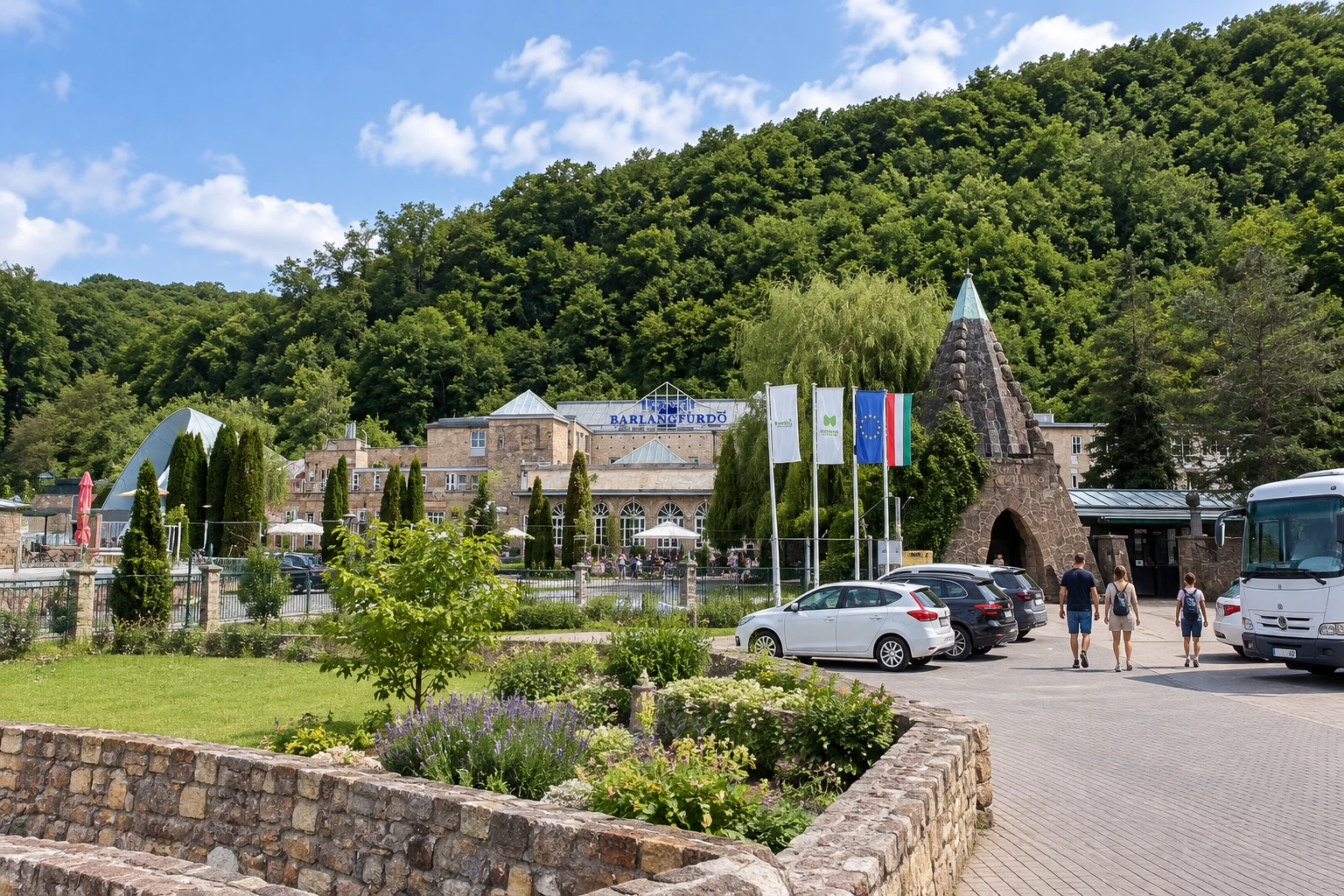
South of downtown is Miskolctapolca, the spa and vacation district. The Barlangfürdő, or Cave Bath, occupies natural limestone passages with warm karst water ranging from 29 to 31 °C. Around it are an old park with a boating lake, another pool complex and attractions for children.
The climate is continental. Winter, from December through February, brings temperatures averaging near freezing, short days and occasional snow and ice in the Bükk valleys. It’s a season for baths and museums. Spring warms quickly from April. Summer highs average around 28 °C. The heaviest rain falls in June and July, generally in showers. Lillafüred is usually cooler than downtown. September and October bring fall color to the woods and comfortable walking weather.
Highlights include a morning in Lillafüred for the hanging gardens, waterfall and one of the caves, a few hours at the Cave Bath, a walk along Széchenyi utca to the Szinva Terrace, and late afternoon at the Avas lookout with a stop at the wine cellars. Plan by area. Between districts, take a bus or tram.
30 places to stay in Miskolc.
30 places to eat in Miskolc.
The city's hotels and restaurants on the map.
The local experience
A dammed lake in Lillafüred, part of Miskolc, surrounded by the wooded slopes of the Bükk mountains.
Bathing in a natural cave environment in the Miskolctapolca neighborhood, with pools connected to underground spaces.
Aggtelek karst system with chambers and calcite formations, known for guided visits from different entrances.
To choose before you go
Where each tour starts, how long it takes, how it is done, what is included and the price range.
Széchenyi utca is the backbone of downtown Miskolc and its traditional shopping street. It was called Market Street before being renamed for István Széchenyi. Pedestrians share it only with trams. It curves with the course of the Szinva stream. Merchants and artisans built their finest houses, inns and hotels here. Look up at the Baroque, Neoclassical, eclectic and Art Nouveau facades, including Weidlich Palace, and peek through the gates into the courtyards. A few steps away is the Szinva Terrace, a square of steps and planting beds descending to a stretch of the stream brought back into the open after decades in a channel. It has an artificial waterfall, a bridge covered in padlocks and the bronze Girls of Miskolc sculpture. The National Theater stands at the corner of Déryné utca. In 1823, the country’s first permanent stone theater to stage plays in Hungarian opened in Miskolc. The current building dates to 1857 and the complex has five performance spaces. Déryné utca leads to Heroes’ Square, Hősök tere, surrounded by the Baroque Minorite church, the Post Office Palace and a synagogue by Ludwig Förster, architect of Budapest’s Dohány Street Synagogue. Plaques at the gate commemorate the Jewish community deported in 1944. On Deák Ferenc tér, the Holy Trinity Orthodox Church is hidden in a courtyard because Emperor Joseph II’s decree prohibited building it on the street front. Inside is a 16-meter iconostasis with about 90 icons. An Orthodox Church museum stands next door. End the walk at Erzsébet tér, the city’s smallest square, at the foot of Avas Hill.
Stops: Széchenyi utca, Szinva Terrace (Szinva terasz), National Theater of Miskolc, Déryné utca, Hősök tere, Miskolc Synagogue, Holy Trinity Orthodox Church, Erzsébet tér.
Includes: Self-guided outing. Any admission fees for churches, museums, and the theater are separate. Check current prices.
Tip: The pedestrian street hosts an antiques market on the first Sunday of each month. The tourist office on Széchenyi utca offers guided walks in several languages. Check dates and reservation requirements.
Best time: Year-round. Café terraces open from May to September. In late November and December the center hosts Advent events.
Avas rises beside downtown. Its name preserves an old word for a forest where entry was forbidden. About 800 cellars and their press houses line narrow, winding streets under old trees. People in Miskolc stored and drank their wine here. The pleasure of the walk is to climb slowly past the cellar doors. At the base of the hill, visible from Erzsébet tér, stands the Avas Reformed Church, the city’s oldest church, with roots in the 13th century. It has a separate bell tower and a historic cemetery. Its roof structure is made entirely of wood, without metal parts. Interior visits usually require an appointment. At the summit is the Avas lookout, a 72-meter tower built in 1963 that doubles as a television antenna and has become a city symbol. Its terrace opens day and night, with views over all of Miskolc to the mountains and scale models of the city’s best-known buildings. Sunset is the most popular time, and visibility depends on the weather. Some wineries along the cellar rows offer Bükk wine tastings, especially on Fridays and Saturdays. The tourist office runs a guided walk from downtown that stops for a tasting and finishes at the lookout. For a quieter stop, arrange a visit to the Avas Arboretum and its collection of pines.
Stops: Avas Reformed Church and bell tower, Avas Historic Cemetery, Rows of wine cellars on Avas Hill, Avas Lookout (Avasi kilátó), Avas Arboretum.
Includes: Self-guided walk. The lookout terrace is free. Wine tastings and guided walks cost extra.
Tip: Walk up through the wine cellar streets and return via the Reformed church and cemetery to Erzsébet tér. Wear sturdy shoes for steps and stony sections. A city bus serves the lookout. Check ahead.
Best time: Late afternoon from April to October. In winter it gets dark early, so head up before sunset.
Miskolc’s downtown museums are within easy walking distance of one another and make a good outing on a cold or rainy day. Part of the Herman Ottó Museum, the Pannonian Sea Museum tells the story of Earth and the Carpathian Basin. Its best-known exhibits are the Bükkábrány swamp cypresses, tree trunks about 7 million years old, displayed alongside the flora and fauna of the Miocene. Other sections cover Carpathian minerals and dinosaurs, with skeletons and models. Dioramas and aquariums recreate the ancient sea that covered the region, and children can play games such as digging for fossils. The museum’s Gallery houses Miskolc Anno, an exhibition that uses paintings to show two centuries of change. The towers of the Minorite and Orthodox churches already appear in 18th- and 19th-century paintings, while other churches are depicted before their towers were built. The collections of István Kövesi and physician Sándor Petró form the core of its Hungarian and international holdings. The Actors’ Museum in Thália House is part of the National Theater complex on Déryné utca, on the site of the first permanent Hungarian-language theater. The exhibition follows theater in Miskolc from traveling actors to the present day. Children have a corner with puppets and costumes. After visiting the Holy Trinity Orthodox Church, stop by the museum next door for vestments woven with gold and silver, crosses and chalices.
Stops: Pannonian Sea Museum (Pannon-tenger Múzeum), Herman Ottó Museum Gallery (Képtár), Actors’ Museum – Thália House, Orthodox Church Museum.
Includes: Self-guided visit. Each museum charges admission. Check current prices. The city tourist card includes museum admissions.
Tip: Check each museum's opening days before visiting. If you plan to see several and use buses and trams, compare costs with the Miskolc Pass.
Best time: Year-round. A good choice for rainy or winter days.
Lillafüred is the mountainous part of Miskolc. The city extends into Bükk National Park, so you can go from city street to forest trail without crossing a municipal boundary. The landmark is the turreted Palotaszálló, a castle-like hotel opened above the valley in 1930. Here Attila József wrote Ode, one of the best-known love poems in Hungarian. Steps descend from the hotel through six themed terraces of the hanging gardens: Youth and Encounters, the Waterfall, Flowers, Music, Poetry with its statue of the poet, and Sculpture. A path through the gardens has nine stops exploring poets, naturalists and the valley itself. The Waterfall Terrace gives a close view of the roughly 20-meter cascade, described as Hungary’s highest. In the 1920s, during construction of the hotel, the Szinva stream was diverted to create it. A pumping system at the lake keeps water flowing during dry periods. In winter the cascade can freeze. Lake Hámori is a few minutes away on a road cut into the slope of Mount Szeleta. The lake is also man-made. The Fazola family built the dam in 1812 to power the valley’s iron forges. Today woodland reaches the water, and boats are available to rent in season. The lakeside path doesn’t yet make a full circuit. The hanging gardens and waterfall are free to visit. Flights of steps link the terraces, and only part of the area is wheelchair accessible.
Stops: Palotaszálló (Hotel Palota), Hanging Gardens of Lillafüred, Lillafüred Waterfall, Lake Hámori (Hámori-tó), Statue of Attila József.
Includes: Self-guided outing. Transportation, parking, boat trips, and meals cost extra.
Tip: Allow at least an hour for the garden's stone paths alone. Bring a warm layer, as the valley is usually cooler than downtown. For a meal, a trout farm in the Garadna Valley serves freshly grilled fish.
Best time: May to October for the lake and flowering garden, October for fall colors in the woods, and December to February to see the valley under snow when conditions allow.
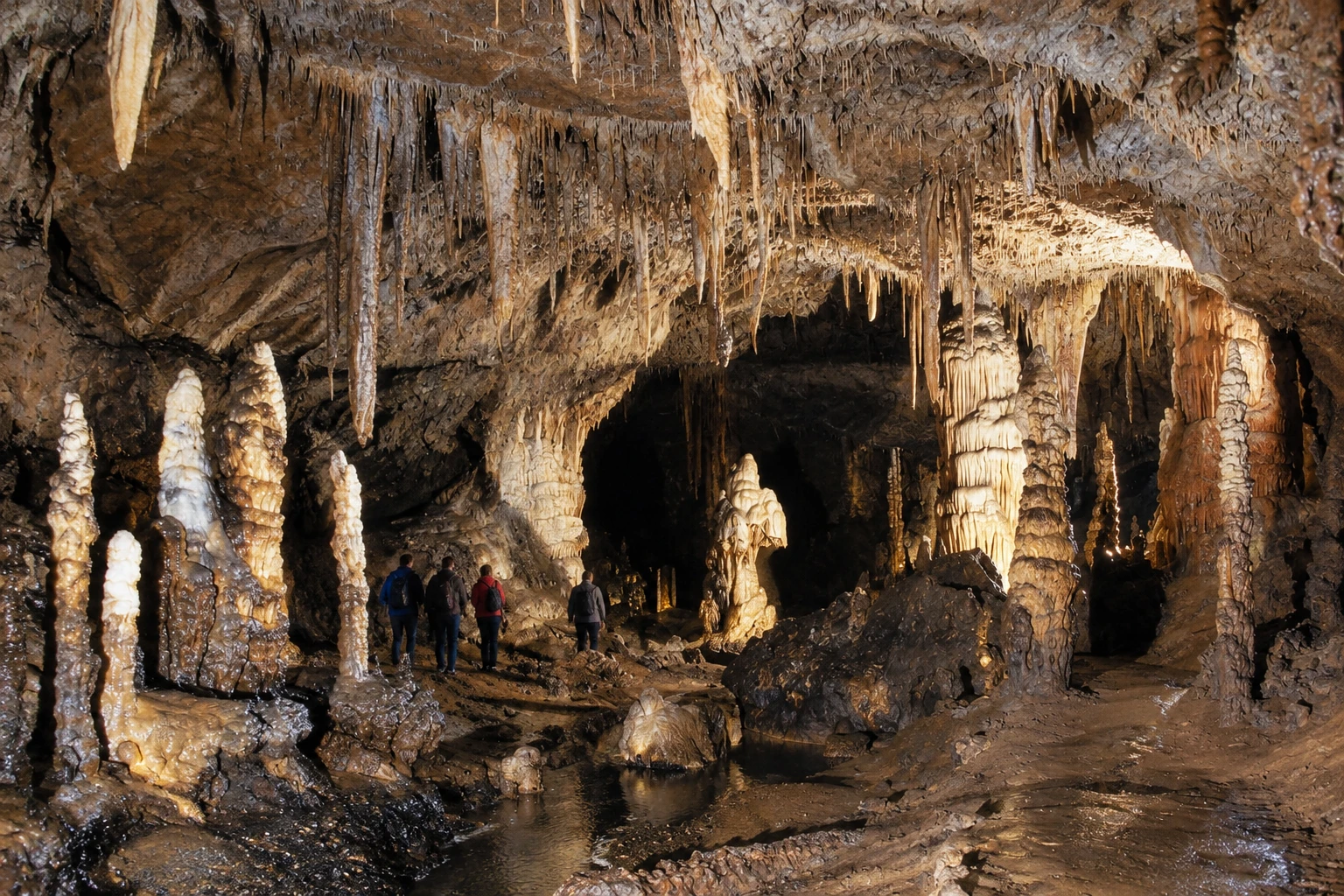
Lillafüred has two very different show caves and a third linked to prehistory. Anna Cave opens beside the waterfall. Unusually, it formed in limestone tufa deposited by the waterfall itself. Its walls preserve petrified loops, plant fibers, mosses and impressions of roots. St. Stephen’s Cave, on the Eger road, is known for its stalactites, spacious chambers and formations hanging from the ceiling and rising from the floor. The visitor path is built and lit, and the air stays cold year-round. Szeleta Cave is almost 100 meters above the Szinva Valley, opposite Hámor cemetery, where naturalist Ottó Herman is buried. Hungary’s cave excavations began here in 1906, revealing cave bear bones, traces of a fire and laurel-leaf-shaped spearheads that gave the Szeleta culture its name. A dark line on the walls shows the level of the debris before excavation. An uphill woodland trail leads to the cave. At the valley entrance, Bükk National Park’s Szeleta Park Visitor Center has an exhibition on the mountain caves, with original stone tools, a mammoth tusk, a life-size cave bear statue and a children’s play area. A guided tourist office walk links all the sites. It starts at the visitor center, climbs to Szeleta and descends to Lillafüred for Anna and St. Stephen’s caves. The route covers 5.5 km with about 300 meters of ascent, with a return by city bus or forest railway. According to the organizers, the Bükk Mountains contain more than 1,100 caves.
Stops: Anna Cave (Anna-barlang), St. Stephen’s Cave (Szent István-barlang), Szeleta Cave (Szeleta-barlang), Szeleta Park Visitor Center.
Includes: The caves and visitor center charge separate admission. Check current prices. The guided walk has its own registration and requires a minimum number of participants.
Tip: The caves are cold even in summer. Bring a warm layer and nonslip shoes. Groups depart at scheduled times. Check ahead, especially in winter.
Best time: Anna and Szent István caves work in any season, including rainy days. The Szeleta trail is more pleasant from April to October.
The Lillafüred Forest Railway, known as LÁEV, is one of Hungary’s most popular narrow-gauge lines. It began hauling timber along the Szinva and Garadna valleys in 1920. As tourism grew in Lillafüred, carrying passengers became more important. Some cars still in service are nearly a century old. The main line runs from the Dorottya utca terminus in Diósgyőr to Garadna, with its main intermediate stop at Lillafüred, roughly halfway. The train goes through tunnels, crosses the Deep Valley Viaduct and passes above Lake Hámori. It runs year-round, with more weekend departures than weekday ones. About ten minutes by train beyond Lillafüred is Újmassa, home to one of the country’s most important industrial monuments. The Fazola Blast Furnace is the last survivor of the valley’s old ironworks. Next door, the Massa Museum tells the century-long story of the Diósgyőr-Hámor ironworks and the Fazola family. There’s a reconstructed waterwheel-driven forge, and across the Garadna stream an outdoor display of mining and blacksmithing machinery. At the end of the line, Garadna has a Forestry History Collection covering forestry and the railway itself, plus a children’s theme park. The valley also has a trout farm serving roasted fish in the woods. On announced dates, special trains take the Mahóca branch into a more remote part of the mountains. In November and December, the Diósgyőr Santa train runs with advance ticket sales.
Stops: Lillafüred Forest Railway (LÁEV), Deep Valley Viaduct, Lillafüred Station, Újmassa Blast Furnace (Fazola-kohó), Massa Museum, Garadna Station, Forestry History Collection.
Includes: Train tickets are sold separately for each leg, and the museums charge their own admission. Check current rates.
Tip: Check the train schedule before you leave and note the last return departure. One option is to ride uphill, get off at Lillafüred for the garden and waterfall, then take a city bus back downtown.
Best time: April through October, with open cars on warm days. The forest changes color in fall. In winter the train still runs, with fewer departures.
There are two ways to see Lillafüred and the Bükk Mountains from above. Combine them in a day or visit separately. The chairlift leaves from Erzsébet sétány and climbs Jávor-hegy, more than 600 meters above sea level. Its cable stretches almost a kilometer and rises 263 meters, carrying you slowly above the beech canopy. Several trails start at the top, including the Oxygen Trail, with interactive stops about mountain wildlife and ecology, information panels and viewpoints. The lift carries bikes for riders who want to descend the trails, and a mountain scooter course runs alongside it. The chairlift ride down, facing the mountains, is often the most scenic part. Zsófia Lookout stands on Dolka-hegy at 390 meters. The original, built in 1900, was the first lookout tower outside Budapest. Charity balls and boat rentals on Lake Hámori paid for it. Demolished in the 1950s, it was rebuilt in its original style, with a stone base, timber structure and dome. It takes its name from Countess Zsófia Teleki. A zigzag trail climbs about 700 meters from Felsőhámor. From the top, the Palotaszálló stands out among the mountains. A nearby interpretive trail explores life in the treetops. Longer hikes from Lillafüred cross the Bükk plateau toward Fehérkőlápa, Szentlélek, Jávorkút and Bánkút. Look for sinkholes, depressions characteristic of karst terrain. The Jávorkút trail explains this landscape.
Stops: Lillafüred Chairlift (Lillafüredi Libegő), Jávor-hegy, Oxygen Trail, Zsófia Lookout (Zsófia-kilátó), Dolka-hegy, Felsőhámor.
Includes: The chairlift charges a separate fare. Check current rates. Walking up to Zsófia Lookout is free.
Tip: Check on the day whether the chairlift is running, especially in poor weather. Bring water and hiking shoes for the lookout. The climb is short but steep.
Best time: April through October. The forest understory blooms in spring, and the beech trees change color in October.
Many people come to Miskolc for the Barlangfürdő, a thermal bath inside a natural limestone cave. Karst water rises from deep in the mountain and flows through the passages. Enter the pool and move through the water between rock walls and vaulted ceilings, accompanied by the cave’s echo. The water ranges from 29 to 31 °C and has a low mineral content, so you can spend a good while in it. The dust- and pollen-free cave air is part of its reputation. The route includes massage pools in natural passages, the Star Hall with lights overhead and corridors where the current carries bathers along. Outside, landscaped grounds have seasonal pools and sun terraces for the warmer months. Records from the 13th century describe the healing reputation of Tapolca’s water. A Benedictine monastery was founded here in 1219, and the monks used the spring to treat wounds and pain. The first pool, built of wood in the open air, dates to 1723. The cave passages opened as public baths in 1959, followed by the shell-shaped outdoor pool in 1969. Later additions created the Star Hall and flowing-water passages. The complex is in Miskolctapolca’s old park, south of downtown. Take a city bus for about 20 to 25 minutes, then walk a few minutes from the terminus to the entrance. The emphasis here is on relaxation. Families looking for waterslides can find them at Ellipsum, the neighborhood’s other pool complex.
Stops: Miskolctapolca Barlangfürdő, Star Hall, Flowing-water passages, Outdoor pools.
Includes: Admission covers the pools. Saunas, massages, and other services cost extra. Check current prices and facility rules.
Tip: Bring swimwear, a towel, and flip-flops. Weekends, summer vacations, and holidays are busiest. Try a weekday morning. The baths close a few days a year for maintenance, usually in winter. Check before traveling.
Best time: Year-round. In winter this is the city's most popular outing. In summer the outdoor pools also open.
Miskolctapolca is Miskolc’s resort district, where the Bükk woods meet gardens, hotels and summer houses. Even without going for a swim, you can spend half a day here. The park beside the Cave Bath grew out of the forest of a medieval abbey. Exotic trees and shrubs planted in the 1920s give the protected area the feel of an arboretum. At its center is a boating lake with several islands, including the Island of Love, the subject of a local legend. An 18 °C spring feeds the lake and gives rise to the Hejő stream. Water lilies bloom in warm weather. Rent rowboats or pedal boats in season. Along the paths, children can hunt for small bronze sculptures of sights and animals from Miskolc and the surrounding area. On the Pazár István promenade are the ruins of the Benedictine abbey. Uphill on Brassói utca, the Rock Chapel was consecrated in 1935 in hollows cut into tufa that had once sheltered sheep. Its entrance, in a 9-meter retaining wall, has a carved wooden gate in the style of Transylvania’s Székely people. For more action, a bobsled track winds downhill through the woods. A treetop adventure park is described as Hungary’s largest in a natural setting. There’s also an electric go-kart track. Ellipsum, the neighborhood’s newer pool complex, has elliptical halls designed for families, with waterslides, massage beds in the pools and an outdoor seated pool reached by swimming through a passage. In summer, the outdoor bathing area operates separately.
Stops: Miskolctapolca Park, Boating lake (Csónakázó-tó), Benedictine abbey ruins, Rock Chapel (Sziklakápolna), Bobsled track, Adventure park, Ellipsum.
Includes: The park is free. Boats, the bobsled ride, adventure park, go-karts, and Ellipsum cost extra. Check current prices.
Tip: Combine this with the Cave Bath in one day. Visit the park and chapel in the morning and bathe in the afternoon. The boating lake and hillside attractions have individual seasons and opening days. Check ahead.
Best time: May to September for boating, water lilies, and outdoor attractions. In winter the park stays open for walking and Ellipsum has indoor facilities.
Between Diósgyőr and Lillafüred, at the entrance to the mountains, you can spend a morning or afternoon on a family outing. Miskolc Zoo occupies the wooded Csanyik Valley in the Bükk Mountains, on the site of a 14th-century royal hunting reserve. It opened in 1983 as a wildlife park focused on local mountain fauna. Today it has more than 120 species and about 800 animals, including lions, meerkats, endangered Persian leopards and brown bears. The zoo participates in breeding programs for threatened species and takes in orphaned or injured animals. Along the way, a sculpture park features life-size bronzes commemorating extinct animals and prominent zoologists. February usually brings a bear-watching event, and feeding demonstrations run during the year. Nearby on Hegyalja utca, the Szeleta Park Visitor Center is Bükk National Park’s largest exhibition space. A full-size mammoth marks the entrance. Inside, exhibits explain how the mountain caves formed and how water moves through karst. They display original Szeleta stone tools and mammoth tusks, and project a starry sky on the ceiling to illustrate light pollution. Children have suspension bridges and a place to play archaeologist. Outside are an herb garden, a geological park and the start of the Szinva Nature Trail to Lillafüred. The center also rents e-bikes. On the same street, the Diósgyőr Paper Museum traces more than 230 years of the local mill through models, documents and banknotes printed on its paper.
Stops: Miskolc Zoo (Miskolci Állatkert), Csanyik Valley, Szeleta Park Visitor Center, Szinva Nature Trail, Diósgyőr Paper Museum.
Includes: Each site charges its own admission. Check current rates. Transportation and meals cost extra.
Tip: The zoo is on a hillside with uphill stretches, so wear comfortable shoes and bring water. The Paper Museum belongs to the paper mill. Check whether it is receiving visitors that day.
Best time: April through October for the zoo. The indoor visitor center is a good option in wet weather and in winter.
Day by day
Suggestions to plan the trip. Change the order of the days according to the weather and tour availability.
Start early in Lillafüred. Take a city bus to the Palotaszálló stop or, if the schedule works, the forest train from Diósgyőr. Walk down through the hanging garden terraces, see the waterfall up close and continue to Lake Hámori. If you have time, visit a cave. Anna Cave is beside the waterfall and St. Stephen’s Cave is on the road to Eger. If you prefer bathing to hiking, spend the morning in Miskolctapolca instead, with a few hours at the Cave Bath. There isn’t time for both areas in one morning. Return downtown for lunch. In the afternoon, walk along Széchenyi utca, descend to Szinva Terrace, pass the National Theater and Hősök tere, and step into the Holy Trinity Orthodox Church to see the iconostasis. Late in the afternoon, climb Avas Hill through the wine-cellar streets to the lookout. The city gradually lights up after sunset. On Friday or Saturday, see whether a cellar is open for a glass of Bükk wine before descending past the Reformed church.
Ride the forest train to Lillafüred from Dorottya utca station in Diósgyőr. Take your time with the hanging gardens, waterfall and Lake Hámori, then visit Anna and St. Stephen’s caves. If you prefer mountain views, swap one cave for the chairlift to Jávor-hegy. Have lunch in the area. The trout farm in the Garadna Valley serves roasted fish in the woods. Return downtown by city bus. Walk along Széchenyi utca, Szinva Terrace and the squares, then finish on Avas Hill among the wine cellars and at the lookout before dinner downtown.
Devote the second day to Miskolctapolca. Arrive by city bus in the morning and start on dry land. Walk around the boating lake, look for miniature bronze statues in the old park, see the Benedictine abbey ruins and climb to the Rock Chapel on Brassói utca. After lunch, head into the Cave Bath and linger in the rock passages and Star Hall. Families can opt for the slides at Ellipsum or add the bobsled track and adventure park. If you travel onward today, leave enough time to get back downtown and reach Tiszai station.
Spend your first day downtown. In the morning, walk along Széchenyi utca, Szinva Terrace and Déryné utca to Hősök tere, with its synagogue and Minorite church. Visit the Holy Trinity Orthodox Church. Choose one or two museums: the Pannonian Sea Museum, with its 7-million-year-old tree trunks and dinosaur room, the Gallery with paintings of the old city, or the Actors’ Museum beside the National Theater. Climb Avas Hill in the afternoon. See the Reformed church and bell tower from outside, walk among the wine cellars and reach the lookout for sunset. Have dinner downtown.
Spend the day in nature. Catch the forest train in Diósgyőr and get off in Lillafüred for the hanging gardens, waterfall, Lake Hámori and Anna and St. Stephen’s caves. After lunch, choose among three routes. For industrial history, take the train to Újmassa for the Fazola Blast Furnace and Massa Museum, then continue to Garadna. For views, ride the chairlift to Jávor-hegy or hike from Felsőhámor to Zsófia Lookout. Families can stop on the return trip at the zoo in the Csanyik Valley or at the Szeleta Park Visitor Center. Return downtown by city bus or on the day’s last train.
Save day three for Miskolctapolca. Walk through the old park in the morning, rent a boat on the lake in season and visit the Rock Chapel. Spend the afternoon at the Cave Bath or, with children, at Ellipsum. If you still have energy, the bobsled track and adventure park are on the slope next door. With a fourth day, take a longer hike from Lillafüred into the Bükk Mountains toward Szentlélek, Jávorkút or Bánkút. Another option is Baradla Cave in Aggtelek, which takes a full day out of town.
Best time to go
The seasons shown are the most usual ones; nature doesn't always follow the calendar.
The Cave Bath usually closes for a few days for maintenance
The coldest month brings averages between −4 and 2 °C, about 28 mm of precipitation, often snow, and short days. It’s time for thermal baths and museums. In Lillafüred the waterfall can freeze, the valley sometimes turns white and the hanging garden paths can be icy. Check the Cave Bath’s opening days, as it usually closes for winter maintenance.
Meat Jelly Festival (Kocsonyafesztivál) · Bear watching at the zoo
It stays cold, averaging between −3 and 5 °C, with about 35 mm of precipitation. Downtown hosts Kocsonyafesztivál, a winter festival named for kocsonya, Hungary’s meat jelly. The zoo usually holds a bear-watching event. Otherwise, it’s a month for baths, museums and theater.
Antiques market on the first Sunday of the month
Spring starts slowly, with averages between 1 and 11 °C and about 31 mm of rain, making this one of the driest months. The days get longer, and downtown and Avas Hill become pleasant for walking again. In the Bükk valleys it’s still cold, and trails may be muddy. The caves and baths operate, but seasonal attractions such as boats and the bobsled track may still be closed.
Outdoor attractions open for the season
Temperatures average between 6 and 18 °C, with about 47 mm of rain. Trees come into leaf in Lillafüred, the forest floor blooms and the waterfall usually flows well. It’s a good month for the forest railway, hanging gardens and climb to Zsófia Lookout. Bring a warm layer for mornings and caves, and check what has opened for the season in Miskolctapolca.
Miskolc Day on May 11
Temperatures average between 11 and 23 °C, with about 67 mm of rain in showers. Everything is green, boats return to the lakes and downtown terraces fill up. Combine a walk in Lillafüred with late afternoon on Avas Hill. Bring a light raincoat for the trails.
Bartók Plusz Opera Festival, usually in June
Early summer brings averages between 14 and 26 °C and around 85 mm of rain, usually in late-afternoon storms. These are the longest days of the year. The city generally hosts its international opera festival, with performances at the National Theater and other venues. Plan outdoor visits for the morning and save caves, museums and baths for rainy spells.
Summer vacations · Outdoor pools open
The hottest and wettest month averages between 16 and 28 °C, with about 91 mm of rain in showers. Miskolctapolca is in full season, with outdoor pools, boating and hillside attractions, and larger crowds at the baths. Cooler Lillafüred offers a break from the heat, and the caves stay cold year-round. Book accommodations ahead.
Peak summer season
The weather stays hot, averaging between 16 and 28 °C, with less rain than July at about 65 mm. Bath and lake season continues. Visit the hanging gardens and chairlift in the morning and Avas Lookout in the late afternoon. Lillafüred and the Cave Bath tend to fill up on weekends.
CineFest, Miskolc’s international film festival
The heat eases, with averages between 11 and 22 °C and about 54 mm of rain. It’s a good month to hike in the Bükk Mountains and climb Avas Hill. Downtown hosts CineFest, the international film festival. Seasonal attractions in Miskolctapolca begin opening fewer days.
Fall colors in the Bükk forest
Temperatures average between 6 and 16 °C, with about 57 mm of rain. The beech trees in Lillafüred change color. See the valley from the forest train, chairlift or Zsófia Lookout. Days grow shorter, so start early and bring a warm layer. End the day in the baths.
Advent celebrations begin late in the month · Diósgyőr Santa train
Cold and damp, with averages between 2 and 9 °C, about 45 mm of rain and little sunshine. Spend time at thermal baths, museums and the theater. Downtown Advent events begin in late November, and Diósgyőr’s Santa train runs with tickets sold in advance. Expect mud and fog on the trails.
Advent in Miskolc · Year-end evening swim at Ellipsum
Winter brings averages between −3 and 3 °C, about 39 mm of precipitation and the shortest days of the year. Downtown has an Advent market and lights, church concerts and a producers’ market. Ellipsum usually schedules evening bathing in December. Lillafüred may see snow. Check shorter schedules for the forest train and caves.
Plan the journey
Miskolc has no commercial airport. The closest international airports are Budapest Ferenc Liszt (BUD), Debrecen (DEB) and Košice (KSC) in Slovakia.
Budapest has the most flights and the simplest onward connection. Travel from the airport into the city, then take a direct train from Keleti station to Miskolc. Debrecen and Košice are closer on the map but have fewer routes. Check whether any fit your trip and what ground connections run that day.
Travelers arriving from another continent usually fly to Budapest, changing planes if needed, and continue by train or car. Check flights and connections before buying.
The train is the most convenient way to arrive. Miskolc is on the main line through northeastern Hungary, and trains crossing the region stop here. Direct trains leave Budapest’s Keleti station. Travelers from western Hungary generally change trains in the capital.
The main station, Miskolc-Tiszai, is east of downtown a few kilometers from the pedestrian shopping street. Both tram lines and several buses terminate here. Trams serve downtown and continue to Diósgyőr. The station has luggage storage for individual travelers.
The same line continues to Szerencs and Tokaj, making it possible to combine Miskolc and the wine region without a car. Rail services also connect with Košice in Slovakia.
A smaller station, Gömöri, serves trains heading north.
Buy tickets ahead on weekends and holidays, and check schedules before traveling.
From Budapest, drive about 180 km east on the M3 and then the M30 into Miskolc. From Debrecen, take the M35 to the M3.
Hungarian highways require a vignette, which you must buy before entering.
Tokaj is about 57 km from Miskolc. Eger, on the opposite side of the Bükk Mountains, is another nearby stop often included on the same trip. To reach Lillafüred, head west from downtown via Diósgyőr along the Szinva Valley. Aggtelek and Baradla Cave are north of the city and make a full-day outing.
A car helps if you want to visit Lillafüred, Miskolctapolca and the zoo in the same day. Downtown, Széchenyi utca is pedestrian-only, and there’s an underground garage on Hősök tere. Parking is charged in Lillafüred and Miskolctapolca.
Most travelers arrive by train, but long-distance buses are useful for routes without a direct rail connection. The bus station is on Búza tér east of downtown.
Buses leave here for regional cities such as Eger and Debrecen and for smaller communities in the county. For Aggtelek without a car, take a regional bus and plan the day around the return departure.
Check times and platforms before traveling, especially on weekends.
Miskolc is long and spread out, with considerable distances between visitor areas. Public transit makes getting around straightforward.
For Miskolctapolca, take city bus 20 or 20A from downtown to the terminus in the district. The ride takes about 20 to 25 minutes, and the Cave Bath entrance is a few minutes away on foot.
For Lillafüred, take tram 1 to its Felső-Majláth terminus, then bus 5 or 15 to Palotaszálló. Alternatively, ride the forest train from Dorottya utca station in Diósgyőr.
Walk up Avas Hill from downtown or take the bus to the lookout.
The tourist office sells single tickets and books of ten. Buy day passes and one-, three- or seven-day visitor tickets at transit ticket offices or machines at the busier stops. The Miskolc Pass includes unlimited city transit and one admission to participating baths and museums.
Route numbers may change. Check at the tourist office or at the stops.
Your questions
Miskolctapolca is for bathing; the Baradla in Aggtelek is a guided geological visit. Keep the programs separate.
It is in a valley set apart from the urban core, although it is part of Miskolc.
Check the chosen route and book in advance on the official website when required.
The transfers spread across different directions; three days let you treat each program with its own time.
There are two routes. By city transit, take tram 1 to the Felső-Majláth terminus and transfer to bus 5 or 15. Get off at Palotaszálló for the hotel, hanging gardens and waterfall. Alternatively, take the narrow-gauge forest railway from Dorottya utca station in Diósgyőr to Lillafüred. Check routes and schedules before setting out.
City buses 20 and 20A terminate in Miskolctapolca. The ride takes about 20 to 25 minutes, followed by a short walk from the last stop to the baths. If you’re driving, the district is south of downtown and has paid parking.
The karst water at the Barlangfürdő ranges from 29 to 31 °C. It feels gently warm and has a low mineral content, so you can spend a good while in the pools. Outdoor pools also open in summer.
Partly. In the 1920s, during construction of the Palotaszálló, the Szinva stream was diverted to create the roughly 20-meter cascade in the hanging gardens. The flow varies, and a pumping system at Lake Hámori helps keep water flowing during dry spells. The waterfall can freeze in winter.
Two are set up for visitors. Anna Cave, beside the waterfall, formed in calcareous tufa and contains petrified plants and roots. St. Stephen’s Cave, on the road to Eger, has large chambers and stalactites. A trail leads to a third cave, Szeleta, a prehistoric site above the valley. Bring a warm layer. The caves are cold year-round.
Yes. The main line between Dorottya utca in Diósgyőr and Garadna runs year-round, with more trains on weekends than on weekdays. The Mahóca branch runs only on announced dates. Ask for the day’s timetable at the tourist office or railway ticket offices.
It’s the city’s visitor card. It covers unlimited city transit and one admission to participating attractions such as baths and museums, plus discounts elsewhere. There’s a children’s version. Buy it online or at the tourist office on Széchenyi utca. Before buying, compare the pass price with the tickets you plan to use.
Downtown, the terrace of the 72-meter Avas lookout tower is open day and night, with views across the city to the mountains. In Lillafüred, a short, steep trail from Felsőhámor leads to Zsófia Lookout, and a chairlift goes up to Jávor-hegy. The views depend on the weather.
Avas, the hill beside downtown, has about 800 historic wine cellars. Some wineries offer tastings of Bükk regional wines, especially on Fridays and Saturdays. The tourist office runs a guided tasting walk that ends at the lookout. Check which cellars will be open on the day of your visit.
Yes, especially for thermal baths and time in town. The Cave Bath and Ellipsum have indoor facilities, the museums and theater are in season, and Advent celebrations fill downtown in late November and December. In Lillafüred, the valley may be snowy and the waterfall frozen. Days are short and cold, with temperatures averaging around freezing. Check winter opening hours.
Try the zoo in the Csanyik Valley, the Szeleta Park Visitor Center with its play area and mammoth at the entrance, the forest railway or the dinosaur room at the Pannonian Sea Museum. In Miskolctapolca, there’s Ellipsum with its slides, a boating lake, a bobsled track and an adventure park. Outdoor attractions operate seasonally, so check ahead.
Try the Cave Bath and Ellipsum, Anna and St. Stephen’s caves, the Pannonian Sea Museum, the Gallery with its Miskolc Anno exhibition, the Actors’ Museum or the Holy Trinity Orthodox Church with its 16-meter iconostasis. The Szeleta Park Visitor Center is also indoors.
There are no commercial flights to Miskolc. The nearest international airports are Budapest, Debrecen and Košice in Slovakia. Budapest has the most flights and a straightforward onward connection. Direct trains to Miskolc depart from Keleti station. Check flights and connections before booking.
Yes. Miskolc-Tiszai station has luggage storage for individual travelers, handy if you’re in town for the day. Large groups can arrange storage ahead of time with the tourist office on Széchenyi utca. Check opening hours for the day of your visit.