Gyula · Hungary · Castle
Gyula Castle
Gothic brick castle on flat ground, with a courtyard and museum rooms in the centre of Gyula.

 Search
 Brazil
 Antarctica
 Argentina
 Bolivia
 Chile
 Colombia
 Ecuador
 Falkland Islands (Malvinas)
 French Guiana
 Guyana
 Paraguay
 Peru
 Suriname
 Uruguay
 Venezuela
 Austria
 Belgium
 Croatia
 Denmark
 Finland
 France
 Germany
 GreeceHungary
 Iceland
 Ireland
 Italy
 Luxembourg
 Norway
 Poland
 Portugal
 Slovakia
 Slovenia
 Spain
 Sweden
 Switzerland
 the Czech Republic
 the Netherlands
 the United Kingdom
 Turkey
 Bermuda
 Canada
 Greenland
 Mexico
 Saint Pierre and Miquelon
 the United States
 the Dominican Republic
 JapanTurkey
 Egypt
 South Africa
 Australia
 Fiji
 New Zealand
 Papua New Guinea
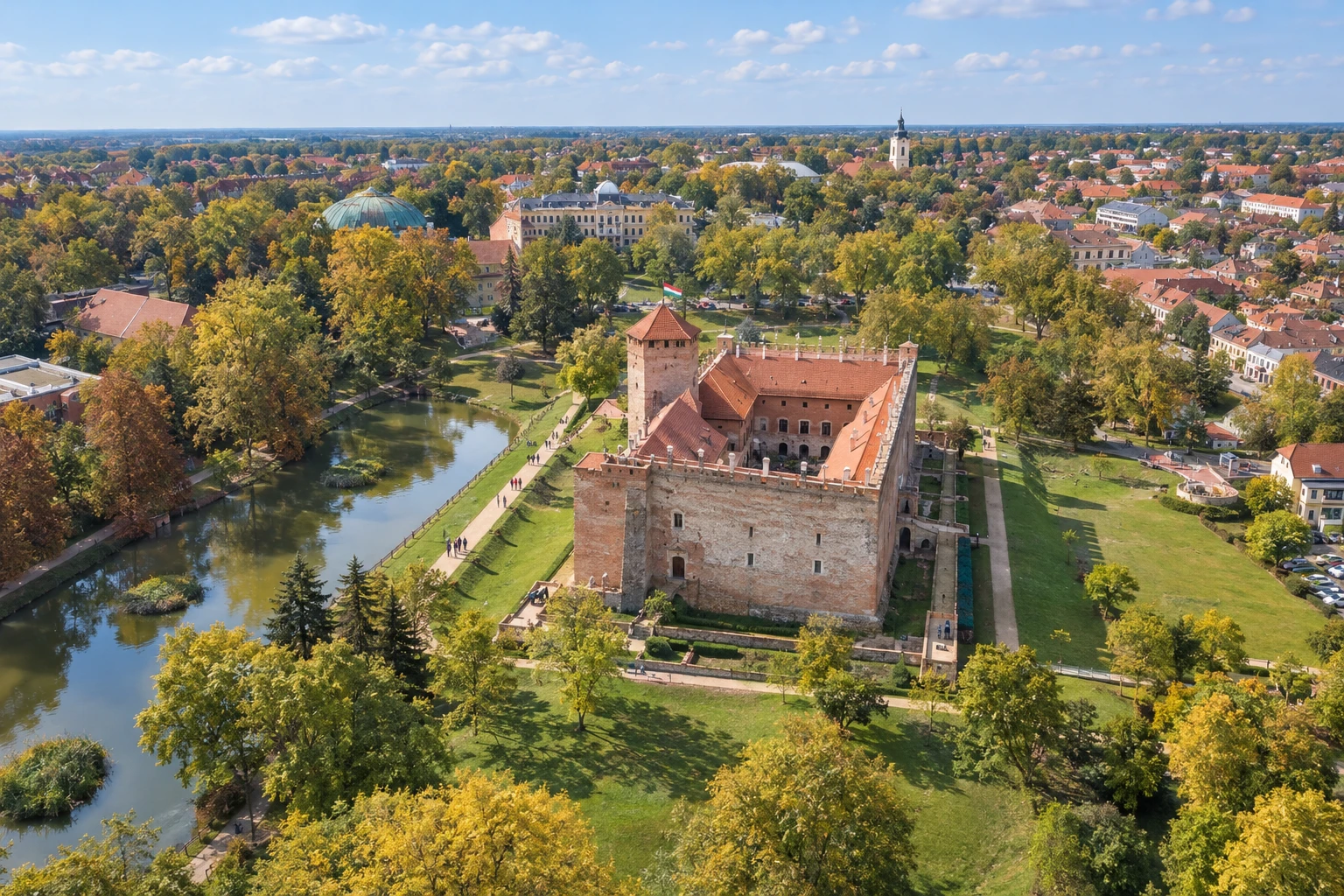
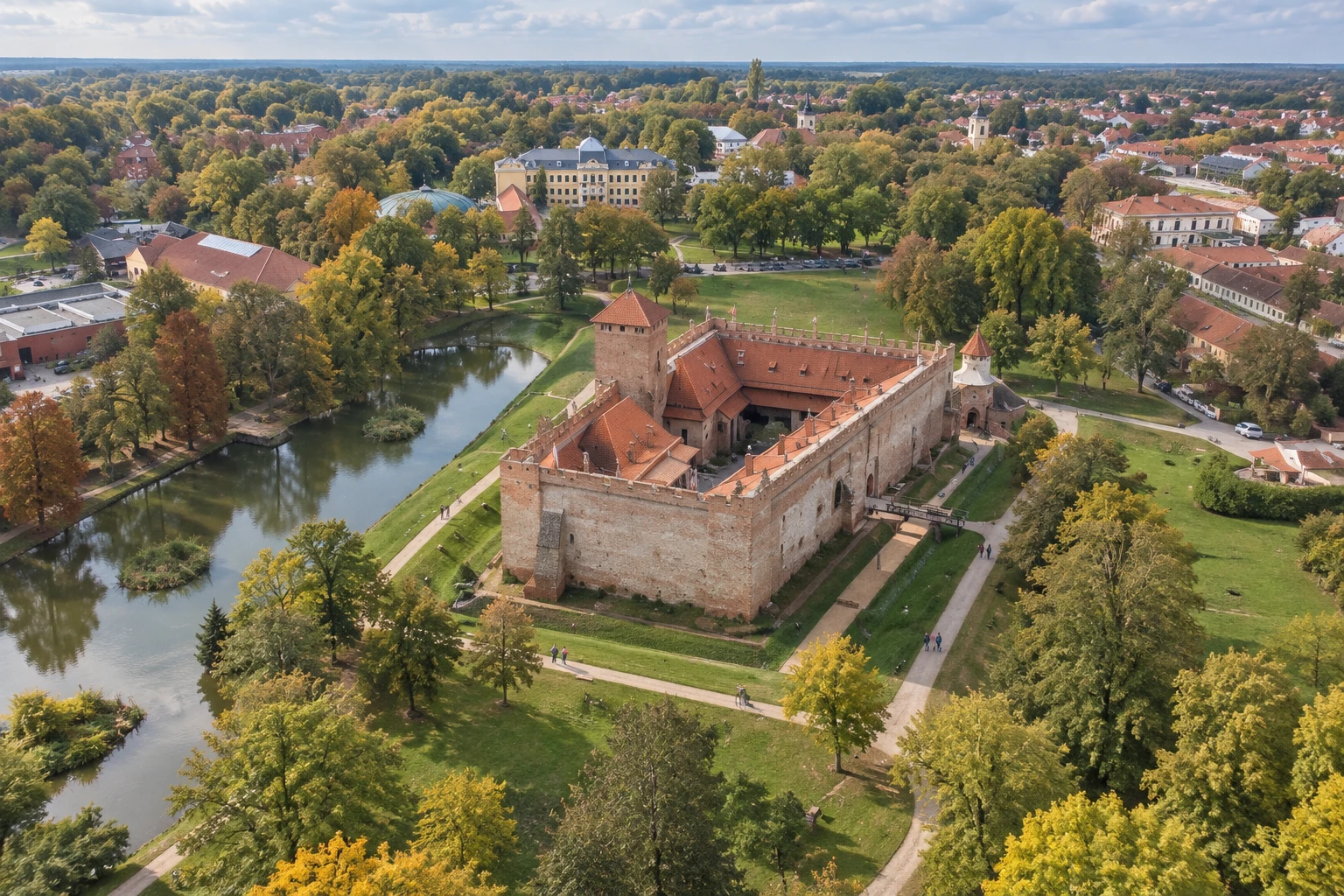
In the photo: Gyulai vár
Illustrative images. The pictures in this guide are illustrations based on the real place, not photographs, and may differ from it.

The city
Gyula combines a Gothic brick castle, the Almásy Palace and a thermal bath complex around the park. The three programs have different access and pacing. The town is a stop in southeastern Hungary, close to the county seat of Békés.
Gyula is a spa town in southeastern Hungary on the southern Great Plain, beside the Fehér-Körös River about 5 kilometers from the Romanian border. It is the second-largest town in Békés County. The county seat, Békéscsaba, lies 16 kilometers west. The region is among Hungary’s lowest-lying areas, and Gyula is flat, leafy and compact. You can walk from the center to the baths.
The sights that draw visitors from afar share one park. Gyula’s 15th-century castle is an intact Gothic brick fortress on level ground. In 1566 it held out against the Turkish army for 62 days. A boating lake lies in front. Next door are the Várfürdő, the castle baths, with 23 thermal-water pools in a park of old trees, and Almásy Palace, whose exhibition explores the lives of the counts and especially the servants who kept the household running.
The historic town begins a few minutes from the park. Kossuth utca and Városház utca lead to the parish church, Erkel tér, the Százéves Cukrászda pastry shop, open since 1840, and Ladics House, a middle-class home preserved with all its contents. Gyula is the birthplace of Ferenc Erkel, composer of Hungary’s national anthem. His birthplace is a museum in Németváros, the former German quarter. The Élővíz Canal, once the bed of the Fehér-Körös, forms a green corridor across downtown.
Hungarian, German and Romanian communities shaped Gyula, leaving their mark on its churches, neighborhoods and cooking. Gyula sausage is its best-known product, alongside pálinka fruit brandy.
The climate is continental. December through February is cold, with averages near 0°C, the season for indoor baths, saunas and museums. Spring is mild, with more rain in May and June. July and August are hot and sunny, with outdoor pools open and the Castle Theatre festival occupying the fortress courtyard from late June to mid-August. September and October are dry and quiet.
Highlights include the castle and tower climb, Almásy Palace, at least half a day in the Várfürdő, a walk from the park to Erkel tér with a stop at the historic pastry shop, Ladics House and Erkel’s birthplace. With more time, add the Kohán Gallery, sausage museum and a bike ride through the Körös woodlands.
30 places to stay in Gyula.
16 places to eat in Gyula.
Hotéis e restaurantes da cidade no mapa.
The local experience
Gothic brick castle on flat ground, with a courtyard and museum rooms in the centre of Gyula.
Aristocratic residence with an exhibition about the daily life of the palace's owners and staff.
Thermal complex near the castle and the palace, with bathing areas and water programs in a park setting.
To choose before you go
Where each tour starts, how long it takes, how it is done, what is included and the price range.
Built in the 15th century, Gyula Castle is described as the only intact lowland brick fortress in Central and Eastern Europe. At street level, it stands in parkland with a boating lake in front, a different setting from the hilltop castles of northern Hungary. János Maróti built it. János Corvin, son of King Matthias, enlarged it by adding the round cannon tower, the rondella, also called the Corvin Bastion. In the early 16th century the castle and estate passed to Corvin’s wife, Beatrix Frangepán. In the second half of that century, Gyula ranked among the country’s three strongest fortresses alongside Eger and Szigetvár. In 1566 around 2,000 soldiers held out against the Turkish army for 62 days before the fortress fell. Within the walls, a 24-room museum traces nearly seven centuries of history. The route passes the dungeon, torture chamber, workshops, kitchen and pantry, lady’s chamber, Knights’ Hall and chapel. There you can ring the bell in memory of the defenders. Digital displays recreate the siege and show the 16th-century complex, when the surviving inner castle was enclosed by a second, trapezoidal brick castle. Finish at the lookout tower overlooking town and park. On a clear day you can see the distant Bihar Mountains in Romania. In summer the courtyard becomes the auditorium for the Castle Theatre.
Stops: Gyula Castle (Gyulai vár), Knights’ Hall, Castle chapel, Lookout tower, Corvin Bastion (rondella).
Includes: Admission covers the exhibition and tower. Check current prices. Packages combine the castle, Almásy Mansion, Erkel House, Kohán Gallery, and Ladics House.
Tip: Check opening days before visiting. If you're planning several museum visits, ask about the combined package valid for several days.
Best time: Year-round. Performances take place in the courtyard from late June to mid-August.
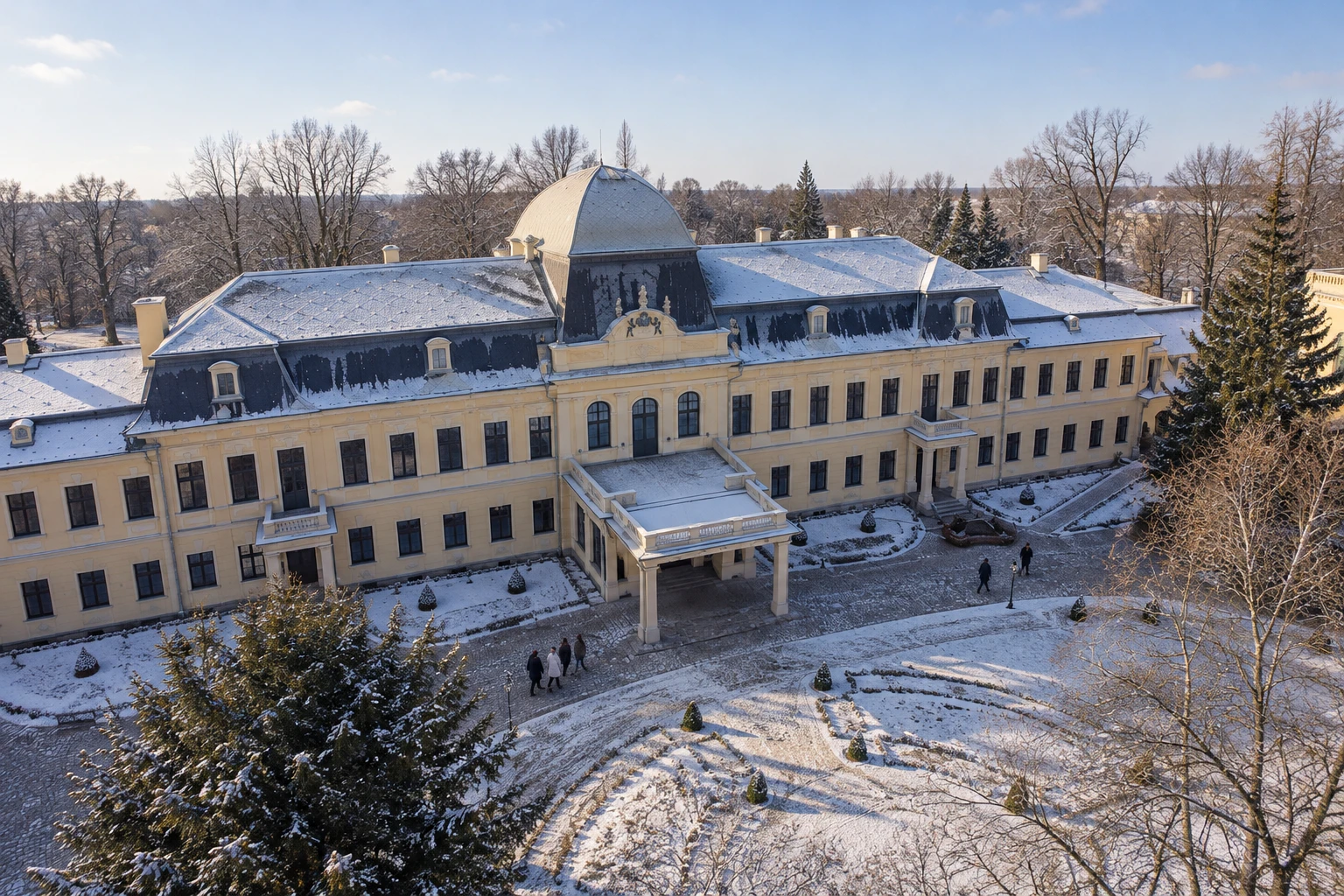
Almásy Palace stands opposite the castle and adds a different period and perspective to your visit. The exhibition looks beyond the reception rooms to pairs of opposites: celebrations and ordinary days, aristocrats and servants, light and shadow. Follow life behind the scenes in a great household to see the servants’ world and the work that sustained the family’s splendor. Interactive displays and hands-on stations form part of the visit. The house has a place in Hungarian cultural history. In 1746 it hosted the first theatrical performance in a Hungarian palace. Several generations of the Erkel family gave recitals here, and Ferenc Erkel composed parts of his operas in the park. Artist Mihály Munkácsy had his first encounter with painting in the house. In 1849 ten of the thirteen generals later executed at Arad laid down their arms in Gyula before being handed over to the Austrian army. A few steps away, sculptures arranged in a semicircle at the Martyrs of Arad memorial mark the surrender site. The visitor center was named among 40 outstanding European museums in 2018. Alongside the permanent exhibition are temporary shows and a lookout tower. The café has its own entrance from the park and requires no museum ticket. The shop sells work by Békés County craftspeople.
Stops: Almásy Mansion Visitor Center (Gyulai Almásy-kastély), Mansion lookout tower, Mansion grounds, Mansion café, Memorial to the Martyrs of Arad.
Includes: Tickets are available for the permanent exhibition, temporary exhibition, and tower. Check current prices. The combined museum package includes the palace.
Tip: Allow time for the interactive stations, a highlight of the visit. The castle and mansion have separate ticket offices. If visiting both on the same day, stop for coffee in the park between them.
Best time: Year-round. A good choice on cold or rainy days.
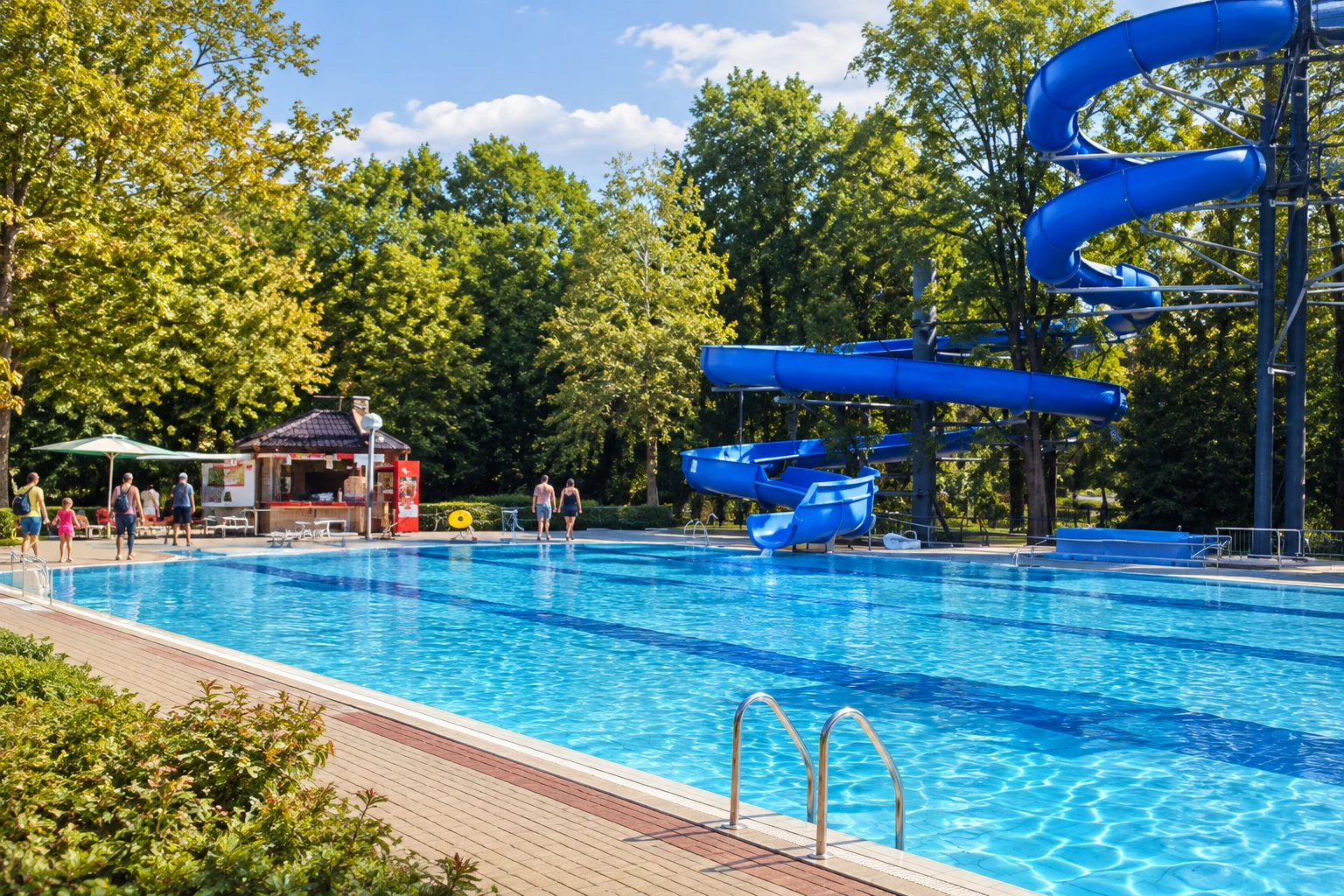
The Várfürdő occupies a park of mature trees beside the castle and gives Gyula its reputation as a spa town. Its 23 pools have 5,500 square meters of water surface. Thermal water emerges at 72°C from a well 2,005 meters deep. The alkaline water contains bicarbonate and chloride. Treatments supervised by health professionals require an advance consultation. The year-round complex has several sections. Indoor and outdoor medicinal pools form its traditional core. AquaPalota is an indoor adventure bath of more than 6,000 square meters, with slides, a lighted tunnel, a 3.5-meter diving pool, lazy river, waterfalls, pools for children and babies, and a swim-up bar. Castello Saunapark has several saunas, three outdoors, with guided sessions. For swimming there are 50-meter and 25-meter pools. The outdoor leisure pools open in summer. Children’s Paradise has slides, water cannons and fountains and can accommodate up to 300 children at a time. A playground with rubber surfacing is beside it. In fall and winter AquaPalota, the indoor medicinal pools and saunas remain open. Outdoor pools depend on the season and weather. The complex publishes a daily list of open pools.
Stops: Gyulai Várfürdő, Medicinal pools, AquaPalota, Castello Saunapark, 50-meter pool, Children’s Paradise.
Includes: Admission is charged by section and time slot. Check current rates. Treatments, massages and saunas may cost extra. Parking nearby is paid.
Tip: Bring a swimsuit, flip-flops and a towel. Before setting out, check which pools are open that day, as sections may close for maintenance.
Best time: Year-round. All outdoor pools are open June through August. Winter brings warm pools, saunas and AquaPalota.
The park surrounding the castle, palace and baths is a favorite town walk in every season. The short, level circuit links several sights you can enjoy without a ticket. The boating lake in front of the castle reflects its brick walls. Rowboats and pedal boats are available in warm weather, and a stage on the lake hosts Castle Theatre performances. In season a 50-meter-diameter Ferris wheel turns nearby. Its 30 cabins hold up to six people each, with views over the castle, baths and Almásy Palace. Book ahead. Várkert utca has the memorial to the Martyrs of Arad, generals from the 1848–1849 war of independence executed by the Austrians. The colors of the paving, gravel and lawn in front of the sculptures form the tricolor cockade, a symbol of the revolution. On Epreskert utca, the Franciscan ruins stand in an enclosed garden open daily. The friars came to the Gyula estate in 1410. The church and monastery stood from 1420 to 1566, when the friars fled the Ottoman attack. Excavations in 1930 uncovered the Gothic church, 35 meters long by 10 wide. You can see the apse and parts of the cells. János Corvin’s daughter Elisabeth and his wife Beatrix Frangepán were buried here. Elsewhere in town, St. Nicholas Sculpture Park has busts of Béla Bartók, Attila József, Endre Ady and Albrecht Dürer, whose father left nearby Ajtós for Nuremberg.
Stops: Castle Park (Várkert), Boating lake (Csónakázó-tó), Park Ferris wheel, Memorial to the Martyrs of Arad, Franciscan ruins, St. Nicholas Sculpture Park.
Includes: Self-guided outing. The park and ruins are free. Boats and the Ferris wheel cost extra.
Tip: The Ferris wheel and boat rentals operate seasonally and depend on the weather. Check before promising the children a ride. Late afternoon is most pleasant in summer.
Best time: April to October for the lake. The park is worth visiting year-round.
The first of two walks suggested by the town tourist office starts at the castle, passes Almásy Palace and the baths, then follows Kossuth utca toward downtown. The tourist office on Kossuth utca houses the Radio History Exhibition, with prewar Hungarian radios, telephones and other equipment, all kept in working order by a retired engineer. The office also stores luggage and rents bicycles. On Városház utca, the World Clock occupies a busy corner. A green 3.5-ton sphere at eye level represents Earth and shows the time zones. Lit at night, it is a meeting place and summer spot for street performers. Farther on is TájVízHáz, the water authority’s exhibition house on the landscape, rivers, medicinal baths and folk medicine of the Körös region. It closes in winter. The municipal library occupies the former town hall. Construction of the Nádi Boldogasszony parish church on Harruckern tér began in 1775 at the initiative of Ferenc Harruckern. Consecrated in 1777, it is a single-nave late Baroque church. A 470-square-meter ceiling painting created in 1986–1987 depicts figures and episodes from Gyula’s history. Behind the church lies Erkel tér. At its center is an 1896 bronze bust of Ferenc Erkel. Lights in the pavement around it reproduce the notes of the Hungarian national anthem. The historic Százéves Cukrászda pastry shop faces the square with Ladics House next door.
Stops: Kossuth utca, Radio History Exhibition, Városház utca, World Clock (Világóra), TájVízHáz, Nádi Boldogasszony Parish Church, Erkel tér, Százéves Cukrászda.
Includes: Self-guided visit. The radio exhibit, TájVízHáz, and the museums charge separate admission.
Tip: Finish at the pastry shop on Erkel tér. There's also a 2.7 km city exploration game with maps and puzzles, starting at the World Clock. Allow about 2 hours and buy it online.
Best time: Year-round. The TájVízHáz opens from March to October.
Ladics House is a single-story Baroque house built in the early 19th century as a notary’s residence. Dr. György Ladics and his wife moved in as newlyweds, and their descendants stayed until the house became a museum. Five generations preserved the furniture, everyday objects, clothing, library and family archive. The town bought both the building and its contents. The house is significant for the life it records. Hungary has many rural homes portraying peasant life and many furnished palaces. Ladics House is described as the country’s only middle-class home preserved with all its contents, a portrait of provincial life under the Austro-Hungarian monarchy and between the world wars. The exhibition retains the interiors and adds interactive features. The kitchen and pantry have handling replicas, and a 19th-century bathroom predates running water. In the shed, sit in a replica carriage and put on a virtual reality headset to explore 19th-century central Gyula. The shed leads to the courtyard of the neighboring Százéves Cukrászda. Open since 1840, it is Hungary’s second-oldest pastry shop. The Empire-style building has painted walls and original Biedermeier furniture. It serves traditional pastries, handmade chocolates and ice cream. The former workshop is now a confectionery museum with period utensils.
Stops: Ladics House (Ladics-ház), Százéves Cukrászda, Confectionery museum.
Includes: Ladics House charges admission, included in the combined museum package. Check current prices. Pastries and drinks cost extra.
Tip: Check opening days for Ladics House. The pastry shop fills up on summer afternoons, with more tables available in the morning.
Best time: Year-round.
The second walk suggested by the town tourist office starts on Kossuth tér, the square where motorists arrive. In the 19th century it was even bigger and hosted Gyula’s fairs. It has fountains and a pavement mosaic of 290,000 pieces that deliberately distorts Dürer’s Adam and Eve. The correct image appears reflected in a polished metal column. Follow Bartók Béla utca past the former synagogue, now a music school, into Németváros, the old German quarter. Behind the Catholic church stands the Ferenc Erkel Memorial House. Built in 1795 as the neighborhood school and teacher’s home, it took its neoclassical form in an 1830 renovation. Teacher József Erkel came from Bratislava in 1806. His son Ferenc was born here on November 7, 1810. He wrote the music for the Hungarian national anthem and established Hungarian national opera. Interactive terminals introduce the anthems of Europe, followed by rooms on European music, Erkel’s musician sons and his love of chess. A bedroom, living room and kitchen evoke family life. On the same square, Máriás House of 1770 is one of the town’s oldest homes and a cultural center for the German community. Visits require reservations. Back downtown, Göndöcs-kert is a park laid out in 1886 with oak and plane trees, a 42-meter water tower and a mosaic by György Kohán. Beside the Vigadó stands the Kohán Gallery, in a neoclassical building of 1895, the first purpose-built museum in the county. Kohán, a blacksmith’s son born in Gyulavári in 1910, studied in Budapest, Paris and Rome and left the town 691 paintings and 2,215 graphic works. The return route to the castle passes City Hall on Petőfi tér.
Stops: Kossuth tér, Old synagogue, Ferenc Erkel Memorial House (Erkel Ferenc Emlékház), Máriás House (Máriás-ház), Göndöcs-kert, Kohán Gallery (Kohán Képtár), City Hall.
Includes: Erkel House and Kohán Gallery charge admission, included in the combined museum package. Check current prices. Máriás House charges for its guided visit.
Tip: Both museums have weekly closing days. Check before planning your visit. The digital Visit Gyula Card offers discounts on both admissions.
Best time: Year-round.
Gyula sausage carried the town’s name abroad. Two places help explain its story. The first is the market. Gyula has a long tradition of fairs, and the producers’ market remains part of local life, with a leafy outdoor area and covered hall. Stalls sell smoked meats, homemade dairy products and cheeses, seasonal and preserved fruit and vegetables, seedlings, honey, preserves and crafts. The widest selection is on Tuesday, Friday and Sunday mornings. The second is the Gyula Sausage Museum in the former municipal slaughterhouse. A meat factory employee began the collection before 1985 with his own objects and tools donated by butchers’ families in and around Gyula to preserve the trade’s history. After years of closure and dismantling, the exhibition returned to the slaughterhouse through the efforts of the town butchers’ association, founded in 2008 to restore and maintain the museum. This living museum combines exhibits on the meat industry with sausage-making demonstrations that involve visitors and gatherings devoted to food. The town also has a pálinka distillery continuing a 300-year tradition and an award-winning chocolate maker.
Stops: Gyula Sausage Museum (Gyulai Kolbász Múzeum), Gyula Market.
Includes: The museum charges admission. Check current prices and ask about tastings. Market purchases are at your own expense.
Tip: Visit the market early on one of its three busiest days. Confirm the museum's visiting days and hours, especially outside summer.
Best time: Year-round. The market has the widest selection from late spring through fall.
Gyulavári is a former village now part of Gyula. It makes a good outing if you have a third day or enjoy cycling. Gyulavári Palace houses the Folk Art Memorial Room. Its permanent exhibition presents craft traditions from Gyula and the surrounding area, including Békés County and Kalotaszeg embroidery and handwoven wool and cotton rugs. More than a hundred pieces came from the town’s former folk art and home craft cooperative. Displays trace local weaving and the artisans who keep it alive. The room follows the palace’s opening hours. Opposite the Reformed church is the Zoltán Bay Memorial Exhibition. The physicist was born in the Gyulavári parsonage in 1900. By thirty he headed the theoretical physics department at the University of Szeged. Later, in Budapest, he established the country’s first nuclear physics department. His experiments gave rise to radar astronomy. He emigrated to the United States in 1948. A story relates that as a boy, seeing the moon behind the church tower, he wondered if climbing it would let him reach the moon. Gyulavári is also the birthplace of painter György Kohán, whose work is displayed in the downtown gallery.
Stops: Gyulavári Mansion (Gyulavári-kastély), Folk Art Memorial Room, Zoltán Bay Memorial Exhibition, Gyulavári Reformed Church.
Includes: Some properties charge admission or require reservations. Check before you visit.
Tip: Call ahead for palace and Zoltán Bay exhibition hours. The cycling route is flat. The tourist office rents conventional and electric bikes.
Best time: April to October for cycling.
Gyula and the Körös valley are flat, with bike paths linking the town to floodplain forests and river beaches. In town, the Élővíz Canal follows the former bed of the Fehér-Körös, creating a green corridor through the center. Walk or cycle alongside it for an easy way to see Gyula beyond the shopping streets. You can also take a rowboat on the canal. Three classic destinations lie outside town. Városerdő is a summer resort with a river beach on the Fekete-Körös, accessible by bike or car. Szanazug sits at the meeting of the Körös rivers and attracts beach sports enthusiasts. Póstelek forest park between Gyula, Békéscsaba and Békés was part of a Wenckheim family estate and is now a woodland recreation area. The Fehér-Körös and Fekete-Körös are among Hungary’s cleanest rivers, and the banks and forests are protected. The tourist office rents mountain bikes, some children’s bikes and e-bikes by the hour, day or week. E-bikes require a deposit. Shared electric scooters can be unlocked by app at marked locations.
Stops: Élővíz Canal (former course of the Fehér-Körös), Városerdő, Szanazug, Póstelek Forest Park.
Includes: Bike rental costs extra. Check current rates at the tourist office.
Tip: Bring water, a hat, and insect repellent in summer. Ask the tourist office about routes and check river beach conditions before planning a swim.
Best time: May to September. Spring and early fall offer milder weather for cycling.
Day by day
Suggestions to plan the trip. Change the order of the days according to the weather and tour availability.
Start early at the castle. Explore the rooms, ring the chapel bell and climb the tower. Cross to Almásy Palace for the exhibition on counts and servants, and take a break at the palace café in the park. Have lunch downtown and try Gyula sausage. In the afternoon, follow Kossuth utca and Városház utca past the World Clock and parish church to Erkel tér. Visit Ladics House and sit down at Százéves Cukrászda. If there is still daylight, return to the park via the Martyrs of Arad memorial and circle the lake. If you prefer water to museums, spend the afternoon at the Várfürdő instead. Both complete outings are difficult to fit into a single day.
Spend the morning at the castle and Almásy Palace. Use the combined museum ticket if you plan to visit the other museums the next day. After lunch, walk from the castle to Erkel tér via the Radio History Exhibition, World Clock, Nádi Boldogasszony church, Ladics House and the historic pastry shop. In the late afternoon, go to Kossuth tér for the Dürer mosaic and return along the Élővíz Canal. In summer, check the Castle Theatre program and buy tickets ahead.
Begin at the Ferenc Erkel Memorial House in Németváros and continue to Göndöcs-kert and the Kohán Gallery. On Tuesday, Friday or Sunday, stop at the market first. Reserve the rest of the day for the Várfürdő. Enjoy the medicinal pools, AquaPalota if traveling with children, and the saunas toward evening. Check at the entrance which sections are open. Finish with a walk through the castle park.
Devote the morning to the castle and Almásy Palace. Stay in the park in the afternoon for the boating lake, Martyrs of Arad memorial, Franciscan ruins and, in season, the Ferris wheel. End the day with a walk to Erkel tér for a sweet at the historic pastry shop.
Spend the morning at Ladics House, the Ferenc Erkel Memorial House and the Kohán Gallery in whatever order their opening days allow. If Gyula sausage interests you, include the museum in the former slaughterhouse. Take the afternoon and evening at your own pace at the Várfürdő.
Rent a bike at the tourist office. Follow the Élővíz Canal and choose between Gyulavári, with the palace and Zoltán Bay exhibition, or the Körös woodlands at Városerdő or Szanazug, with river beaches in summer. With a car or by train, an alternative is Békéscsaba, 16 kilometers away, with museums devoted to painter Mihály Munkácsy. Both outings take you beyond central Gyula. Return in time for one last thermal bath.
Best time to go
The seasons shown are the most usual ones; nature doesn't always follow the calendar.
Indoor baths, saunas and museums
The coldest month. At Békéscsaba station, 16 kilometers away, the average is near -2°C, with about 35 mm of rain or snow and little sunshine. It is the season for the indoor Várfürdő, where the medicinal pools, AquaPalota and saunas operate normally. The castle, Almásy Palace and Ladics House fill the short days. TájVízHáz closes in winter.
Castle Theater chamber season
Winter continues, with an average around 0°C and about 37 mm of precipitation. Days grow slightly longer. Museums and indoor baths make good outings, and the Castle Theatre holds chamber performances indoors from October to April. Dress warmly for the walk between the park and downtown.
TájVízHáz usually reopens in the middle of the month
Spring begins with an average of 6°C and around 32 mm of rain. Park trees begin to bud and downtown walks grow more pleasant. TájVízHáz usually reopens after its winter break. Outdoor pools at the Várfürdő still depend on the weather.
Start of cycling season
Mild days average 11 °C, with around 44 mm of rain. It’s a good month to cycle along the Élővíz Canal and out to Gyulavári, and to visit the castle and mansion without lines. Bring a light layer and a raincoat.
Boats on the castle lake
Temperatures average 17 °C, with about 57 mm of rain falling in showers. The park is at its greenest, boats are out on the lake, and people start visiting the Körös river beaches on warmer days. Some outdoor pools at the Várfürdő open as weather permits.
Castle Theater Festival from late June
Early summer brings the wettest month, averaging 20°C with around 82 mm of rain in late-afternoon storms. The outdoor leisure pools open at the Várfürdő. The Castle Theatre festival begins late in the month with shows in the fortress courtyard and on the lake stage.
Shakespeare Festival in early July · Castle Theater
The hottest and sunniest month averages 22°C, with around 49 mm of rain. The Castle Theatre has performances almost daily, and the Shakespeare Festival brings Hungarian and international companies early in the month. Visit museums in the morning and spend afternoons in the water. Book accommodations ahead.
Castle Theater through mid-August
Summer heat averages 21°C, with around 51 mm of rain. All sections of the Várfürdő operate at this busiest time of year. The Castle Theatre festival runs until midmonth. The river beaches at Városerdő and Szanazug are in season.
Outdoor pool season ends
The heat eases, averaging 17 °C, with about 34 mm of rain in one of the driest months. The town quiets down after the vacations, making it a good time to combine museums, cycling and baths. Outdoor pools gradually close as the weather changes.
Castle Theater chamber season resumes
Dry fall weather averages 11 °C, with about 34 mm of rain. The trees turn color in the castle park and Göndöcs-kert. Várfürdő switches to its fall and winter schedule, with AquaPalota, indoor medicinal pools and saunas.
Indoor baths and museums
It turns colder and gets dark early. The average is 5 °C, with about 54 mm of rain and few hours of sunshine. Explore indoors at the castle, Almásy Mansion, Ladics House, Erkel House and Kohán Gallery, then end the day in the warm pools.
Indoor baths, saunas and museums
Winter averages are close to 1 °C, with about 54 mm of rain or snow and the shortest days of the year. The season’s highlight is an outdoor thermal pool steaming in the cold air. Check museum and bath opening hours over the holidays.
Plan the journey
Gyula has no airport. Visitors arriving from farther away generally fly into Budapest International Airport and continue by car, train or bus.
The town tourist office also suggests two regional airports, Debrecen in Hungary, about two hours by car, and Timișoara in Romania, also about two hours away with a border crossing at Gyula. Both have fewer flights. Check available routes.
Local companies offer airport transfers by advance arrangement.
From another continent, the journey usually involves a connection in a European city. Confirm flights and connections before buying.
Gyula is on the railway line from Szeged through Békéscsaba toward Kötegyán. Békéscsaba, 16 kilometers away, is the regional junction. Some trips from Budapest require a change there.
Gyula station is around 2 kilometers from the castle park. Finish the journey by taxi, local transportation or on foot.
Check times and transfer requirements before buying your ticket.
Gyula has a bus station with regional connections. Békéscsaba, the county seat, lies 16 kilometers away.
The national transportation planner recommended by the town tourist office combines bus and rail timetables. Check before traveling, particularly on weekends and holidays.
The main approach is the M44 expressway, connecting the region to Budapest. The drive from the capital takes about two and a half hours. Route 47 takes around an hour and a half from Szeged or two hours from Debrecen.
From Romania, crossing at Gyula, allow about an hour and a half from Arad or two hours from Timișoara via the E671. From Oradea, allow around two hours with a crossing at Méhkerék. Route 44 bypasses the built-up area.
Parking is paid in marked town zones, including around the Várfürdő. Meters display rates for each zone, payable in cash or by app.
If crossing the border, entry requirements depend on nationality and travel documents and may change. Confirm them before you travel.
Distances are short in Gyula. The castle, Almásy Palace and Várfürdő stand in the same park. From there to Erkel tér, the walk follows flat, tree-lined streets.
The tourist office on Kossuth utca rents regular bikes and e-bikes, stores luggage and provides information on taxis and bus stops. Cycle paths run through town and into the surrounding area.
Shared electric scooters are available at marked locations and unlocked with an app. Return yours to a designated spot.
Taxis are available by phone. Local tourist information also mentions a sightseeing train for exploring without walking. Ask at the office whether it is operating.
Your questions
The seat is Békéscsaba; Gyula is nearby and concentrates the heritage programmes of this destination.
They are separate buildings, with their own themes and ticketing.
Check the chosen connection; a change in Békéscsaba may be necessary.
For a more comfortable pace, reserve another period or day for the pools and changing.
It’s a tight fit. The drive takes about 2 hours 30 minutes each way, and the train may require a change in Békéscsaba. One day covers the castle, Almásy Mansion and a walk downtown, leaving out the baths. The Várfürdő deserves at least half a day, so it makes sense to stay a night or two.
About 5 km. Gyula has a road border crossing, and the drive takes about 1 hour 30 minutes to Arad or two hours to Timișoara or Oradea. Local companies offer minibus trips to these cities. Entry requirements depend on your nationality and travel document and can change, so check before traveling.
Yes. A castle visit includes the lookout tower, with views over the town and park. On a clear day you may see the distant Bihar Mountains in Romania. Almásy Mansion also has a lookout tower, with its own ticket. Check current prices and opening days before you go.
Yes. In fall and winter, AquaPalota, the indoor baths with waterslides, stays open alongside the indoor medicinal pools and saunas. The outdoor leisure pools depend on the season and weather. Check the baths’ daily list of open pools before setting out.
It’s the town’s digital discount card. Register online and use the QR code without downloading an app. It offers discounts at attractions including the Erkel Memorial House, Kohán Gallery and Ladics House, as well as for bike rentals, participating restaurants and other services. A combined admission package is also available for the town’s museums.
Yes. The Várfürdő has AquaPalota, with waterslides and pools for children and babies, plus the outdoor Children’s Paradise in summer. The castle park has a boating lake and a seasonal Ferris wheel. At the castle, children can see a dungeon, ring a bell and climb the tower. Ladics House offers a virtual-reality carriage ride. Everything is a short walk apart.
Gyula sausage is the best-known local specialty. It has its own museum in the old slaughterhouse, and you’ll find it at the market and in restaurants. The town also makes handcrafted chocolates and has a 300-year tradition of distilling pálinka, a fruit brandy. For pastries, try Százéves Cukrászda on Erkel tér. Open since 1840, it’s Hungary’s second-oldest pastry shop.
Ferenc Erkel composed the music for Hungary’s national anthem and founded the Hungarian national opera tradition. He was born on November 7, 1810, in the Németváros schoolhouse where his father taught. The building is now the Ferenc Erkel Memorial House. On Erkel tér, lights in the pavement near his bust reproduce the notes of the anthem. He composed parts of his operas in the grounds of Almásy Mansion.
It runs from late June to mid-August, with theater, musicals, dance, jazz, blues, classical concerts and children’s events almost daily. Most performances take place in the castle courtyard, with some on the lake stage. The Shakespeare Festival takes place in early July. From October through April, the theater continues in its chamber venue. Buy tickets ahead of time.
Yes. The tourist office on Kossuth utca rents mountain bikes, including children’s sizes, and electric bikes by the hour, day or week. Electric bikes require a cash deposit. The town is flat, with bike paths to Gyulavári and the Körös woodlands. Shared electric scooters are also available through an app.
Békéscsaba, 16 km away, has a cultural quarter dedicated to painter Mihály Munkácsy, with a memorial house and museum, as well as a large Lutheran church. Szabadkígyós has Wenckheim Palace and its English-style park. Closer options include Póstelek Forest Park and the river beaches at Városerdő and Szanazug. You can make these trips by car or bike.
Gyula has no airport. Long-distance visitors often use Budapest Airport, about 2 hours 30 minutes away by car. The town tourism office also suggests Debrecen in Hungary and Timișoara in Romania, each about a two-hour drive away and served by fewer flights. Check connections before booking.
The two main choices are the baths area and the historic center. Beside the Várfürdő and castle park, accommodations range from apartments and guesthouses to spa hotels, convenient for time in the baths. The old streets around Erkel tér suit visitors who want restaurants and cafés on their doorstep. The two areas are within walking distance of each other. Book ahead in July and August.