

 Brazil
 Antarctica
 Argentina
 Bolivia
 Chile
 Colombia
 Ecuador
 Falkland Islands (Malvinas)
 French Guiana
 Guyana
 Paraguay
 Peru
 Suriname
 Uruguay
 Venezuela
 Albania
 Austria
 Belgium
 Croatia
 Denmark
 Finland
 France
 Germany
 Hungary
 Iceland
 Ireland
 Italy
 Luxembourg
 Norway
 Poland
 Portugal
 Slovakia
 Slovenia
 Spain
 Sweden
 Switzerland
 the Czech Republic
 the Netherlands
 the United Kingdom
 Turkey
 Bermuda
 Canada
 Greenland
 Mexico
 Saint Pierre and Miquelon
 the United States
 the Dominican Republic
 Japan
 Egypt
 South Africa
 Australia
 Fiji
 New Zealand
 Papua New Guinea
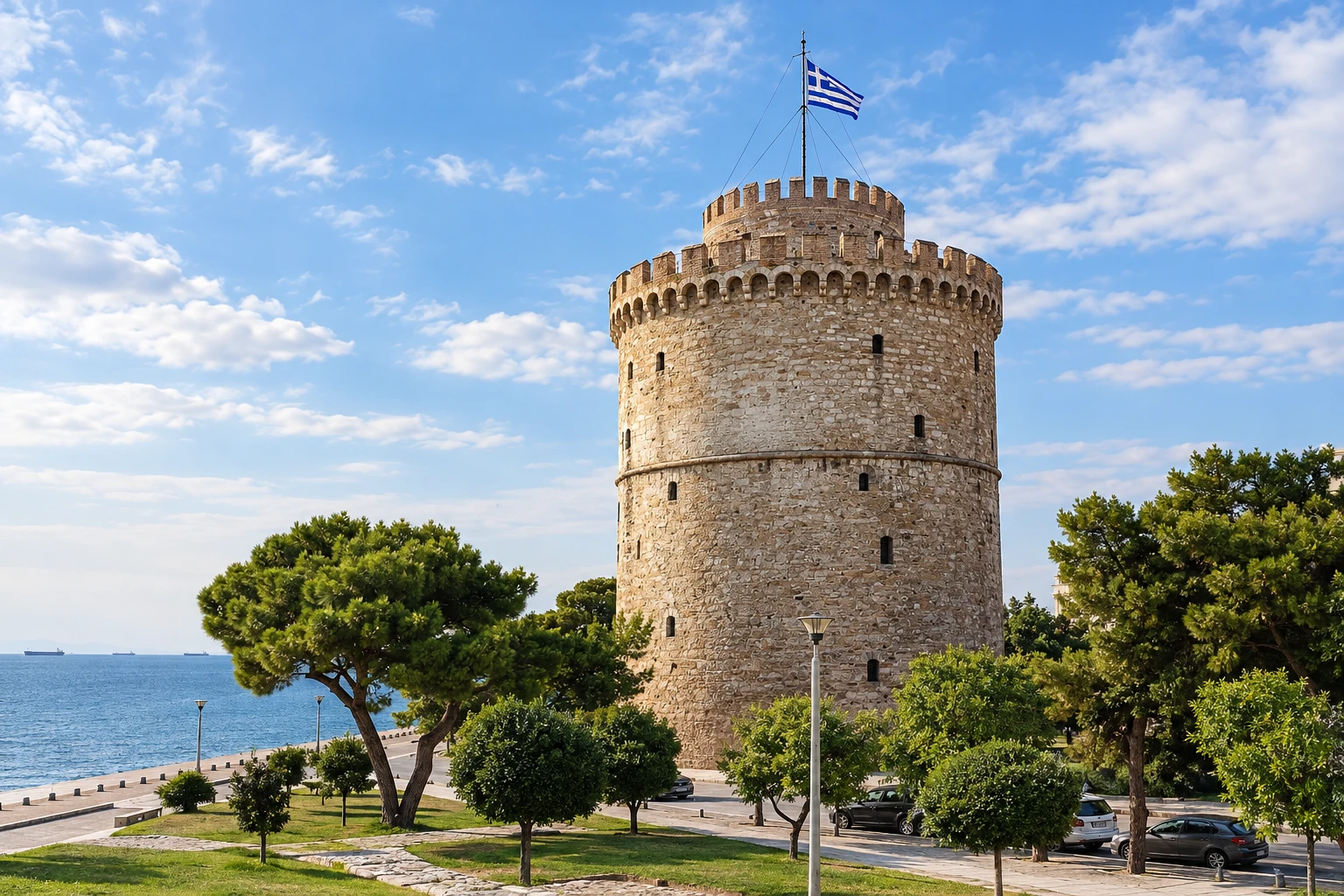
Archaeological site · Thessaloniki, Greece
Vergina: Polycentric Museum of Aigai (Polykentriko Mouseio Aigon)
Vergina, ancient Aigai, the first capital of Macedonia: the underground museum with the tomb of Philip II and the golden larnax, the main museum and the palace where Alexander was acclaimed king. 75 km from Tessalônica.
Illustrative images. The pictures in this guide are illustrations based on the real place, not photographs, and may differ from it.

Discover
About Vergina: Polycentric Museum of Aigai (Polykentriko Mouseio Aigon)
Vergina is the modern village above ancient Aigai, the first capital of the kingdom of Macedonia, about 75 km southwest of Tessalônica, at the foot of the Piérios mountains. The site has been part of the Unesco World Heritage since 1996 and is visited today as the Museu Policêntrico de Aigai, with three centres.
The Museu dos Túmulos Reais lies beneath a grassy mound, the Great Tumulus, which archaeologist Manolis Andronikos began excavating in 1977. Inside, in the dark, are the façades of the intact tombs, among them the one attributed to Filipe II, father of Alexandre the Great, and that of Alexandre IV, son of Alexandre. In the display cases, the gold larnax with the sol da Macedônia on the lid, which held the king's bones, the gold oak‑leaf crown, the ceremonial armour, the diadem and Queen Meda's jewellery.
The Museu Central, about a kilometre away, is the gateway to the complex, with the exhibition A Memória de Aigai: everyday objects, weapons, sculptures, inscriptions and the veiled statue of Queen Eurídice, as well as a reconstruction of a section of the palace façade in a glazed atrium.
The Palácio de Aigai, above the village, was built in the reign of Filipe II and is the largest building of classical Greece, covering about 15,000 square metres around a large courtyard with Doric colonnades and mosaic floors, such as the Rape of Europa. It was there that Alexandre was acclaimed king in 336 BC, after his father's assassination. Restored for many years, it is open to visitors. Below it lies the theatre.
Before you go
Practical information
Cidade Turismo reviews its information regularly, but something may have changed. Check with the place before planning your trip.
How much time to set aside
About 3 to 4 hours for the three sites; a full day if coming from Tessalônica.
Best time
In the morning, arriving at the opening of the tombs museum before the groups. Spring and autumn are more pleasant for the palace and the outdoor theatre. The complex closes on some holidays and has shorter winter hours; check before you go.
How to get there
By car, about 75 km and one hour from Tessalônica via the Egnatia Odos highway, exit Veria. By KTEL bus, from the Makedonia terminal to Veria and from there a local bus or taxi for 13 km to Vergina. By train, to Veria station and then taxi.
Tip
Start at the Museu Central and leave Filipe's tomb for last, when your eyes have adjusted to the dim light. Photography is not allowed inside the tombs museum. Bring water and a hat for the palace, which has little shade. Ask about the single ticket that covers the three sites.
Official website
Your questions
Frequently asked questions about Vergina: Polycentric Museum of Aigai (Polykentriko Mouseio Aigon)
Is a day trip from Tessalônica to Vergina possible?
Yes. It's about 75 km and an hour by car; by KTEL bus, with a change in Veria, it takes longer. Allow a full day for the three sites.
Is the tomb of Filipe II really in Vergina?
Tomb II of the Great Tomb is attributed to Filipe II by most archaeologists, although there is debate. The golden sarcophagus and the armor found within it are displayed on site.
Can the palace of Aigai be visited?
Yes. After a long restoration, the palace is open, with the colonnades rebuilt and the mosaics protected. It stands above the village, a few minutes' drive from the museums.
Can you take photographs inside the tombs' museum?
No. Photography is prohibited in the underground museum to protect the façade paintings. In the Museu Central and in the palace it is allowed without flash.