

 Brazil
 Antarctica
 Argentina
 Bolivia
 Chile
 Colombia
 Ecuador
 Falkland Islands (Malvinas)
 French Guiana
 Guyana
 Paraguay
 Peru
 Suriname
 Uruguay
 Venezuela
 Albania
 Austria
 Belgium
 Croatia
 Denmark
 Finland
 France
 Germany
 Hungary
 Iceland
 Ireland
 Italy
 Luxembourg
 Norway
 Poland
 Portugal
 Slovakia
 Slovenia
 Spain
 Sweden
 Switzerland
 the Czech Republic
 the Netherlands
 the United Kingdom
 Turkey
 Bermuda
 Canada
 Greenland
 Mexico
 Saint Pierre and Miquelon
 the United States
 the Dominican Republic
 Japan
 Egypt
 South Africa
 Australia
 Fiji
 New Zealand
 Papua New Guinea
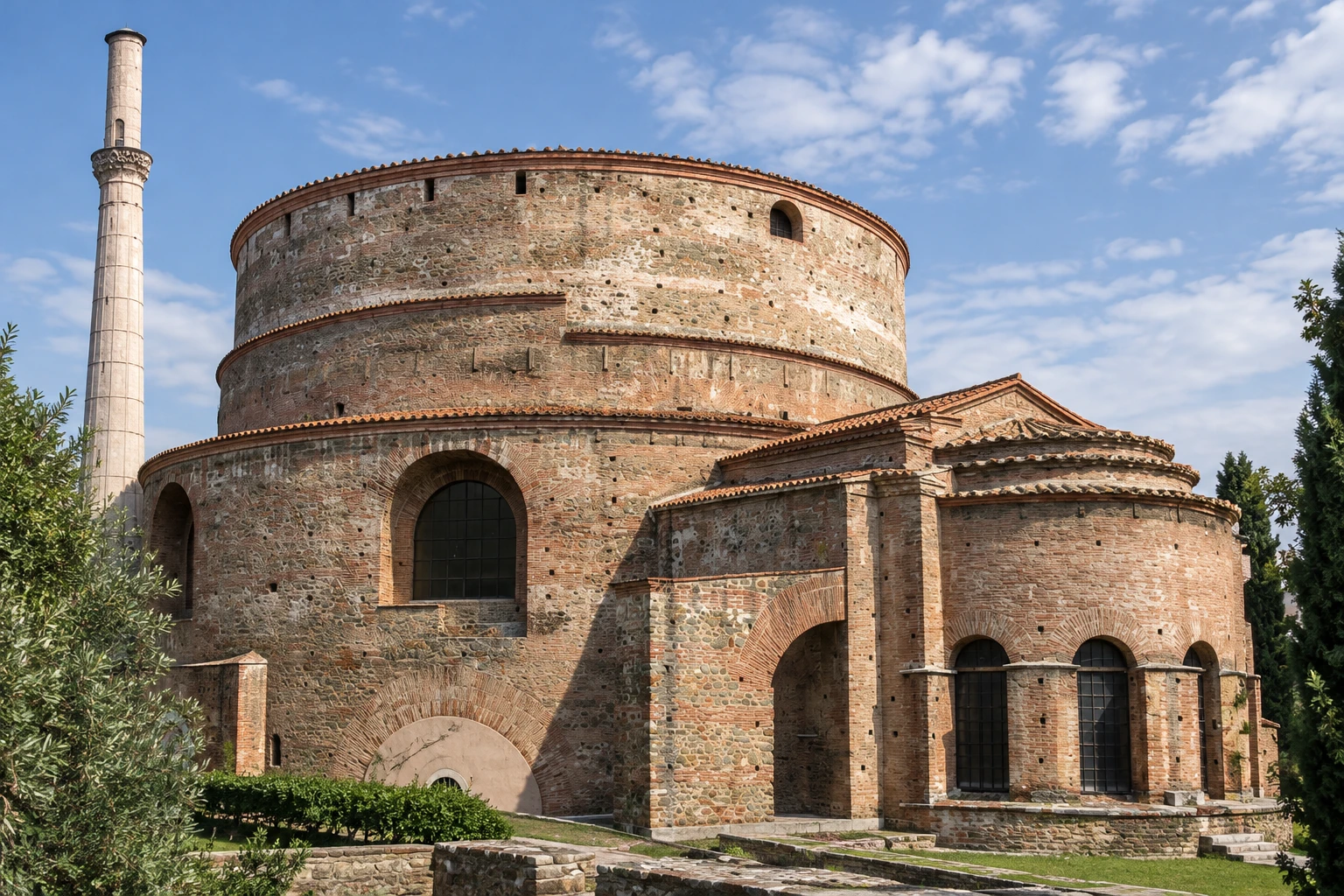
Monument · Thessaloniki, Greece
Rotunda of Galerius (Rotonda)
4th-century circular Rotunda, built by Galério, which was a church, a mosque and then a church again. It houses early-Christian mosaics in the dome and is part of the UNESCO World Heritage.
Illustrative images. The pictures in this guide are illustrations based on the real place, not photographs, and may differ from it.

Discover
About Rotunda of Galerius (Rotonda)
The Rotonda is a circular brick building with an internal diameter of about 24 metres and walls more than six metres thick, built around 306 by order of Emperor Galério, near the palace and the arch that bear his name. It has never been certain whether it began as a mausoleum or as a temple. At the end of the 4th century it became a Christian church, gained an apse and an ambulatory and spent more than a thousand years as the church of the Archangels, later known as Agios Georgios.
In 1590 the Ottomans converted it into a mosque and erected the minaret, the only one that remained in Tessalônica. In 1912, with the city's entry into Greece, it was reconsecrated as a church, but the minaret remained. Today it is a monument under the Ministry of Culture, with Orthodox services on certain dates of the year.
The main attraction is the dome mosaics, from the late 4th or early 5th century: a band of standing martyr saints in front of golden architectural façades, and traces of the upper register with angels. Part of the mosaics has been lost, and what remains is one of the oldest early-Christian ensembles known. The 1978 earthquake damaged the building, which was restored in the following decades.
The Rotonda is part of the paleochristian and Byzantine monuments of Tessalônica inscribed by Unesco in 1988. It stands a few steps above the Arco de Galério, at the end of Dimitriou Gounari street.
Before you go
Practical information
Cidade Turismo reviews its information regularly, but something may have changed. Check with the place before planning your trip.
How much time to set aside
30 minutes to 1 hour.
Best time
In the morning, when light comes through the high windows and illuminates the mosaics. The monument closes on some holidays and, as a church, may hold services on specific dates; check before you go.
How to get there
At the top of Dimitriou Gounari street, 125 metres north of the Arco de Galério, about a 12-minute walk from praça Aristotelous via the Egnatia.
Tip
Bring binoculars or use your camera's zoom to see the details of the martyrs on the dome. There is a ticket that includes several of the city's Byzantine monuments at certain times; ask at the desk.
Your questions
Frequently asked questions about Rotunda of Galerius (Rotonda)
Is the Rotonda a church or a museum?
It is a monument administered by the Ministry of Culture, open to visitors with an entrance fee, and it also hosts Orthodox worship on some dates of the year.
What are the mosaics of the Rotonda?
Early Christian mosaics from the late 4th or early 5th century, in the dome, showing martyr saints before golden facades. They are among the oldest known.
Why is there a minaret beside it?
The Rotonda was a mosque from 1590 to 1912. The minaret from that period is the only one remaining in Tessalônica and was kept as part of the building's history.
Is it far from Arco de Galério?
No. It's about 125 meters up Dimitriou Gounari street, which follows the axis of the ancient Roman processional way.