

 Brazil
 Antarctica
 Argentina
 Bolivia
 Chile
 Colombia
 Ecuador
 Falkland Islands (Malvinas)
 French Guiana
 Guyana
 Paraguay
 Peru
 Suriname
 Uruguay
 Venezuela
 Austria
 Belgium
 Croatia
 Denmark
 Finland
 France
 Germany
 Hungary
 Iceland
 Ireland
 Italy
 Luxembourg
 Norway
 Poland
 Portugal
 Slovakia
 Slovenia
 Spain
 Sweden
 Switzerland
 the Czech Republic
 the Netherlands
 the United Kingdom
 Turkey
 Bermuda
 Canada
 Greenland
 Mexico
 Saint Pierre and Miquelon
 the United States
 the Dominican Republic
 Japan
 Egypt
 South Africa
 Australia
 Fiji
 New Zealand
 Papua New Guinea
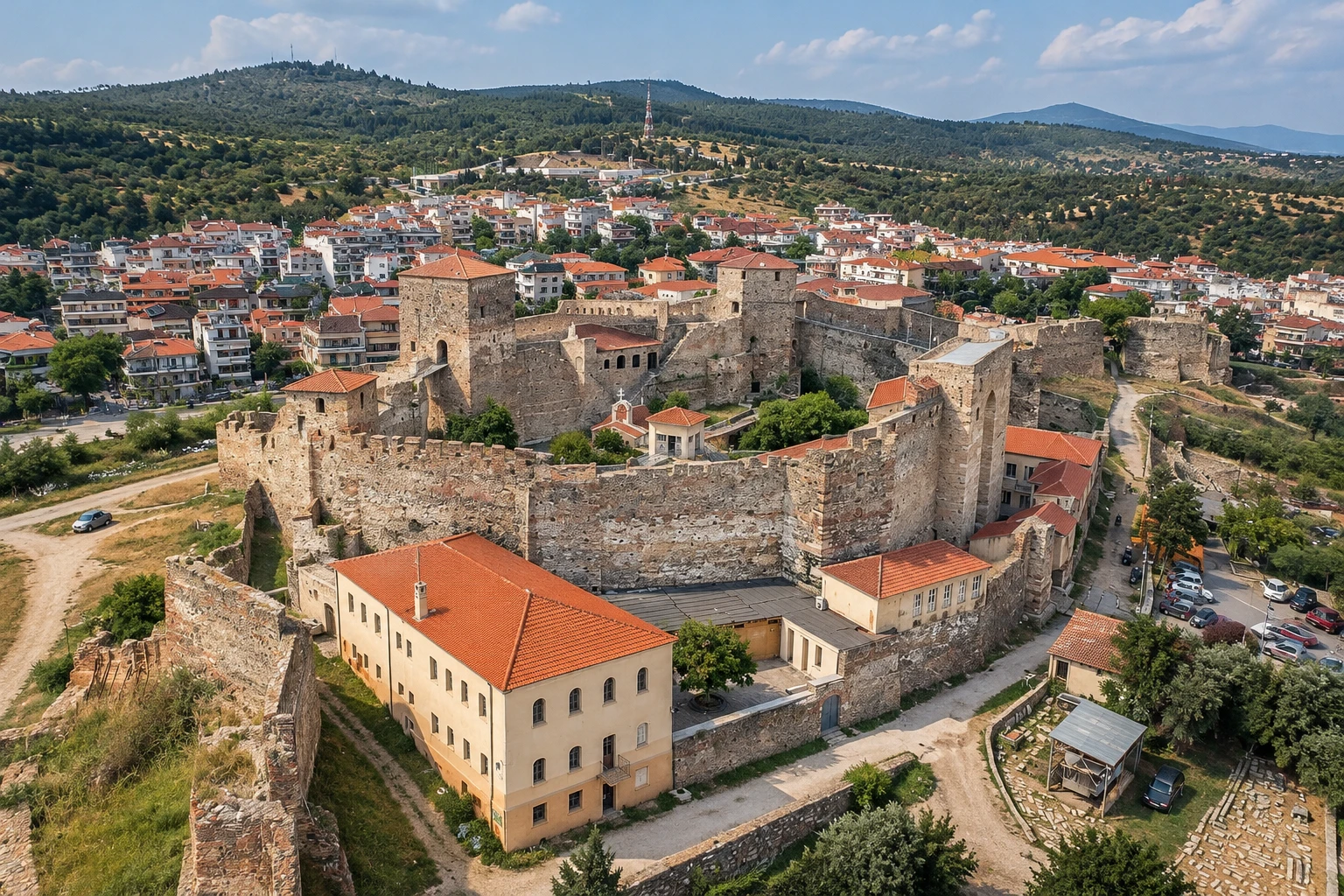
Fortress · Thessaloniki, Greece
Ano Poli, the City Walls and the Heptapyrgion
The fortress of the seven towers, high on Ano Poli, with Byzantine and Ottoman walls, a prison that operated until 1989 and the best view of the city and the bay. Around it lie the upper town and the ramparts.
Illustrative images. The pictures in this guide are illustrations based on the real place, not photographs, and may differ from it.

Discover
About Ano Poli, the City Walls and the Heptapyrgion
The Eptapyrgio (Heptapyrgion, or Yedi Kule in Turkish, the seven towers) is the citadel at the northeast corner of the acropolis of Tessalônica, the highest point of the walls. Despite the name, it has ten towers. The five on the north side date from the late Roman or early Byzantine period; the southern ones are from the 12th century. An inscription over the gate records the reconstruction by the Ottomans in 1431, soon after the conquest, when the fortress came to house the military governor and his garrison.
At the end of the 19th century the fortress became a prison, and it remained so until 1989. It housed common and political prisoners from various regimes, and the name Yedi Kule appears in many rebetiko songs, the Greek urban music. Since its closure the Ministry of Culture has been studying and restoring the complex; parts of the cells and the prison courtyards can be visited together with the walls.
The walk up there is an attraction in itself. Ano Poli, the upper town, escaped the 1917 fire and preserves Ottoman wooden houses, stone alleyways, small Byzantine churches and the four kilometers of walls that once surrounded the city. The Torre Trigonio, next to the gate of Anna Paleóloga, is the locals' favorite viewpoint at the end of the day, with the whole city and the bay below; visits inside the tower are by appointment only.
Nearby are the mosteiro de Vlatadon, still active, and the churches of Osios David and Agios Nikolaos Orfanos.
Before you go
Practical information
Cidade Turismo reviews its information regularly, but something may have changed. Check with the place before planning your trip.
How much time to set aside
Allow 1 to 2 hours for the fortress; half a day if you include the walk through Ano Poli and the walls.
Best time
Late in the afternoon, to watch the sun set over the bay from the Torre Trigonio and the walls. The fortress is closed on Tuesdays and on some holidays; check before you go. On hot days, take the bus up and walk down.
How to get there
At the top of Ano Poli, about 2 km and a 35-minute uphill walk from praça Aristotelous. Urban buses on the lines serving Ano Poli and the Eptapyrgio run from the centre and stop near the gate; check the line number at the stop or on the OASTH app.
Tip
Take a bus up to the Eptapyrgio and walk down along the walls to the Torre Trigonio, then through the alleys to Osios David and the Rotonda. Bring water: there are few cafés along the walls. Sturdy footwear for the stones.
Your questions
Frequently asked questions about Ano Poli, the City Walls and the Heptapyrgion
Is the Eptapyrgio open to visitors?
Yes, with admission, closed on Tuesdays and some holidays. The route goes through the walls, courtyards and part of the former prison; check opening hours before going.
How to get up to Ano Poli without getting tired?
By city bus from the center to the upper area, then walk down along the walls and alleyways. Walking up from Aristotelous square takes about 35 minutes uphill.
Can you enter the Torre Trigonio?
Interior visits are by appointment only, on specified days. The view of the area around the tower, next to the walls, is accessible at any time.
Why does the fortress appear in songs?
It was a prison from 1890 to 1989, and the name Yedi Kule entered the lyrics of rebetiko, the Greek urban popular music of the 20th century.