

 Brazil
 Antarctica
 Argentina
 Bolivia
 Chile
 Colombia
 Ecuador
 Falkland Islands (Malvinas)
 French Guiana
 Guyana
 Paraguay
 Peru
 Suriname
 Uruguay
 Venezuela
 Albania
 Austria
 Belgium
 Croatia
 Denmark
 Finland
 France
 Germany
 Hungary
 Iceland
 Ireland
 Italy
 Luxembourg
 Norway
 Poland
 Portugal
 Slovakia
 Slovenia
 Spain
 Sweden
 Switzerland
 the Czech Republic
 the Netherlands
 the United Kingdom
 Turkey
 Bermuda
 Canada
 Greenland
 Mexico
 Saint Pierre and Miquelon
 the United States
 the Dominican Republic
 Japan
 Egypt
 South Africa
 Australia
 Fiji
 New Zealand
 Papua New Guinea
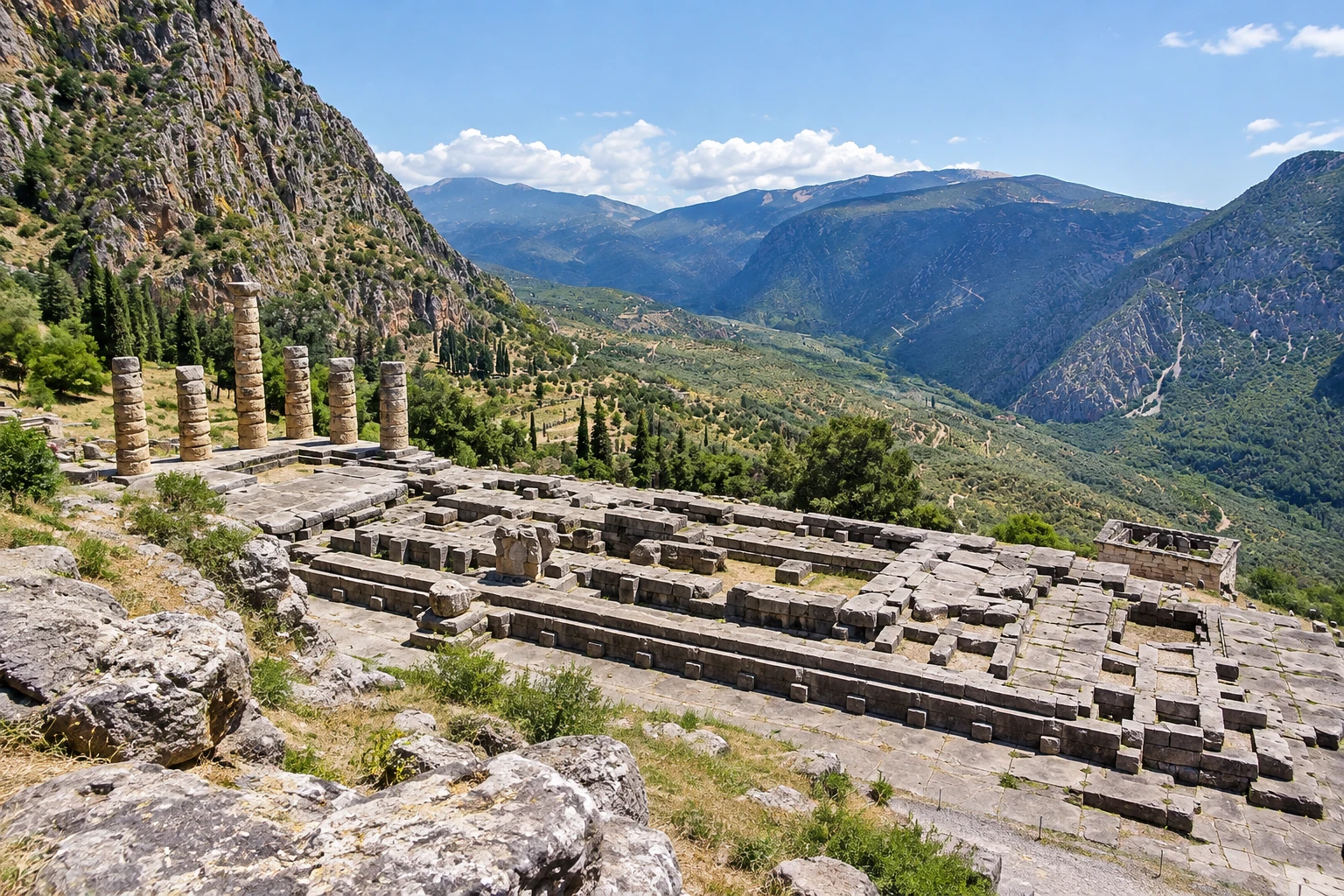
Archaeological site · Delphi, Greece
Archaeological Site of Delphi (Archaiologikos Choros Delfon)
The sanctuary of Apollo on the slope of Parnaso: the Sacred Way rises between treasuries and statues to the Temple of Apollo, home of the oracle, the 4,500-seat theater and the stadium at the top. UNESCO World Heritage Site.
Illustrative images. The pictures in this guide are illustrations based on the real place, not photographs, and may differ from it.

Discover
About Archaeological Site of Delphi (Archaiologikos Choros Delfon)
The archaeological site of Delfos is the sanctuary where the oracle of Apollo operated, consulted across the Greek world from the 8th century BC until the Roman era. The ruins climb in terraces up the slope of Parnaso, between the two rocks of the Phaedriades, and the visit follows the Sacred Way, the zigzag path that pilgrims took carrying offerings. On the sides stood statues, votive columns and the treasuries, small temples where cities kept their gifts.
The Treasury of the Athenians, reconstructed in the early 20th century with the original stones, commemorates the victory at Marathon in 490 BC. Just above is the Rock of the Sibyl and the Stoa of the Athenians, leaning against the polygonal wall that supports the temple terrace. The Temple of Apollo visible today is from the 4th century BC, the sixth built on the site, with six facade columns re-erected; at its rear lay the adyton, the chamber where the Pythia gave her responses seated on a tripod.
Above the temple, the 4th-century BC theater, remodeled by the Romans, held about 4,500 people and offers the best view of the sanctuary, with the valley and olive groves beyond. A climbing trail leads to the stadium at the highest point, with a 177-meter track, stone stands for 6,500 spectators and the starting line still marked; the Pythian Games, held every four years, staged athletic contests there.
Near the gate, 500 meters toward Arachova, lies the valley of the Castalian Spring, where pilgrims purified themselves; access to the spring is not usually open, but the ruins are visible from the road. The visit is entirely uphill, over smooth stones and without shade: bring water, a hat and closed shoes.
Before you go
Practical information
Cidade Turismo reviews its information regularly, but something may have changed. Check with the place before planning your trip.
How much time to set aside
2 to 3 hours to climb to the stadium and return; the museum is separate and takes another hour.
Best time
At opening in the morning, before the tour buses from Athens, which arrive between mid-morning and noon, or in the last two hours before closing. In summer the heat on the stones is strong; in winter hours are reduced and the site closes in mid-afternoon. Check the schedule for the day.
How to get there
The gate is on the road that links the village of Delfos with Arachova, about 500 meters from the village center, a 10-minute walk uphill; the museum is on the way, before the gate. By car there is roadside parking near the museum. The KTEL bus from Athens stops in the village.
Tip
Buy the combined site-and-museum ticket and see the ruins first, in the morning, leaving the museum for the midday heat. Climb up to the stadium: many people stop at the theater and miss the emptier part. From the theater, turn to view the Pleistos valley and the sea of olive trees down to the gulf.
Your questions
Frequently asked questions about Archaeological Site of Delphi (Archaiologikos Choros Delfon)
What is still standing at Delfos?
Six columns of the Templo de Apolo, the Tesouro dos Atenienses reassembled, the theatre almost intact, the stadium with its track and stands, the polygonal wall, statue bases and the remains of other treasuries along the Via Sacra.
How did the oracle work?
The Pythia, Apolo's priestess, answered questions seated on a tripod at the back of the temple, and the priests relayed the response, often in ambiguous verse. Consultations were held on set days, after sacrifices and purification at the Fonte Castália.
Is the climb up to the stadium difficult?
It is steep and on smooth rock, about a 20-minute climb from the theatre. It's worth the effort: it's the quietest and best-preserved part. Those who prefer not to climb can stop at the theatre, which already offers a view of the site.
Can you see the Fonte Castália?
The ruins of the fountain lie 500 metres from the gate, on the road to Arachova, and can be seen from the roadside. Access to the fountain is usually not allowed due to the risk of falling rocks from the Phaedriades.
Is there shade or water at the site?
There is practically no shade, and there is no water sold inside the site. Bring a bottle, hat and sunscreen, especially from June to September.