

 Brazil
 Antarctica
 Argentina
 Bolivia
 Chile
 Colombia
 Ecuador
 Falkland Islands (Malvinas)
 French Guiana
 Guyana
 Paraguay
 Peru
 Suriname
 Uruguay
 Venezuela
 Albania
 Austria
 Belgium
 Croatia
 Denmark
 Finland
 France
 Germany
 Hungary
 Iceland
 Ireland
 Italy
 Luxembourg
 Norway
 Poland
 Portugal
 Slovakia
 Slovenia
 Spain
 Sweden
 Switzerland
 the Czech Republic
 the Netherlands
 the United Kingdom
 Turkey
 Bermuda
 Canada
 Greenland
 Mexico
 Saint Pierre and Miquelon
 the United States
 the Dominican Republic
 Japan
 Egypt
 South Africa
 Australia
 Fiji
 New Zealand
 Papua New Guinea
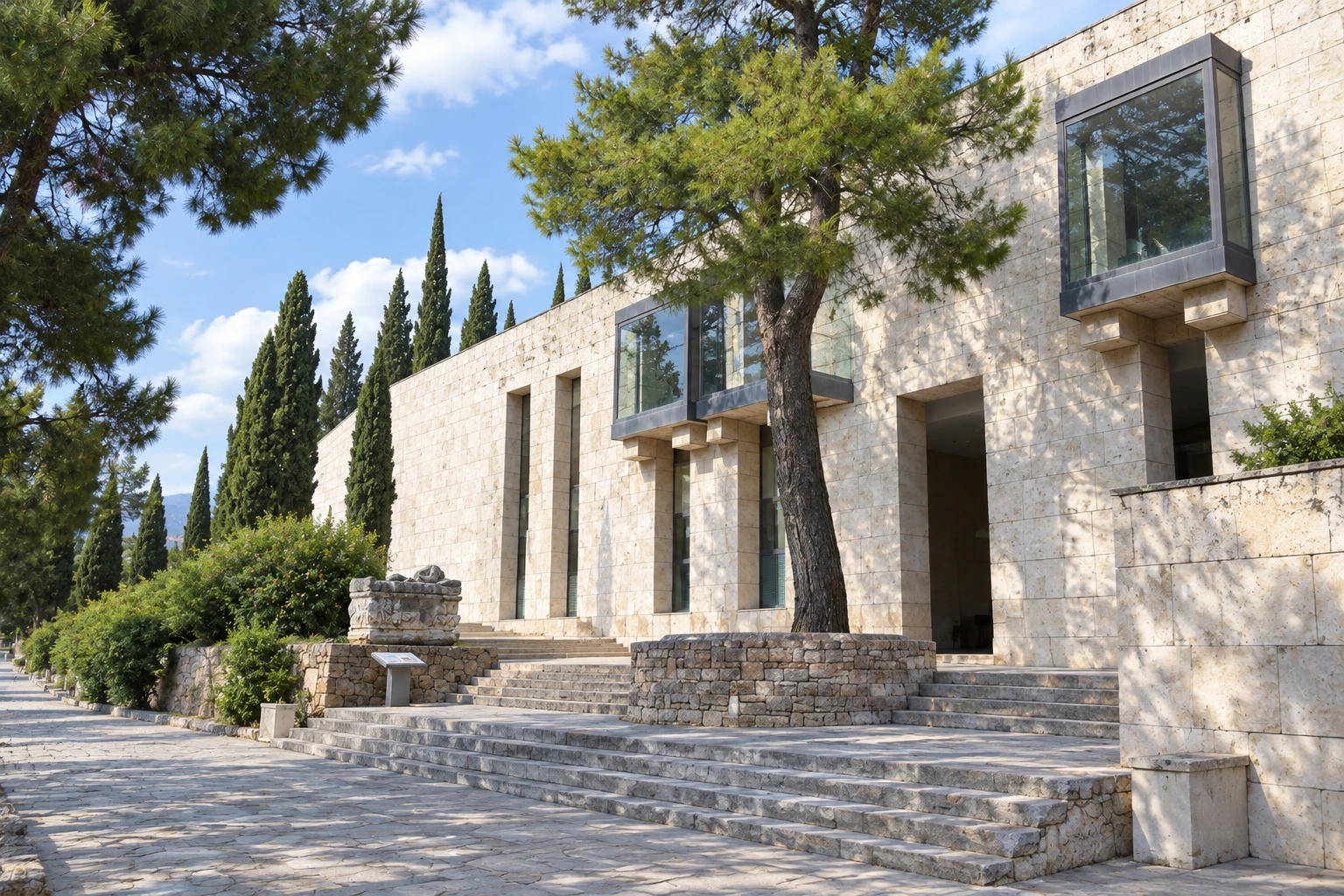
Museum · Delphi, Greece
Delphi Archaeological Museum (Archaiologiko Mouseio Delfon)
Museum beside the site, with pieces found in the sanctuary: the bronze Auriga, the Sphinx of Naxos, the friezes from the Treasury of Sifnos, the twins Cléobis and Bíton, the statue of Antinous and the omphalos. Fourteen rooms in chronological order.
Illustrative images. The pictures in this guide are illustrations based on the real place, not photographs, and may differ from it.

Discover
About Delphi Archaeological Museum (Archaiologiko Mouseio Delfon)
The Archaeological Museum of Delfos houses what was found in the sanctuary of Apollo since the French excavations at the end of the 19th century. The first building opened in 1903; the current building has been expanded several times and underwent its latest renovation between 1999 and 2003, with a new foyer and a dedicated room for the Auriga. There are fourteen rooms on two levels, arranged chronologically from the Mycenaean period to the beginning of the Byzantine era.
The best-known piece is the Auriga of Delfos, a bronze statue from around 475 BC that was part of a four-horse chariot offered by a Sicilian tyrant after winning the race at the Pythian Games. The stone eyes and the details of the eyelashes and the diadem are preserved. Near the end of the visit, it stands alone in a room at the same level where it was found.
In the archaic rooms are the Sphinx of Naxos, which once crowned a 12‑metre column, the carved friezes from the Treasury of Sifnos with scenes from the Trojan War and the assembly of the gods, and the kouroi Cléobis and Bíton, from Argos, dating to the early 6th century BC. A vault‑shaped room gathers the remains of the gold-and-ivory statues of Apollo, Artemis and Leto, burned in antiquity and recovered in fragments.
Also here are the metopes from the Treasury of the Athenians, the Dancers of Delfos, a column with three female figures, the marble omphalos that represented the navel of the world, and the statue of Antinous, the young favourite of Emperor Hadrian, one of the most intact Roman works found in Greece.
Before you go
Practical information
Cidade Turismo reviews its information regularly, but something may have changed. Check with the place before planning your trip.
How much time to set aside
About 1 to 1.5 hours.
Best time
At midday, when the sun is strong at the site, the museum—with air conditioning—is the natural shelter. At opening the museum also tends to be empty. In winter the opening hours are reduced; check ahead.
How to get there
It is on the road between the village of Delfos and the site's gate, about 400 metres from the village centre, a 5‑minute walk. There is parking in front. The path to the site's gate starts beside the museum, a short uphill walk of a few minutes.
Tip
Visit after the ruins to recognise where each piece came from: the museum has models of the sanctuary that help you understand what you saw. Go straight to the Auriga room if time is short. Non‑flash photography is allowed; the museum has a café with a terrace overlooking the valley.
Your questions
Frequently asked questions about Delphi Archaeological Museum (Archaiologiko Mouseio Delfon)
What is the Auriga de Delfos?
A bronze statue dating to around 475 BC that represents the charioteer of a victorious race in the Jogos Píticos. It is one of the few large Greek bronze statues to survive, with its stone eyes preserved.
Is it worth buying the combined ticket for the museum and the site?
Yes, the ticket is usually a single one for both, valid on the same day. Check at the ticket office, as rules can change.
Is the museum large?
There are fourteen rooms on two levels, visitable in about 1 to 1.5 hours. The best-known pieces are spread along the chronological route, with the Auriga almost at the end.
What is the omphalos?
A stone shaped like a cone or egg that, according to the Greeks, marked the center of the world. The museum's example is a Roman marble copy, decorated with net reliefs, of the original that stood in the temple.