

 Brazil
 Antarctica
 Argentina
 Bolivia
 Chile
 Colombia
 Ecuador
 Falkland Islands (Malvinas)
 French Guiana
 Guyana
 Paraguay
 Peru
 Suriname
 Uruguay
 Venezuela
 Albania
 Austria
 Belgium
 Croatia
 Denmark
 Finland
 France
 Germany
 Hungary
 Iceland
 Ireland
 Italy
 Luxembourg
 Norway
 Poland
 Portugal
 Slovakia
 Slovenia
 Spain
 Sweden
 Switzerland
 the Czech Republic
 the Netherlands
 the United Kingdom
 Turkey
 Bermuda
 Canada
 Greenland
 Mexico
 Saint Pierre and Miquelon
 the United States
 the Dominican Republic
 Japan
 Egypt
 South Africa
 Australia
 Fiji
 New Zealand
 Papua New Guinea
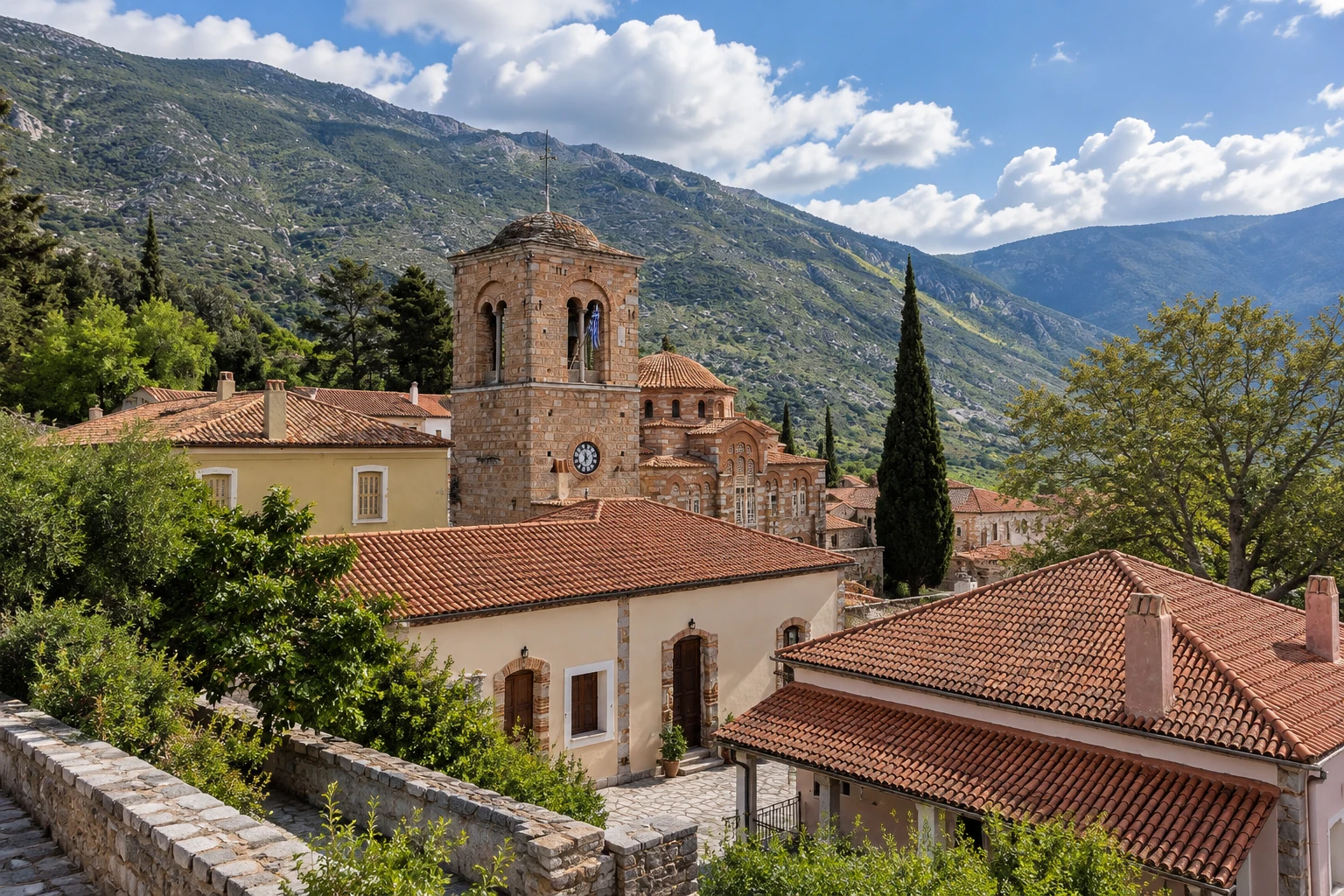
Monastery · Delphi, Greece
Hosios Loukas Monastery (Moni Osiou Louka)
Byzantine monastery from the 10th century on the slopes of Helicon, 30 km from Delphi. The main church, dating to around 1011, houses one of the most complete sets of mosaics in Byzantine art; the crypt contains 11th-century frescoes. UNESCO World Heritage Site.
Illustrative images. The pictures in this guide are illustrations based on the real place, not photographs, and may differ from it.

Discover
About Hosios Loukas Monastery (Moni Osiou Louka)
The monastery of Hosios Loukas sits on a slope of Mount Helicon, near the town of Distomo, amid olive and almond groves, about 30 km from Delphi. It was founded in the mid-10th century around the tomb of Lucas of Stiris, a hermit and local miracle-worker, and grew with imperial patronage. It is one of three Byzantine monasteries in Greece inscribed together as a World Heritage Site in 1990, along with Dafni and Nea Moni.
There are two joined churches: that of the Theotokos, the older, built around 960, with masonry decorated with bricks in geometric patterns, and the katholikon, dating to about 1011, larger and with a broad dome on arches. The interior of the katholikon is faced with polychrome marble and mosaics on a gold ground that cover the narthex, vaults and niches, with saints, scenes from Christ's life and the group offering the church to the saint. It is the best-preserved mosaic ensemble of the Macedonian dynasty period.
Beneath the katholikon, the crypt housing Lucas's tomb is painted with frescoes from the second half of the 11th century: scenes of the Passion and the Resurrection in the lunettes and forty medallions of saints on the vaults. Around it are the refectory, now a sculpture museum, the cells and a courtyard with views over the Distomo valley.
The monastery remains active, with a few monks, and enforces a dress code: shoulders and knees must be covered. It usually closes for a few hours at midday; check the opening times.
Before you go
Practical information
Cidade Turismo reviews its information regularly, but something may have changed. Check with the place before planning your trip.
How much time to set aside
About 1 to 1½ hours.
Best time
In the morning, when light pours through the katholikon's windows and illuminates the mosaics, or in the late afternoon. It usually closes for a few hours in the early afternoon; check before you go. Spring and autumn give a green valley and mild weather.
How to get there
About 30 km from Delphi: take the road from Arachova to Distomo and then 9 km on a secondary road to the monastery, roughly a 40-minute drive. There is no direct public transport; taxis from Delphi or Arachova can do a return trip with waiting. From Athens it is about 150 km.
Tip
Bring cash for the entrance fee and wear appropriate clothing, as skirts are not lent. Go down to the crypt, which many visitors skip, to see the 11th-century frescoes. From the courtyard the view over the Distomo valley and Parnassus is good for photos.
Your questions
Frequently asked questions about Hosios Loukas Monastery (Moni Osiou Louka)
Why is Hosios Loukas a World Heritage Site?
Because of the architecture and the 11th-century mosaics, which form one of the most complete and well-preserved ensembles of middle Byzantine art. It was inscribed in 1990 together with the monasteries of Dafni, near Atenas, and Nea Moni, in Quios.
Can you go to Hosios Loukas without a car?
There is no bus to the monastery. The option is a taxi from Delfos or Arachova, with waiting, or an organized tour. By car it's about 40 minutes from Delfos.
Does the monastery still have monks?
Yes, it is an active monastery, with a small community. Therefore there are rules on clothing and silence in the churches.
Who was Hosios Loukas?
Lucas of Stiris, a hermit who lived in the 10th century in the region and became known for healings and prophecies. He died in 953 and the monastery grew around his tomb, which is in the crypt.