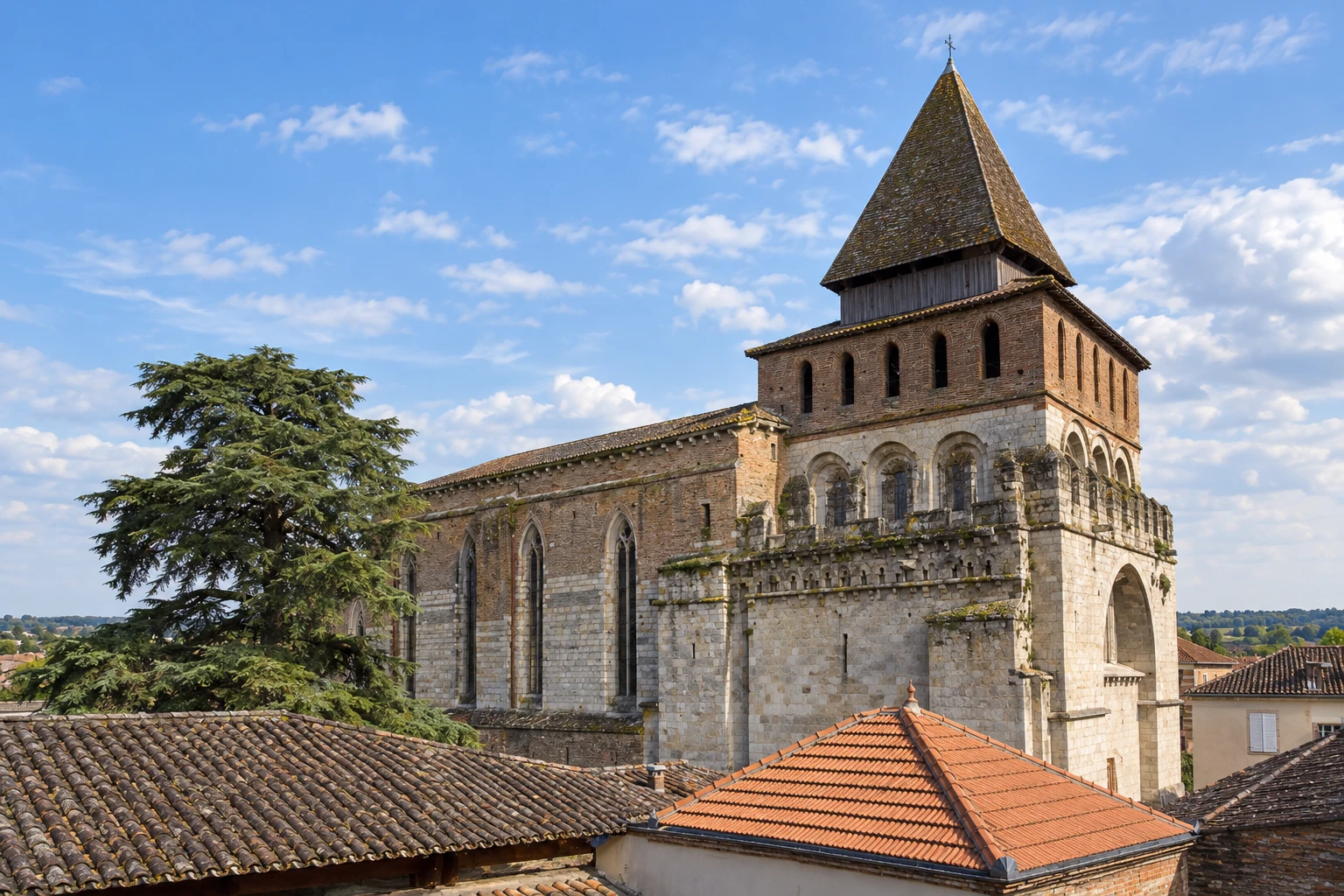
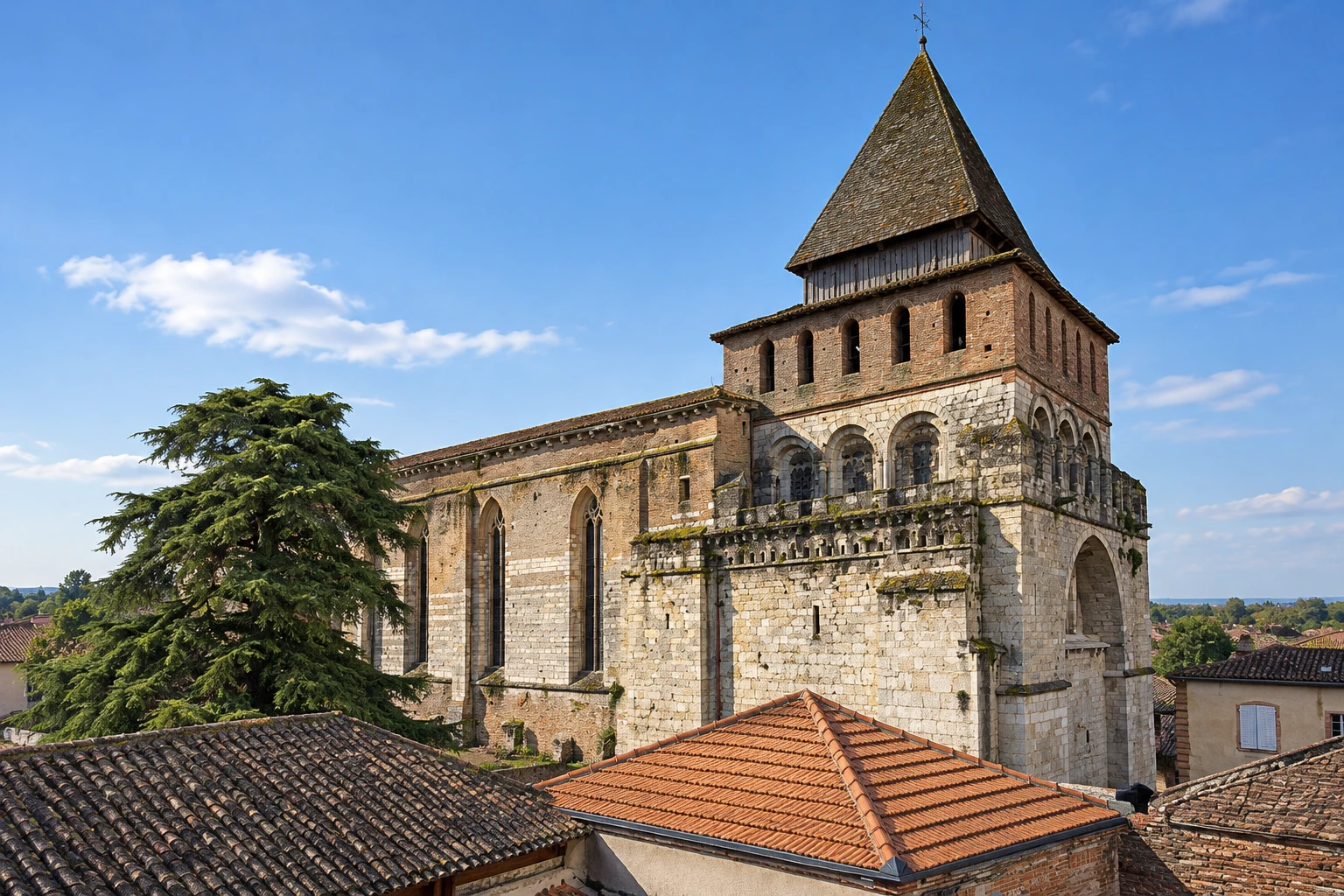
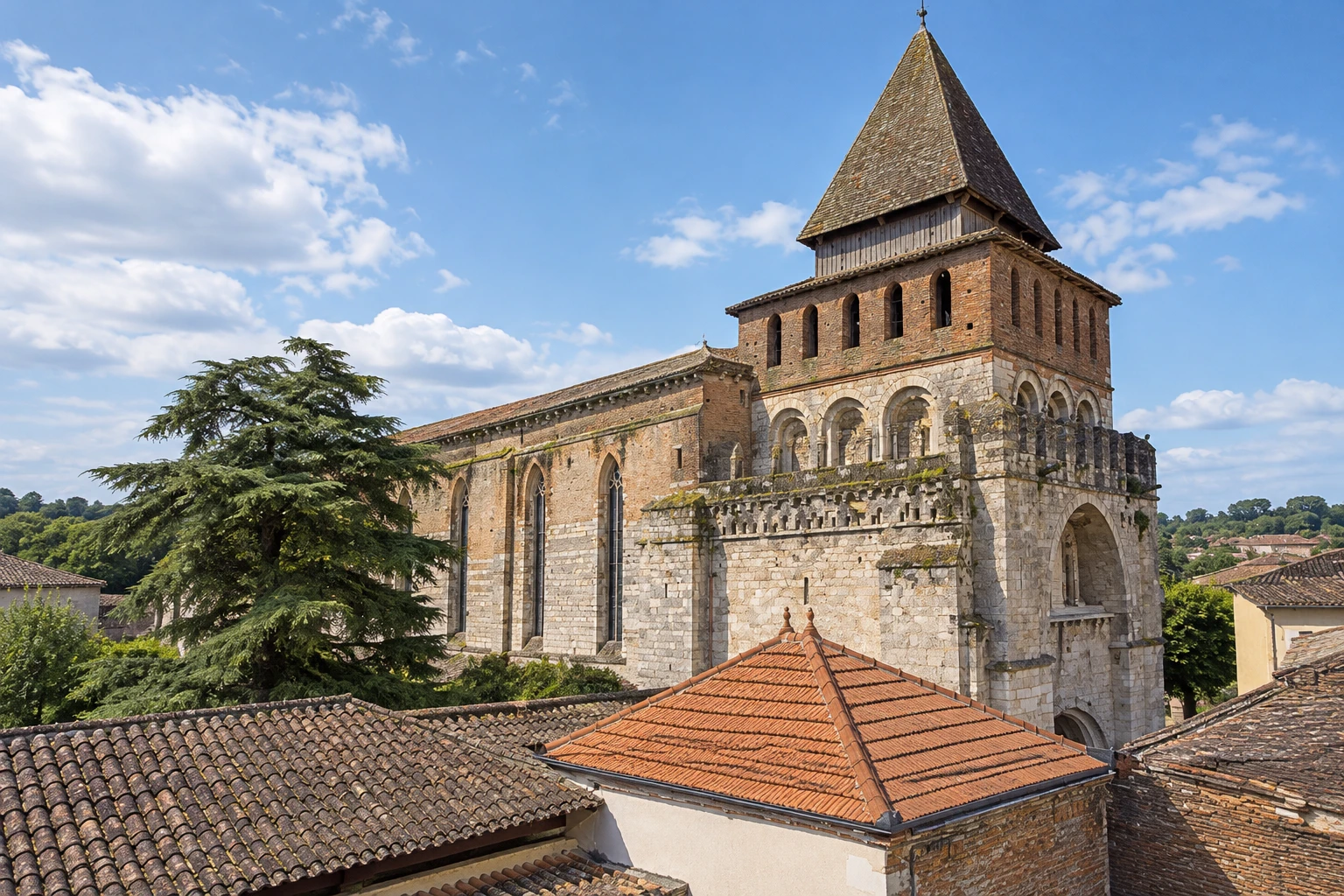
In the photo: Exterior ensemble of the abbey of Saint-Pierre de Moissac.
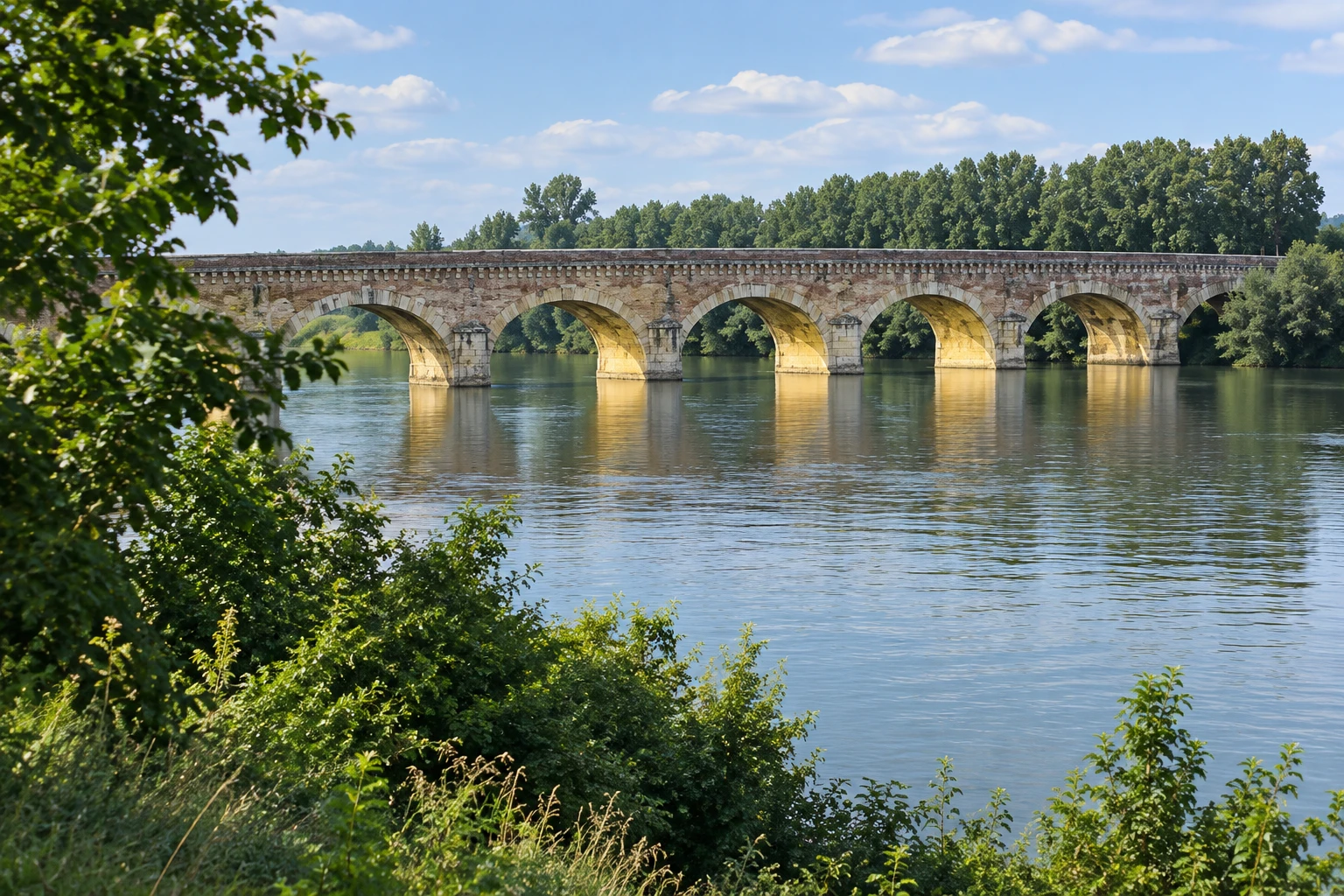
Illustrative images. The pictures in this guide are illustrations based on the real place, not photographs, and may differ from it.
The city
What to expect from Moissac.
Moissac lies on the banks of the Tarn river, near where it meets the Garonne, and houses the abbey of Saint-Pierre, a World Heritage site, with the Tympanum of the Apocalypse and a cloister from 1100 with 76 carved capitals, one of the oldest in Europe. The Canal Lateral à Garonne crosses the town and passes over the Tarn via the ponte-canal do Cacor. The region is known for the table grape chasselas de Moissac.
The former Benedictine abbey of Moissac, a World Heritage site, with the church of Saint-Pierre and the tympanum of the south portal, from the 12th century, depicting the vision of the Apocalypse.
The Romanesque cloister dated to 1100, one of the oldest in Europe, with 76 carved capitals, 46 of them with scenes from the Bible and the lives of the saints.
Approximate distances. Check flights and bus, train or boat schedules before you travel.
Connections with Brazil usually require a transfer in another city. Confirm before buying. Moissac station is on the train line between Bordeaux and Toulouse; from Toulouse the journey usually takes less than an hour. By car it is about 70 km from Toulouse. The station is roughly 1 km from the abbey. The nearest airport is Toulouse.
How many days
Half a day covers the abbey, the tympanum and the cloister; a full day includes a walk along the canal to the ponte-canal do Cacor. Pilgrims often stop for one night.
When to go
From May to October, with long days for walking along the canal. July and August are hot. In September the chasselas harvest takes place, the region's table grape. In winter the town is quiet.
The seasons shown are the most usual ones; nature doesn't always follow the calendar.
Do you need a car?
No. The abbey, the cloister and the canal are visited on foot, and the station is close to the center. To the ponte-canal do Cacor you can go on foot or by bicycle along the path beside the canal.
Suggested itinerary
An order that works
Built with the places on this page. No rush: it's paced so you have time to see them.
One day in Moissac
manhã
Tympanum and abbey church
Start at the south portal of the church of Saint-Pierre, with the Tympanum of the Apocalypse, and enter the church.
tarde
Cloister
Visit the cloister from 1100 and look for, among the 76 capitals, the scenes from the Bible and the lives of the saints.
fim de tarde
Canal to the Cacor
Walk or cycle along the bank of the Canal Lateral à Garonne to the ponte-canal do Cacor over the Tarn.
noite
Dinner by the Tarn
Have dinner in the center and, at the end of summer, taste the chasselas de Moissac.
Check before you go. Opening hours and days change, and places may close for renovations, holidays or events. This itinerary is a suggestion from Cidade Turismo, not a commitment: plan yours by checking directly with each place you intend to visit.
Before you go
Frequently asked questions
Why is the cloister of Moissac known?
It is one of the oldest and best-preserved Romanesque cloisters in Europe, dated to 1100 by an inscription, with 76 carved capitals.
How to get to Moissac from Toulouse?
By train in under an hour on the Toulouse–Bordeaux line, or by car about 70 km.
What is the chasselas de Moissac?
A white table grape from the region, with an appellation of origin. The harvest usually takes place in September.
Is Moissac on the Camino de Santiago?
Yes, on the Le Puy route of the Camino de Santiago, between Cahors and Lectoure. The abbey is a World Heritage site as part of the Routes of Santiago in France.
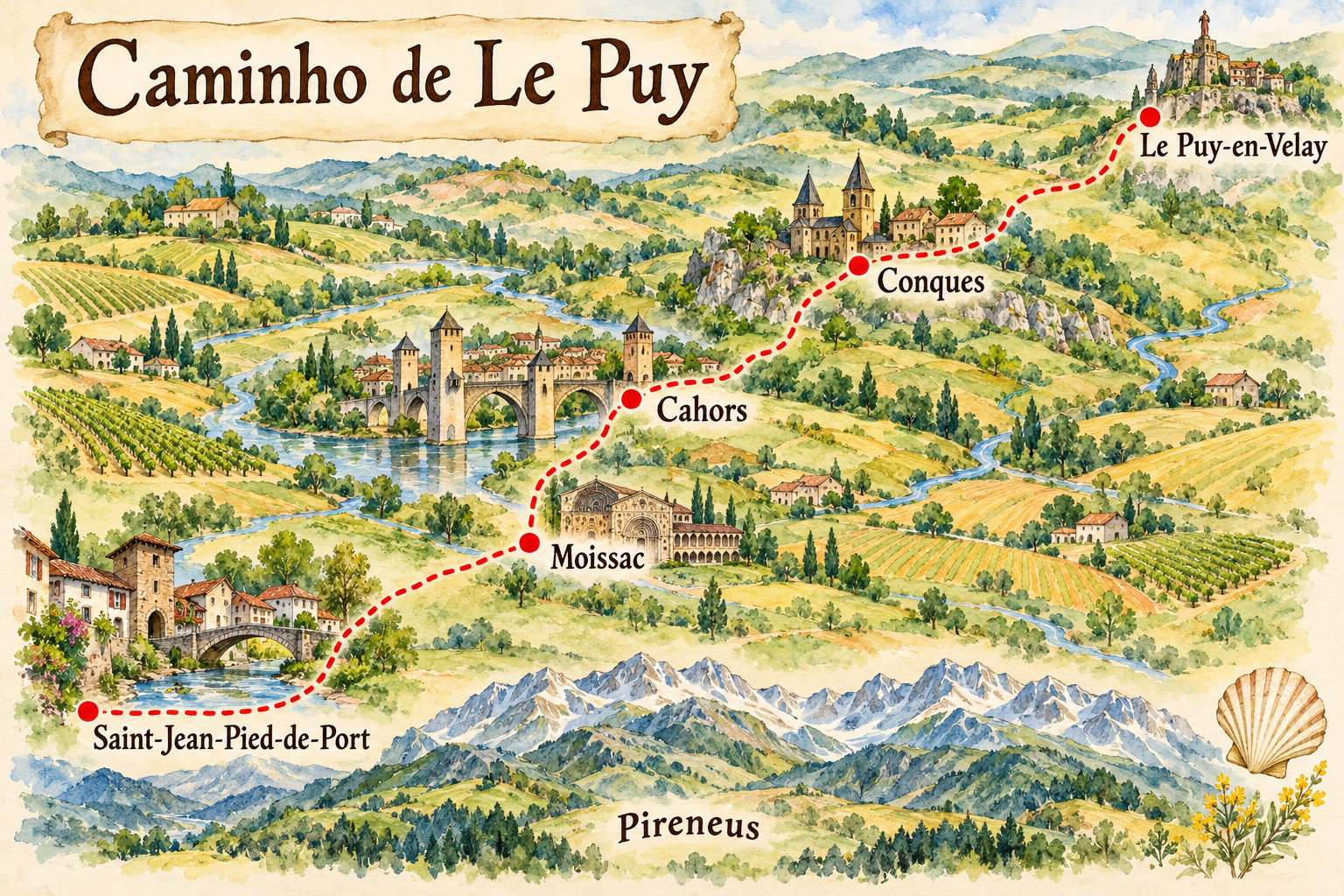
The most walked Camino de Santiago route in France: from Le Puy-en-Velay to the Pyrenees on foot, across the Aubrac plateau, Conques, Cahors and Moissac, to Saint-Jean-Pied-de-Port, where the French Way begins.
Illustrative map, not to scale. Tap a city to open its page.


 Brazil
 Antarctica
 Argentina
 Bolivia
 Chile
 Colombia
 Ecuador
 Falkland Islands (Malvinas)
 French Guiana
 Guyana
 Paraguay
 Peru
 Suriname
 Uruguay
 Venezuela
 Austria
 Belgium
 Croatia
 Denmark
 Finland
 Germany
 Greece
 Hungary
 Iceland
 Ireland
 Italy
 Luxembourg
 Norway
 Poland
 Portugal
 Slovakia
 Slovenia
 Spain
 Sweden
 Switzerland
 the Czech Republic
 the Netherlands
 the United Kingdom
 Turkey
 Bermuda
 Canada
 Greenland
 Mexico
 Saint Pierre and Miquelon
 the United States
 the Dominican Republic
 Japan
 Egypt
 South Africa
 Australia
 Fiji
 New Zealand
 Papua New Guinea