

 Brazil
 Antarctica
 Argentina
 Bolivia
 Chile
 Colombia
 Ecuador
 Falkland Islands (Malvinas)
 French Guiana
 Guyana
 Paraguay
 Peru
 Suriname
 Uruguay
 Venezuela
 Albania
 Austria
 Belgium
 Croatia
 Denmark
 Finland
 France
 Germany
 Greece
 Hungary
 Iceland
 Ireland
 Italy
 Luxembourg
 Norway
 Poland
 Portugal
 Slovakia
 Slovenia
 Sweden
 Switzerland
 the Czech Republic
 the Netherlands
 the United Kingdom
 Turkey
 Bermuda
 Canada
 Greenland
 Mexico
 Saint Pierre and Miquelon
 the United States
 the Dominican Republic
 Japan
 Egypt
 South Africa
 Australia
 Fiji
 New Zealand
 Papua New Guinea
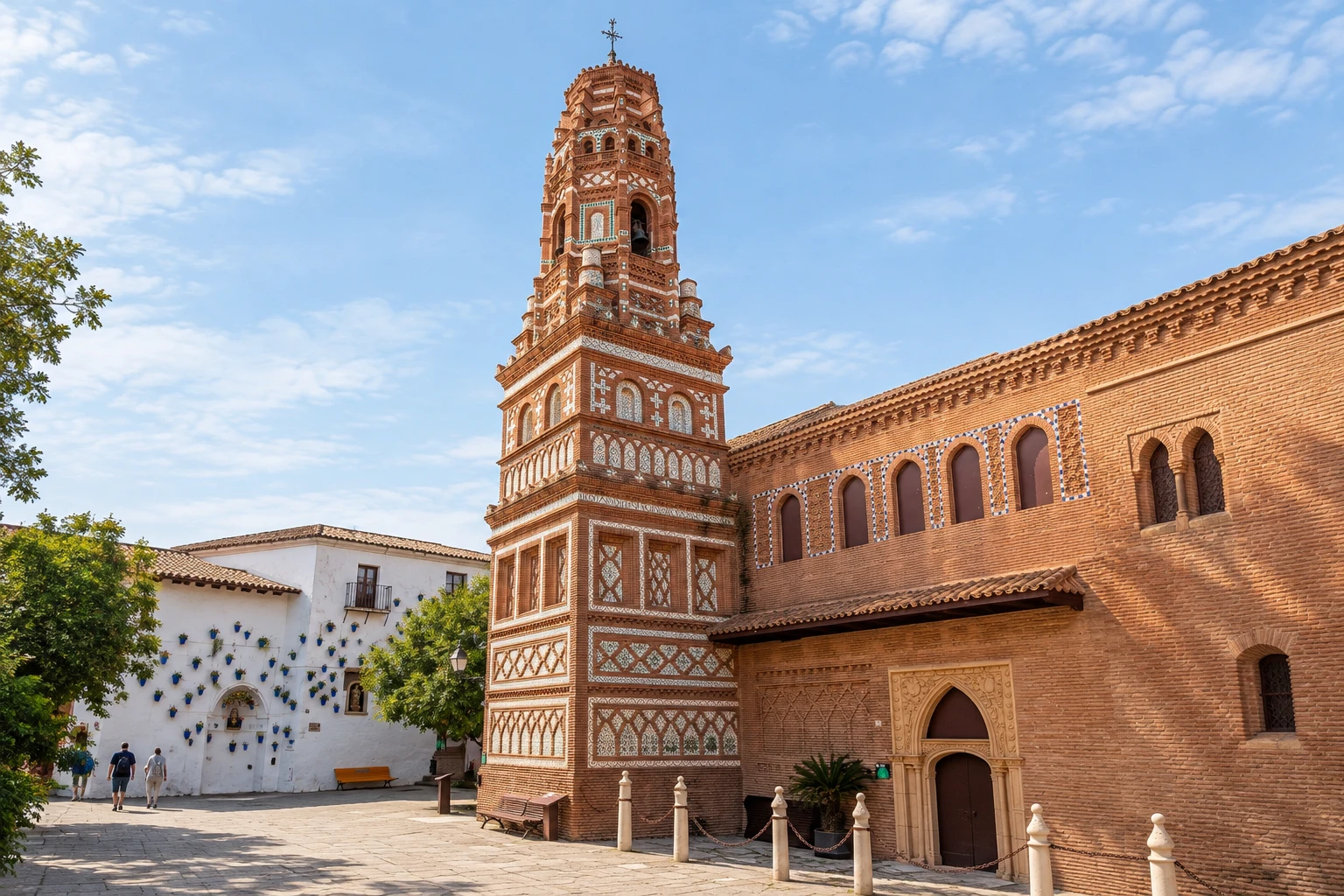
Open-air museum · Barcelona, Spain
Poble Espanyol
Village built for the 1929 Exposition with 117 life-size replicas of houses, squares and churches from various regions of Spain. It houses artisan workshops, restaurants and a museum of contemporary art.
Illustrative images. The pictures in this guide are illustrations based on the real place, not photographs, and may differ from it.

Discover
About Poble Espanyol
Poble Espanyol was erected between 1926 and 1929 for the Barcelona International Exposition. The idea came from architect Josep Puig i Cadafalch. The project was carried out by architects Francesc Folguera and Ramon Reventós, the critic and painter Miquel Utrillo and the painter Xavier Nogués.
To choose the models, the four travelled around 20,000 kilometres across Spain and visited more than 1,600 places. The result is 117 buildings reproduced at full scale, laid out like a small town, with streets, stairways and a main square. There are façades inspired by Andalusia, Castile, the Basque Country, Galicia, Aragon and Catalonia itself.
The ensemble is listed as a cultural asset of local interest. Today the houses host artisan workshops, shops, restaurants, a theatre and a contemporary art museum. The visit shows, in one place, how stone, brick and roofs vary from one region of the country to another.
Before you go
Practical information
Cidade Turismo reviews its information regularly, but something may have changed. Check with the place before planning your trip.
How much time to set aside
Allow 1h30 to 2 hours to walk the streets, visit the workshops and see the museum. With lunch, half a day.
Best time
Early in the morning or late in the afternoon, to avoid the midday sun on the stone streets, especially from June to August (winter in Brazil). From October to March, with short days, go before mid-afternoon. Check the opening hours before you go.
How to get there
It's in Montjuïc, about 400 metres from the Font Màgica. From Espanya station (L1 and L3), go up avenida de la Reina Maria Cristina to the Font Màgica and walk along the slope, or take bus 150, which goes up the hill.
Tip
There is an entrance fee; check the conditions on the official website. Combine it with the MNAC and the Font Màgica on the same day. The streets have steps and uneven paving.
Official website
Your questions
Frequently asked questions about Poble Espanyol
What is the Poble Espanyol?
An open-air architecture museum built for the 1929 Exposition, with 117 buildings that replicate at full scale constructions from various regions of Spain.
Who designed the Poble Espanyol?
The architects Francesc Folguera and Ramon Reventós, with critic Miquel Utrillo and painter Xavier Nogués, from an idea by Josep Puig i Cadafalch.
What's inside the Poble Espanyol?
Craftsmen's workshops, shops, restaurants, a theater and a contemporary art museum, spread across the village's streets and squares.
What is it near?
About 400 meters from the Font Màgica, and on the same side of Montjuïc as the MNAC.