

 Brazil
 Antarctica
 Argentina
 Bolivia
 Chile
 Colombia
 Ecuador
 Falkland Islands (Malvinas)
 French Guiana
 Guyana
 Paraguay
 Peru
 Suriname
 Uruguay
 Venezuela
 Albania
 Austria
 Belgium
 Croatia
 Denmark
 Finland
 France
 Germany
 Greece
 Hungary
 Iceland
 Ireland
 Italy
 Luxembourg
 Norway
 Poland
 Portugal
 Slovakia
 Slovenia
 Sweden
 Switzerland
 the Czech Republic
 the Netherlands
 the United Kingdom
 Turkey
 Bermuda
 Canada
 Greenland
 Mexico
 Saint Pierre and Miquelon
 the United States
 the Dominican Republic
 Japan
 Egypt
 South Africa
 Australia
 Fiji
 New Zealand
 Papua New Guinea
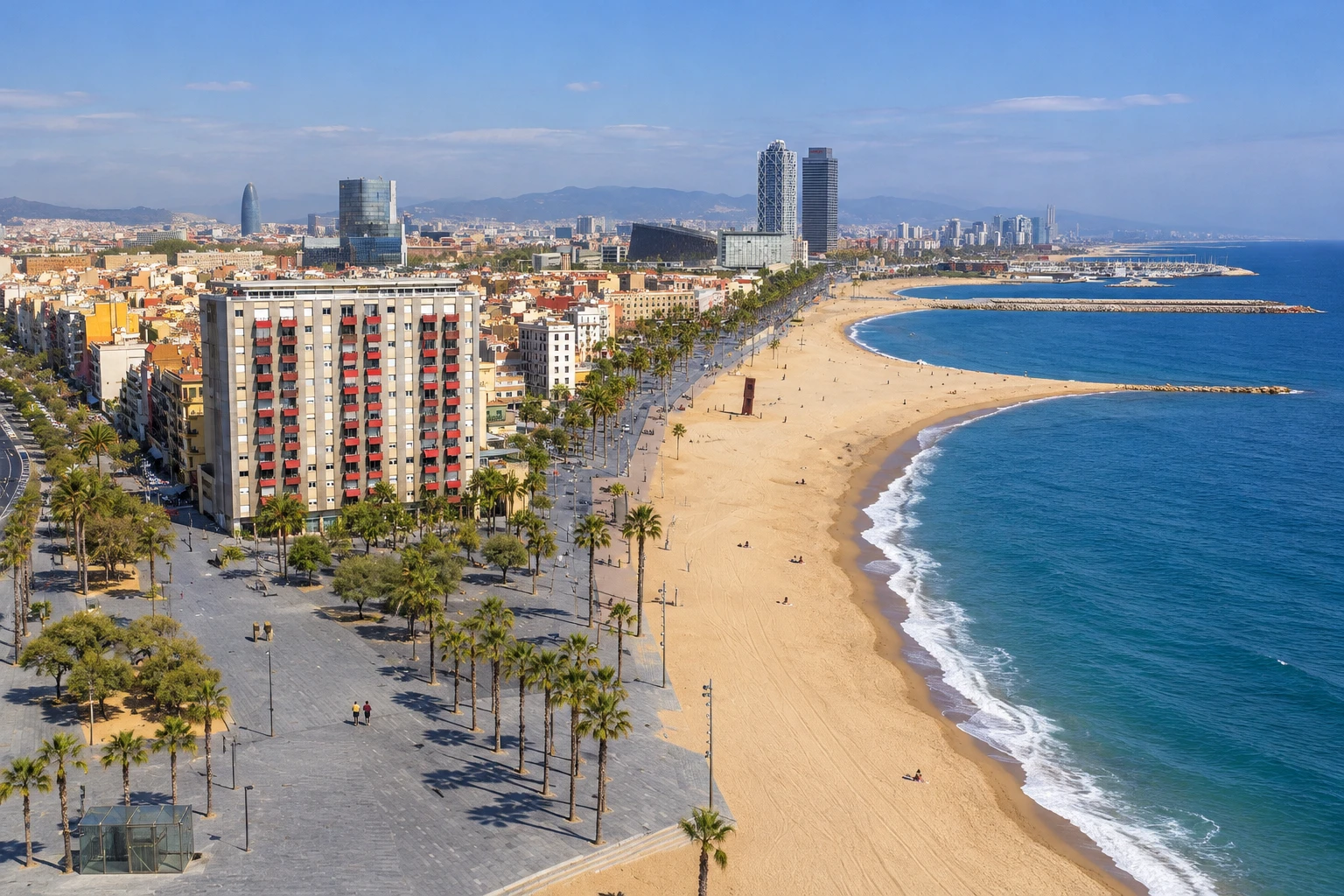
Beach · Barcelona, Spain
Barceloneta Beach
The city's oldest and most traditional beach, next to the fishing neighbourhood of Barceloneta, laid out in the 18th century. The promenade is lined with seafood restaurants and links Port Vell to Port Olímpic.
Illustrative images. The pictures in this guide are illustrations based on the real place, not photographs, and may differ from it.

Discover
About Barceloneta Beach
Barceloneta occupies a triangular spit of land between the Mediterranean, Port Vell and El Born. Until the 17th century almost all of it was sea. The land was formed by sand accumulated by the harbour breakwater. The neighbourhood was designed by military engineer Juan Martín Cermeño to house residents of the Ribera district, displaced by the construction of the Ciutadella. The first houses began to be built in 1754.
The streets are narrow and straight, with low-rise buildings and balconies hung with laundry. The Casa de la Barceloneta, in a 1761 building, tells the history of the neighbourhood. The church of Sant Miquel del Port is in the central square, and the clock tower, from 1772, served as the harbour's lighthouse. In 1791 the scientist Pierre Méchain used it in the meridian measurements that gave rise to the metric system.
The beach was remodelled before the 1992 Olympic Games. Together with the neighbouring beaches of Sant Sebastià and Sant Miquel it has about 1.1 km of sand. On the promenade are Rebecca Horn's stacked cubes sculpture, "Homenatge a la Barceloneta", and, closer to Port Olímpic, Frank Gehry's large golden fish.
From the Torre de Sant Sebastià, at the tip of the neighbourhood, departs the cable car that crosses the harbour to Montjuïc, opened in 1931. The restaurants on Passeig de Joan de Borbó, facing the harbour, serve paella and seafood. The Museu d'Història de Catalunya is in the Palau de Mar on the same promenade.
Before you go
Practical information
Cidade Turismo reviews its information regularly, but something may have changed. Check with the place before planning your trip.
How much time to set aside
Half a day is enough to stroll through the neighbourhood, walk the promenade and have lunch. Those who go to sunbathe and swim usually stay the whole afternoon.
Best time
Sea bathing is most popular from June to September (winter and early spring in Brazil), when the water is less cold. July and August are the busiest months. For walking, the European spring and autumn, from April to June and from September to October, are usually quieter.
How to get there
Barceloneta station (metro line L4) is at the entrance to the neighbourhood. From the Rambla you can walk along the Port Vell in about 20 minutes, passing the Mirador de Colom and the Moll de la Fusta. Several urban bus lines reach the Passeig de Joan de Borbó.
Tip
Take only what you need for the beach and keep an eye on your belongings in crowded places. Spanish lunch starts around 2 p.m., and paella is usually served at lunch rather than at dinner. For the port cable car, check whether it's operating before you go.
Your questions
Frequently asked questions about Barceloneta Beach
Can you swim in the sea at Barceloneta?
Yes. The water is usually less cold from June to September, which is the most popular period for bathing. Outside that period the beach is more used for walking.
How to get to Barceloneta beach?
By metro to Barceloneta station (L4) or on foot from the Rambla, passing through Port Vell, in about 20 minutes.
What to see in the Barceloneta neighborhood?
The straight streets from the 18th century, the church of Sant Miquel del Port, the clock tower of 1772, the Casa de la Barceloneta and the Museu d'Història de Catalunya in the Palau de Mar.
Where to eat paella in Barceloneta?
Restaurants are concentrated on Passeig de Joan de Borbó, facing the port, and on the beach promenade. Paella is usually a lunchtime dish.