

 Brazil
 Antarctica
 Argentina
 Bolivia
 Chile
 Colombia
 Ecuador
 Falkland Islands (Malvinas)
 French Guiana
 Guyana
 Paraguay
 Peru
 Suriname
 Uruguay
 Venezuela
 Albania
 Austria
 Belgium
 Croatia
 Denmark
 Finland
 France
 Germany
 Greece
 Hungary
 Iceland
 Ireland
 Italy
 Luxembourg
 Norway
 Poland
 Portugal
 Slovakia
 Slovenia
 Sweden
 Switzerland
 the Czech Republic
 the Netherlands
 the United Kingdom
 Turkey
 Bermuda
 Canada
 Greenland
 Mexico
 Saint Pierre and Miquelon
 the United States
 the Dominican Republic
 Japan
 Egypt
 South Africa
 Australia
 Fiji
 New Zealand
 Papua New Guinea
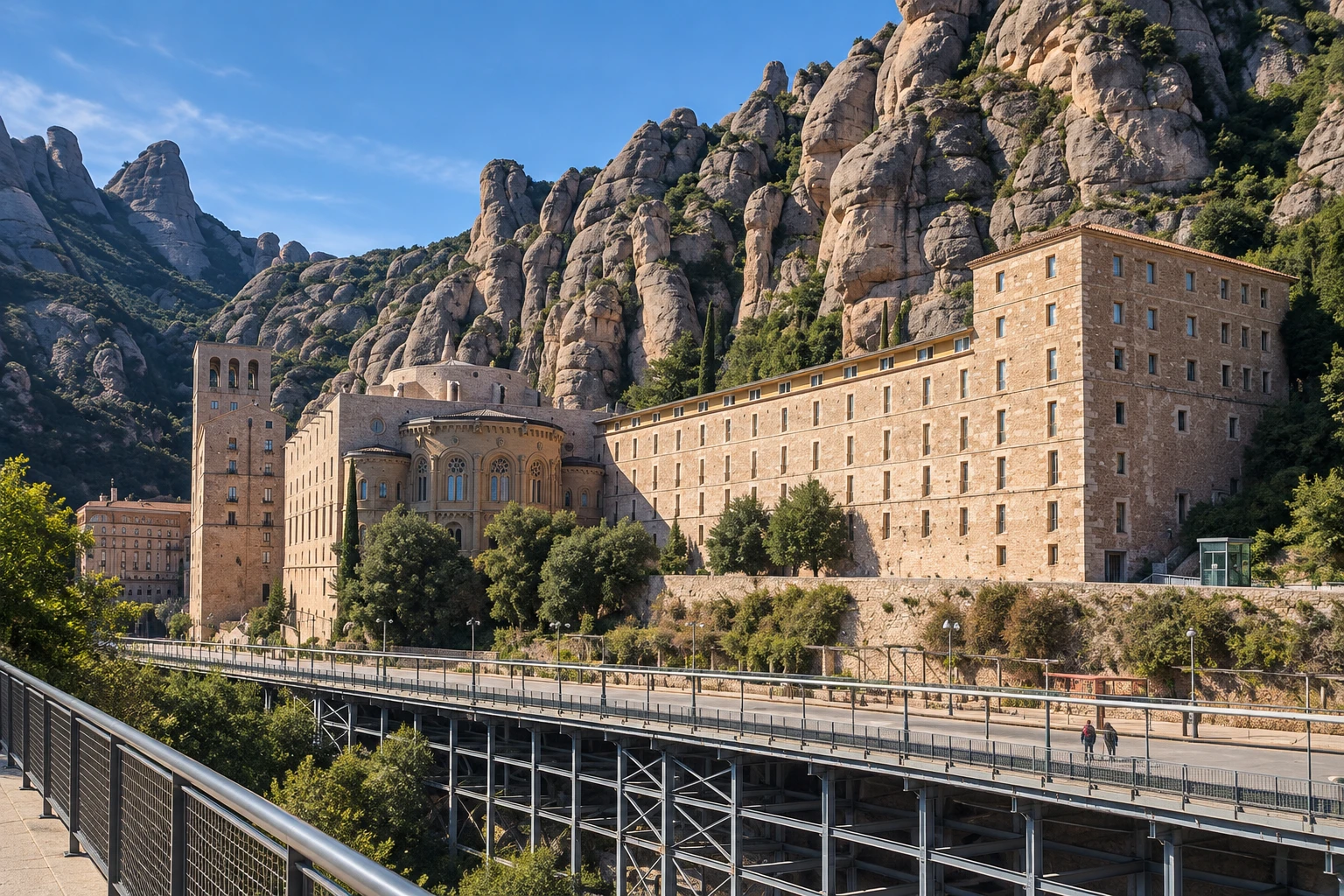
Monastery · Barcelona, Spain
Montserrat Monastery
Benedictine abbey set into the jagged rocks of Montserrat, about 50 km from Barcelona, founded in 1025. It houses the Virgem de Montserrat, the Moreneta, patron saint of Catalonia, and has one of the oldest boys' choirs in Europe.
Illustrative images. The pictures in this guide are illustrations based on the real place, not photographs, and may differ from it.

Discover
About Montserrat Monastery
Santa Maria de Montserrat is a Benedictine abbey founded in 1025 on the mountain of the same name, in the municipality of Monistrol de Montserrat, about 50 km northwest of Barcelona. The name means "serrated mountain", because of the rock needles that form the massif. The community of monks remains active, and the monastery is the main religious centre of Catalonia.
In the basilica is the Virgem de Montserrat, the Moreneta, a polychrome Romanesque wooden image from the late 12th century, 95 cm high. It is one of the Black Madonnas of Europe and patron saint of Catalonia. Pope Leo XIII decreed its canonical coronation in 1881, the same year the church received the title of minor basilica. Visitors pass through a corridor behind the altar to get close to the image.
The basilica was destroyed in the Peninsular War and rebuilt from 1811. The current façade was made after the Civil War, between 1942 and 1968. The Escolania, a boys' choir linked to the monastery, is among the oldest in Europe and sings at celebrations. The abbey's press published its first book in 1499 and remains active, and the museum houses works by well-known painters.
Besides the monastery, the mountain has trails and viewpoints. Funiculars take visitors to the chapel of the Santa Cova and to the higher parts of the massif, and footpaths reach Sant Jeroni, the highest point at 1,236 metres, from where much of Catalonia can be seen.
Before you go
Practical information
Cidade Turismo reviews its information regularly, but something may have changed. Check with the place before planning your trip.
How much time to set aside
Set aside the whole day, allowing about 1 hour of travel each way. The monastery and basilica alone take 2 to 3 hours; with funicular and hike, add another 2 to 3.
Best time
Go early, before the arrival of groups, and on weekdays. From November to March (summer in Brazil) it is cold on the mountain and it gets dark early. In the Spanish summer, from June to August, the trails require water and an early start. The Escolania's singing schedule varies: check before you go.
How to get there
From Plaça d'Espanya station, take the FGC train on the line that goes to Manresa. Get off at Monistrol de Montserrat for the rack railway, which runs 5 km up to the monastery, or at Montserrat-Aeri for the cable car. There are combined train-and-ascent tickets. By car, the road reaches the monastery.
Tip
Buy the combined train-and-rack-rail or cable-car ticket and check the schedule of the last return trains. The cable car and the rack railway are operated by different companies and are not integrated. The line to see the Moreneta grows as the day goes on.
Official website
Your questions
Frequently asked questions about Montserrat Monastery
Can you get from Barcelona to Montserrat without a car?
Yes. The FGC train departs from Plaça d'Espanya and goes to Monistrol de Montserrat, where you transfer to the rack railway, or to Montserrat-Aeri for the cable car. The trip takes about 1 hour.
Who is the Moreneta?
The Virgin of Montserrat, a Romanesque wooden image from the late 12th century, one of Europe's Black Madonnas and the patron saint of Catalonia.
Does the Moreneta have a connection with Brazil?
Yes. An 18th-century replica of the image, displayed in the Basílica de São Pedro in the Vatican, was a gift from Brazilian president João Goulart to Pope Paul VI in 1963.
How much time should you allow for Montserrat?
A full day. The monastery and the basilica take 2 to 3 hours, not counting the trip and the mountain trails or funiculars.
What is the Escolania de Montserrat?
The monastery's boys' choir, one of the oldest in Europe. It sings at the basilica's celebrations, at varying times: check before you go.