

 Brazil
 Antarctica
 Argentina
 Bolivia
 Chile
 Colombia
 Ecuador
 Falkland Islands (Malvinas)
 French Guiana
 Guyana
 Paraguay
 Peru
 Suriname
 Uruguay
 Venezuela
 Albania
 Austria
 Belgium
 Croatia
 Denmark
 Finland
 France
 Germany
 Greece
 Hungary
 Iceland
 Ireland
 Italy
 Luxembourg
 Norway
 Poland
 Portugal
 Slovakia
 Slovenia
 Sweden
 Switzerland
 the Czech Republic
 the Netherlands
 the United Kingdom
 Turkey
 Bermuda
 Canada
 Greenland
 Mexico
 Saint Pierre and Miquelon
 the United States
 the Dominican Republic
 Japan
 Egypt
 South Africa
 Australia
 Fiji
 New Zealand
 Papua New Guinea
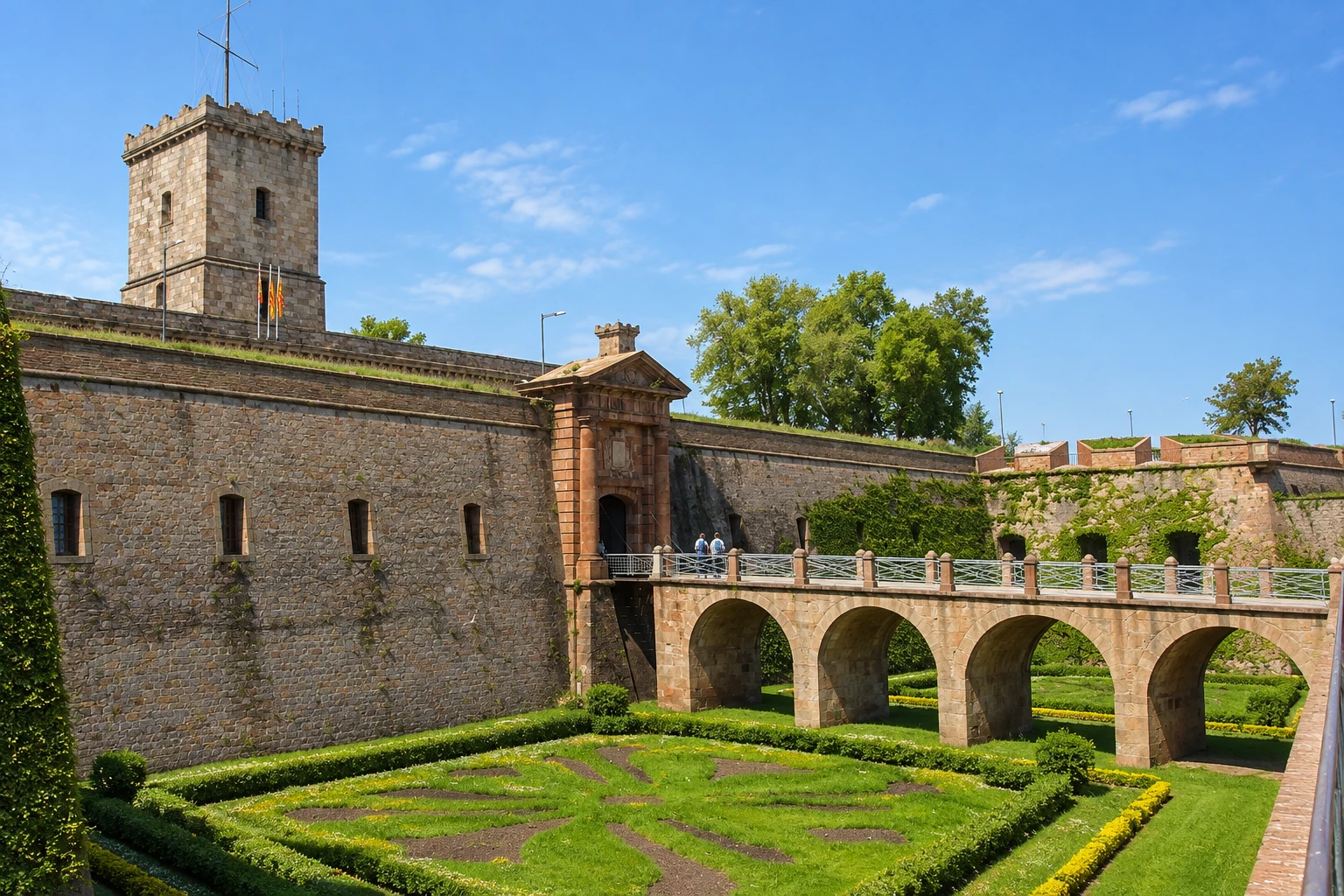
Castle · Barcelona, Spain
Montjuïc Castle
Star-shaped fortress atop the hill of Montjuïc, with a moat, four bastions and views over the port and the city. It began as a fort in 1640 and acquired its present form in the 18th century. It has belonged to the city council of Barcelona since 2007.
Illustrative images. The pictures in this guide are illustrations based on the real place, not photographs, and may differ from it.

Discover
About Montjuïc Castle
The Castell de Montjuïc sits atop the hill that closes Barcelona on the seaward side. There used to be a watchtower on the site that warned the city of arriving ships. In 1640, during the Guerra dels Segadors, the Catalan revolt against King Filipe IV, a small earthwork fort was built there, which withstood a Castilian attack in January 1641.
The fort became a castle in 1694. In the 18th century, the military engineer Juan Martín Cermeño demolished the old structure and gave the fortress its current layout: an irregular trapezoid with four bastions and a moat, in a star-fort design. Major works between 1779 and 1799 left the castle armed with about 120 cannons.
The site's history is harsh. In the 19th century the city was bombarded from the castle in 1842 and 1843, and its cells held trade unionists, anarchists and political prisoners. During the Civil War and the Franco regime it served as a prison and execution site. It was there that Lluís Companys, president of the Generalitat da Catalunha, was executed by firing squad in 1940.
In 1963 the castle became a military museum. Ownership passed fully to the Barcelona city council in 2007, and today the space hosts exhibitions about the history of the hill and the fortress. For visitors, the main attraction is walking along the ramparts, from which you can see the port, the sea and a large part of the city.
Before you go
Practical information
Cidade Turismo reviews its information regularly, but something may have changed. Check with the place before planning your trip.
How much time to set aside
Allow 1h30 to 2 hours for the castle and the ramparts. Including the cable car ride and a walk through the hill's gardens, plan on a half day.
Best time
From April to October the castle usually stays open later, which makes it possible to arrive at dusk with softer light over the port. In the Spanish summer, from June to August (winter in Brazil), the strong midday sun makes the exposed ramparts uncomfortable; choose the morning or late afternoon. It is generally open every day except January 1 and December 25. Check before you go.
How to get there
The most common way is to combine the funicular de Montjuïc, which departs from Paral·lel metro station (lines L2 and L3) and climbs to avinguda de Miramar, with the Telefèric de Montjuïc, the cable car operated by TMB. It is 752 metres long and links Parc de Montjuïc station to Castell station next to the fortress, with enclosed cabins for up to eight people. There is also a city bus to the top, and you can walk up through the gardens.
Tip
The cable car is paid separately and may be closed for technical maintenance during some weeks of the year; check its operation before you go. Entrance to the castle is charged, with concessions for certain groups and free-access days set by the city council: confirm the current rules. Bring water, a hat and comfortable shoes, as the rampart surfaces are uneven.
Official website
Your questions
Frequently asked questions about Montjuïc Castle
How to get up to the Castell de Montjuïc?
The most used route is to take the metro to Paral·lel station, take the funicular to avinguda de Miramar and continue by cable car to the Castell station, next to the fortress. There's also a city bus to the top of the hill, and if you like walking you can ascend through the gardens.
Is the Montjuïc cable car the same as the one that crosses the port?
No. The Telefèric de Montjuïc is operated by the TMB and links the Parc de Montjuïc to the castle on a 752-meter route. The cable car that crosses the port, departing from Barceloneta, is a different system with its own ticket.
How long does a visit to the castle take?
Between 1.5 and 2 hours are enough to see the courtyard, the exhibitions and the walls. Including the ascent and the hill's gardens, count on half a day.
What important events happened at the castle?
It was a fortress in the Catalan revolt of 1640, was used to bombard Barcelona in the 19th century, and served as a political prison. In 1940, Lluís Companys, president of the Generalitat of Catalonia, was executed there. The castle was transferred to the city council in 2007.