

 Brazil
 Antarctica
 Argentina
 Bolivia
 Chile
 Colombia
 Ecuador
 Falkland Islands (Malvinas)
 French Guiana
 Guyana
 Paraguay
 Peru
 Suriname
 Uruguay
 Venezuela
 Albania
 Austria
 Belgium
 Croatia
 Denmark
 Finland
 France
 Germany
 Greece
 Hungary
 Iceland
 Ireland
 Italy
 Luxembourg
 Norway
 Poland
 Portugal
 Slovakia
 Slovenia
 Sweden
 Switzerland
 the Czech Republic
 the Netherlands
 the United Kingdom
 Turkey
 Bermuda
 Canada
 Greenland
 Mexico
 Saint Pierre and Miquelon
 the United States
 the Dominican Republic
 Japan
 Egypt
 South Africa
 Australia
 Fiji
 New Zealand
 Papua New Guinea
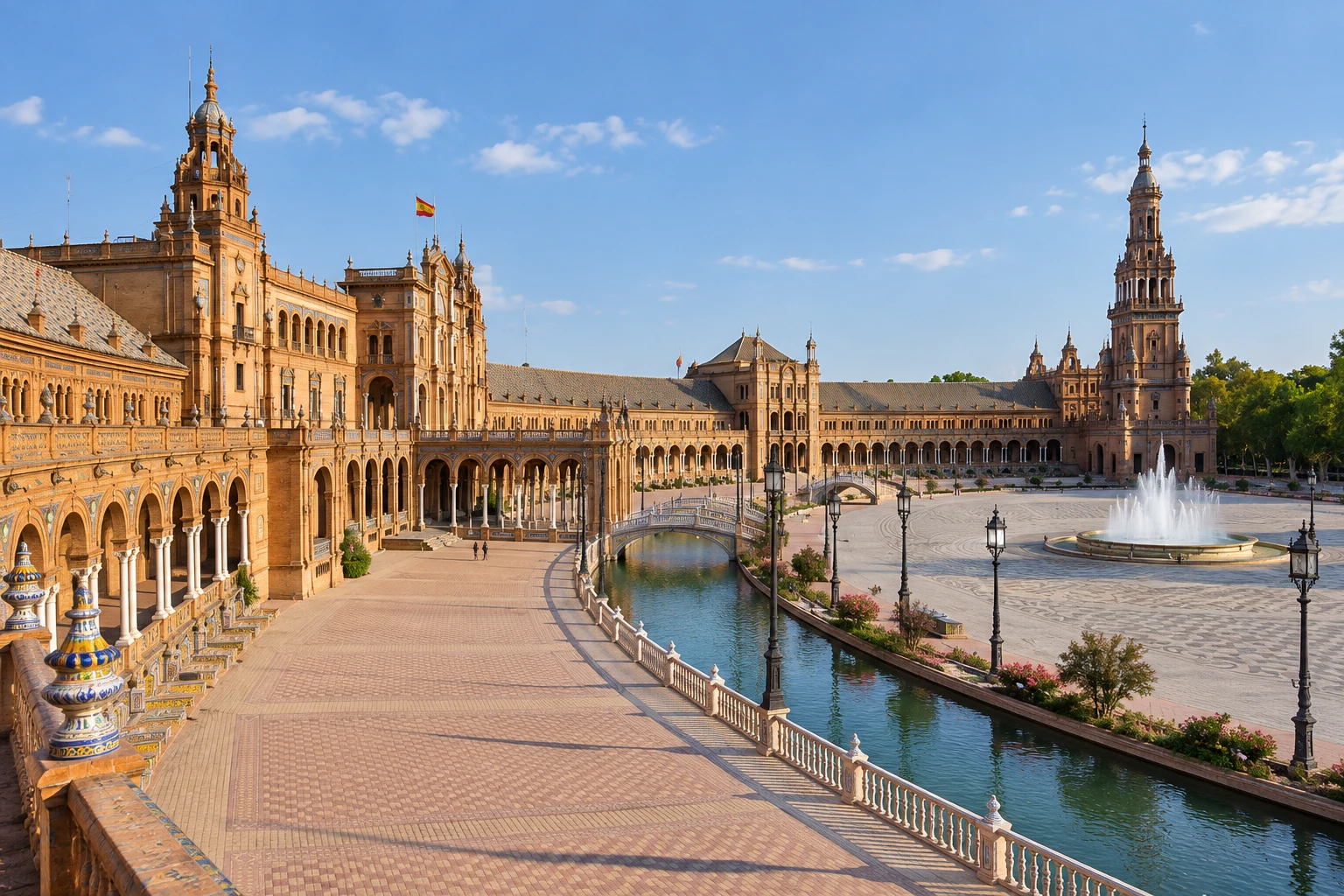
Square · Seville, Spain
Plaza de España
Semicircular plaza designed by Aníbal González for the Ibero-American Exposition of 1929, with a canal, bridges, towers and tiled benches dedicated to the Spanish provinces.
Illustrative images. The pictures in this guide are illustrations based on the real place, not photographs, and may differ from it.

Discover
About Plaza de España
Plaza de España was the main work of the Ibero-American Exposition of 1929. The project is by Seville architect Aníbal González, and the construction took place from 1914 to 1929. It is located within the Parque de María Luisa.
The complex forms a large semicircle of exposed brick, with a central building and two towers at the ends. A canal follows the curve of the plaza and is crossed by four bridges decorated with ceramics. In the center there is a fountain.
Along the base are 48 tiled benches, each dedicated to a Spanish province, with a map and a historical scene. Above them there are 52 medallions with figures from Spanish history. Sevillians and visitors often look for the bench of their province to take photos.
The buildings house public offices and an Army headquarters. In one of the galleries is the entrance to the Museo Histórico Militar.
Before you go
Practical information
Cidade Turismo reviews its information regularly, but something may have changed. Check with the place before planning your trip.
How much time to set aside
From 45 minutes to 1 hour 30 minutes, including the walk through the galleries.
Best time
Late afternoon, when the low sun hits the bricks and the heat eases. From June to August, avoid the central hours of the day: the plaza is open and has little shade.
How to get there
It is located in Parque de María Luisa, about a 20-minute walk from the Cathedral, along Avenida de la Constitución and San Fernando. The tram (metrocentro) stops at Prado de San Sebastián next door, and the Prado de San Sebastián metro station is also nearby.
Tip
The plaza is open and has no admission fee. Go up to the upper-level galleries to see the whole semicircle. Combine it with Parque de María Luisa, which is adjacent.
Your questions
Frequently asked questions about Plaza de España
Who designed the Plaza de España?
The Sevillian architect Aníbal González, for the Ibero-American Exposition of 1929. The work took place from 1914 to 1929.
What are the tile benches of the Plaza de España?
They are 48 benches, one for each Spanish province, with a map and a historical scene painted in ceramics. They line the base of the semicircle.
Do you have to pay to enter the Plaza de España?
There is no ticket. It is an open public space. Only the Museo Histórico Militar, in one of the galleries, has its own entry rules.