

 Brazil
 Antarctica
 Argentina
 Bolivia
 Chile
 Colombia
 Ecuador
 Falkland Islands (Malvinas)
 French Guiana
 Guyana
 Paraguay
 Peru
 Suriname
 Uruguay
 Venezuela
 Albania
 Austria
 Belgium
 Croatia
 Denmark
 Finland
 France
 Germany
 Greece
 Hungary
 Iceland
 Ireland
 Italy
 Luxembourg
 Norway
 Poland
 Portugal
 Slovakia
 Slovenia
 Sweden
 Switzerland
 the Czech Republic
 the Netherlands
 the United Kingdom
 Turkey
 Bermuda
 Canada
 Greenland
 Mexico
 Saint Pierre and Miquelon
 the United States
 the Dominican Republic
 Japan
 Egypt
 South Africa
 Australia
 Fiji
 New Zealand
 Papua New Guinea
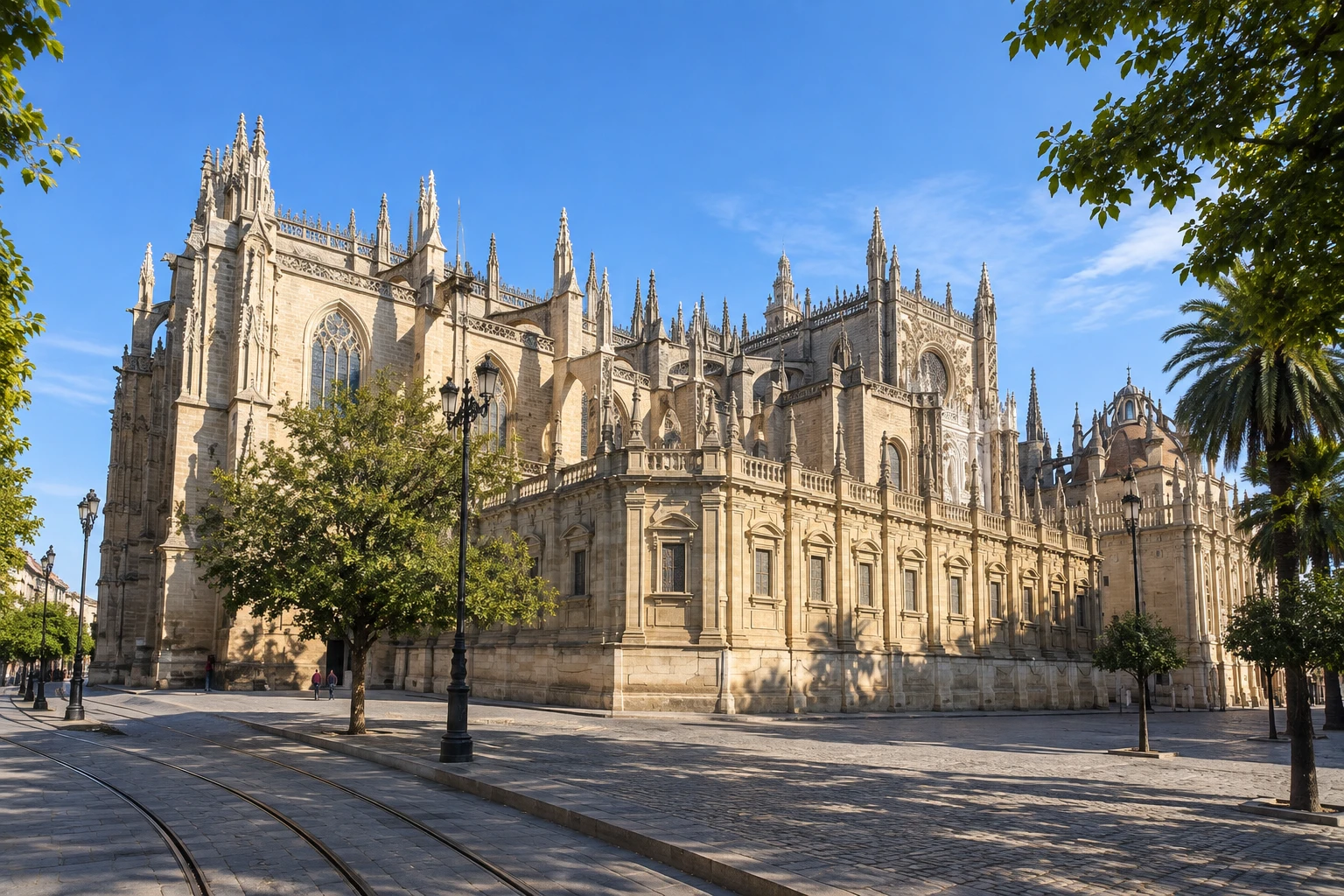
Cathedral · Seville, Spain
Seville Cathedral
The largest Gothic cathedral in the world, built on the site of the former Almohad mosque, from which it inherited the Giralda and the Patio de los Naranjos. It houses the tomb of Christopher Columbus and a huge gilded altarpiece.
Illustrative images. The pictures in this guide are illustrations based on the real place, not photographs, and may differ from it.

Discover
About Seville Cathedral
The cathedral occupies the site of the great Almohad mosque, built between 1172 and 1198. After the Christian conquest in 1248, the mosque served as the cathedral for more than 150 years. The current Gothic work only appears in documents from 1433, and the last stone of the crossing was placed in 1506.
Two elements remain from the mosque. The first is the Patio de los Naranjos, the former ablutions courtyard, with orange trees. The second is the Giralda, the minaret begun in 1184. Between 1558 and 1568, Hernán Ruiz II added the Renaissance belfry. At the top, the Giraldillo, a bronze statue that serves as a weather vane, represents the triumph of faith. The tower measures 94.69 meters.
The ascent to the Giralda is made via 35 wide ramps and a final stretch of 17 steps to the bell level. From the top you can see the Alcázar, the river and the roofs of the city center.
Inside, the altarpiece of the Capilla Mayor, begun in 1482 by the Flemish woodcarver Pedro Dancart, is considered by the cathedral to be the largest in Christendom. Christopher Columbus's funerary monument was designed by Arturo Mélida and inaugurated in 1902. The Chapter House holds paintings by Murillo, and the Royal Chapel houses tombs of the kings of Castile.
The cathedral was inscribed on the World Heritage list in 1987, together with the Alcázar and the Archivo de Indias. It remains in use as the archdiocese seat, with daily masses.
Before you go
Practical information
Cidade Turismo reviews its information regularly, but something may have changed. Check with the place before planning your trip.
How much time to set aside
About 1 hour 15 minutes for the cathedral and the climb to the Giralda, according to the cathedral. Special guided tours last about 1 hour 30 minutes.
Best time
At the start of the morning visit or late in the afternoon, when groups thin out. On Sundays the cultural visit is usually only in the afternoon. From June to August, the climb to the Giralda is more comfortable early. On days with religious celebrations, some areas may be closed: check before you go.
How to get there
It is on Avenida de la Constitución, between Plaza Virgen de los Reyes and Plaza del Triunfo, opposite the Alcázar. The tram (metrocentro) stops at Avenida de la Constitución. Those who buy online enter through the Puerta del Lagarto; the ticket office is at the Puerta del Príncipe.
Tip
Buy your ticket on the official website before you go. The time printed on the ticket is the entry time, and the visit starts at the Giralda, which has its own access control and capacity limits. The same ticket admits the Iglesia del Salvador. The visit to the roof walkways is guided and requires a separate reservation. Wear clothing that covers shoulders and knees.
Official website
Your questions
Frequently asked questions about Seville Cathedral
Does the Giralda have stairs?
Hardly. The ascent is by 35 wide ramps, built for the minaret era, and only the final stretch has 17 steps up to the level of the bells.
Is Christopher Columbus buried in the Cathedral of Sevilha?
The cathedral houses Columbus’s funerary monument, designed by Arturo Mélida and inaugurated in 1902.
Does the Cathedral ticket include the Giralda?
Yes. General admission includes the cathedral and the climb up the Giralda, and also entry to the Iglesia del Salvador. Special guided visits, such as to the rooftops, are sold separately.
How long does the visit take?
The cathedral estimates about 1 hour 15 minutes for the general visit including the Giralda. On busy days, allow a little more time.